AI Giants and Rising Stars to Watch in 2026

Riten Debnath
03 Dec, 2025
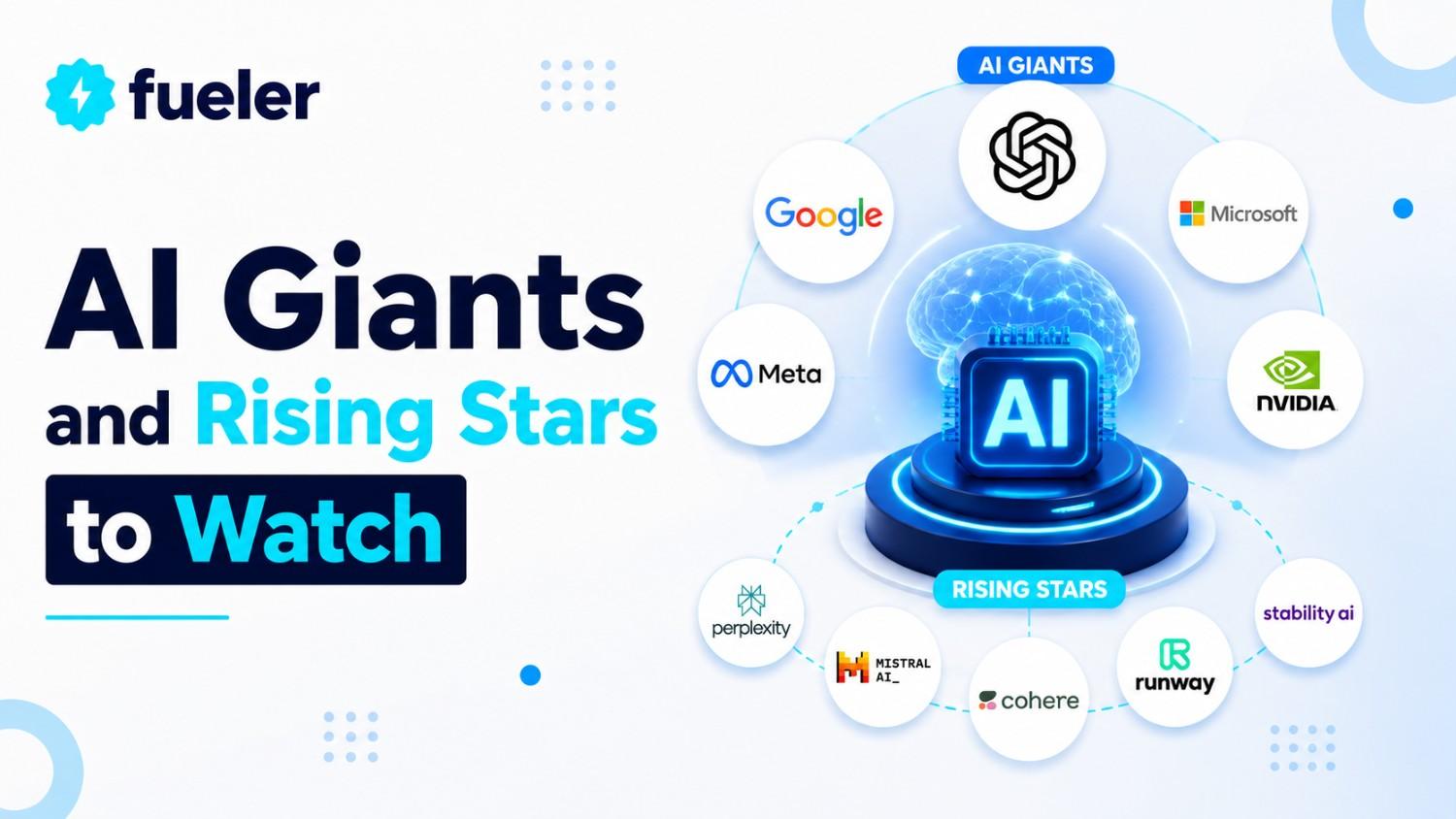
Artificial Intelligence isn’t slowing down, it’s accelerating faster than anyone predicted. What seemed futuristic a few years ago is now part of daily life, from AI tools writing content to machines generating movies, medical analyses, and brand strategies. 2026 isn’t about asking if AI will change the world, but who is leading that charge.
I’m Riten, founder of Fueler - a skills-first portfolio platform that connects talented individuals with companies through assignments, portfolios, and projects, not just resumes/CVs. Think Dribbble/Behance for work samples + AngelList for hiring infrastructure
Today, we’ll explore AI giants and rising startups that are shaping how humans and technology evolve together in 2026. Whether you're an innovator, student, or creator, these are the names worth knowing.
1. OpenAI
OpenAI continues to dominate the global AI landscape, pushing human-computer interaction to its limits. Their models from ChatGPT to Sora are setting the standard for what intelligent systems can understand, create, and reason about.
- Unveiled GPT-5, capable of advanced logical problem-solving, emotional understanding, and long-context recall that spans multiple sessions.
- Launched Sora, an AI video generator that turns text prompts into stunning, cinematic visuals complete with realistic physics and lighting.
- Expanded ChatGPT Enterprise, helping businesses train custom agents that understand company-specific workflows securely.
- Improved AI safety systems, with layered moderation and ethical design frameworks.
- Integrated multimodal intelligence, combining text, image, voice, and video processing under a single interface.
Why it matters: OpenAI’s work continues to shape new standards of intelligence and creativity, making AI tools not just assistants but collaborators across industries.
2. Anthropic
Anthropic takes a more measured approach to AI, one centered on understanding, ethics, and trust. Its flagship assistant Claude has become the benchmark for conversational safety and reasoning clarity.
- Launched Claude 3.5, offering emotionally aware, calm, and transparent conversations while maintaining factual precision.
- Implemented Constitutional AI, allowing the model to follow aligned ethical principles automatically while interacting.
- Partnered with enterprises, bringing safe AI to customer service, education, and analysis use cases without data compromise.
- Improved context retention, helping AI sustain long, multi-turn dialogues that feel genuinely human.
- Expanded open research initiatives, sharing technical insights to promote responsible innovation industry-wide.
Why it matters: Anthropic proves that AI progress doesn’t need to sacrifice safety. It balances rapid growth with accountability, something the industry sorely needs.
3. DeepMind
DeepMind, Google’s AI powerhouse, remains at the crossroads of research and humanity’s most ambitious goals. From protein folding to quantum reasoning, DeepMind’s breakthroughs continue to push both science and technology forward.
- Released Gemini 2, a multimodal model trained to reason across text, imagery, code, and complex data problems seamlessly.
- Advanced AlphaFold 3, mapping protein structures with near-perfect precision to accelerate drug development.
- Built AI sustainability tools, optimizing renewable energy usage and data center efficiency.
- Expanded partnerships with universities, amplifying the academic power behind applied scientific discovery.
- Open-sourced select components, maintaining transparency and reproducibility in AI research.
Why it matters: DeepMind stands for what’s most inspiring about AI using technology not just for convenience, but to expand human understanding of life itself.
4. NVIDIA
Behind nearly every modern AI system lies an NVIDIA chip. Once just a graphics card maker, NVIDIA has evolved into the beating heart of global AI infrastructure.
- Launched H200 Tensor Core GPUs, redefining processing speed while cutting power consumption drastically.
- Expanded NVIDIA AI Foundations, enabling companies to build and deploy custom generative models.
- Boosted Omniverse, a platform blending simulation, design, and AI training for industries like architecture and robotics.
- Partnered with governments, supporting national AI computing initiatives globally.
- Enhanced ecosystem tools, helping startups accelerate large-scale model training affordably.
Why it matters: NVIDIA powers the tools, startups, and models defining AI’s next decade — quite literally fueling tomorrow’s creativity.
5. Hugging Face
Hugging Face is the people’s AI platform, an open-source community that embodies collaboration over competition. It’s the digital campfire where the world’s best developers, data scientists, and AI thinkers come to share progress.
- Expanded its model hub, now hosting millions of pre-trained systems for text, vision, and speech.
- Evolved the Transformers library, which underpins much of generative AI development worldwide.
- Built Spaces, allowing creators to deploy interactive AI apps directly in the browser.
- Encouraged transparent AI development, with clear documentation and safety-focused updates.
- Partnered with major tech ecosystems, ensuring open compatibility with both proprietary and public research tools.
Why it matters: Hugging Face ensures innovation remains inclusive, letting individual developers contribute meaningfully to global AI progress.
6. Midjourney
Midjourney continues to set the gold standard for AI-generated art. Its visual quality, human emotion, and interpretive freedom make it a creative's ultimate playground.
- Released Midjourney V7, providing unmatched lighting, dynamic perspectives, and texture realism.
- Enhanced community curation, letting artists collaborate and refine each other’s prompts.
- Added live rendering previews, helping users fine-tune artistic direction in real time.
- Built collaboration rooms, enabling teams to brainstorm and create together through AI visuals.
- Improved style persistence, making serial image creation consistent for branding and filmmaking.
Why it matters: Midjourney blurs the lines between artist and algorithm, giving everyone the power to paint worlds with words.
7. Runway
Runway has reinvented content production. Its AI systems are now powering everything from music videos to documentaries, democratizing visual storytelling for anyone with a story to share.
- Launched Gen-3 Alpha, which brings motion, realism, and emotional tone control into generative filmmaking.
- Expanded editing capabilities, letting creators transform scenes, moods, and colors automatically.
- Integrated voice narration and cinematic audio, turning prompts into complete video experiences.
- Partnered with streamers and studios, bridging AI creation with professional production.
- Simplified cloud collaboration, making co-editing and feedback much smoother.
Why it matters: Runway is democratizing storytelling itself, allowing solo creators to make content once reserved for production studios.
8. Perplexity AI
Perplexity AI isn’t a search engine, it’s an intelligent research companion. It combines the best of information retrieval and conversational reasoning to deliver meaningful answers backed by verified sources.
- Rolled out Pro Search, giving professionals trusted, cited summaries instantly.
- Expanded multimodal input, letting users mix images, audio, and text queries seamlessly.
- Improved contextual learning, recalling past searches and evolving with each session.
- Integrated privacy-focused data handling, ensuring your interactions aren’t stored or monetized.
- Partnered with educators and researchers, building knowledge systems tailored to academic needs.
Why it matters: Perplexity transforms information overload into clarity, marking the next evolution of how humans access and understand knowledge.
9. Cohere
Cohere has become a go-to for organizations that want privacy-first AI infrastructure. It’s where enterprise-grade innovation meets smart, secure deployment.
- Introduced Command R, allowing retrieval-augmented generation for more grounded enterprise insights.
- Developed private AI models, trained solely within company data silos for maximum confidentiality.
- Enhanced analytics comprehension, helping businesses summarize data without losing accuracy.
- Partnered with global enterprises, enabling industry-specific fine-tuning through simple APIs.
- Streamlined integration tools, lowering technical barriers to internal AI adoption.
Why it matters: Cohere gives companies the chance to harness AI’s power without trading away their intellectual property or privacy.
10. Mistral AI
Europe’s Mistral is shaking up the AI space by proving that open models can compete with billion-dollar private ones. Their focus on efficient, transparent, and lightweight architectures made them the indie success every startup dreams about.
- Launched Mixtral, a hybrid model balancing intelligence and speed while remaining fully open source.
- Focused on multilingual fluency, expanding global reach to languages often overlooked by big tech AI.
- Contributed open datasets, fostering fairness and reproducibility in public model training.
- Partnered with European research agencies, promoting AI autonomy across public sectors.
- Enhanced decoding efficiency, reducing energy usage without affecting accuracy.
Why it matters: Mistral stands as proof that innovation doesn’t need a trillion-dollar budget openness and agility can lead the race too.
Final Thoughts
The AI race in 2026 isn’t just about the biggest players anymore. Startups, independent researchers, and open communities are rising fast, creating a far richer ecosystem. Whether it’s OpenAI’s advancements, Hugging Face’s community spirit, or Runway’s visual storytelling magic, each company adds a unique brushstroke to AI’s global masterpiece.
If you’re building your own career or startup, now is the time to showcase what you can create. Platforms like Fueler help you build a portfolio that proves your skills through projects and assignments, not just resumes. In a decade shaped by creativity and code, your work will speak louder than words.
FAQs
1. Which companies are leading AI innovation in 2026?
Top names include OpenAI, Anthropic, DeepMind, Nvidia, and Mistral, with new players like Runway and Perplexity AI quickly rising.
2. What makes these AI companies special?
Each focuses on transforming everyday life from content creation and research to business automation and open-source development.
3. Can freelancers and creators use their tools?
Yes, platforms like Midjourney, Runway, and Jasper AI make powerful AI creation tools accessible to independent professionals.
4. What skills help you succeed in this AI era?
Hands-on experimentation, problem-solving, and building visible portfolio projects matter more than formal degrees.
5. How does Fueler help professionals grow in AI?
Fueler lets you showcase your projects, work samples, and experiments to attract clients and employers who value real skills.
What is Fueler Portfolio?
Fueler is a career portfolio platform that helps companies find the best talent for their organization based on their proof of work. You can create your portfolio on Fueler, thousands of freelancers around the world use Fueler to create their professional-looking portfolios and become financially independent. Discover inspiration for your portfolio
Sign up for free on Fueler or get in touch to learn more.

What should you do next?
You've read the article. Now turn your skills into proof of work and unlock more opportunities.
Build your proof of work portfolio
Create a clean portfolio with projects, assignments, resumes, and AI stack details that companies actually want to see.
Create your Fueler portfolio →Apply through assignments, not resumes
Stand out by solving real tasks from companies hiring on Fueler.
Explore assignments →Get discovered by companies
Make your work public and let recruiters discover your skills through actual projects instead of keywords.
Get discovered →