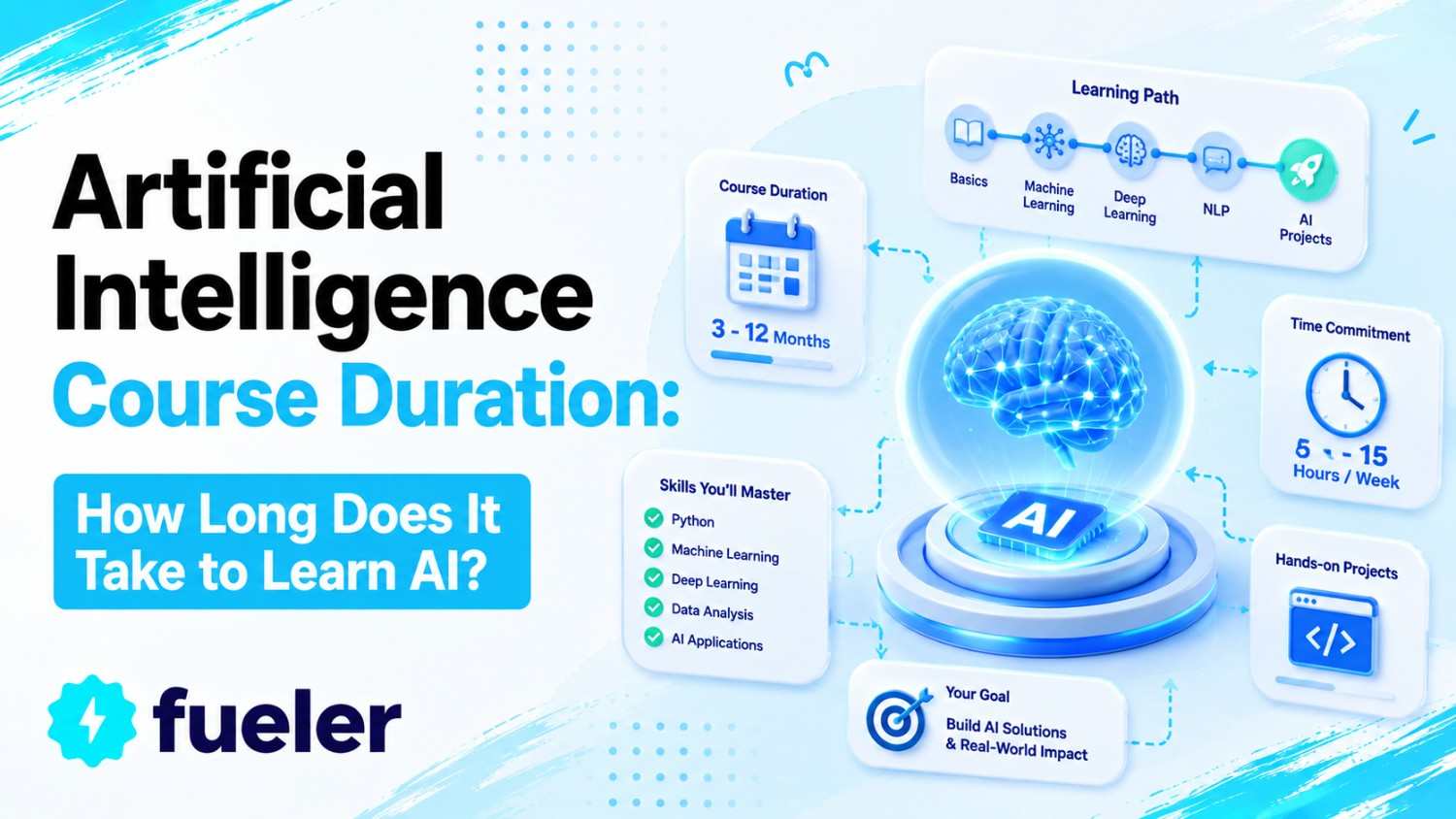
Artificial Intelligence Course Duration: How Long Does It Take to Learn AI?

Riten Debnath
30 Aug, 2026
Artificial Intelligence has become an important skill across technology, finance, healthcare, education, e-commerce, marketing and many other industries. Because of this, more students, graduates and working professionals are looking at AI courses to understand how long it actually takes to learn Artificial Intelligence and become ready for practical work.
The most common question is simple: How long does it take to learn AI? There is no single answer because the learning time depends on your educational background, programming knowledge, learning schedule and career goal. Someone who wants to understand the basics of AI may need only a few months, while someone who wants to become an AI or Machine Learning professional may need a year or more of consistent learning and project practice.
I’m Riten, founder of Fueler. I’m building Fueler around a simple idea: companies should be able to discover people through their actual work, assignments and projects instead of judging candidates only through resumes.
This idea is especially relevant to Artificial Intelligence. Completing an AI course can give you knowledge, but building projects can show whether you can actually use that knowledge to solve problems.
In this guide, I’ll explain Artificial Intelligence course duration, how long it takes to learn AI, AI course duration after Class 12, how long beginners need, how much time is required to become job-ready and what you should learn at each stage.
Artificial Intelligence Course Duration in India: Quick Overview
The duration of an Artificial Intelligence course depends mainly on the type and level of the programme. A short introductory course may take a few weeks, while a professional certificate programme can take several months. Undergraduate programmes related to Artificial Intelligence can take around four years, while postgraduate programmes generally take one to two years depending on the institution and programme structure.
It is important to understand that course duration and learning duration are not the same thing. Completing a three-month course does not automatically mean that you will become an AI professional in three months. You also need time to practise programming, understand mathematics, work with data, build projects and learn how to apply AI concepts to real problems.
Artificial Intelligence Course Duration at a Glance
These are broad ranges rather than fixed national standards. Every institute can set its own curriculum, schedule and programme duration, so students should always check the official course details before enrolling.
How Long Does It Take to Learn Artificial Intelligence?
If you are starting from zero, it is better to think about learning Artificial Intelligence as a series of stages rather than expecting to master everything within a fixed number of months. You can understand basic AI concepts relatively quickly, but developing practical skills requires more time because you need to learn programming, mathematics, data handling, Machine Learning and project development.
A learner who studies consistently for one to two hours a day can build a basic foundation within a few months. With continued practice over six to twelve months, you can develop stronger technical skills and start working on independent projects. If your goal is to become a professional AI or Machine Learning engineer, the learning process can take a year or longer because you will need deeper knowledge of algorithms, software development, model evaluation and deployment.
How Long Does It Take to Learn AI?
These timelines are estimates rather than promises. Your previous knowledge, study time and quality of practice can make the actual learning period shorter or longer.
How Long Does It Take to Learn AI for a Beginner?
If you have never written code before, your Artificial Intelligence learning journey will usually take longer because you first need to understand programming and data concepts. Python is a useful starting point because it is widely used for data science, Machine Learning and AI development. You should first become comfortable with variables, conditions, loops, functions, lists, dictionaries and basic programming logic.
After learning Python, you can move into mathematics, statistics, SQL and data analysis before studying Machine Learning. This approach may feel slower in the beginning, but it creates a much stronger foundation. I would rather spend several months building proper fundamentals than rush into advanced AI tools without understanding how the underlying systems work.
If you are starting from zero, six to twelve months of consistent learning and practical project work is a reasonable period to build a strong foundation. Becoming highly skilled will take longer.
You can also read our Python for Data Science guide to understand which Python concepts are useful for data-related careers.
How Long Is an AI Course After Class 12?
Students who have completed Class 12 can choose different pathways depending on their career goals. A short certificate course may take a few months, while an undergraduate programme related to Artificial Intelligence, Computer Science or Data Science can take around four years. Students should compare these options based on the depth of education they want rather than choosing a course only because it has a shorter duration.
If your long-term goal is to become an AI Engineer or Machine Learning Engineer, a full undergraduate technical programme can provide more time to study mathematics, programming, algorithms, databases and Machine Learning. At the same time, you can also learn AI independently through online courses and practical projects alongside your regular degree.
The important point is that AI course duration after Class 12 can range from a few months to several years, depending on the learning path you choose.
How Long Does It Take to Learn AI and Machine Learning?
Artificial Intelligence is a broad field, and Machine Learning is one of its major areas. Learning Machine Learning properly requires you to understand data preparation, statistics, supervised learning, unsupervised learning, model training and evaluation. After learning these concepts, you can move towards deep learning and more specialised areas.
A beginner may need several months to develop a good Machine Learning foundation. Becoming comfortable with real-world projects can take six months to a year or longer, especially if you are learning programming and mathematics at the same time.
The important thing is not to rush through algorithms. You should understand what problem an algorithm solves, what type of data it needs, how you evaluate its performance and what limitations it has.
Our guide to Data Science project ideas can also help you identify practical projects that you can work on while learning.
What Should You Learn During an Artificial Intelligence Course?
A good Artificial Intelligence learning path should cover more than AI tools. You need a foundation that helps you understand programming, data, mathematics and Machine Learning. Without these basics, it can become difficult to understand why a model behaves in a particular way or how to improve its performance.
1. Python Programming
Python is widely used in AI and Machine Learning, so learning programming should be one of your first priorities. You should become comfortable writing basic programs and solving small problems without depending completely on copied code. Once your fundamentals are strong, you can learn libraries commonly used for data analysis and Machine Learning.
2. Mathematics and Statistics
Mathematics is important because many AI and Machine Learning methods depend on mathematical and statistical concepts. Beginners should gradually learn algebra, probability, statistics and linear algebra. Depending on your career goal, you may also need calculus and optimisation as you move towards advanced Machine Learning and research.
3. Data Analysis
AI systems depend heavily on data, which means you need to understand what happens before a model is trained. You should learn how to clean datasets, handle missing information, identify patterns and create useful visualisations. Good data preparation can have a major effect on the quality of the final model.
4. Machine Learning
After learning programming and data fundamentals, you can study Machine Learning concepts such as regression, classification, clustering, feature engineering, model training and evaluation. Instead of memorising algorithms, focus on understanding when and why a particular approach should be used.
5. Deep Learning
Deep Learning is an advanced area of Machine Learning that uses neural networks with multiple layers. Once your Machine Learning foundation is strong, you can learn neural networks and their applications in areas such as computer vision, speech processing and Natural Language Processing.
6. Generative AI
Generative AI is another important area that learners may explore after building their basic AI knowledge. Depending on your career goal, this can include concepts related to large language models, embeddings, retrieval-augmented generation and AI application development. You do not need to learn every Generative AI technology at once. Building strong fundamentals first can make advanced topics easier to understand.
How Long Does It Take to Become Job-Ready in AI?
Learning Artificial Intelligence and becoming job-ready are two different goals. You may understand AI concepts after a few months, but employers usually expect candidates to demonstrate practical skills through coding, problem-solving and projects.
For a complete beginner, six to eighteen months of consistent learning and practical work can be a reasonable range for developing entry-level AI or Machine Learning skills. However, this depends heavily on your background, the amount of time you can study and the role you are targeting. Someone with a Computer Science degree and strong Python skills may progress faster than someone starting programming from zero.
You also do not need to wait until you feel like an expert before looking for opportunities. Once you have a strong foundation and a few meaningful projects, you can start exploring internships, assignments and entry-level opportunities while continuing to learn.
What Projects Should You Build While Learning AI?
Projects are one of the best ways to convert theoretical knowledge into practical skills. Instead of building many projects by copying tutorials, I recommend building a smaller number of projects where you understand the complete process and can explain your decisions.
You could work on projects such as customer churn prediction, sales forecasting, recommendation systems, image classification or text classification. The project should explain the problem you are solving, the data you used, how you prepared it, the approach you selected, how you evaluated the model and what you would improve in the future.
This is where having a data science portfolio becomes useful. A portfolio gives you a place to show your actual work instead of only listing a course or certificate.
I believe this is much more valuable than simply saying, "I completed an AI course."
How Many Hours Should You Study AI Every Day?
There is no universal number of hours that you need to study Artificial Intelligence every day. Your available time will depend on whether you are a student, working professional or full-time learner. Someone studying three to four hours every day will naturally have more learning time than someone who can study only one hour after work.
For most learners, one to two focused hours a day can create meaningful progress when the time is used properly. You should divide your study time between learning concepts, writing code, solving problems and building projects. Watching tutorials for several hours without practising will usually not produce the same results as focused study followed by hands-on work.
Consistency is more important than trying to study for extremely long hours for a few days and then stopping.
Artificial Intelligence Learning Timeline for Beginners
If I were starting Artificial Intelligence from zero today, I would divide the learning journey into different stages. The first few months would focus on programming and data foundations, followed by Machine Learning and practical projects. Once those skills are comfortable, I would choose a specialisation such as Deep Learning, Generative AI, Natural Language Processing or Computer Vision.
This is only one possible learning path. If you already know Python, statistics and SQL, you can move through the early stages faster. If you are starting from zero, you may need additional time to build these foundations.
AI Course Duration for Working Professionals
Working professionals usually need a flexible learning plan because they cannot spend several hours every day studying. In this situation, a six-month or one-year structured programme can be more practical than trying to complete an intensive course in a few weeks.
You can also connect AI learning with your existing career. A software developer may focus on Machine Learning engineering, while someone working in analytics may focus on predictive modelling and data science. A marketing professional may instead find value in learning AI applications, automation and analytics.
Your existing experience can become an advantage if you learn how to combine it with AI skills rather than treating AI as a completely separate career.
Artificial Intelligence Course Duration vs Practical Learning
One mistake I often see is treating course duration as a measure of course quality. A six-month programme is not automatically better than a three-month programme, and a one-year course does not guarantee that you will become job-ready.
What matters is what you actually do during those months. A good learning programme should give you enough time to understand concepts, practise them and work on meaningful projects. You should also spend time outside the course applying what you learn.
This is why I believe Proof of Work is important. If you complete an AI course but cannot explain a project you built, it becomes difficult for an employer to understand your practical ability. If you can show a project, explain the problem and discuss your technical decisions, your skills become much easier to evaluate.
If you are starting without professional experience, you can also read our guide on how to build a portfolio with no experience.
How to Choose an Artificial Intelligence Course Based on Duration
Do not choose an AI course simply because it is short or long. First decide what you want to achieve and then find a programme whose curriculum, projects and learning schedule match that goal.
You should also check whether the course includes practical assignments, projects, mentor support, assessments and opportunities to apply the concepts. A course that gives you only recorded lectures may not provide enough practical experience for a technical career.
Key Takeaways
- Artificial Intelligence course duration can range from a few weeks to several years depending on the programme.
- A short AI course can help you understand the basics, but completing it does not automatically make you job-ready.
- Beginners may need six to eighteen months of consistent learning and practical work to develop strong entry-level AI skills.
- Students after Class 12 can choose short courses, diploma programmes or undergraduate degrees related to Artificial Intelligence.
- Python, mathematics, statistics, SQL and data analysis are useful foundations for learning AI.
- Building projects while learning is important because it helps you turn theoretical knowledge into practical skills.
- Your daily study time can affect how quickly you progress, but consistency is more important than studying for very long hours occasionally.
- Course duration should not be the only factor you consider when comparing Artificial Intelligence courses.
- A portfolio can provide evidence of what you can actually build with your AI knowledge.
Final Thoughts
There is no magic number of months that can make someone an Artificial Intelligence expert. If you are starting from zero, give yourself enough time to understand programming, mathematics and data before moving into advanced AI topics. If you already have a technical background, you may be able to move faster.
But I would not make speed your main goal.
Your goal should be to understand the technology well enough to solve real problems. Learn a concept, write some code, work with data, build a project, make mistakes, fix them and document what you learned.
That process is much more valuable than simply completing course videos.
At Fueler, I believe strongly in Proof of Work because companies need better ways to understand what candidates can actually do. An AI certificate can tell someone that you completed a programme. A well-built AI project can show them how you think, how you solve problems and what you can build.
So if you are planning to learn Artificial Intelligence in 2026, do not ask only, "How quickly can I finish an AI course?"
Ask a better question:
"What can I build with AI after I finish learning?"
That question can help you choose the right course, the right learning timeline and the right projects for your career.
Frequently Asked Questions
1. How long does it take to learn Artificial Intelligence?
The time required depends on your background and learning goal. A beginner can learn basic AI concepts within one to three months, while developing strong practical AI and Machine Learning skills can take six to eighteen months or longer with consistent practice.
2. How long is an Artificial Intelligence course in India?
Artificial Intelligence course duration varies by programme. Short certificate courses may last a few weeks or months, professional programmes can run for six to twelve months, postgraduate programmes can take one to two years, and undergraduate AI-related degrees can take around four years.
3. How long does it take to become job-ready in Artificial Intelligence?
For a complete beginner, becoming job-ready can take around six to eighteen months of consistent learning, coding practice and project development. The exact time depends on your previous technical knowledge, study schedule and the AI role you want to pursue.
4. Can I learn Artificial Intelligence in 3 months?
Yes, you can learn the fundamentals of Artificial Intelligence in three months if you study consistently. However, three months is generally not enough to master AI and Machine Learning or become highly skilled in a technical AI role. You will need continued practice, projects and deeper learning after the initial foundation.
5. How many hours should I study Artificial Intelligence every day?
There is no fixed number of hours that everyone needs. One to two focused hours a day can create meaningful progress for many students and working professionals when that time is divided between learning concepts, coding, solving problems and building projects. Consistent practice is more important than simply spending a large number of hours watching tutorials.
Why 100,000+ professionals use Fueler
Fueler helps professionals showcase proof of work through projects, assignments, case studies, and achievements.
- Thousands of professionals use Fueler to create their digital portfolio
- Thousands of projects are published on Fueler. Check here
- Startups and Companies hire through proof of work on Fueler
- Used by freelancers, creators, marketers, video editors, writers, designers, and product managers
Our mission is to help the next 100 million professionals build a verified professional identity through proof of work

What should you do next?
You've read the article. Now turn your skills into proof of work and unlock more opportunities.
Build your proof of work portfolio
Create a clean portfolio with projects, assignments, resumes, and AI stack details that companies actually want to see.
Create your Fueler portfolio →Apply through assignments, not resumes
Stand out by solving real tasks from companies hiring on Fueler.
Explore assignments →Get discovered by companies
Make your work public and let recruiters discover your skills through actual projects instead of keywords.
Get discovered →