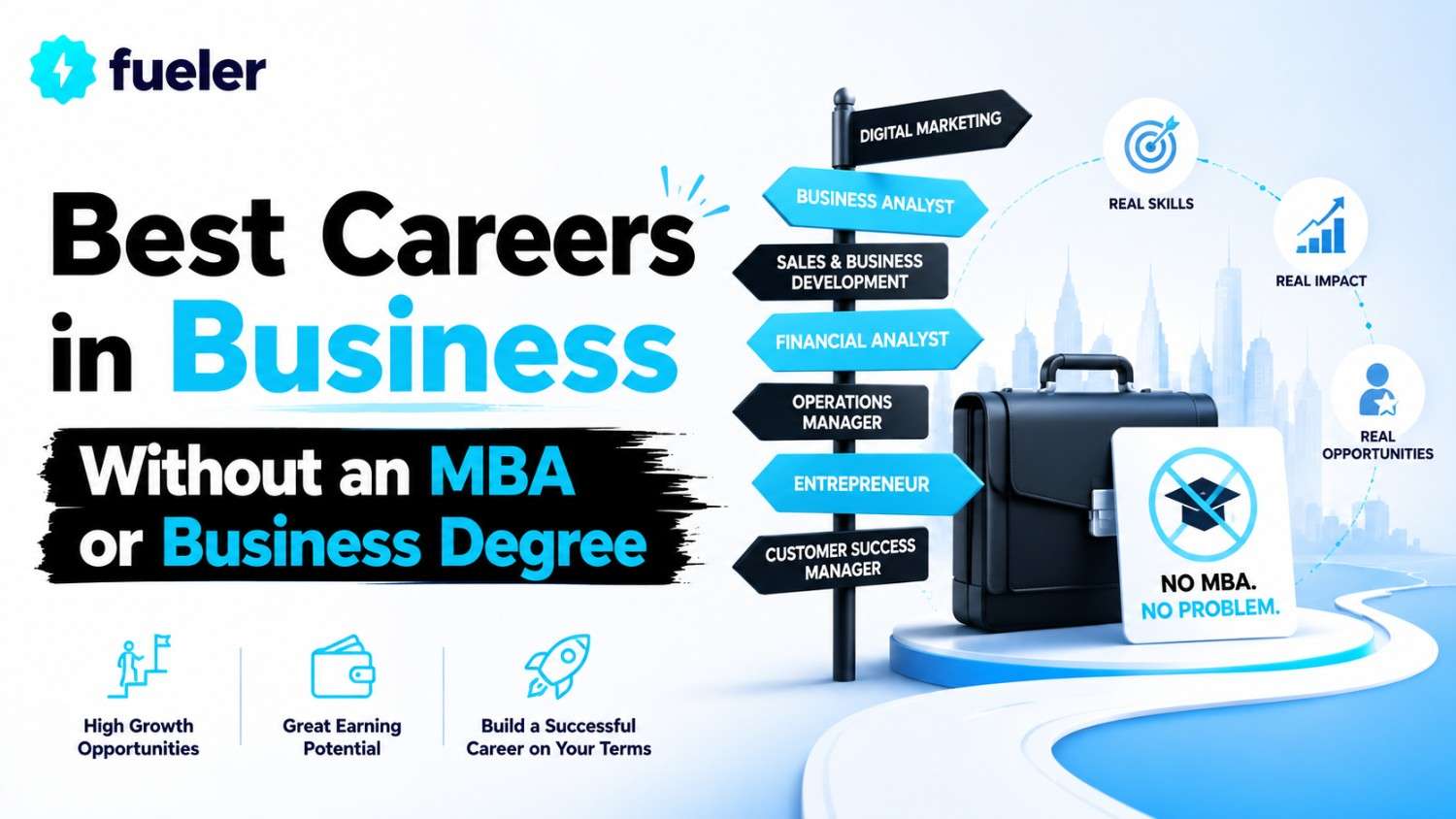
Best Careers in Business Without an MBA or Business Degree

Riten Debnath
28 Jul, 2026
Last updated: July 2026
You do not need an MBA or even a business degree to build a strong career in business. Many high-paying roles today hire people from engineering, arts, science, and commerce backgrounds, based purely on skills and results. This guide covers the best business careers open to people with any degree background, or none at all.
I’m Riten, founder of Fueler, a skills-first portfolio platform building the career infrastructure for 100 million creative professionals. Fueler connects talented individuals with companies through assignments, portfolios, and projects, not just resumes or CVs. Think of it as Dribbble/Behance for work samples combined with AngelList for hiring infrastructure.
What does "no MBA or business degree" really mean?
This means your qualification does not matter as much as your skill and proof of work.
- You can come from any academic background, including engineering, arts, or science.
- You may not have studied business formally at all, and that is fine for most roles.
- Employers focus on what you can do, tested through interviews, tasks, or your portfolio.
This is different from just skipping an MBA. It removes the assumption that you need a business-related degree at all to enter these careers.
Which academic backgrounds succeed in business careers?
A wide range of academic backgrounds now succeed in business roles.
- Engineers often move into product management, business analysis, or growth roles, using their structured problem-solving skills.
- Arts and humanities graduates frequently excel in content strategy, brand management, and communication-heavy sales roles.
- Science graduates often do well in data-driven roles like business analytics or research-based product roles.
- Commerce graduates without an MBA can move directly into finance-adjacent roles like business analysis or operations.
- Non-graduates with strong self-taught skills increasingly enter digital marketing, sales, and freelance consulting roles.
Your background can even become an advantage. An engineer in product management, for example, often understands technical trade-offs better than a purely business-trained hire.
Which business careers work well for non-business graduates?
Certain careers are especially open to people without a business or MBA background.
- Product Manager. Many top product managers come from engineering or design backgrounds, not business schools.
- Business Analyst. Strong analytical thinking, often built through science or engineering degrees, transfers well here.
- Digital Marketing Manager. Creative and communication skills from arts backgrounds fit naturally into marketing roles.
- Growth Marketer. A mix of curiosity, data comfort, and creativity matters more than a specific degree.
- Content Strategist. Writing and storytelling skills, often built in humanities degrees, are the core requirement here.
- Sales Executive. Communication and persistence matter more than any specific degree background.
- Operations Manager. Process thinking, common in engineering and science backgrounds, applies directly to this role.
How do I translate my degree into relevant business skills?
Your degree likely already gave you transferable skills. The key is identifying and framing them clearly.
- If you studied engineering, highlight your structured problem-solving and technical understanding.
- If you studied arts or humanities, highlight your writing, research, and communication skills.
- If you studied science, highlight your analytical thinking and comfort with data and experiments.
- If you studied commerce without an MBA, highlight any accounting, economics, or basic business concepts you already know.
- Regardless of background, look for coursework, projects, or part-time work that already used business-relevant skills, even if it was not labelled that way.
What proof do employers look for instead of a business degree?
Without a business degree, your proof of skill becomes even more important.
- A portfolio of real projects, even small ones, that show you applying business thinking.
- Certifications in your target area, like a digital marketing, product management, or data analytics course.
- Internship or freelance experience, even short-term, that shows you can perform in a business context.
- Clear communication during interviews, since many companies now test practical thinking through case studies or role-specific tasks.
Practical steps or strategies to enter business without a business degree
- Identify one business career from this list that fits your natural academic strengths.
- List out the transferable skills from your current degree, and match them clearly to that career's requirements.
- Take one focused course to fill the specific skill gap between your background and the role.
- Build one small project that directly applies your existing knowledge to a business problem.
- Apply for entry-level or associate roles, using your project and transferable skills as your main proof points.
Common mistakes to avoid
- Assuming your non-business degree is a disadvantage. Many successful business professionals come from unrelated academic backgrounds.
- Failing to translate your existing skills clearly. Recruiters will not automatically see the connection unless you explain it.
- Applying only for roles that mention your exact degree. Many job postings are more flexible about background than they appear.
- Ignoring smaller companies and startups. They often care more about skill fit than degree background.
- Underselling non-traditional experience. College projects, clubs, and part-time work often carry more relevant skills than you think.
How do I build confidence when I lack a business background?
Confidence often comes from proof, not from a degree, so building small wins early can change how you see your own readiness.
- Complete one small, real business-related task, even outside a job, like helping a friend's small business with a marketing plan.
- Read case studies from your target field, and notice how often solutions relied on basic logic rather than specialised business theory.
- Talk to people in the role you want who also came from a non-business background, since their path can show you what is realistically possible.
- Remind yourself that most business concepts, like understanding customers or managing a budget, are learnable in weeks, not years.
Confidence usually follows action, not the other way around. Taking a small first step often matters more than feeling fully ready.
Key takeaways
- You do not need an MBA or a business degree to build a strong business career.
- Engineers, arts graduates, science graduates, and non-graduates all succeed in business roles today.
- Careers like Product Manager, Business Analyst, and Digital Marketing Manager are especially open to varied academic backgrounds.
- Translating your existing degree into transferable skills is a key step in your application.
- A portfolio of real projects matters more than the subject you studied in college.
FAQs
1. Can an engineer really succeed in a business career without an MBA?
Yes. Many engineers move successfully into product management, business analysis, and operations roles using their existing problem-solving skills.
2. Do I need any business knowledge at all if I studied arts or science?
Basic business awareness helps, but it can be learned quickly through short courses. Your core skills from your degree often matter more.
3. Which business career is best for someone with no degree at all?
Digital marketing, sales, and freelance consulting are generally the most accessible business careers for people without a formal degree.
4. How do I explain my unrelated degree in a business job interview?
Focus on the transferable skills your degree gave you, like analytical thinking or communication, and connect them clearly to the role.
5. Will I be paid less because I don't have a business degree?
Not necessarily. Pay depends more on your skills, results, and role than on your original degree background.
At Fueler, we help people from every academic background show recruiters their real business skills through a career portfolio, no matter what degree they started with.
Why 100,000+ professionals use Fueler
Fueler helps professionals showcase proof of work through projects, assignments, case studies, and achievements.
- Thousands of professionals use Fueler to create their digital portfolio
- Thousands of projects are published on Fueler. Check here
- Startups and Companies hire through proof of work on Fueler
- Used by freelancers, creators, marketers, video editors, writers, designers, and product managers
Our mission is to help the next 100 million professionals build a verified professional identity through proof of work

What should you do next?
You've read the article. Now turn your skills into proof of work and unlock more opportunities.
Build your proof of work portfolio
Create a clean portfolio with projects, assignments, resumes, and AI stack details that companies actually want to see.
Create your Fueler portfolio →Apply through assignments, not resumes
Stand out by solving real tasks from companies hiring on Fueler.
Explore assignments →Get discovered by companies
Make your work public and let recruiters discover your skills through actual projects instead of keywords.
Get discovered →