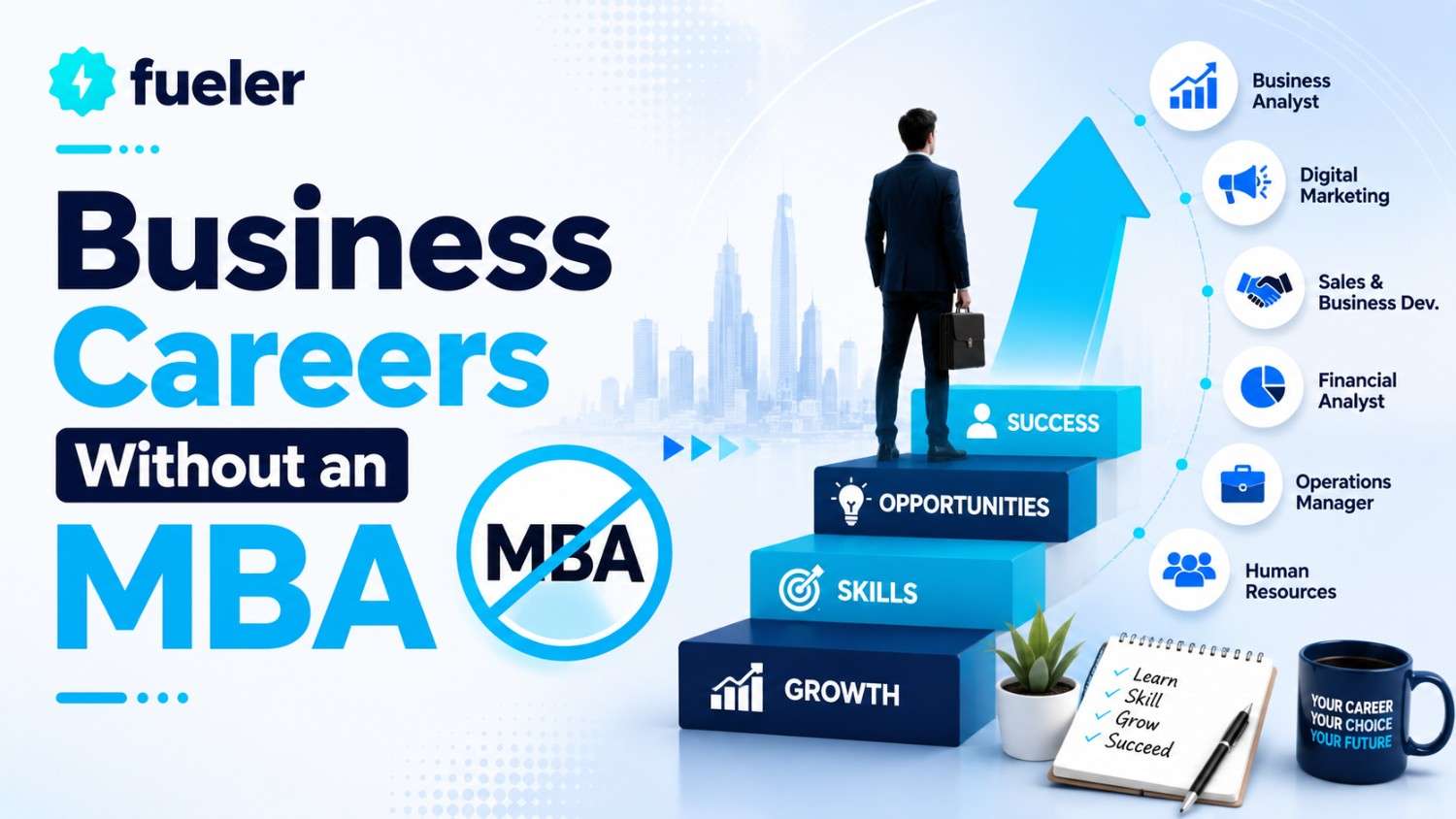
Business Careers Without an MBA: The Complete Career Guide (2026)

Riten Debnath
29 Jul, 2026
Last updated: July 2026
Building a business career without an MBA is possible if you follow a clear roadmap: pick a skill area, prove it through real work, and grow step by step. This complete guide walks you through the full journey, from choosing a path to growing into a senior role, without ever needing a management degree.
I’m Riten, founder of Fueler, a skills-first portfolio platform building the career infrastructure for 100 million creative professionals. Fueler connects talented individuals with companies through assignments, portfolios, and projects, not just resumes or CVs. Think of it as Dribbble/Behance for work samples combined with AngelList for hiring infrastructure.
What is a complete career guide for business without an MBA?
A complete career guide covers the entire journey, not just a list of jobs. It includes:
- How to choose the right business skill area for you.
- How to get your first role without a management degree.
- How to grow from entry-level to mid-level to senior roles.
- How to keep your career moving forward every year.
This guide treats your career as a path with stages, not a single decision you make once.
Stage 1: How do I choose the right business path without an MBA?
Choosing a path early saves you years of unclear direction.
- Sales and growth, if you enjoy talking to people and closing deals.
- Marketing and content, if you enjoy writing, campaigns, and creative problem-solving.
- Product and operations, if you enjoy building systems and solving process problems.
- Finance and analytics, if you enjoy numbers, structure, and detail-oriented work.
- Independent and freelance, if you prefer flexibility over a fixed role.
Pick one path to start. You can always pivot later, but starting focused helps you build real skill faster.
Stage 2: How do I get my first business role without a management degree?
Your first role is about proving you can do real work, not proving you have theoretical knowledge.
- Take a short, focused course in your chosen path, lasting weeks, not years.
- Complete one small real project, like running a mock ad campaign or analysing a public dataset.
- Apply for internships, entry-level, or associate roles, even if the title feels basic.
- Use your project as the centrepiece of your application, not just your resume.
- Be ready to start at a lower salary than an MBA graduate. The gap closes quickly once you show results.
Most people underestimate how much a single strong project can do for their first-role chances.
Stage 3: How do I grow from entry-level to mid-level roles?
Growth in the first 2 to 3 years depends on visible results, not tenure.
- Take ownership of one clear outcome, like a sales target, a campaign, or a process metric.
- Document your results consistently, not just when asked during appraisal season.
- Ask for stretch projects that go slightly beyond your current role.
- Build relationships across teams, since many promotions come from being known for reliable work.
- Add one certification during this stage to formalise your growing expertise.
By the end of this stage, you should have a portfolio of 3 to 5 solid projects or results you can show any employer.
Stage 4: How do I reach senior or leadership roles without an MBA?
Senior roles depend on your ability to lead outcomes, not just execute tasks.
- Take ownership of a full function or team, not just individual tasks.
- Mentor newer team members, since leadership potential is often judged by how you help others grow.
- Learn to read and present business numbers clearly, even outside a finance role.
- Build a track record across multiple projects or business cycles, showing consistency, not a single lucky win.
- Consider a targeted executive certification, like a short leadership programme, if you want extra credibility without a full MBA.
Many senior leaders in sales, product, and operations today reached those roles through consistent results over 8 to 10 years, not a degree.
Stage 5: How do I keep growing throughout my career?
Career growth without an MBA is an ongoing process, not a one-time achievement.
- Review your skills every year and identify one gap to close.
- Update your portfolio every time you complete a meaningful project.
- Stay aware of industry shifts, like new tools or changing customer behaviour, that affect your field.
- Build a professional network you can learn from and refer opportunities with.
- Reassess your path every few years. It is normal to pivot from sales into product, or from operations into consulting.
Practical steps or strategies for this complete journey
- Start with one path, and give yourself 90 days to learn the basics and build a first project.
- Apply broadly for your first role, since early experience matters more than the specific company name.
- Track every result you deliver, from day one, in a simple document or portfolio tool.
- Add one certification every 2 to 3 years, timed to match your career stage.
- Review your career path yearly, adjusting direction based on what you enjoy and where demand is growing.
Common mistakes to avoid
- Trying to plan the entire career at once. Focus on the current stage, not every future step.
- Comparing your starting salary to MBA graduates. The gap narrows fast with real results.
- Skipping documentation of your work. Without a written record, you will forget your own wins.
- Staying too long in a comfortable role. Growth often requires taking on slightly uncomfortable stretch projects.
- Ignoring feedback from managers and peers. This feedback often points directly to your next skill gap.
What if I want to change paths midway through this guide?
Changing direction partway through your career is common and rarely wastes the time you have already invested.
- Skills like communication, data literacy, and execution transfer across most business paths, even if the job title changes.
- A pivot from sales into product management, or from operations into consulting, often uses the same core strengths in a new context.
- Give yourself a clear reason for the change, whether it is better growth potential, stronger interest, or a better fit for your strengths.
- Treat the pivot as a new Stage 2 in this guide, rebuilding a portfolio and first project in the new direction, rather than starting completely from zero.
Most professionals change direction at least once in their first 10 years. The stages in this guide still apply, just applied to your new path.
Key takeaways
- A business career without an MBA follows five stages: choosing a path, getting your first role, growing to mid-level, reaching senior roles, and continuous growth.
- Real projects and documented results matter more than a management degree at every stage.
- Certifications help at specific points, not as a replacement for hands-on experience.
- Career growth is an ongoing process that needs yearly review, not a single big decision.
- Many senior business leaders built their careers through consistent results, not an MBA.
FAQs
1. Can I really reach a senior business role without an MBA?
Yes. Many senior leaders in sales, product, and operations reach these roles through consistent results over several years, without an MBA.
2. How long does it take to build a full business career without an MBA?
Expect 2 to 3 years to reach mid-level roles and 8 to 10 years to reach senior leadership, similar to many MBA-holder timelines.
3. Do I need any certification during this journey?
Certifications help at specific stages, especially mid-career, but they are not required at every step of this path.
4. What is the biggest factor in growing without an MBA?
Consistent, documented results. Employers promote people who can clearly show the outcomes they have delivered.
5. Can I switch business paths partway through this guide?
Yes. Many professionals switch from sales to product, or operations to consulting, once they understand their strengths better.
We built Fueler to help you document every stage of this journey through a career portfolio, so your growth is visible to any employer, at any point in your career.
Why 100,000+ professionals use Fueler
Fueler helps professionals showcase proof of work through projects, assignments, case studies, and achievements.
- Thousands of professionals use Fueler to create their digital portfolio
- Thousands of projects are published on Fueler. Check here
- Startups and Companies hire through proof of work on Fueler
- Used by freelancers, creators, marketers, video editors, writers, designers, and product managers
Our mission is to help the next 100 million professionals build a verified professional identity through proof of work

What should you do next?
You've read the article. Now turn your skills into proof of work and unlock more opportunities.
Build your proof of work portfolio
Create a clean portfolio with projects, assignments, resumes, and AI stack details that companies actually want to see.
Create your Fueler portfolio →Apply through assignments, not resumes
Stand out by solving real tasks from companies hiring on Fueler.
Explore assignments →Get discovered by companies
Make your work public and let recruiters discover your skills through actual projects instead of keywords.
Get discovered →