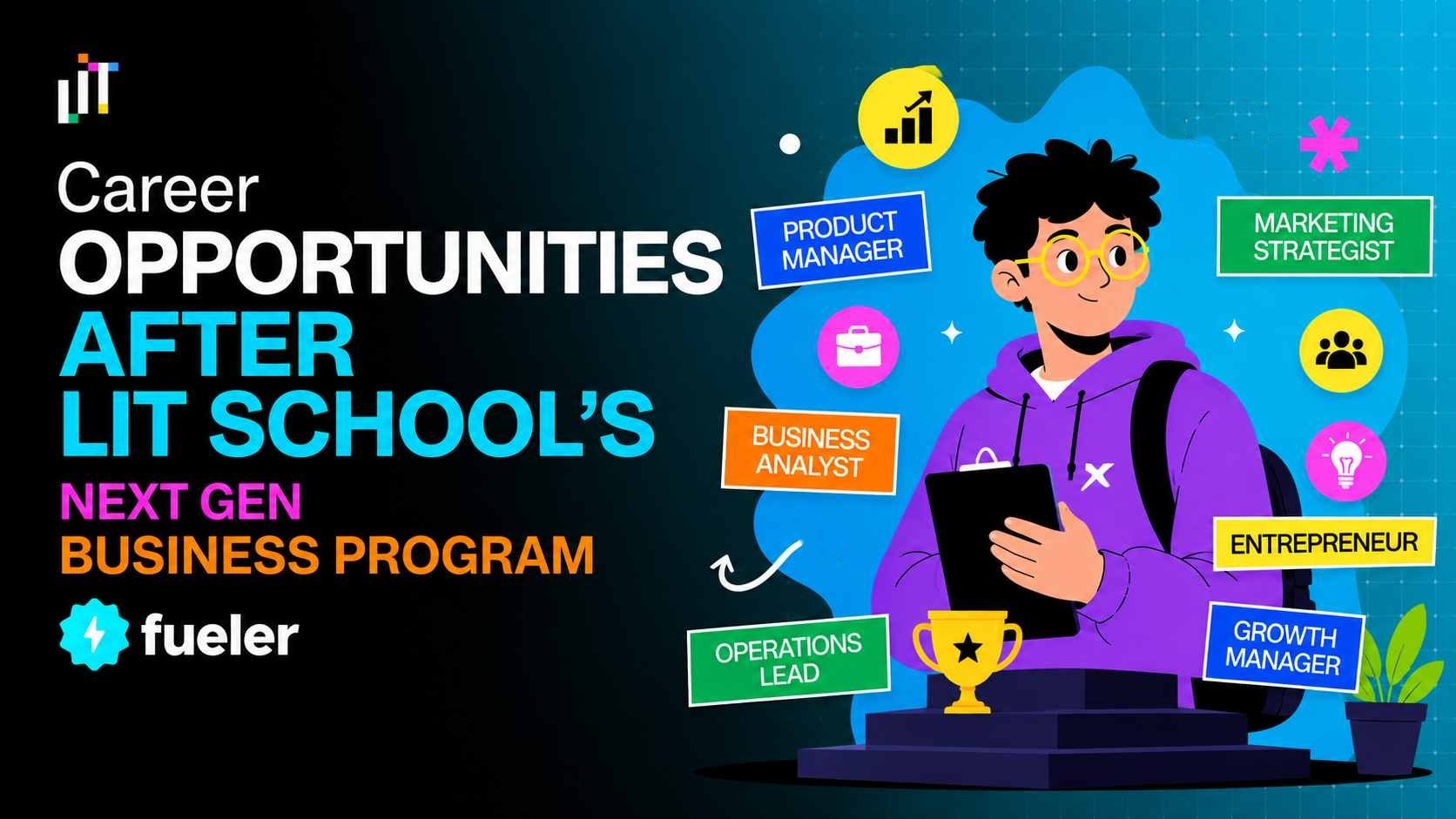
Career Opportunities After LIT School's Next Gen Business Program

Riten Debnath
15 Aug, 2026
Last updated: August 2026
Walk into any startup office in Indiranagar or HSR Layout in Bangalore, and ask a founder about their hiring headaches. They will tell you the exact same thing: traditional business degrees are completely disconnected from modern execution.
Colleges spend three years teaching students how to write 40-page theoretical business plans, memorize textbook definitions from the 1990s, and analyze corporate case studies that have zero relevance to how software companies scale today.
When a traditional graduate applies for an entry-level job at a fast-moving startup, the hiring manager does not care about their exam scores or slide decks. They ask simple, direct execution questions: Can you set up Meta and Google ad campaigns from scratch? Can you build landing pages using Webflow? Can you automate internal workflows using Zapier and Airtable? Can you use AI tools to run market research in two hours instead of two weeks?
When standard graduates stare back blankly, the execution gap becomes painfully obvious. High-growth internet companies do not hire managers to oversee teams on day one. They hire builders and operators who can execute immediately.
I’m Riten, founder of Fueler, a skills-first portfolio platform building the career infrastructure for 100 million creative professionals. Fueler connects talented individuals with companies through assignments, portfolios, and projects, not just resumes or CVs. Think of it as Dribbble/Behance for work samples combined with AngelList for hiring infrastructure.
Having evaluated thousands of proof-of-work profiles and worked directly with hiring managers across the tech ecosystem, I look at higher education through a single lens: does a program force a student to build verifiable output, or does it sell passive promises?
This analytical breakdown dissects LIT School’s Next Gen Business Program, examining the exact career opportunities it unlocks, how its hands-on academic framework operates, and whether its cost makes sense for your career in 2026.
Quick Answer Summary
- Who it is for: High school graduates, gap-year students, and aspiring entrepreneurs who want hands-on execution experience rather than traditional classroom lectures.
- Cost: Total program fee of ₹18.45 Lakhs for the full 3-year duration (includes ₹17.5 Lakhs base tuition fee plus a one-time admission fee of ₹95,000).
- Key Takeaway: The program trades standard academic memorization for practical proof of work, making it valuable for self-driven individuals targeting the startup ecosystem.
- Best Suited For: Students planning to work in early-stage tech companies, venture-backed startups, growth agencies, or start their own business in tech hubs like Bangalore.

What is LIT School's Next Gen Business Program?
The Next Gen Business Program at LIT School (Leaders in Tech School) is a 3-year undergraduate degree track designed to replace traditional business education with live industry execution. Situated in Jayanagar, Bangalore, the program combines an accredited Bachelor of Business Administration (BBA) degree with challenge-based learning.
Instead of spending three years memorizing textbooks for written exams, students spend their time working on real business briefs, running digital growth campaigns, and managing operational workflows. The program aims to train students to step directly into execution roles at fast-moving internet companies.
At its core, the program focuses on four primary operational pillars: digital growth marketing, visual web development (no-code), generative AI workflows, and practical unit economics. This structure directly addresses the widening gap between what traditional universities teach and what modern technology companies require.
In traditional programs, students study marketing concepts using outdated case studies. At LIT School, students handle active marketing budgets, set up analytics tracking, and analyze actual conversion drop-off rates. That difference in methodology changes how a student approaches business problems.
Key Facts Table
Detailed Explanation: Career Opportunities After LIT School's Next Gen Business Program
The practical value of an alternative business degree comes down to the exact roles you can secure after graduation. Traditional BBA graduates often get stuck in basic administrative roles because they lack concrete execution capabilities.
LIT School’s challenge-based framework trains students directly for modern roles across venture-backed technology startups, digital growth agencies, consumer internet brands, and venture studios.
1. Founder’s Office / Generalist Operator
What: Working directly alongside startup founders and senior executives to execute cross-functional projects, business operations, competitive intelligence, and key strategic initiatives.
Why: Startup founders are constantly drowning in execution work. They need versatile operators who can step into any problem, from evaluating a new sales channel to coordinating an upcoming product launch, without requiring step-by-step supervision.
How: At LIT School, students complete multi-departmental business challenges. They learn how to analyze unit economics, set up automated internal dashboards, and present clear executive updates.
Real-world Implications: Serving in a Founder’s Office gives you a complete view of how a company scales. It is one of the fastest paths to chief of staff roles, operational leadership, or building your own venture. (Starting Salary Range: ₹7.0 LPA – ₹12.0 LPA)
2. Growth Marketing Specialist / Performance Marketer
What: Managing digital user acquisition campaigns, running paid media tests, writing conversion-focused copy, and optimizing marketing funnels.
Why: Internet companies depend entirely on cost-effective customer acquisition. Hiring someone who already knows how to run paid ad tests, set up analytics, and read funnel data saves companies months of onboarding time.
How: Students manage real campaign budgets during campus challenges. They learn how to track customer acquisition costs (CAC), build landing pages on Webflow, and optimize conversion metrics.
Real-world Implications: Rather than making vague claims on a resume, candidates can share a public Fueler portfolio displaying their actual ad dashboards, conversion metrics, and campaign spend efficiency. (Starting Salary Range: ₹6.0 LPA – ₹10.0 LPA)
3. Product Operations Lead
What: Managing user onboarding systems, tool integrations, customer feedback loops, and operational workflows for web platforms and digital apps.
Why: Software products require continuous operational coordination. Product Operations bridges the gap between software developers, customer support teams, and end users.
How: Students build no-code tools using Airtable, Zapier, Make, and Notion to streamline business processes. They practice building automated workflows that manage customer data without manual entry.
Real-world Implications: You enter a startup capable of diagnosing operational bottlenecks immediately. By automating manual data tasks, you free up core engineering resources. (Starting Salary Range: ₹6.5 LPA – ₹11.0 LPA)
4. No-Code Developer & Business Automation Specialist
What: Designing visual web applications, internal operational tools, and automated data pipelines using visual software platforms.
Why: Early-stage companies cannot afford to spend months of engineering bandwidth on internal administrative tools. They rely heavily on visual automation platforms to launch operations quickly.
How: The curriculum emphasizes practical software tools like Make, Webflow, Zapier, and Airtable. Students build functional web applications and database integrations as part of their weekly course assignments.
Real-world Implications: You can join growth agencies or startups and ship functional web prototypes or automated workflows in days rather than months. (Starting Salary Range: ₹6.0 LPA – ₹9.5 LPA)
5. Venture Builder / Independent Startup Founder
What: Launching your own consumer brand, digital agency, micro-SaaS platform, or tech-enabled business service.
Why: Many students choose an alternative business degree specifically to launch a startup rather than pursue traditional corporate employment.
How: The final six months of the program are dedicated to venture incubation. Students receive mentorship, investor access, and structural guidance to turn campus projects into registered businesses.
Real-world Implications: Even if an early startup attempt fails, building a real business provides unmatched operational experience. Showcasing real user traction metrics and product launches on your public profile makes you an exceptionally high-value candidate for startup recruiters.
How It Works: The 3-Year EPIC Academic Model
LIT School structures its 3-year BBA degree using what it calls the EPIC pattern, dividing the learning process into distinct operational phases:
- Months 1 to 24 (Experiential Core Phase):
- Students spend the first two years on campus in Jayanagar, Bangalore. Daily work consists of brief-based challenges, team projects, and brand campaigns. There are no traditional exams; performance is evaluated based on project delivery, presentation quality, and campaign data.
- Months 25 to 30 (Structured Paid Internship Phase):
- Students move into full-time, 6-month paid industry internships at venture-backed startups, digital agencies, or tech companies with an average monthly stipend of ₹20,000. This phase gives students real corporate experience before graduation.
- Months 31 to 36 (Incubation and Launch Phase):
- The final six months focus on either launching a new business or scaling an existing project with campus support, investor access, and mentorship.
Every milestone across these three years leads directly to proof of work. Instead of storing projects in private folders, students publish their work online, documenting their contributions to every campaign, landing page, and operational build.

Real Practical Benefits
- Built-in Proof of Work: You graduate with a portfolio showing real campaigns, live web builds, and measurable business results.
- Bangalore Tech Ecosystem: Studying in Jayanagar puts you directly inside India's main startup hub. Founders, operators, and growth leads drop by campus regularly for workshops, reviews, and hiring.
- Accreditation Safety Net: Because the program partners with established institutions like Manipal University and Medhavi Skills University, students receive a recognized BBA degree alongside their practical skills.
- Mandatory Paid Work Experience: The 6-month paid internship ensures you leave the program with actual corporate experience already on your profile.
- Modern Tool Fluency: You master the software stack modern startups actually usefrom design and analytics to automation and AI platforms.
Challenges and Limitations
It is equally important to look at the downsides of this model before making a decision.
- High Total Tuition Cost: At ₹18.45 Lakhs for the 3-year track, this program is a major financial investment compared to standard public university fees.
- High Personal Initiative Needed: The challenge-based structure requires constant self-direction. If you expect a teacher to tell you what to memorize every day, you will struggle.
- Campus Relocation Expenses: The program requires 100% in-person attendance in Bangalore. Outstation students must budget for accommodation, food, and local travel costs.
- Unsuitable for Conventional Corporate Roles: If your goal is to land a traditional corporate role in investment banking, risk management, or legacy public sector firms, conventional B-schools or traditional university pathways remain better suited.
Comparison Table: Program Alternatives
Fees, Cost Structure, and Return on Investment (ROI)
Understanding the complete financial commitment is necessary to judge whether the program makes sense for your family.
- Base Tuition Fee: ₹17,50,000
- Admission Fee (One-Time): ₹95,000
- Total Program Fee: ₹18.45 Lakhs
- Application Fee: ₹2,475
Financial Aid and Scholarships
LIT School provides two primary categories of fee waivers to lower tuition costs:
- Merit-Based Scholarships: Offers 5%, 8%, 12%, and 15% tuition waivers based on performance in the LITmus entrance test and presentation interview.
- Special Category Waivers: Reductions up to 21% for applicants with existing track records in digital community building, freelancing work, client projects, or early business efforts.
Expected Financial Return
Placements at LIT School generally yield an average starting package between ₹6.0 LPA and ₹8.0 LPA (cohort average sitting around ₹6.95 LPA), while top performers land roles between ₹10.0 LPA and ₹13.0 LPA.
If you take out an education loan for ₹18.45 Lakhs, graduating into a starting salary of ₹6 LPA to ₹7 LPA means your recovery period will extend over 3 to 4 years of active work. The financial equation works best if you make full use of the 6-month paid internship and Bangalore ecosystem to secure high-growth placement offers or launch your own venture early.
Industry Demand & Growth Trends
The startup hiring market has changed permanently. Venture-funded startups and internet brands no longer rely on brand-name college degrees as their primary filter. They prioritize candidates who can demonstrate practical capabilities immediately.
When candidates present documented campaign analytics, visual web builds, and project case studies on platforms like Fueler, recruiters can instantly evaluate their execution ability. That visibility bypasses standard resume screening tools and leads directly to practical job interviews.

Who Should Choose This Program?
- Students who learn best by doing, building, and running live campaigns rather than memorizing lecture slides.
- Aspiring entrepreneurs who want to start a business and need practical skills in marketing, product operations, and financial planning.
- High school graduates who want to build a career in the Bangalore startup ecosystem.
- Individuals who want to build an active digital portfolio of work samples before entering the job market.
Who Should Avoid This Program?
- Students seeking a traditional, low-stress university experience focused on standard textbook exams and classroom lectures.
- Candidates targeting legacy fields like traditional banking, public sector units, or corporate accounting.
- Applicants with tight financial budgets who cannot afford the ₹18.45 Lakhs fee or living costs in Bangalore without heavy debt.
- Individuals who struggle with self-driven execution and prefer fixed daily instructions.
Final Thoughts
Education is shifting away from certificates and toward proof of work. Companies care far less about where you sit in a lecture hall and far more about what you can execute on your first day at work.
LIT School’s Next Gen Business Program offers a direct path for students who want to skip theoretical business lectures and learn how tech startups actually operate. Its ₹18.45 Lakhs price tag makes it a substantial investment, but for self-driven students committed to building real campaigns and projects, the practical experience and Bangalore ecosystem access make it a powerful launchpad.
If you choose this path, do not rely solely on campus credentials. Document every project you build, store your campaign results on Fueler, and let your work show what you can do.
Key Takeaways
- Execution Focus: Replaces theoretical business lectures with live brand challenges and real project delivery.
- Accredited Degree: Delivers an official BBA degree through university partners alongside practical training.
- Bangalore Location Advantage: Campus location in Jayanagar gives students direct access to local startup founders and operators.
- Total Program Cost: Total fee stands at ₹18.45 Lakhs for the full 3-year track.
- Built-In Internships: Includes a mandatory 6-month paid industry internship during the third year.
- Proof-Driven Outcomes: Graduates rely on live project portfolios rather than standard resume sheets to secure jobs.
Frequently Asked Questions (FAQs)
What primary career roles can I land after finishing LIT School's Next Gen Business Program?
Graduates target operational roles including Founder’s Office Associate, Growth Marketer, Product Operations Lead, and Business Automation Specialist across startups and tech agencies.
What is the average starting salary for graduates of this program?
The average starting package ranges between ₹6.0 LPA and ₹8.0 LPA (with cohort averages around ₹6.95 LPA), while top performers land packages between ₹10.0 LPA and ₹13.0 LPA.
How do graduates prove their skills to recruiters without a traditional paper resume?
Graduates publish verified project samples, campaign analytics, and workflow builds on platforms like Fueler to give hiring managers direct, verifiable proof of work.
Do traditional corporations hire graduates from challenge-based business programs?
While tech startups and growth agencies hire rapidly from these practical programs, legacy corporate sectors like public sector banking still prefer traditional university degrees.
Does LIT School provide structured placement support during the course?
Yes, the program includes a mandatory 6-month paid industry internship during the third year, connecting students directly with hiring startup networks in Bangalore.
Why 100,000+ professionals use Fueler
Fueler helps professionals showcase proof of work through projects, assignments, case studies, and achievements.
- Thousands of professionals use Fueler to create their digital portfolio
- Thousands of projects are published on Fueler. Check here
- Startups and Companies hire through proof of work on Fueler
- Used by freelancers, creators, marketers, video editors, writers, designers, and product managers
Our mission is to help the next 100 million professionals build a verified professional identity through proof of work

What should you do next?
You've read the article. Now turn your skills into proof of work and unlock more opportunities.
Build your proof of work portfolio
Create a clean portfolio with projects, assignments, resumes, and AI stack details that companies actually want to see.
Create your Fueler portfolio →Apply through assignments, not resumes
Stand out by solving real tasks from companies hiring on Fueler.
Explore assignments →Get discovered by companies
Make your work public and let recruiters discover your skills through actual projects instead of keywords.
Get discovered →