7 Competitor Analysis Tools I Trust After 14 Years in the Trenches (2026)

Team Fueler
09 Aug, 2026
Most roundups of competitor analysis tools rank platforms on feature counts nobody ever opens. That's the wrong test. The real question is what a tool actually sees versus what its marketing page claims. In 2026, that gap is wide. When the same query runs through Google's AI Mode, the cited URLs overlap the top-10 organic results only about 14% of the time. So a tool that reads classic rankings and nothing else is now blind to most of where visibility actually happens. A competitor can own the AI answer and sit on page two of the blue links at once. So I score on coverage, honesty, and whether the output tells me what to do next.
Here's what I weighted:
- Does it see AI answers, not just Google rankings?
- Does it span organic, paid, and AI in one view, or force you to stitch three subscriptions together?
- Is the gap analysis actionable — a shortlist I can brief on, not a CSV to re-interpret?
- Is the data measured or modeled? You need to know which number is a guess.
I've run competitor research in these tools across client accounts for years. Here's how they compare.
The matrix that actually matters
*Similarweb self-service entry; higher tiers quote-based. †Serpstat entry price on annual billing; API/AI tools start at Team.
How to read this matrix
Four columns separate a real seo competitor analysis tool from a rank checker in 2026. AI-search visibility comes first: Gartner found only 33% of consumers think generative AI is as effective as classic search, yet 82% now notice AI Overviews), so you optimize for both. Then scope: organic-only versus organic, paid, and AI in one screen. Then actionable gap analysis, not a data dump. Look — the column people skip is measured versus modeled data. Confusing one for the other is how you brief a client on a number that was never real.
1. SE Ranking
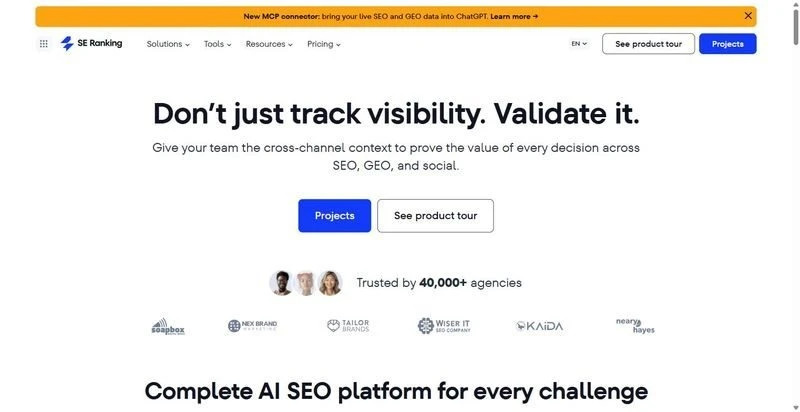
An SEO and AI-search visibility platform that profiles any domain's organic, paid, and AI-answer footprint from one entry point.
Best for: Agencies and mid-market in-house teams benchmarking rivals across SEO, PPC, and AI answers in one place.
Standout: Point its competitor research tool at a domain and you get its organic traffic, PPC keywords and ads, top pages, plus how often that brand shows up in AI Overviews, AI Mode, ChatGPT, Gemini, and Perplexity answers. No project setup required.
Pros:
- Finds real search rivals you didn't know about (the ones no one on the account thought to track), not just the names you fed it.
- Runs keyword gap and backlink gap analysis side by side against multiple competitors.
- Includes API and MCP access on every plan, not only the top tier.
Cons:
- Requires a manual "Expand Database" request for some domains and regions instead of instant data.
- Scales competitor-domain counts and historical depth with plan tier, so lower tiers see less.
Pricing: Core $129/mo ($103.20 billed annually), Growth $279/mo ($223.20 annually); 14-day free trial. AI Competitive Research covers 5 domains on Core, 15 on Growth.
My verdict: Look — if your reporting has to cover SEO, PPC, and AI answers without juggling three logins, this is the competitor keyword analysis tool I'd put in front of a client. Watch the tier limits on competitor count. Otherwise, recommended for teams doing real benchmarking work.
2. Similarweb
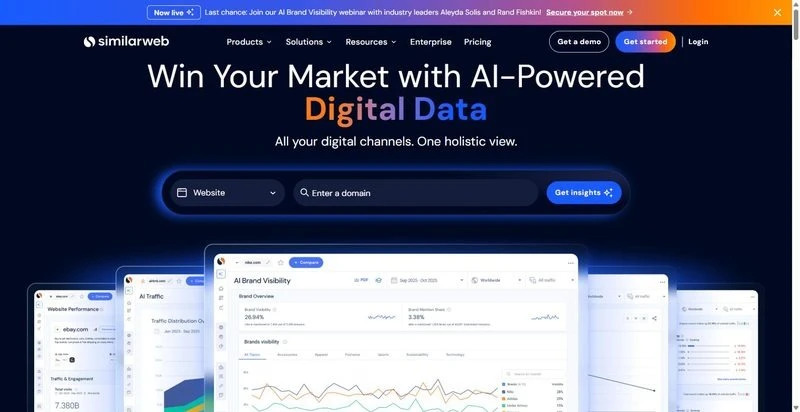
A market-intelligence platform that estimates a rival's whole-market traffic, audience, and channel mix from panel and clickstream data.
Best for: Teams sizing a competitor's total market traffic and audience, not just its SEO footprint.
Standout: It models total visits, traffic sources, audience overlap, and market share across a rival's entire digital presence, then adds ads intelligence and a Gen-AI suite tracking AI traffic and brand visibility.
Pros:
- Estimates total market traffic and share, not only search visibility.
- Maps audience overlap so you see who else your rival's visitors touch.
- Adds ads intel and a Gen-AI suite for AI traffic and brand visibility.
Cons:
- Hides real pricing behind quote-based Business tiers that climb fast with add-on suites.
- Models traffic from panels, so accuracy slips on smaller domains and SEO/backlink depth stays thin.
Pricing: Self-service Web Intelligence from $125/mo billed annually; Business and Enterprise tiers are quote-based.
My verdict: Buy Similarweb to size a competitor's entire market and audience, not to grade their SEO. For keyword and backlink depth, pair it with a dedicated tool. The sticker price rarely survives contact with sales.
3. Semrush
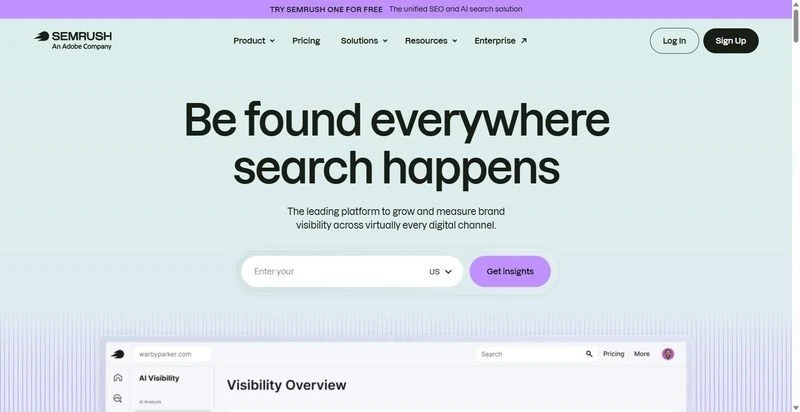
An all-in-one suite packing SEO, content, PPC and AI-search research on one of the largest keyword and competitor databases.
Best for: Teams that want the widest keyword and ad database in one suite.
Standout: Domain Overview and Organic Research surface competitor keywords, positions and estimated traffic. Keyword Gap and Backlink Gap sit next to Advertising Research and PLA data, Traffic Analytics with Market Explorer, plus AI-search visibility and prompt tracking. The breadth is the point.
Pros:
- Covers organic, paid and AI-search research in one login
- Maps keyword and backlink gaps against multiple rivals
- Tracks competitor ad copy and PLA listings over time
Cons:
- Traffic Analytics has historically been a paid add-on, not bundled
- Plans ship one seat and meter reports with daily caps; costs climb with add-ons
Pricing: From $139/mo monthly ($117.33/mo annual); Starter $199/mo, Pro+ $299/mo. Free plan exists.
My verdict: Look — if you want one tool that sees the whole board, this is it. Just price it honestly: add seats and Traffic Analytics and a mid-market team lands well north of the headline. Worth it for the coverage.
4. SpyFu
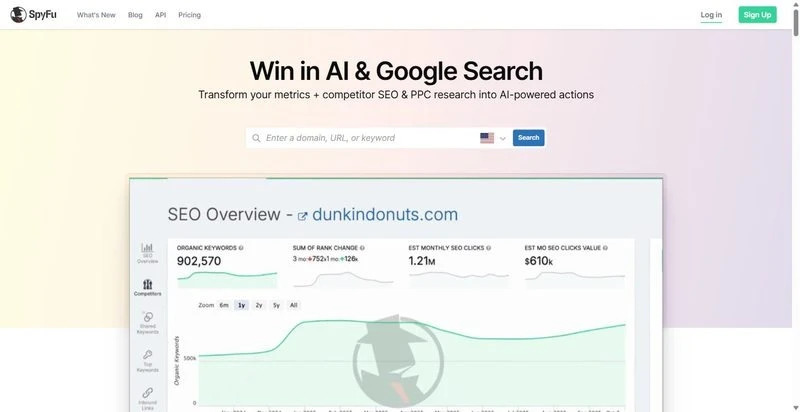
Exposes a competitor's paid and organic keywords alongside years of their ad-copy history in one view.
Best for: Reading a rival's paid-search playbook and years of ad history.
Standout: It pulls organic keywords with estimated traffic, AdWords keywords, and ad history with copy tracked over time. Kombat compares keyword gaps across up to three domains, and you get backlink and SERP analysis on top. The paid-search intelligence is where it earns its place.
Pros:
- Surfaces a rival's PPC keywords and full ad-copy timeline
- Compares keyword overlap across three domains with Kombat
- Tracks organic keywords and estimated traffic alongside paid
Cons:
- Data is strongest for the US and thins out internationally
- Traffic estimates, backlink index and site-audit depth trail pricier tools; the interface feels dated
Pricing: From $39/mo (Basic monthly; $33/mo annual); Professional $79/mo adds API, unlimited exports and 10+ years of history.
My verdict: SpyFu knows one job cold: what competitors bid on and how their ads evolved. For paid-search teardowns, keep it in the stack. Don't expect it to run your rank tracking. Point it at ads and it delivers.
5. Serpstat
An all-in-one SEO platform covering keyword research, rank tracking, site audits, backlinks and competitor analysis.
Best for: Lean in-house teams wanting keyword and backlink gap analysis without an enterprise contract.
Standout: Competitor analysis spans organic and paid keyword rankings, keyword and domain gap comparisons, backlink analysis with backlink gap, and estimated traffic. Higher tiers add an AI Overview Brand Opportunities report. You get the core competitive workflows most teams run without a heavyweight enterprise platform.
Pros:
- Compares domains head to head on organic and paid keywords
- Runs keyword and backlink gap analysis in one workflow
- Adds AI Overview brand tracking on Team and above
Cons:
- Entry Individual plan drops API, batch analysis, AI tools and JS rendering
- Databases and estimates run smaller than the largest vendors, especially backlinks and non-major regions
Pricing: From $50/mo (Individual, annual billing); Team $100/mo adds API, batch analysis, AI tools and MCP.
My verdict: Serpstat covers the competitive basics without an enterprise contract, which matters for a lean in-house team. The entry plan is stripped down; you'll want Team for anything serious. The data won't match the giants, but for gap analysis it holds up.
6. Moz Pro
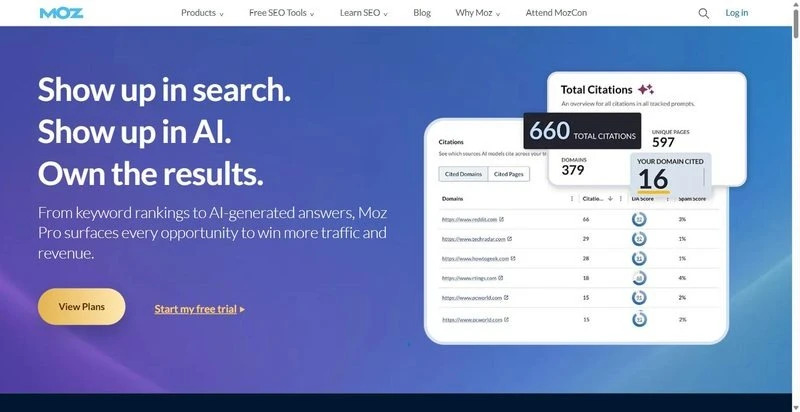
The platform that built its name on Domain Authority, now with AI-search visibility so you track citations next to authority scores.
Best for: Teams that run their benchmarking on Domain Authority and want AI-citation tracking alongside it.
Standout: Competitive Research surfaces a rival's keywords, authority, and top pages, while Link Explorer handles backlink and link-gap work. The newer AI Visibility dashboards track prompts and citations across GPT, Gemini, and Google AI Mode, so DA-native teams get generative-search signals without leaving the platform they already trust.
Pros:
- Track AI citations across GPT, Gemini, and Google AI Mode alongside classic metrics
- Profile competitor keywords, authority, and top pages from one Domain Overview
- Research backlink and link-gap opportunities through Link Explorer
Cons:
- Keyword and backlink databases run smaller than the largest vendors
- Meters monthly queries and offers minimal paid/PPC competitor data
Pricing: Starter $49/mo, Standard $99/mo ($79/mo annual), Medium $179/mo.
My verdict: If your reporting already speaks Domain Authority, Moz keeps that language and adds AI-citation tracking. Just know DA and PA are Moz estimates, not Google metrics, and the databases trail the biggest vendors. Fine as a benchmarking anchor, weak for paid-search intel.
7. seoClarity
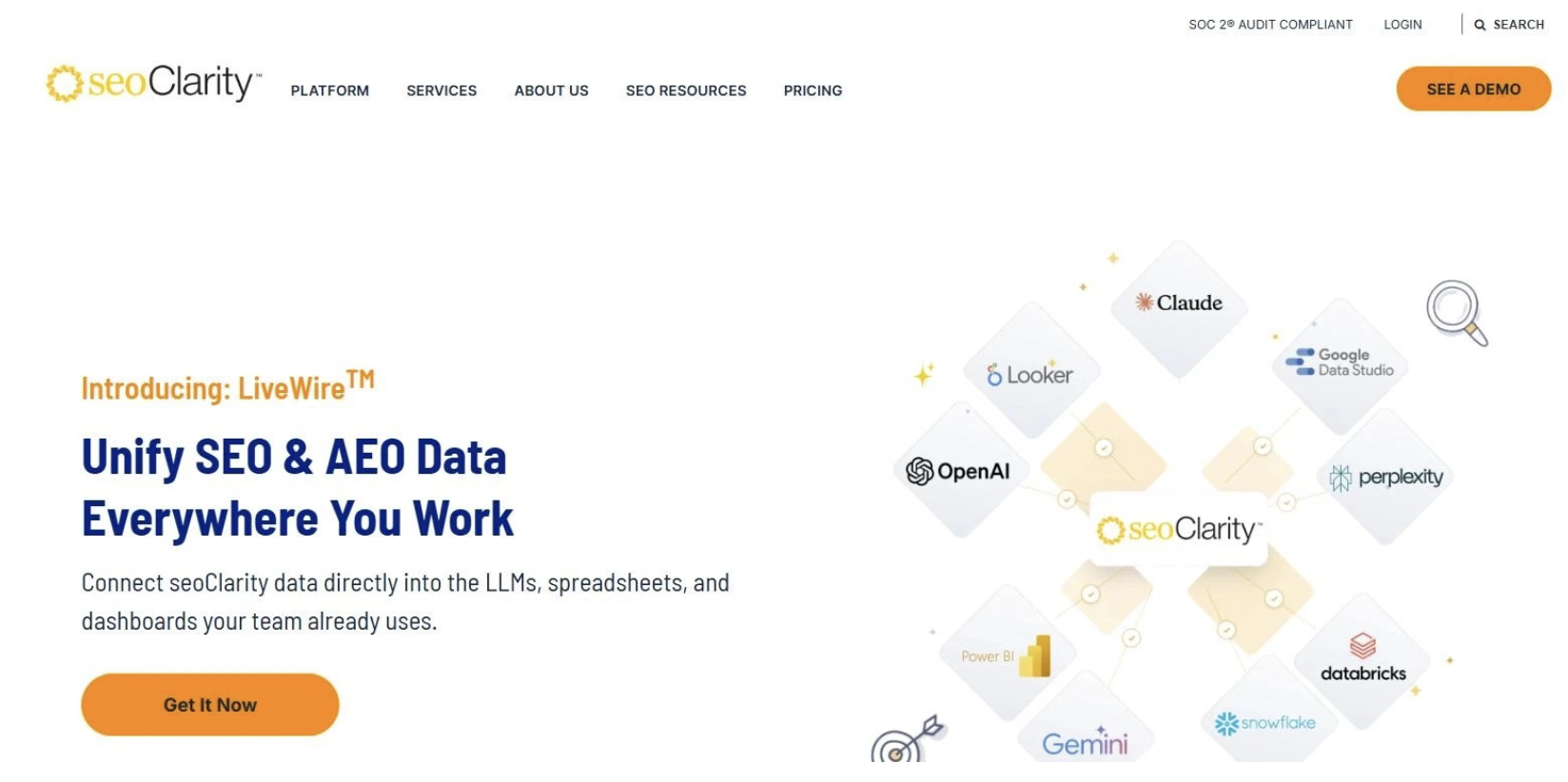
An enterprise SEO platform for large brands tracking huge keyword sets, with unlimited rank tracking and an AI assistant, Sia.
Best for: Large brands tracking share-of-voice across huge keyword sets.
Standout: Competitor rank tracking and share-of-voice run at scale against a large data warehouse, backed by content-gap, keyword-gap, and SERP analysis plus backlink research. AI-search visibility arrives through ClarityArcAI add-ons.
Pros:
- Track competitor share-of-voice across unlimited keywords at enterprise scale
- Combine content-gap, keyword-gap, and SERP analysis in one warehouse
- Add AI-search visibility through ClarityArcAI modules
Cons:
- Publishes no transparent or entry pricing. Enterprise contracts only
- Demands steeper onboarding and account-management reliance, with several capabilities as paid add-ons
Pricing: Custom, quote-based enterprise contracts only (published starting points land roughly in the $2,500-$4,500/mo range, priced by domains and keywords tracked).
My verdict: seoClarity earns its keep when you're an enterprise team drowning in keywords and need share-of-voice at scale. For everyone else, the quote-only pricing and onboarding weight are hard to justify. Buy it for breadth, not speed or transparency.
How to actually pick one
Here's how I'd cut through it. If you want SEO, PPC, and AI competitor research in one view without stitching three subscriptions together, SE Ranking is my top pick, and the one I'd hand most agency and in-house teams looking for the best tools for competitor analysis. The alternates earn their place: Similarweb for whole-market traffic sizing and audience overlap; SpyFu when a single rival's paid and ad-history is the whole question; seoClarity for share-of-voice across tens of thousands of keywords at enterprise scale. Skip if: skip audience-only platforms like Similarweb when you actually need keyword and backlink gap data, and skip quote-only enterprise suites unless you're genuinely tracking tens of thousands of keywords.
FAQ
Can competitor analysis tools track visibility inside AI Overviews and AI Mode?
Only some do. Plenty of tools still read the classic ten blue links and ignore what AI engines say. If AI Overviews and AI Mode matter to your reporting, check coverage before you buy. For a deeper look at how AI Mode affects search visibility, see SE Ranking's AI Mode study. SE Ranking tracks across five AI engines, which is where I'd start.
Do you need a dedicated PPC tool to analyze competitors' ads?
Not usually. All-in-one suites now bundle paid and ad research, so you can pull a rival's keywords, spend signals, and ad copy without a second subscription. A dedicated PPC tool only earns its place when you need deep, long-range ad-history on one rival.
What's the difference between a competitor analysis tool and a rank tracker?
Different jobs. A rank tracker watches your own positions move over time. A competitor analysis tool points outward: it profiles rivals' organic, paid, and AI presence and finds the gaps you can take. You want both, but don't confuse one for the other.
Why 100,000+ professionals use Fueler
Fueler helps professionals showcase proof of work through projects, assignments, case studies, and achievements.
- Thousands of professionals use Fueler to create their digital portfolio
- Thousands of projects are published on Fueler. Check here
- Startups and Companies hire through proof of work on Fueler
- Used by freelancers, creators, marketers, video editors, writers, designers, and product managers
Our mission is to help the next 100 million professionals build a verified professional identity through proof of work

What should you do next?
You've read the article. Now turn your skills into proof of work and unlock more opportunities.
Build your proof of work portfolio
Create a clean portfolio with projects, assignments, resumes, and AI stack details that companies actually want to see.
Create your Fueler portfolio →Apply through assignments, not resumes
Stand out by solving real tasks from companies hiring on Fueler.
Explore assignments →Get discovered by companies
Make your work public and let recruiters discover your skills through actual projects instead of keywords.
Get discovered →