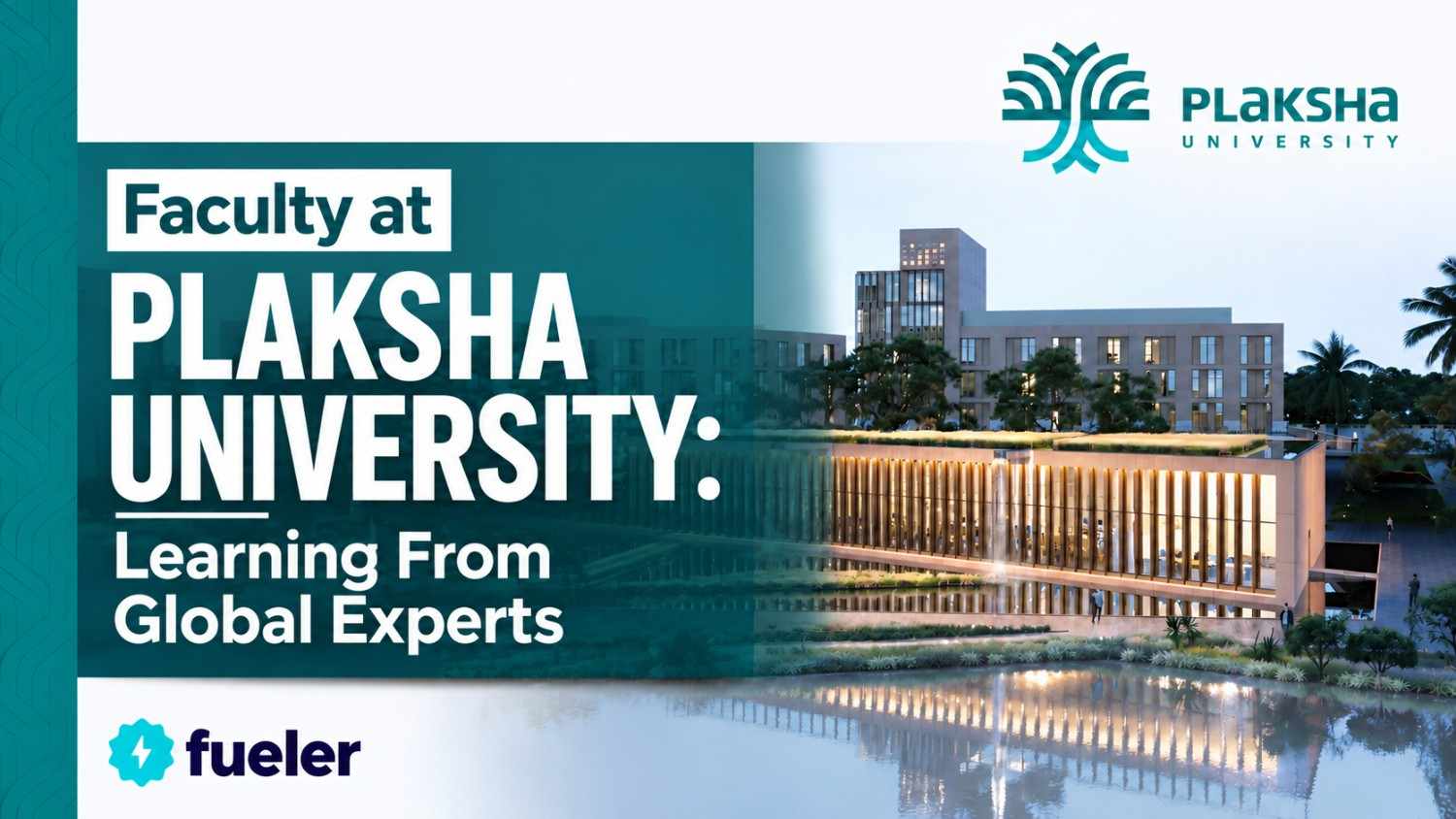
Faculty at Plaksha University: Learning From Global Experts

Riten Debnath
31 Aug, 2026
Last updated: August 2026
Legacy higher education often suffers from a fundamental disconnect: the people teaching technology are rarely the ones actively building it or shaping its global cutting edge. In most traditional engineering colleges, students spend four years memorizing decades-old slides delivered by professors who have never launched a product, filed a commercial patent, or run an industrial R&D lab.
I’m Riten, founder of Fueler, a skills-first portfolio platform building the career infrastructure for 100 million creative professionals. Fueler connects talented individuals with companies through assignments, portfolios, and projects, not just resumes or CVs. Think of it as Dribbble/Behance for work samples combined with AngelList for hiring infrastructure.
At Fueler, we evaluate thousands of early-stage engineers, product builders, and designers every month. The pattern is crystal clear: a student's career trajectory is rarely capped by their intelligence; it is capped by the standard of mentorship they receive and the quality of proof of work they produce during their formative years. When you learn from global academic leaders and industry operators, your baseline definition of "good work" changes instantly.
This is precisely why the academic delivery model at Plaksha University warrants close examination. Instead of relying solely on local tenure-track academics, Plaksha has engineered a hybrid faculty framework that embeds global researchers, Silicon Valley practitioners, and seasoned startup founders directly into the classroom.
If you are a student, parent, or early professional evaluating modern higher education options, this guide breaks down how the faculty ecosystem at Plaksha University operates, who these global experts are, and how their presence fundamentally changes student outcomes.

Quick Answer Summary
- Who It Is For: Undergraduates, tech fellows, and research aspirants who want direct, unmediated mentorship from global academics and technology executives.
- Global Affiliations represented: Faculty and academic advisors hold credentials from institutions including MIT, UC Berkeley, Purdue University, Stanford, UPenn, Carnegie Mellon, and IISc.
- Teaching Philosophy: Project-based, interdisciplinary instruction focused on solving open-ended Grand Challenges rather than memorizing textbooks.
- Key Takeaway: Students interact directly with global researchers and operators, building a public proof of work that mirrors industry standards rather than academic theory.
- Best Suited For: Self-driven builders, future founders, AI engineers, and prospective researchers who thrive on high accountability and active mentorship.
What is the Global Faculty Framework at Plaksha University?
The faculty framework at Plaksha University is an academic instruction model designed to bridge the gap between higher education and frontier technology. Instead of staffing departments strictly through traditional administrative hierarchies, Plaksha structures its teaching staff across three core pillars: full-time resident faculty, visiting international faculty, and industry leaders in residence.
Context and Educational Roots
Plaksha University was co-founded by over 60 global technology leaders, corporate executives, and entrepreneurs. This founding group recognized that traditional Indian engineering curricula were isolated from global research shifts and industry needs.
To fix this, they built an Academic Advisory Board and Research Advisory Council featuring global academic leaders such as Dr. S. Shankar Sastry (former Dean of Engineering at UC Berkeley), Dr. Anant Agarwal (founder of edX and MIT professor), and Dr. Frances Ligler (NC State / UNC Chapel Hill). These advisors do not just lend their names; they actively shape course structures, evaluate faculty hires, and facilitate joint research.
Why It Matters
In traditional setups, students learn theories that are often ten years behind current industry deployments. When your instructors are active researchers published in peer-reviewed journals or active founders building software systems, your learning reflects real-time realities.
Understanding advanced artificial intelligence, cyber-physical systems, or synthetic biology requires guidance from people who actively work with those tools.
How It Differs From Alternatives
- Traditional Indian Universities: Primarily staffed by permanent tenure-track professors whose primary experience is within legacy academic systems, with limited exposure to global industrial R&D or startup execution.
- Offshore Foreign Campuses: Overseas universities charging full international fees (often $60,000+ per year) to access foreign faculty on their home turf.
- Plaksha's Hybrid Model: Brings international scholars and operators to Mohali for intensive block teaching, co-designed modules, and continuous capstone mentorship at an Indian fee structure.
Key Facts Table
Detailed Explanation of Faculty and Mentorship
The faculty ecosystem at Plaksha University operates through four distinct layers of instruction, mentorship, and research governance.
1. Resident Full-Time Faculty
What It Is
Resident faculty form the backbone of Plaksha’s academic operations at the Mohali campus. These are full-time professors who hold doctorates and post-doctoral research credentials from top global universities and IISc/IITs. They lead foundational courses, manage research labs, and oversee day-to-day academic progress.
How They Teach and Why It Matters
Unlike traditional professors who lecture from pre-determined textbooks, resident faculty at Plaksha design studio-based courses. For instance, a data science module does not end with a written exam; it ends with students writing algorithms to clean, process, and analyze real-world datasets.
Because resident faculty maintain active research labs in cyber-physical systems, clean energy, and digital health, undergraduates can join active research teams during their second or third year.
2. International Visiting Faculty and Academic Advisors
What It Is
Plaksha regularly brings scholars from international partner institutions including UC Berkeley, Purdue University, and the University of Pennsylvania to deliver specialized modules, masterclasses, and intensive term courses.
Global Curriculum Alignment
These visiting professors bring identical pedagogical standards from their home institutions. For example, modules co-designed with UC Berkeley’s Sutardja Center for Entrepreneurship & Technology (SCET) introduce Silicon Valley framework models directly into the Mohali classroom.
Students are exposed to global benchmarks for speed, critical thinking, and technical documentation. When students build solutions under this guidance, documenting their assignments into a structured portfolio becomes essential. Showcasing live builds on platform tools like Fueler allows students to share their work with recruiters across global markets, demonstrating proof of work that aligns with international standards.
3. Industry Practitioners and Founders-in-Residence
What It Is
Engineering and technology do not exist in a vacuum. Plaksha integrates technology founders, venture capitalists, and corporate executives directly into its instructional roster.
Industry Experience in the Classroom
Instructors include leaders who have founded venture-backed companies, led engineering divisions at major tech firms, or managed deep-tech funds.
Instead of teaching theoretical business management, an industry practitioner walks students through actual product teardowns, unit economics models, system scaling failures, and go-to-market trade-offs. They critique student projects using real commercial criteria rather than academic grading rubrics.
4. Grand Challenge Capstone Mentorship
What It Is
In their final year, students complete a year-long Grand Challenge Capstone Project. Rather than working under a single advisor on an abstract academic topic, student teams are co-mentored by a resident faculty member and an industry mentor.
Real-World Implications
This dual-mentorship structure ensures that student capstones meet two strict standards: technical rigor (checked by resident faculty) and market viability (checked by industry mentors).
Projects often mature into early-stage startups incubated at Plaksha's Centre for Entrepreneurship, or yield research papers published at international conferences.
How Learning From Global Experts Works: Step-by-Step
Understanding how a student interacts with this faculty network over four years helps demonstrate the practical impact on their education.
- Step 1: Core Fundamentals & Studio Orientation (Year 1)
- Students take interdisciplinary foundation courses co-taught by resident professors. Instruction shifts quickly from lecture halls to maker labs, where students apply physics, mathematics, and computing principles to physical builds.
- Step 2: Advanced Electives with Visiting Faculty (Years 2 & 3)
- As students select their major tracks, they enroll in specialized modules taught by visiting global professors and industry experts. These courses run as intensive workshops or semester blocks covering topics like deep learning, smart mobility, and precision agriculture.
- Step 3: Joining Applied Research Centers (Years 2 & 3)
- Students apply to join research groups hosted within campus centers like the Center for Water Security or the Indorama Ventures Center for Clean Energy. Guided by resident researchers, students execute field tests, gather empirical data, and co-author papers.
- Step 4: Capstone Execution & Industry Co-Mentorship (Year 4)
- Teams are paired with industry veterans to solve real-world problems. Mentors evaluate weekly sprints, review code architectures, and provide feedback on hardware designs.
- Step 5: Career Transition & Portfolio Launch (Graduation)
- With direct recommendations from global faculty and industry mentors, graduates transition into startup roles, corporate R&D divisions, or top global master's programs.
Practical Benefits of Plaksha's Faculty Model
- Access to High-Value Networks: Learning from international professors and founders gives students direct access to professional networks that normally take years to build.
- No Theoretical Dead-Ends: Coursework focuses on real applications. Students build functional systems instead of filling out theoretical bluebooks.
- Letters of Recommendation That Matter: When applying to top graduate schools abroad or deep-tech research roles, a detailed letter of recommendation from an internationally recognized researcher carries significant weight.
- Relevant Career Mentorship: Industry mentors help students navigate real career choices such as deciding between product management, AI engineering, or launching a startup based on current market dynamics.
- Public Proof of Work: Continuous project reviews force students to clean up their code repositories, document their design iterations, and publish their results publicly.
Challenges and Limitations
It is important to evaluate any academic model critically. Here are potential limitations to consider:
- High Adjustment Curve for Freshers: Students accustomed to traditional Indian schooling may initially feel overwhelmed by open-ended assignments, continuous evaluations, and direct faculty questioning.
- Visiting Faculty Schedules: Visiting international professors often teach in concentrated, high-intensity modules rather than staying on campus full-time year-round. Students must manage their time effectively during these intensive sprints.
- Rigor Demand: Faculty expect professional-grade output. Skimping on documentation, missing sprint deadlines, or turning in unverified builds leads directly to low evaluations.
Comparison Table: Faculty Experience Models
Tuition, Fees, and Value Orientation
The quality of faculty and campus infrastructure directly influences tuition structures. Plaksha operates as a non-profit university backed by philanthropic tech leaders, reinvesting fees into academic delivery.
Fee Breakdown (Undergraduate Track)
- Tuition Fee (Category A): Approx. ₹7,80,000 per year.
- Hostel Accommodation: ₹1,44,000 per year.
- Meal Plan (Mess): ₹66,000 per year.
- Total Base Annual Cost: Approx. ₹9,90,000 per year.
Financial Aid Accessibility
To ensure qualified students are not turned away due to financial constraints, Plaksha provides need-based financial aid covering up to 100% of tuition costs for families earning under ₹50 Lakhs per year:
- Family Income < ₹18L/yr: 100% Tuition Fee Waiver
- Family Income ₹18L–₹28L/yr: 75% Tuition Fee Waiver
- Family Income ₹28L–₹38L/yr: 50% Tuition Fee Waiver
- Family Income ₹38L–₹50L/yr: 25% Tuition Fee Waiver
Career Pathways Driven by Faculty Mentorship
Direct interaction with global faculty opens up distinct career opportunities that standard campus placements rarely offer:
- AI & Robotics Research Roles: Students working within research centers transition directly into international R&D labs or deep-tech engineering teams.
- Venture-Backed Startup Founder: Mentorship from active entrepreneurs gives student founders the feedback needed to validate ideas, build MVPs, and pitch to seed-stage investors.
- Associate Product Manager (APM): Industry-led project modules prepare students to bridge technical engineering with product strategy, making them strong APM candidates.
- Direct US/Europe Graduate Admissions: Strong research references from globally connected professors simplify entry into top international MS and Ph.D. programs.
Who Should Choose Plaksha's Faculty Ecosystem?
- Proactive Learners: Students who actively ask questions, seek mentorship, and want to build real systems rather than just take exams.
- Aspiring Researchers: Candidates who want to write papers and contribute to real-world research labs early in their undergraduate journey.
- Future Tech Leaders & Founders: Students who value advice from entrepreneurs who have successfully built and scaled technology businesses.
Who Should Avoid This Path?
- Passive Learners: Students who expect professors to spoon-feed syllabus material for rote exam memorization.
- Grade-Only Seekers: Anyone focused solely on obtaining a traditional degree certificate without putting in the hours to build a functional portfolio.
Final Thoughts
The quality of an academic program ultimately comes down to the quality of its faculty and the environment they create. If your professors are isolated from the modern tech landscape, your education will be out of sync before you even graduate.
Plaksha University's strategy of combining resident researchers, visiting global scholars, and active industry practitioners provides a compelling template for higher education. It forces students out of passive listening and into active creation.
At Fueler, we consistently observe that early-career success depends on proving what you can build. Having global experts critique your work, push your standards, and guide your builds helps you construct a proof of work that stands out anywhere in the world. If you are ready to engage directly with high-caliber mentors and take ownership of your learning, this environment offers a strong foundation for your growth.
Key Takeaways
- Plaksha University uses a hybrid faculty model comprising resident professors, visiting global scholars, and industry operators.
- Visiting faculty and advisors hold credentials from leading global institutions, including UC Berkeley, MIT, Purdue, and UPenn.
- Academic delivery relies heavily on project-based learning, studio labs, and real-world problem solving.
- Students have direct access to research centers focused on clean energy, water security, and digital health.
- Mentorship from active founders and executives helps align student capstone builds with market demands.
- Financial aid covers up to 100% of tuition fees for eligible families earning below ₹50 Lakhs annually.

FAQs
Who teaches undergraduate classes at Plaksha University?
Classes are taught by full-time resident faculty with global doctorates, visiting international professors from partner universities, and experienced tech industry practitioners.
Do international professors from universities like UC Berkeley actually teach on campus?
Yes, visiting faculty from institutions like UC Berkeley, Purdue, and UPenn lead specialized modules, conduct workshops, and co-design course curricula at the Mohali campus.
How does Plaksha's faculty model differ from legacy engineering colleges in India?
Instead of relying solely on traditional lectures and final exams, Plaksha faculty emphasize hands-on studio projects, continuous evaluation, and active research participation.
Can undergraduate students collaborate on faculty research projects?
Yes, undergraduates can join active campus research centers in areas like clean energy, health tech, and cyber-physical systems starting in their early academic years.
How do industry practitioners mentor students at Plaksha?
Industry leaders co-mentor final-year Grand Challenge Capstone projects, review student builds, deliver specialized business modules, and provide startup incubation guidance.
Why 100,000+ professionals use Fueler
Fueler helps professionals showcase proof of work through projects, assignments, case studies, and achievements.
- Thousands of professionals use Fueler to create their digital portfolio
- Thousands of projects are published on Fueler. Check here
- Startups and Companies hire through proof of work on Fueler
- Used by freelancers, creators, marketers, video editors, writers, designers, and product managers
Our mission is to help the next 100 million professionals build a verified professional identity through proof of work

What should you do next?
You've read the article. Now turn your skills into proof of work and unlock more opportunities.
Build your proof of work portfolio
Create a clean portfolio with projects, assignments, resumes, and AI stack details that companies actually want to see.
Create your Fueler portfolio →Apply through assignments, not resumes
Stand out by solving real tasks from companies hiring on Fueler.
Explore assignments →Get discovered by companies
Make your work public and let recruiters discover your skills through actual projects instead of keywords.
Get discovered →