Founder’s Office Career Path: Skills, Salary, and Growth

Riten Debnath
18 Jul, 2026
Last updated: July 2026
The Founder’s Office has shifted from an experimental startup department into one of the most coveted career paths for ambitious professionals. It serves as an internal incubator for high-leverage talent, positioning generalists directly alongside chief executives to drive special initiatives, patch broken systems, and clear organizational bottlenecks. However, because the role is highly fluid, clear information around long-term progression, skills development, and salary structures can be difficult to find.
I’m Riten, founder of Fueler, a skills-first portfolio platform building the career infrastructure for 100 million creative professionals. Fueler connects talented individuals with companies through assignments, portfolios, and projects, not just resumes or CVs. Think of it as Dribbble/Behance for work samples combined with AngelList for hiring infrastructure.
This comprehensive breakdown details the actual career trajectory within a Founder's Office, the baseline operational skills required to thrive, verified market compensation benchmarks, and realistic long-term growth avenues.
The Architectural Hierarchy of a Founder’s Office Career Path
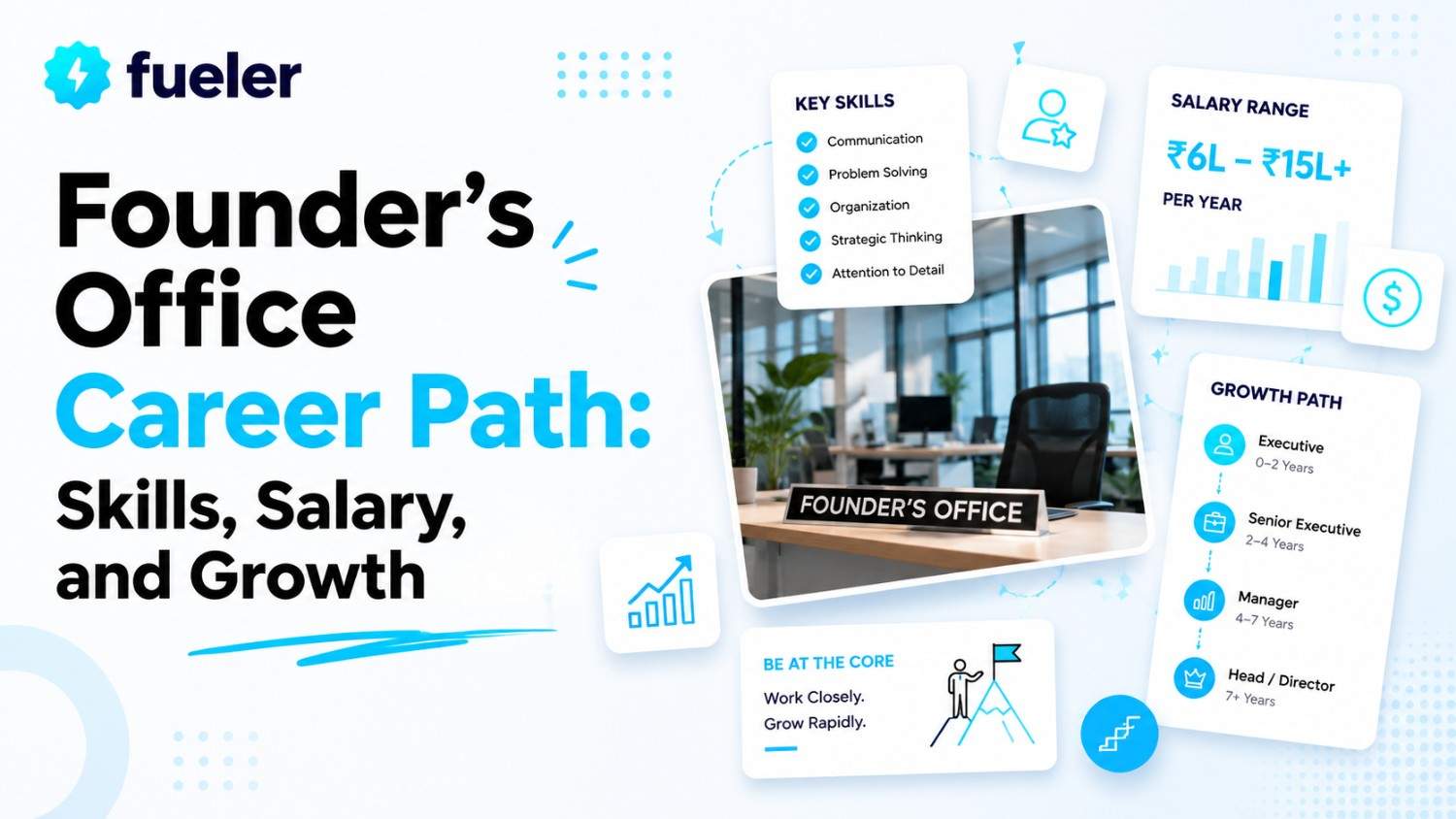
The progression inside a Founder's Office does not follow a traditional corporate ladder. Instead, it scales alongside your capability to manage increasing levels of operational ambiguity and financial complexity. You enter as a hands-on execution partner and progress into a strategic gatekeeper who directly influences company-wide resource allocation.
At the entry point, your focus is entirely task-oriented, ensuring day-to-day projects move forward without stalling. As you mature, your responsibilities transition from managing small tactical processes to orchestrating multi-departmental turnarounds, board reporting, and capital allocation frameworks.
- Founder’s Office Associate acts as the primary execution engine, handling database cleanups, customer data audits, and coordinating cross-functional task follow-ups.
- Manager, Founder’s Office takes ownership of standalone projects, such as setting up automated internal tracking tools or running initial pilot tests for new market expansions.
- Director / Head of Founder’s Office synchronizes broader departmental milestones, optimizes high-level budgeting, and builds operational bridges between isolated functional teams.
- Chief of Staff functions as the definitive strategic proxy for the CEO, managing investor communications, board preparation, and sensitive, high-impact company emergencies.
- Special Projects Lead operates as an internal builder who temporarily embeds within broken or unlaunched verticals to establish foundational systems before handing them off.
Why It Matters
Understanding this organizational hierarchy allows you to benchmark your personal progression against industry standards. It prevents you from getting trapped in permanent administrative loops by clearly showing when you need to transition from basic task execution to high-stakes strategic ownership.
Core Operational Skills Demanded by Executive Teams
Thriving in this environment requires a unique balance of high analytical capabilities and exceptional communication skills. You cannot specialize in just one vertical; you must possess the functional literacy required to speak intelligently with engineering, finance, and marketing teams alike.
Ego must be completely absent from your operational framework. You must be equally comfortable designing a multi-million dollar expansion blueprint on a Monday and manually formatting broken CSV data rows on a Tuesday morning.
- Advanced structural data analysis involves aggregating messy, unstructured metrics from sales and product tools to locate hidden drops in your customer acquisition funnels.
- Rigorous financial modeling literacy means tracking cash burn rates, verifying unit economics, and building forecasting tools that show how headcount changes impact runway.
- Asynchronous documentation mastery focuses on compressing complex corporate developments into clear, single-page executive memos that establish immediate team alignment without meetings.
- Systems automation architecture requires using modern workspace APIs and database links to eliminate manual data entry across marketing and operations workflows.
- High-stress conflict resolution allows you to navigate friction between competitive department heads without relying on formal corporate authority to enforce decisions.
Why It Matters
A lack of hard operational skills quickly turns a Founder’s Office employee into an expensive administrative assistant. Mastering these specific capabilities ensures you provide genuine leverage to leadership, protecting the founder's schedule while directly accelerating the company's growth velocity.
Verified Compensation Benchmarks Across Scaling Stages
Compensation within the Founder's Office varies significantly based on funding metrics, team scale, and your geographical region. Because these roles handle highly sensitive data, companies offer competitive packages to attract and retain high-agency operators.
At the early stage, salaries lean heavily into equity components to offset lower cash reserves. As startups mature into Series B, C, and late-stage enterprises, compensation transitions into premium fixed salaries coupled with performance-linked cash variables.
Why It Matters
Having real, uninflated market data protects you from under-valuing your execution capabilities during negotiation phases. It ensures you balance your risk profile correctly by requesting the appropriate mix of liquid cash and equity based on the company's capitalization stage.
Long-Term Growth Trajectories and Exit Horizons
The Founder’s Office is fundamentally an accelerated finishing school for business generalists. Spending twenty-four months working directly under an active founder packs a decade's worth of traditional corporate learning into a highly concentrated window.
When it comes time to transition out of the core office, your path splits into distinct, highly lucrative options. You either step into an internal executive function or exit the business entirely to apply your operational knowledge externally.
- Transitioning to a Functional VP or GM allows you to take full operational and profit-and-loss ownership over a specific department like Operations, Sales, or Growth.
- Stepping out to become a Startup Founder lets you launch your own venture utilizing the direct fundraising, hiring, and scaling patterns learned from leadership.
- Moving into Venture Capital as an Operator involves joining investment firms to evaluate incoming startup deals and optimize operations across their portfolio brands.
- Stepping into an International Expansion Lead role means taking full ownership of launching the company’s existing product lines into entirely new geographic markets.
- Advancing to Chief Operating Officer (COO) cements your place as the long-term internal operational leader who runs the company's daily machinery at scale.
Why It Matters
This career path is not designed for permanent residency; it is an active trampoline. Mapping out your exit horizon early ensures that every project you pick up inside the office directly stacks the specific skills needed for your ultimate destination.
How Does This Connect to Building a Strong Career or Portfolio?
Your long-term professional leverage depends entirely on the public visibility of your shipped projects. Because the work inside a Founder's Office is often highly confidential or internal, traditional resumes fail completely at showcasing the systems you built. You must find clean ways to document your operational processes, anonymize your data wins, and showcase your problem-solving frameworks.
When you structurally organize your evidence of execution on Fueler, you establish an indisputable record of your competence. It allows forward-thinking startup teams to instantly review your tactical style, turning your portfolio into an active talent magnet.
Final Thoughts
The Founder’s Office path is one of the most intense yet rewarding trajectories available to modern business generalists. It strips away corporate politics and measures your worth entirely by your speed of execution and clarity of thought. If you can handle extreme ambiguity, master the underlying data, and check your ego at the door, this career path offers unparalleled professional acceleration. Focus on building public proof of your work, and let your shipped output open the doors to leadership.
Frequently Asked Questions
What is the typical background for someone entering a Founder's Office?
While many historically came from investment banking or consulting, modern startups care far more about a tangible track record of shipping projects, building operations, and showing independent proof of execution.
How does a Founder’s Office role differ from a traditional Executive Assistant?
An Executive Assistant focuses primarily on logistics, calendar management, and travel schedules. A Founder’s Office role owns strategic execution, data analysis, cross-departmental alignment, and project delivery.
Do Founder’s Office employees get significant equity?
Yes, early-stage startup roles offer meaningful equity components (ranging from 0.1% to 1%) to align the operator's financial upside directly with the long-term enterprise growth of the venture.
How long do people typically stay in a Founder's Office role?
The standard tenure is twelve to twenty-four months. After this window, operators typically transition into deep functional leadership roles within the company or leave to launch their own startups.
What is the single biggest point of failure in this role?
Misaligned communication and low agency. Operators who wait around for explicit step-by-step instructions or fail to provide crisp, synthesized updates to their founders usually drop out of the pipeline quickly.
Why 100,000+ professionals use Fueler
Fueler helps professionals showcase proof of work through projects, assignments, case studies, and achievements.
- Thousands of professionals use Fueler to create their digital portfolio
- Thousands of projects are published on Fueler. Check here
- Startups and Companies hire through proof of work on Fueler
- Used by freelancers, creators, marketers, video editors, writers, designers, and product managers
Our mission is to help the next 100 million professionals build a verified professional identity through proof of work

What should you do next?
You've read the article. Now turn your skills into proof of work and unlock more opportunities.
Build your proof of work portfolio
Create a clean portfolio with projects, assignments, resumes, and AI stack details that companies actually want to see.
Create your Fueler portfolio →Apply through assignments, not resumes
Stand out by solving real tasks from companies hiring on Fueler.
Explore assignments →Get discovered by companies
Make your work public and let recruiters discover your skills through actual projects instead of keywords.
Get discovered →