High-Income AI Careers: Top Jobs for 2026

Riten Debnath
23 May, 2025
Last updated: July 2026
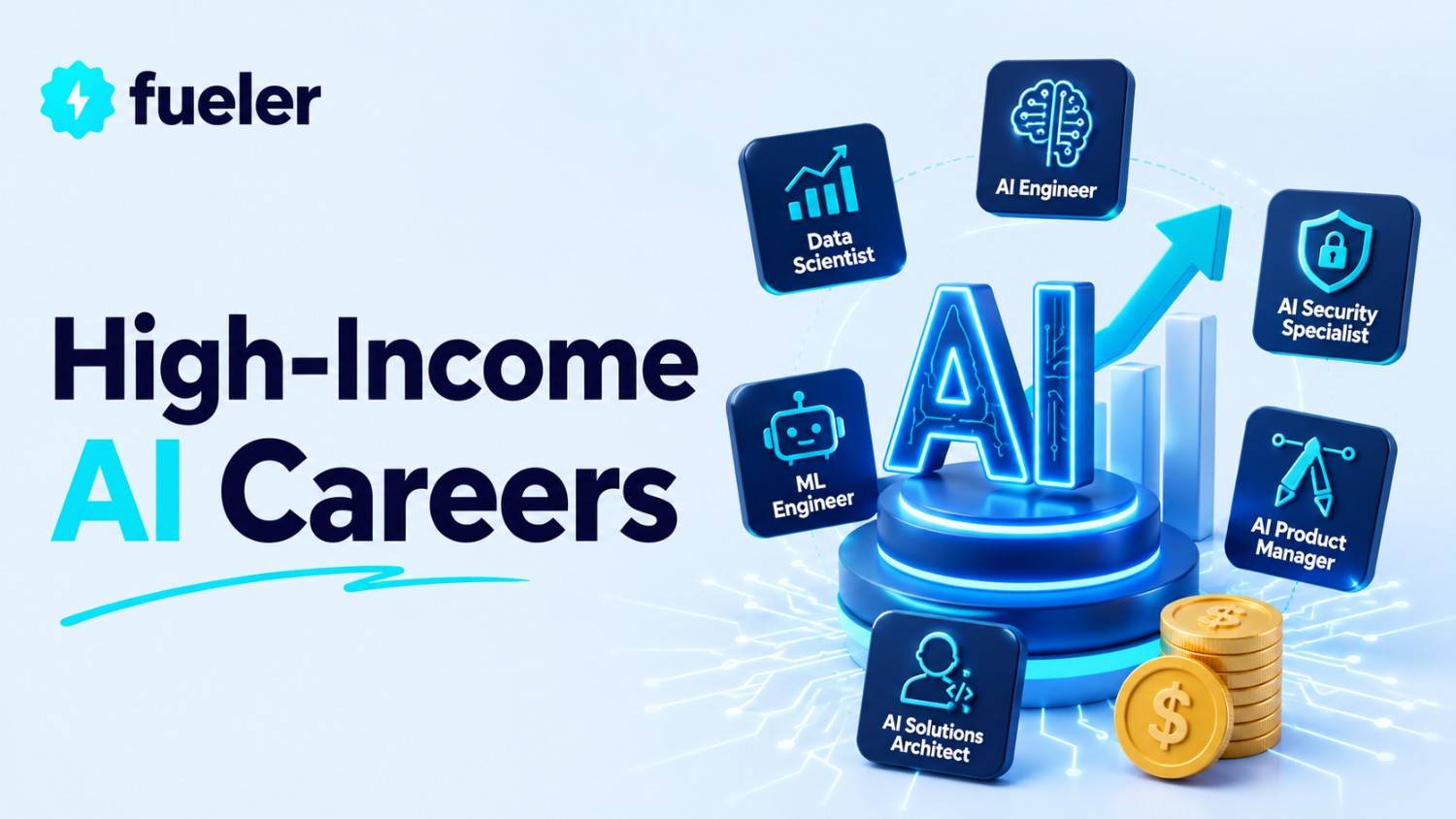
Artificial Intelligence (AI) is no longer just a buzzword; it's the driving force behind some of the most lucrative and future-proof careers today. In 2026, AI professionals are in high demand across industries, from tech and finance to healthcare and defense. If you're aiming for a high-paying, impactful career, AI is the place to be.
I’m Riten, founder of Fueler, a skills-first portfolio platform building the career infrastructure for 100 million creative professionals. Fueler connects talented individuals with companies through assignments, portfolios, and projects, not just resumes or CVs. Think of it as Dribbble/Behance for work samples combined with AngelList for hiring infrastructure.
1. AI Engineer: The Backbone of Intelligent Systems
AI engineers design, build, and maintain AI models and systems that help businesses automate processes and analyze data. They work with machine learning algorithms, deep learning networks, and data engineering tools to create solutions that power smart applications like recommendation engines, chatbots, and predictive analytics.
This career requires strong programming skills, knowledge of AI frameworks, and a deep understanding of mathematics and statistics. The AI engineer role is one of the highest-paid in the tech world due to the complexity and value of the solutions they create.
- Global Salary Range: $120,000 to $225,000 annually.
- Top Companies: Google, Meta, OpenAI, Microsoft, Amazon, Apple, NVIDIA.
- Top 10% Earnings: Up to $280,000 per year.
- Median Salary: Approximately $172,000 per year.
- In India: Salaries range from ₹3.5 Lakhs to ₹27 Lakhs per year, with top companies offering up to ₹35 Lakhs.
2. Machine Learning Scientist: Innovators Behind AI Breakthroughs
Machine learning scientists focus on researching and developing new AI algorithms and models. They analyze large datasets, create predictive models, and push the boundaries of what AI can do. This role is research-intensive and demands a strong academic background in computer science, statistics, and data science.
In 2026, machine learning scientists will be crucial in developing smarter AI applications and improving existing technologies. Their work directly influences the capabilities of AI products used worldwide.
- Global Salary Range: $130,000 to $200,000 annually.
- Top Companies: DeepMind, OpenAI, Google Research.
- Top 10% Earnings: Up to $250,000 per year.
- In India: Salaries range from ₹6 Lakhs to ₹25 Lakhs per year.
3. Data Scientist: Turning Data Into Business Gold
Data scientists extract meaningful insights from massive datasets to help companies make data-driven decisions. They use AI techniques to build predictive models that forecast trends, customer behavior, and risks. Data science combines programming, statistics, and business knowledge.
The demand for data scientists remains strong as every company wants to use AI to gain a competitive edge. It is a high-income career because it directly impacts company profits and strategic direction.
- Global Salary Range: $110,000 to $220,000 annually.
- Top Companies: Facebook (Meta), Google, Amazon, Netflix.
- Top 10% Earnings: Up to $250,000 per year.
- In India: Salaries range from ₹6 Lakhs to ₹35 Lakhs per year.
4. AI Product Manager: Bridging Technology and Business
AI product managers lead the development of AI-powered products from concept to launch. They work closely with engineers, designers, and business teams to ensure the AI solutions meet user needs and deliver value. This role requires technical knowledge combined with strong project management and communication skills.
In 2026, AI product managers are critical because they help translate AI research into practical, profitable products. They ensure AI is not just cutting-edge but also user-friendly and impactful.
- Global Salary Range: $120,000 to $170,000 annually.
- Top Companies: Google, Microsoft, Amazon, Apple.
- In India: Salaries range from ₹8 Lakhs to ₹22 Lakhs per year.
5. Robotics Engineer: Building the Future of Automation
Robotics engineers design and develop robots and automated systems using AI to perform tasks traditionally done by humans. From manufacturing robots to autonomous vehicles, their work is hands-on and multidisciplinary, combining AI, mechanical engineering, and software development.
This field is growing rapidly with high pay, as companies look to improve efficiency and reduce labor costs through automation.
- Global Salary Range: $90,000 to $150,000 annually.
- Top Companies: Boston Dynamics, Tesla, ABB Robotics.
- In India: Salaries range from ₹2 Lakhs to ₹9.6 Lakhs per year.
6. Natural Language Processing (NLP) Engineer: Teaching Machines to Understand Language
NLP engineers specialize in building AI systems that understand and generate human language. Applications include virtual assistants, chatbots, language translation, and sentiment analysis. As voice interfaces and multilingual services grow, NLP skills are in high demand.
The job requires a strong background in linguistics, AI, and programming. NLP engineers often work on cutting-edge AI projects with lucrative compensation.
- Global Salary Range: $110,000 to $160,000 annually.
- Top Companies: Google, Amazon, Microsoft, OpenAI.
- In India: Salaries range from ₹3 Lakhs to ₹25.5 Lakhs per year.
7. AI Ethics Specialist: Guiding Responsible AI Development
As AI use expands, companies are increasingly concerned about ethical issues like bias, privacy, and transparency. AI ethics specialists ensure AI systems are developed and used responsibly. They create policies, conduct audits, and work with legal teams to make AI safe and fair.
This new career path is gaining importance and offers high salaries due to its critical role in preventing legal and reputational risks.
- Global Salary Range: $100,000 to $140,000 annually.
- Top Companies: Google, Microsoft, IBM, Accenture.
- In India: Salaries range from ₹6 Lakhs to ₹18 Lakhs per year.
How to Build a Portfolio That Lands AI Jobs in 2026
In the AI field, having the right skills is only part of the story. Showing your ability to solve real problems through a strong portfolio is what employers and clients want to see. This is where platforms like Fueler come in. Fueler helps you build a portfolio through real assignments, allowing you to prove your expertise in AI and data science before you even get hired.
A portfolio should include sample projects like AI models you’ve built, code snippets, research papers, or case studies demonstrating your impact. This real-world evidence builds trust and makes your application stand out in the competitive AI job market.
- Showcase Projects: Include clear problem statements and results.
- Code Repositories: Link to GitHub or similar platforms.
- Collaborative Work: Highlight contributions to open-source AI projects.
- Continuous Updates: Regularly add new projects and skills.
Skills to Master for High-Income AI Careers
To succeed in AI and earn a high income, focus on mastering the following skills. These skills are in high demand and open doors to the best AI jobs in 2026.
- Programming Languages: Python, R, Java, C++.
- AI Frameworks: TensorFlow, PyTorch, Keras.
- Machine Learning Algorithms: Supervised and unsupervised learning, reinforcement learning.
- Data Analysis Tools: SQL, Hadoop, Spark.
- Cloud Platforms: AWS, Azure, Google Cloud.
- Soft Skills: Problem-solving, communication, teamwork
Final Thought
As we stand on the brink of a technological revolution, AI is not just a trend; it's the future. The demand for skilled AI professionals is soaring, and with it, the potential for high-income careers. Whether you're a seasoned expert or just starting, the opportunities in AI are vast and varied. By continuously honing your skills, staying updated with industry trends, and building a compelling portfolio, you can position yourself at the forefront of this exciting field. Remember, the journey into AI is not just about mastering technology; it's about shaping the future.
FAQs
1. What is the average salary for an AI engineer in 2026?
In 2026, the average global salary for an AI engineer ranges from $120,000 to $225,000 annually, with top professionals earning up to $280,000. In India, salaries vary between ₹3.5 Lakhs and ₹27 Lakhs per year, depending on experience and location.
2. How can I build a strong AI portfolio?
A strong AI portfolio showcases your practical skills and problem-solving abilities. Include projects that demonstrate your expertise in areas like machine learning, natural language processing, or data analysis. Utilize platforms like Fueler to present your work through real assignments, providing tangible evidence of your capabilities to potential employers.
3. What skills are essential for a career in AI?
Key skills for AI careers include proficiency in programming languages (Python, R, Java), understanding of AI frameworks (TensorFlow, PyTorch), knowledge of machine learning algorithms, data analysis tools (SQL, Hadoop), and cloud platforms (AWS, Azure). Additionally, strong problem-solving abilities and effective communication skills are crucial.
4. Are AI careers in demand in 2026?
Yes, AI careers are in high demand in 2026. The rapid advancement of AI technologies across various sectors, including healthcare, finance, and technology, has led to a significant increase in job opportunities. Companies are actively seeking skilled professionals to develop and implement AI solutions.
5. How can I transition into an AI career without a technical background?
Transitioning into an AI career without a technical background is possible by starting with foundational courses in programming and data science. Platforms like Coursera and edX offer beginner-friendly courses. Additionally, gaining hands-on experience through projects and internships can help build practical skills and credibility in the field.
Why 100,000+ professionals use Fueler
Fueler helps professionals showcase proof of work through projects, assignments, case studies, and achievements.
- Thousands of professionals use Fueler to create their digital portfolio
- Thousands of projects are published on Fueler. Check here
- Startups and Companies hire through proof of work on Fueler
- Used by freelancers, creators, marketers, video editors, writers, designers, and product managers
Our mission is to help the next 100 million professionals build a verified professional identity through proof of work

What should you do next?
You've read the article. Now turn your skills into proof of work and unlock more opportunities.
Build your proof of work portfolio
Create a clean portfolio with projects, assignments, resumes, and AI stack details that companies actually want to see.
Create your Fueler portfolio →Apply through assignments, not resumes
Stand out by solving real tasks from companies hiring on Fueler.
Explore assignments →Get discovered by companies
Make your work public and let recruiters discover your skills through actual projects instead of keywords.
Get discovered →