How Does Masters' Union Teach Business Differently?

Riten Debnath
16 Aug, 2026
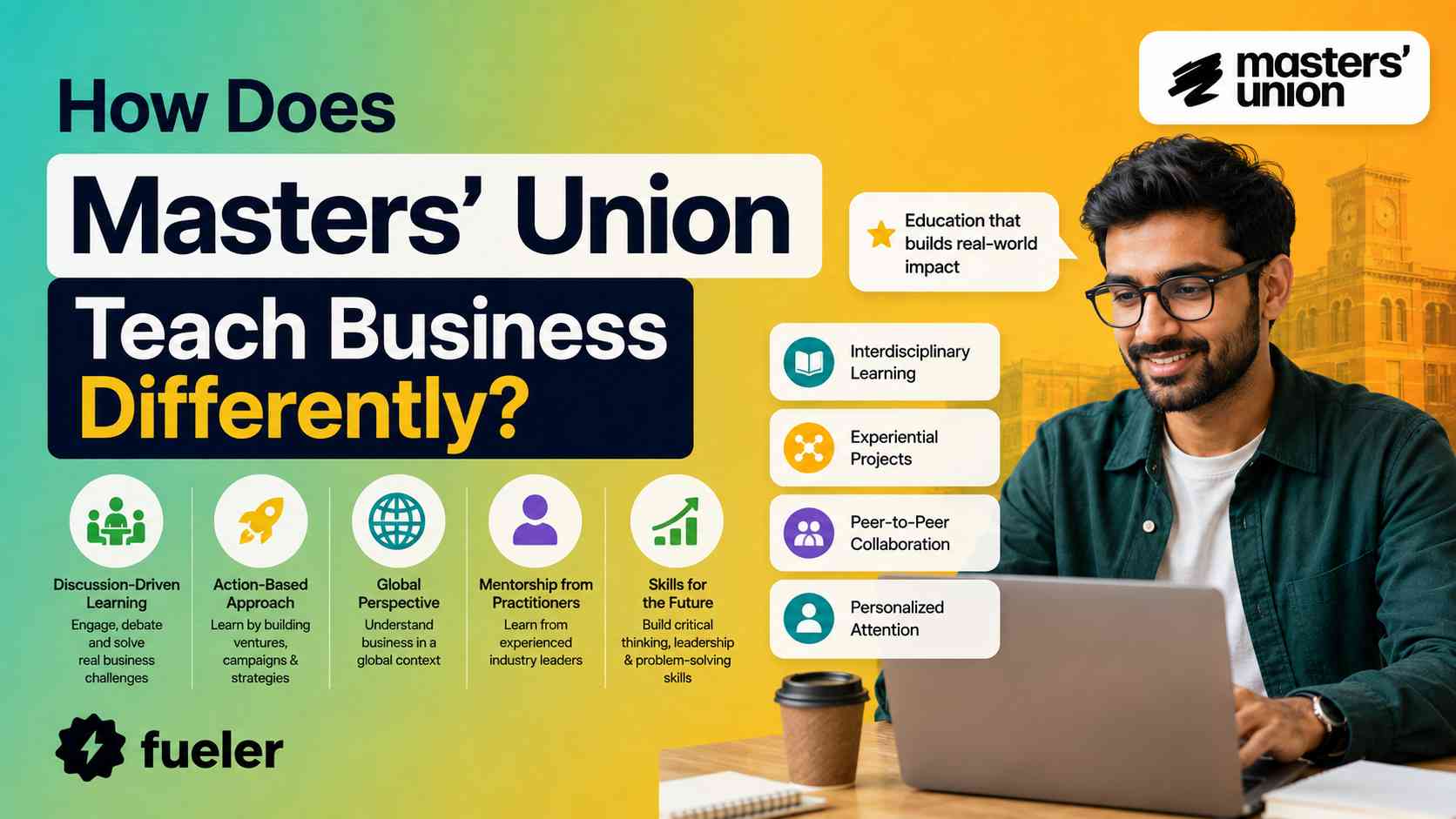
Last updated: August 2026
When a business school decides to throw out the hundred-year-old lecture hall template, it forces everyone in education to pay attention. Traditional management degrees have spent decades teaching business through yellowed textbooks, theoretical case studies, and exams that reward memorization over execution. But building a company in today's fast-moving market requires a completely different kind of muscular memory.
When you analyze how Masters' Union teaches business differently, you quickly realize it is less of a traditional academic institution and more of a 16-month business accelerator.
I’m Riten, founder of Fueler, a skills-first portfolio platform building the career infrastructure for 100 million creative professionals. Fueler connects talented individuals with companies through assignments, portfolios, and projects, not just resumes or CVs. Think of it as Dribbble/Behance for work samples combined with AngelList for hiring infrastructure.
Through my work at Fueler, I spend every day observing how top-tier tech companies, venture capital funds, and high-growth startups evaluate potential hires. Modern hiring managers rarely ask about your academic GPA or how well you analyzed a case study from twenty years ago. They ask: What have you actually built? Can you show me your live projects? What happened when you spent real capital?
This shift in how companies hire is precisely why Masters' Union’s hands-on approach catches so much attention. In this deep dive, we will unpack the exact mechanics of how Masters' Union teaches business differently, breaking down its practitioner-led faculty, real-world business challenges, curriculum architecture, real placement outcomes, and whether this experiential model fits your career trajectory.
Quick Answer Summary
- Practitioner Faculty: Instead of tenured academic professors, classes are taught directly by active startup founders, corporate CXOs, venture capitalists, and industry directors.
- Real-Money Experiments: Students manage a ₹5 Crore student-led investment fund and build live dropshipping businesses with real customer acquisition targets.
- Proof-of-Work Culture: Education is evaluated through tangible assets, live business metrics, and portfolios rather than traditional written theory exams.
- Core Curriculum Integration: Blends classical management fundamentals (finance, operations, strategy) with modern tech infrastructure like AI tools, Python, data analytics, and performance marketing.
- Career Trajectory: Positions graduates directly for high-ownership roles such as Chief of Staff, Founder’s Office, Product Manager, and Venture Capital Associate.

What is the Masters' Union Pedagogy Cohort?
Masters' Union operates out of DLF Cyber Park in Gurgaon, the heart of India's corporate and startup ecosystem. Its flagship offering, the Post Graduate Programme in Technology and Business Management (PGP-TBM), is a 16-month residential program structured around experiential learning.
The fundamental premise of Masters' Union is simple: business cannot be mastered by reading about it. You learn marketing by spending a budget to acquire real users. You learn supply chain mechanics by sourcing products from manufacturers and delivering them to real buyers. You learn corporate finance by evaluating early-stage companies and investing real capital.
This approach closely mirrors how we view professional growth at Fueler. When candidates bring a verified portfolio showing actual campaigns managed, software shipped, or revenue generated, their employment probability jumps dramatically. Masters' Union bakes that exact portfolio-building engine directly into its educational model.
Key Facts Table
Detailed Explanation: How Masters' Union Teaches Business Differently
To understand why this model causes so much debate in higher education, you have to break down its structural shifts across faculty selection, curriculum design, evaluation methods, and industry exposure.
1. Faculty: Professors of Practice vs. Academic Scholars
In a traditional business school, the faculty consists mostly of tenured professors holding doctorates in management science. While they excel at academic research, many have not run a company, managed an active P&L statement, or dealt with a modern growth marketing stack in years.
Masters' Union flips this entirely by hiring "Professors of Practice".
- Active Founders and CXOs: Courses are taught by leaders running active businesses such as Managing Directors from global consulting firms, founders of venture-backed unicorns, and product heads from top consumer tech brands.
- Real-Time Context: When an active Chief Marketing Officer teaches performance marketing, they teach strategies that worked yesterday afternoon, not case studies written in 1998.
- Direct Network Access: Learning directly from industry operators creates immediate mentorship channels. Instead of going through HR gates, top-performing students build relationships with hiring managers inside the classroom.
2. Live Capital and Real-World Practicums
The curriculum replaces static assignments with real capital experiments.
- The Dropshipping Challenge: Students receive a micro-budget to build an e-commerce brand from scratch. They must select products, build a shopfront, configure payment gateways, run targeted performance ads, handle customer service, and balance real profit margin sheets.
- The ₹5 Crore Student-Led Fund: Rather than simulating stock portfolios on paper, students evaluate real businesses, conduct actual financial due diligence, write investment memos, and deploy capital from a dedicated student-managed fund.
- The Creator Challenge: Modern business leaders must understand distribution and personal branding. Students are tasked with building audience channels on platforms like YouTube or Instagram, learning content strategy, video production, algorithms, and organic reach mechanics firsthand.
3. Proof of Work Over Paper Examinations
The traditional academic testing framework rewards memorizing formulas and writing essay responses under timed pressure. Masters' Union evaluates students primarily on output.
- Portfolio Generation: Graduates leave the program with a collection of tangible assets: a running e-commerce business, audited performance campaign results, product tear-downs, and published research memos.
- Demonstrable Execution: Just as creative professionals use Fueler to demonstrate their capabilities through project samples rather than a flat resume, Masters' Union graduates use their live project results as primary proof during recruitment drives.
- Continuous Feedback: Projects are judged by external industry panels, venture capitalists, and real market buyers rather than internal academic grading curves.
4. Integration of Technology and Core Business
Most traditional management programs treat technology as an elective or a separate department altogether. Masters' Union treats technology as a core operational layer across every business function.
- Data-Driven Operations: Students learn SQL, Python, and data visualization tools alongside traditional accounting and corporate finance.
- AI Tooling Integration: Modules explicitly teach students how to leverage modern AI tools for workflow automation, customer research, market analysis, and software prototyping.
- Product Management Focus: Modules teach user experience research, wireframing, sprint planning, and system architecture alongside marketing and financial management.
Step-by-Step Breakdown: The 16-Month Learning Journey
The curriculum moves in fast-paced, sequential phases designed to build execution discipline.
- Phase 1: Foundations & Analytical Hard Skills (Terms 1–2)
- Intensive immersion in business statistics, corporate accounting, economics, and financial modeling.
- Learning essential technology tools including Python, SQL, and design thinking fundamentals.
- Phase 2: The E-Commerce & Execution Sprint (Terms 3–4)
- Launching real dropshipping businesses and running live performance campaigns.
- Mastering customer acquisition cost (CAC), lifetime value (LTV) ratios, logistics, and vendor negotiations.
- Phase 3: Venture Creation & Fund Management (Terms 5–6)
- Participating in the ₹5 Crore investment fund to evaluate real startups.
- Prototyping new venture concepts, conducting market validation, and preparing pitch decks for investors.
- Phase 4: CXO Residencies & Industry Immersion (Term 7)
- Spending time inside corporate offices, factory floors, and tech headquarters across Gurgaon and Bangalore.
- Working on live consulting briefs directly provided by corporate partners.
- Phase 5: Placement Drives & Demo Days (Term 8)
- Presenting ventures to angel investor networks during campus Demo Days.
- Interviewing for high-ownership corporate roles through portfolio-first placement drives.
Practical Career Outcomes and Real ROI
To evaluate if this teaching methodology delivers tangible career value, we have to look directly at audited placement metrics and job role distribution.
Placement Performance Highlights
- Overall Average Package: Standing at ₹33.39 LPA, the overall average compensation rivals top-tier traditional Indian business schools.
- Median Package: Sits at ₹27.78 LPA, showing that earning potential is distributed steadily across the cohort rather than skewed by a few extreme outliers.
- Top 25% Compensation: The top quarter of the cohort averages ₹54.80 LPA, largely driven by tech, product, and international roles.
- Highest Domestic Package: Reached ₹1.28 Crore per annum.
High-Ownership Career Paths
Because the program emphasizes building over textbook reading, recruiters hire these graduates for generalist, high-ownership roles:
- Chief of Staff / Founder's Office: Working alongside tech CEOs and founders on strategy, investor relations, and scaling operations.
- Product Manager (PM): Defining product roadmaps, coordinating engineering sprints, and optimizing consumer app conversions.
- Growth Marketing Lead: Managing multi-channel acquisition budgets, search optimization, and retention loops.
- Venture Capital Analyst: Sourcing early-stage investments, running financial models, and supporting portfolio startups.
Comparison Table: How Masters' Union Teaches vs Competitors
Challenges and Limitations of This Teaching Model
While an experiential model offers clear advantages, it comes with real operational trade-offs that prospective students must understand before applying.
1. High Noise and Fatigue Levels
Moving between e-commerce launches, fund investments, CXO lectures, and content creation challenges within 16 months can feel chaotic. Students who need structured, calm academic schedules often struggle with the constant task-switching.
2. Lack of Academic Degree Status
Masters' Union is an autonomous institute. It does not issue a traditional UGC-recognized Master's degree. If your long-term career plan requires a formal degree for government service exams, corporate compliance in specific global markets, or entry into academic PhD programs, this is a significant hurdle.
3. Faculty Availability Dynamics
Because instructors are active corporate executives, managing directors, and founders, their schedules are subject to business emergencies. Class times can shift, requiring high adaptability from students.

Who Should Choose This Teaching Model?
- Action-Oriented Builders: Professionals who learn best by doing, experimenting, and seeing immediate real-world feedback.
- Future Tech Leaders and PMs: Individuals targeting product management, growth marketing, or business operations inside fast-moving startups.
- Aspiring Entrepreneurs: Candidates who want to test business concepts, pitch to active investors, and build a venture during their program.
- Portfolio-First Believers: Professionals who recognize that proof of work on platforms like Fueler opens more doors in modern tech than a traditional resume.
Who Should Avoid This Teaching Model?
- Traditional Academic Seekers: Anyone looking for classic university campus life, deep academic theory, and research-focused study.
- Public Sector / PSU Candidates: Individuals who need a UGC-recognized degree to qualify for government employment or strict regulatory certifications.
- Risk-Averse Learners: Candidates who feel uncomfortable operating without rigid, long-established institutional rulebooks.
Final Thoughts
The decision to choose Masters' Union comes down to how you believe business should be learned. If you see management as a collection of theoretical frameworks to be memorized for written exams, traditional business schools offer a time-tested path.
However, if you view business as an active trade where success depends on testing ideas, building products, managing real capital, and assembling a verified portfolio of work, then an experiential, practitioner-led model provides an exceptionally potent environment.
At Fueler, we see every day that execution beats assertion. The institutions that teach students how to execute before they step into the interview room are fundamentally reshaping the future of business education.
Key Takeaways
- Practitioner Instruction: Classes are led by active founders, CXOs, and industry operators rather than tenured academics.
- Real Capital Projects: Students run live e-commerce businesses and manage a ₹5 Crore investment fund.
- Portfolio-First Approach: Evaluation centers on tangible execution, metrics, and live assets instead of paper exams.
- Tech-Infused Curriculum: AI tools, SQL, Python, and product design are taught alongside core finance and strategy.
- Strong Placements: Achieved an overall average domestic and international package of ₹33.39 LPA.
- Non-Degree Certificate: Awards an autonomous certificate rather than a UGC-recognized university degree.
Frequently Asked Questions (FAQs)
How are classes taught at Masters' Union without traditional professors?
Classes are taught by active industry leaders, including startup founders, corporate CXOs, managing directors, and venture capitalists. Learning centers on real case breakdowns, live business experiments, and direct mentorship sessions.
What is the Dropshipping Challenge at Masters' Union?
It is a mandatory hands-on module where student teams launch and run real e-commerce stores. They handle product selection, vendor negotiations, digital marketing campaigns, customer acquisition, and cash flow management using real money.
Do students get to invest real money during the program?
Yes, students evaluate startups and deploy real capital from Masters' Union's dedicated ₹5 Crore student-led venture fund. This process teaches due diligence, deal sourcing, financial modeling, and investment strategy through direct experience.
Is the Masters' Union PGP-TBM certificate equivalent to an MBA degree?
No, Masters' Union is an autonomous private institute that grants an executive certificate program. It is not recognized as a UGC or AICTE university degree, focusing instead on practical job readiness.
What types of roles do companies recruit Masters' Union graduates for?
Recruiters primarily hire graduates for high-ownership roles such as Chief of Staff, Founder’s Office, Product Manager, Growth Marketing Lead, and Venture Capital Associate.
Why 100,000+ professionals use Fueler
Fueler helps professionals showcase proof of work through projects, assignments, case studies, and achievements.
- Thousands of professionals use Fueler to create their digital portfolio
- Thousands of projects are published on Fueler. Check here
- Startups and Companies hire through proof of work on Fueler
- Used by freelancers, creators, marketers, video editors, writers, designers, and product managers
Our mission is to help the next 100 million professionals build a verified professional identity through proof of work

What should you do next?
You've read the article. Now turn your skills into proof of work and unlock more opportunities.
Build your proof of work portfolio
Create a clean portfolio with projects, assignments, resumes, and AI stack details that companies actually want to see.
Create your Fueler portfolio →Apply through assignments, not resumes
Stand out by solving real tasks from companies hiring on Fueler.
Explore assignments →Get discovered by companies
Make your work public and let recruiters discover your skills through actual projects instead of keywords.
Get discovered →