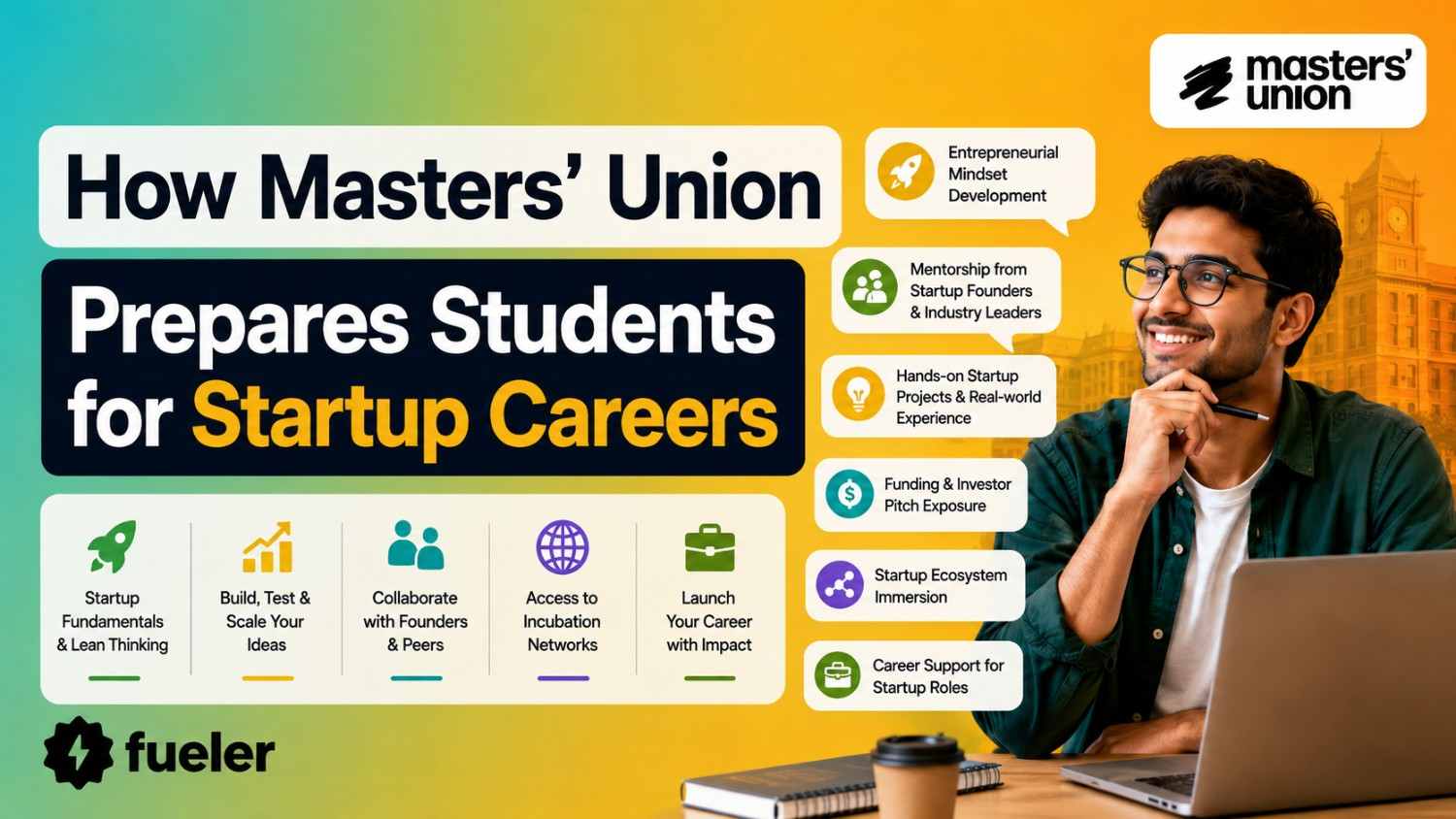
How Masters' Union Prepares Students for Startup Careers

Riten Debnath
17 Aug, 2026
Last updated: August 2026
If you are thinking about working in a fast-paced technology startup or launching your own venture, traditional business degrees often feel painfully outdated. Legacy academic programs focus heavily on theoretical textbooks, decade-old case studies, and memorizing formulas rather than executing real-world strategies.
I’m Riten, founder of Fueler, a skills-first portfolio platform building the career infrastructure for 100 million creative professionals. Fueler connects talented individuals with companies through assignments, portfolios, and projects, not just resumes or CVs. Think of it as Dribbble/Behance for work samples combined with AngelList for hiring infrastructure.
In my daily work alongside founders, hiring managers, and growth teams across the tech ecosystem, I notice the exact same pattern: startups do not care about paper degrees anymore. They hire based on proof of work. Companies want candidates who know how to set up acquisition funnels, run No-Code tools, analyze unit economics, and manage operations from day one. That is precisely why modern, practitioner-led models like Masters' Union have completely rewritten the rules of business education.

Quick Answer Summary
- Who It Is For: Aspiring founders, future Product Managers, Chief of Staff candidates, Growth Marketers, and professionals looking for a practical alternative to a traditional MBA.
- Cost: Approximately ₹25 Lakhs to ₹30+ Lakhs (plus taxes and living costs) depending on the track, cohort, and duration.
- Key Takeaway: Students learn business by building live startups, managing real capital, running dropshipping platforms, and launching digital products instead of taking exams.
- Best Suited For: Self-driven individuals who prefer direct industry mentorship, building a strong proof-of-work portfolio, and networking inside top startup hubs like Bangalore and Gurgaon.
What is Masters' Union?
Masters' Union is a higher education institution built specifically for the modern technology and startup economy. Unlike traditional business schools that rely on tenured professors who may have been out of the industry for decades, the faculty here consists of active founders, Venture Capital partners, product leaders, and C-Suite executives from major tech companies.
At its core, the program approaches business education as a trade that must be practiced rather than a subject to be read. From their first term, students are immersed in real market environments. They build online stores, run paid marketing budgets, pitch business models to angel networks, and manage real money.
This distinction is vital because technology startups move faster than traditional university curricula can update. By the time an academic textbook gets printed, the tools, growth hacks, and operational playbooks used by modern startups have already evolved. Masters' Union bridges this gap by turning the classroom into an active business incubator.
Key Facts Table
Detailed Explanation: How Masters' Union Prepares Students for Startup Careers
To understand how Masters' Union prepares students for startup careers, you have to look at the massive gap in traditional business education. Standard MBA programs prepare students for structured corporate environments like investment banking or corporate consulting. Startups, on the other hand, require generalists who can handle ambiguity, execute tasks without instructions, and deliver measurable proof of work.
Here is a step-by-step breakdown of how the program shapes students into startup-ready operators:
1. The Venture Initiation Programme (VIP)
The flagship element of the curriculum is the Venture Initiation Programme. Students do not just write business plans on paper; they are required to build, launch, and scale a real business during their time on campus.
The process moves through four distinct phases:
- Pre-Seed Stage: Conducting primary research, interviewing real consumers, and identifying genuine market gaps.
- Minimum Viable Product (MVP) Stage: Building working prototypes using No-Code platforms, AI tools, or rapid tech development to solve core problems.
- Go-To-Market (GTM) Stage: Running live performance marketing campaigns, testing organic user acquisition, and closing early sales.
- Product-Market Fit (PMF) Stage: Iterating the product based on customer feedback and analyzing unit economics.
This process forces students to make high-stakes operational choices, manage working capital, and handle customer complaints in real time.
2. Hands-On Micro-Businesses and Practical Challenges
Before building full-scale ventures, students go through intensive micro-challenges designed to teach specific business levers.
For example, the Dropshipping Challenge forces student teams to launch e-commerce platforms from scratch with zero inventory. They select products, build storefronts, write ad copy, set up conversion tracking, and manage real ad spend.
In another module, the Creator-preneur Challenge, students build and monetize content channels across social media platforms. This teaches them organic growth strategies, audience retention, and personal branding skills directly applicable to modern Growth Marketing roles.
3. Managing Real Capital Through the Student Investment Fund
Finance is often taught using static financial modeling spreadsheets based on historical data. At Masters' Union, students run an active student investment fund with real capital.
They evaluate companies, conduct equity valuations, manage risk models, and execute real trades or startup investments. Learning how money flows, how capital is allocated, and how valuation works by handling actual funds creates a deep understanding of financial operations.
4. Direct Learning from Active Startup Founders and VCs
Classes are taught by people who run major companies, manage investment funds, or lead product teams at hyper-growth tech brands.
Instead of traditional grading, students receive feedback directly from practitioners. When a Venture Capital partner critiques a student's business model or a VP of Product reviews an app wireframe, the feedback reflects current market realities rather than academic grading rubrics.
5. Building a Proof of Work Portfolio for the Hiring Market
In the startup world, no founder hires a Product Manager or Growth Lead based on an impressive degree name. They look for tangible evidence of execution capability.
Throughout their time at Masters' Union, students generate live artifacts: active e-commerce campaigns, product teardowns, No-Code prototypes, user acquisition studies, and operational dashboards.
This aligns perfectly with modern hiring platforms like Fueler, where proof of work acts as the primary bridge between ambitious talent and top-tier companies. Having a public portfolio of real projects allows students to walk into interviews and show real data, real metrics, and real outcomes.
How It Works
The journey through the program follows an execution-focused framework designed to move students from fundamentals to full-scale operational leadership:
- Term 1 - Business & Tech Fundamentals: Students master business math, financial statements, basic coding, No-Code workflows, and digital marketing setups.
- Term 2 - The Micro-Business Sprints: Teams run live dropshipping stores, build content channels, and launch basic software or service prototypes to test unit economics.
- Term 3 - Industry Internships & Immersions: Students complete hands-on internships inside fast-growing startups, working directly alongside founders, product managers, or operational heads.
- Term 4 - Venture Initiation & Scale: Students build their core startup ventures, refine their products, gain early customer traction, and prepare for investor presentations.
- Demo Day Execution: The program culminates in a high-stakes Demo Day where student founders pitch their ventures directly to hundreds of active angel investors and Venture Capital funds.
Benefits
Choosing a practitioner-led path offers distinct practical advantages over traditional academic models:
- Real Portfolio Creation: Graduates leave with a rich repository of completed projects, live business metrics, and execution proof rather than just a transcript.
- Direct Ecosystem Access: Being based in Cyber Park, Gurgaon puts students in physical proximity to top corporate headquarters, startup hubs, and tech investors.
- Founder's Mindset Training: Handling real money, dealing with failed campaigns, and managing customer service builds resilience and problem-solving skills that textbooks cannot replicate.
- High-Demand Skill Sets: Curricula adapt continuously to teach modern tools including AI workflows, No-Code platforms, performance ad setups, and product analytics software.
- Early Capital & Support: Top-performing student ventures can secure seed investments, grants, or entry into incubator programs directly through campus pitch events.
Challenges and Limitations
While the model offers significant advantages, it is not suitable for everyone. Potential applicants should carefully evaluate the following constraints:
- High Intensity and Pressure: Operating real businesses alongside intensive coursework creates a fast-paced, high-stress environment.
- Lack of Traditional Academic Safety Nets: Grades are tied to execution, market performance, and peer evaluations rather than memorizing lecture notes.
- Significant Financial Investment: The tuition fee structure is comparable to top-tier global business programs, requiring a clear plan for return on investment.
- Unsuitable for Fixed Career Paths: If your goal is to enter highly traditional fields that demand specific standardized degrees, a non-traditional program may not be the optimal fit.
Comparison Table
Fees and Cost Structure
Pursuing a full-time postgraduate track at Masters' Union involves a notable financial commitment:
- Tuition Fees: Generally range between ₹25 Lakhs to ₹30+ Lakhs (plus applicable taxes) depending on the cohort and track selected.
- Living Expenses: Located in Gurgaon, accommodation, food, and local transportation usually add approximately ₹2.5 Lakhs to ₹4 Lakhs over the course of the program.
- Scholarships & Grants: The institution offers merit-based scholarships, diversity grants, and funding opportunities for exceptional student founders.
- Return on Investment (ROI): Graduates often enter high-growth startup roles such as Chief of Staff, EIR (Entrepreneur-in-Residence), and Product Manager, which carry competitive compensation structures in tech hubs like Bangalore and Gurgaon.
Career Opportunities
The curriculum targets roles within the modern technology ecosystem:
- Chief of Staff / Founder’s Office: Working directly alongside startup CEOs to manage key business operations, track metrics, and execute cross-functional projects.
- Product Manager: Defining product roadmaps, analyzing user behavior, writing product specifications, and managing engineering sprints.
- Growth Marketing Lead: Designing user acquisition strategies, running paid experiments, optimizing conversion funnels, and scaling revenues.
- Venture Capital Analyst: Evaluating early-stage startups, running financial due diligence, and analyzing market trends for investment funds.
- Entrepreneur / Founder: Launching and scaling your own venture using seed capital raised during campus Demo Days.
Who Should Choose This?
This program is well-suited for candidates who:
- Prefer building real projects over writing academic essays.
- Aim to launch their own venture or join an early-stage startup.
- Value direct mentorship from active founders, investors, and business leaders.
- I want to build an undeniable portfolio of proof of work to stand out in the hiring market.
- Thrives in fast-paced, high-stress, and unstructured learning environments.
Who Should Avoid This?
You should consider alternative educational paths if you:
- Prefer structured, predictable, and traditional academic learning environments.
- Are looking primarily for entry into legacy, highly regulated corporate sectors that strictly require traditional degree certifications.
- Prefer individual academic study over team-based business execution.
- Are uncomfortable taking operational risks or managing live project budgets.
Final Thoughts
Having watched the startup hiring landscape evolve rapidly over the past few years, one thing is abundantly clear: paper credentials are losing their leverage, while practical execution is gaining everything.
In a market where hiring managers receive hundreds of identical resumes for every open role, stand-out candidates are those who can point to a live project, a running growth campaign, or a working product specification. Platforms like Fueler exist precisely because the market demands proof over promises.
Educational programs that force students out of the library and into the market reflect where learning is heading. If your goal is to build companies, navigate ambiguity, and secure high-impact roles in the startup ecosystem, learning by doing is no longer optional- it is the prerequisite.
Key Takeaways
- Traditional business degrees often emphasize academic theory, whereas modern startup roles demand practical proof of work.
- Masters' Union relies on a faculty of active CEOs, VCs, and founders instead of tenured academic professors.
- Students build real startups, run e-commerce channels, and manage investment funds as part of the core curriculum.
- High-demand career outcomes include Chief of Staff, Product Manager, Growth Lead, and Founder roles.
- The Gurgaon campus placement puts students in direct contact with top startup operators and capital networks.
- Building a tangible portfolio of work samples is the most reliable way to secure roles in fast-growing tech companies.

FAQs
What is the main difference between a Masters' Union and a traditional MBA?
Traditional MBAs focus on theoretical case studies taught by academic professors. Masters' Union uses practitioner instructors to teach business through live startup building, dropshipping, and managing real investment capital.
Do students at Masters' Union build actual ventures during the course?
Yes, through the Venture Initiation Programme, every student team conceptualizes, launches, and operates a live business, culminating in pitches to active investors on Demo Day.
What kind of roles do graduates get in tech startups?
Graduates typically secure high-impact positions such as Chief of Staff, Product Manager, Growth Marketer, Business Operations Lead, or Founder-in-Residence within high-growth startup ecosystems.
How does proof of work help in getting hired by startups?
Startups prioritize immediate execution capability over academic marks. Showcasing real projects, campaign metrics, and wireframes on platforms like Fueler proves you can perform the job from day one.
Is Masters' Union suitable for someone who has no prior startup experience?
Yes, the program is structured to teach foundational tools, digital marketing setups, and No-Code prototyping from scratch, making it accessible to self-driven individuals from diverse backgrounds.
Why 100,000+ professionals use Fueler
Fueler helps professionals showcase proof of work through projects, assignments, case studies, and achievements.
- Thousands of professionals use Fueler to create their digital portfolio
- Thousands of projects are published on Fueler. Check here
- Startups and Companies hire through proof of work on Fueler
- Used by freelancers, creators, marketers, video editors, writers, designers, and product managers
Our mission is to help the next 100 million professionals build a verified professional identity through proof of work

What should you do next?
You've read the article. Now turn your skills into proof of work and unlock more opportunities.
Build your proof of work portfolio
Create a clean portfolio with projects, assignments, resumes, and AI stack details that companies actually want to see.
Create your Fueler portfolio →Apply through assignments, not resumes
Stand out by solving real tasks from companies hiring on Fueler.
Explore assignments →Get discovered by companies
Make your work public and let recruiters discover your skills through actual projects instead of keywords.
Get discovered →