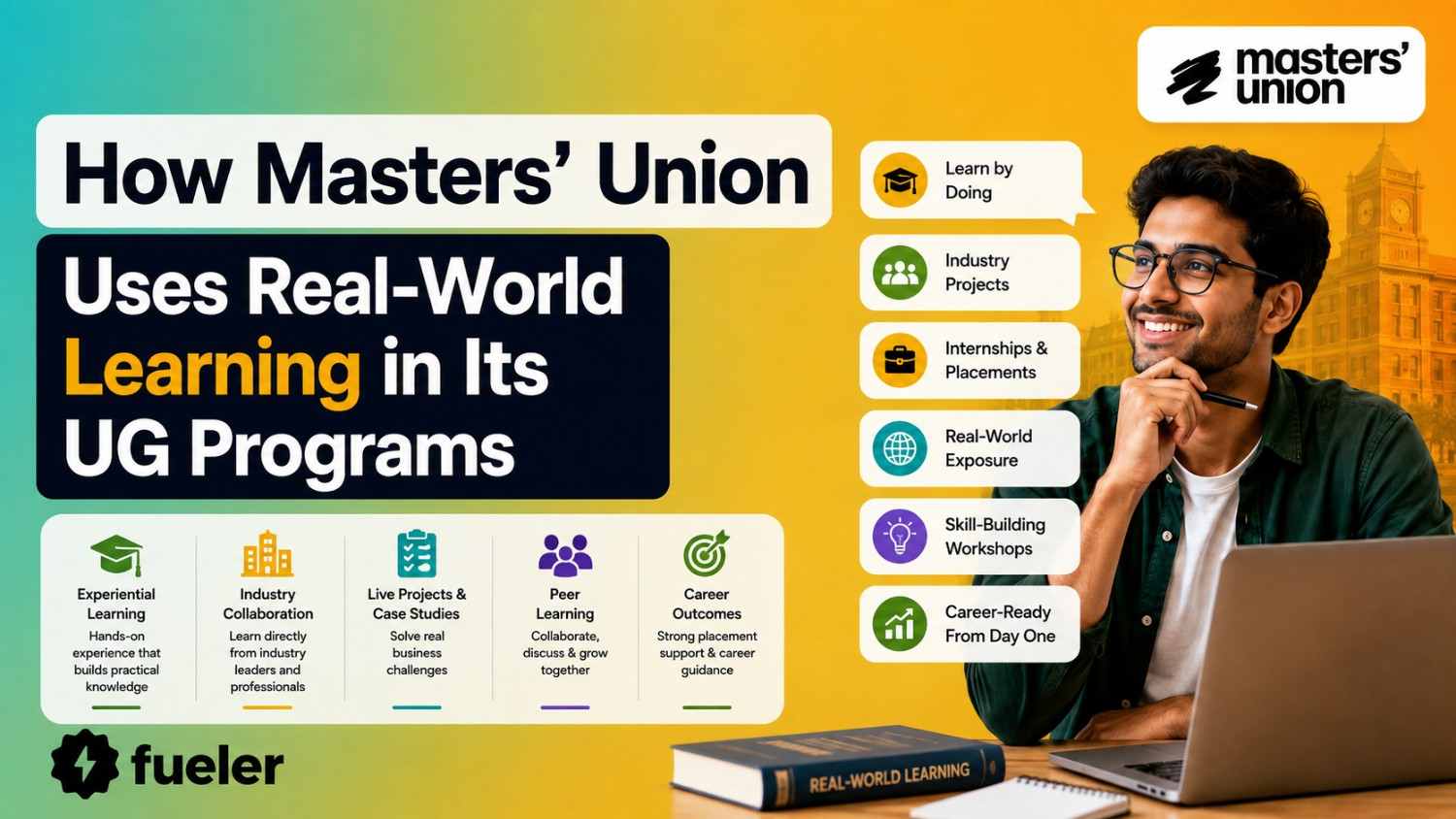
How Masters' Union Uses Real-World Learning in Its UG Programs

Riten Debnath
17 Aug, 2026
Last updated: August 2026
If you look closely at traditional higher education today, you will notice a massive, painful disconnect. Standard universities spend three to four years teaching theoretical concepts out of textbooks that were written a decade ago. Meanwhile, the fast-moving startup ecosystem demands immediate execution, adaptability, data-driven decisions, and practical problem-solving from day one.
I’m Riten, founder of Fueler, a skills-first portfolio platform building the career infrastructure for 100 million creative professionals. Fueler connects talented individuals with companies through assignments, portfolios, and projects, not just resumes or CVs. Think of it as Dribbble/Behance for work samples combined with AngelList for hiring infrastructure.
Working daily with recruiters, founders, and ambitious young talent has shown me one undeniable truth: companies no longer care about degrees on paper; they care about proof of work.
That is exactly why the undergraduate programs at Masters' Union caught my attention. Located in the tech and corporate hub of Gurgaon, Masters' Union is fundamentally flipping the traditional higher education framework. Instead of asking students to memorize business theories, they force students to run actual businesses, manage live ad budgets, build no-code products, and pitch to real venture capital firms.

Quick Answer Summary
- Who It Is For: High school graduates, ambitious young professionals, aspiring founders, and students seeking hands-on business and technology skills.
- Cost: Around ₹9.5 Lakhs to ₹10.5 Lakhs per year in tuition fees, bringing the total core tuition to roughly ₹38 Lakhs to ₹42 Lakhs over four years (excluding living expenses and hostel fees).
- Key Takeaway: Students build real startups, dropship real products, run live growth marketing campaigns, and graduate with a rich portfolio of work rather than just a mark sheet.
- Best Suited For: Action-oriented students who learn by doing, want early exposure to top business leaders, and plan to work in fast-growing tech startups, venture capital, or product management.
What is the Masters' Union Undergraduate Program?
The Masters' Union Undergraduate Program is an intensive four-year degree in Technology and Business Management (B.Com / BA / BMS pathway options depending on the chosen track) designed to function like a startup accelerator paired with a modern business school.
Traditional business degrees teach marketing through case studies written twenty years ago. In contrast, Masters' Union structures its curriculum around real-world execution. Students learn digital marketing by spending real money on live campaigns, learn e-commerce by launching dropshipping stores, and learn finance by investing real capital.
Why does this matter? The job market has shifted dramatically. When a fast-growing startup hires a Growth Marketer or a Founder’s Office Associate, they do not ask for high school grades or memorized definitions. They want to see what you have actually built, launched, managed, or scaled.
By replacing end-of-term written exams with term-end portfolio showcases, the program ensures every student leaves college with a live track record. This approach mirrors what we advocate for at Fueler: showing proof of work is infinitely more powerful than telling someone what you studied in a classroom.
Key Facts Table
Detailed Explanation
To truly understand how Masters' Union operates, you have to look at how they structure their curriculum around real-world learning. They break down the traditional four-year timeline into hands-on practical challenges that force students to interact with the real economy.
How Masters' Union Uses Real-World Learning in Its UG Programs
Masters' Union integrates real-world learning by replacing standard lectures with live business interventions called "drops" or "challenges." Instead of reading about supply chains, students build supply chains. Instead of reading about consumer psychology, they sell products to real consumers online.
Here is how that practical methodology translates into day-to-day education across the four years:
The E-Commerce and Dropshipping Challenge
In their very first year, students are split into small teams and given seed capital. Their objective is simple yet challenging: source a physical product, build a functional e-commerce store using modern no-code tools like Shopify, set up payment gateways, write ad copy, and run targeted performance marketing campaigns on Meta and Google.
What does this teach?
- What: The end-to-end mechanics of running an online consumer business.
- Why: Reading about customer acquisition cost (CAC) in a textbook is completely different from watching your own ad money burn without generating a single sale.
- How: Students learn search engine optimization, user interface design, ad tracking, logistics management, and customer support by running a live store for several weeks.
- Real-world implications: Students immediately understand unit economics, return on ad spend (ROAS), and profit margins before they even reach their second year of college.
The Creator Economy and Content Challenge
Modern business requires distribution. If you cannot build an audience or communicate effectively online, scaling a brand is nearly impossible. During this module, undergraduate students are required to launch a content platform, whether on YouTube, LinkedIn, Instagram, or podcasts and grow an active, organic audience from scratch.
What does this teach?
- What: Audience building, personal branding, storytelling, and content analytics.
- Why: Companies today actively hire individuals who understand organic growth marketing and channel distribution.
- How: Students script, edit, publish, and analyze content performance daily using modern creator tools and AI writing or video editing software.
- Real-world implications: Graduates build strong personal brands early on. Many host podcasts where they interview industry leaders, creating an incredible networking foundation long before they enter the job market.
The Venture Initiation Programme (Building Real Startups)
In the higher terms, real-world learning scales up from short experiments to launching actual companies. Students form founding teams, identify real consumer or business problems, conduct primary market research, build a Minimum Viable Product (MVP), and pitch to seed-stage venture capitalists and angel investors.
What does this teach?
- What: Modern startup creation, market discovery, product development, and fundraising mechanics.
- Why: You cannot learn how to build a company by writing hypothetical business plans that no user ever sees.
- How: Teams write real code or leverage no-code builders, run customer discovery interviews across tech hubs like Bangalore and Gurgaon, and present financial models to active investors.
- Real-world implications: Some student teams actually generate revenues or raise real pre-seed capital, giving them a head start as venture-backed founders before graduating.
Industry Internships and CXO Shadowing
Instead of waiting until the final semester to expose students to corporate life, Masters' Union embeds long internships and shadowing opportunities directly into the program structure. Students work inside fast-moving tech startups, venture capital funds, or established enterprise companies.
What does this teach?
- What: Corporate navigation, high-level business operations, strategy execution, and office dynamics.
- Why: Working alongside a founder or Chief of Staff gives insights into strategic decision-making that standard classroom environments can never recreate.
- How: Students assist executives with real board decks, financial analysis, product roadmaps, and cross-functional team coordination.
- Real-world implications: Students document these projects inside dynamic portfolios similar to the project showcases hosted on Fueler, giving future employers undeniable proof of their operational capabilities.
Through CXO Sessions and Masterclasses, seasoned business leaders and C-suite executives regularly interact with, teach, and mentor students. A prominent example is Rajat Mathur, former Managing Director at Morgan Stanley, who teaches leadership, decision-making, and people management. Other top practitioners, including founders, chief strategy officers, and corporate heads like Naveen Munjal (MD, Hero Electric) and Jishnu Changkakoti (Former Marketing Director, Johnson & Johnson), routinely lead classes and conduct sessions to teach real-world strategy.
How It Works
The entire academic journey follows a progressive step-by-step structure designed to transform high school graduates into execution-focused business operators.
- Foundational Bootcamp (Term 1): Students receive intensive training in business fundamentals, core communications, quantitative analysis, basic coding, and financial literacy.
- Micro-Business Challenges (Year 1): Teams launch short-term real-money initiatives, including dropshipping businesses and organic content platforms, to learn hands-on execution.
- Core Business and Tech Deep Dives (Year 2): Coursework shifts into advanced corporate finance, growth marketing, data science, product design, and no-code stack engineering.
- Out-of-Campus Immersions (Year 2 & 3): Students complete structured industry visits and residential trips to major startup ecosystems like Bangalore, Singapore, or Dubai to study global business models firsthand.
- Venture Incubation & Accelerator (Year 3): Teams spend dedicated time building and testing scalable technology startups with structured mentorship from active operators.
- Long-Term Industry Apprenticeships (Year 4): Students transition into extended internships, working directly with founders, product managers, or venture capital associates while completing specialized electives.
- Portfolio Graduation (Final Term): Graduation is not based on a static score alone. Students present a comprehensive portfolio of published work, live products, revenue figures, and campaign analytics to an industry panel.
Benefits
When you strip away traditional academic fluff and focus purely on practical execution, the professional benefits become clear very quickly.
- Work Experience Before Graduation: Students graduate with four years of documented projects, experiments, and internships rather than an empty resume.
- Direct Access to Industry Mentors: Classes are taught by active CEOs, CTOs, VCs, and product managers from companies like Flipkart, CRED, Meesho, and Urban Company.
- Network in Tech Capital: Being located in Gurgaon places students in the heart of India's corporate and startup density, making networking a daily activity rather than an annual event.
- Early Masterclass in Modern Tech Tools: Students master real tools used by modern businesses daily, including Google Analytics, SQL, no-code app builders, Figma, and performance marketing dashboards.
- Accelerated Career Trajectory: Real-world execution allows graduates to bypass entry-level clerical roles and move directly into high-leverage positions like Founder’s Office or Associate Product Manager.
Challenges and Limitations
While experiential education offers clear advantages, it is important to analyze the limitations so prospective students and parents can make a well-informed decision.
- High Financial Investment: The tuition and living costs in Gurgaon represent a significant financial commitment compared to traditional state or public universities.
- Not Suitable for Pure Academic Research: If a student wants to pursue theoretical economics, deep academic research, or a traditional PhD path, an experiential business program is the wrong choice.
- High Intensity and Stress: Running live businesses, managing actual capital loss, and presenting to tough industry leaders creates a high-pressure environment that requires extreme emotional resilience.
- Evolving Brand History: Unlike heritage institutions like IIMs or traditional central universities that have operated for decades, newer experiential models are actively building their long-term alumni networks.
Comparison Table
Fees and Costs
Understanding the complete financial picture is crucial for families researching undergraduate business options.
- Tuition Fees: The annual tuition fee ranges between ₹9.5 Lakhs to ₹10.5 Lakhs, bringing the total tuition cost over four years to approximately ₹38 Lakhs to ₹42 Lakhs (plus applicable taxes).
- Living and Accommodation Expenses: Since the campus is located in Gurgaon, student housing, food, transportation, and living expenses typically cost an additional ₹1.5 Lakhs to ₹2.5 Lakhs per year.
- Scholarships: Merit-based and need-based financial assistance is available for exceptional applicants, including young entrepreneurs, high achievers in sports, and low-income candidates.
- Return on Investment (ROI): While the upfront cost is substantial, the practical skill set positions graduates for high-growth roles in technology companies, venture capital, and modern consumer brands, significantly reducing the payback period compared to low-outcome traditional degrees.
Career Opportunities
Students who train in execution-heavy environments build skills that align directly with high-demand, modern job categories.
- Founder’s Office / Chief of Staff Associate: Working directly alongside startup founders to execute strategic priorities, manage cross-functional teams, and solve operational bottlenecks.
- Associate Product Manager (APM): Defining product features, conducting user research, collaborating with engineering teams, and managing user onboarding flows.
- Growth Marketing Manager: Designing performance ad campaigns, optimizing conversion funnels, running A/B tests, and scaling organic user acquisition.
- Venture Capital Analyst: Evaluating early-stage pitch decks, analyzing market sizes, performing due diligence on startups, and mapping industry trends.
- E-Commerce Operations Lead: Managing supply chains, inventory, online storefront performance, and digital customer acquisition strategies.
Who Should Choose This?
- Students who learn best by building real things rather than memorizing textbooks.
- Aspiring entrepreneurs who want to start a company during college with active mentorship.
- Action-oriented individuals who want to build a public portfolio on platforms like Fueler to stand out to top hiring managers.
- Students targeting high-growth careers in Product Management, Venture Capital, and Growth Marketing.
- Self-starters who thrive in fast-paced, competitive, and unstructured environments.
Who Should Avoid This?
- Students seeking a relaxed, conventional college experience with minimal daily pressure.
- Individuals focused purely on theoretical research, academic publishing, or pure science track careers.
- Anyone who prefers clear-cut syllabus boundaries and standard multiple-choice testing formats.
- Students who are uncomfortable with public speaking, group collaboration, and handling real business failures.
Final Thoughts
Education is undergoing a massive shift. The era of getting a degree simply by showing up to lectures and passing written exams is rapidly coming to an end. Tech companies, startups, and modern enterprises no longer ask, "What school did you go to?" Instead, they ask, "What have you actually built?"
At Fueler, we see this reality unfold every single day. The candidates who win high-paying, high-impact roles are those who can link to a digital portfolio filled with real-world projects, live ad campaigns, software builds, and documented case studies. Masters' Union has recognized this fundamental shift and built an undergraduate experience around it.
While the high intensity and tuition cost mean it is not the right fit for everyone, its relentless focus on real-world execution provides a powerful blueprint for what modern business education ought to look like. If you are an ambitious student who wants to stop reading about business and start actually doing it, this practical approach is worth serious consideration.
Key Takeaways
- Traditional college degrees often lack the execution-focused skills demanded by modern tech companies and fast-growing startups.
- Masters' Union structures its four-year undergraduate program entirely around live business projects, drops, and challenges.
- Students learn business by launching dropshipping stores, running content platforms, managing ad budgets, and pitching real startups to venture capitalists.
- The faculty consists primarily of active startup founders, CXOs, and industry practitioners rather than purely academic professors.
- Campus proximity to Gurgaon’s tech hub enables continuous networking, CXO shadowing, and long-term industry apprenticeships.
- Graduates leave college with a rich, functional portfolio of real-world accomplishments rather than just a mark sheet.

FAQs
What is the core learning model of the Masters' Union UG program?
The program uses experiential learning. Instead of theoretical lectures, students build live dropshipping businesses, run growth marketing campaigns, manage creator channels, build software products, and pitch real startups directly to active venture capital investors.
Where is the Masters' Union campus located?
The primary campus is located in Cyber Park, Gurgaon (Gurugram), Haryana. This placement exposes students directly to India's major tech companies, multinational corporations, and venture capital firms throughout their studies.
Do Masters' Union undergraduate students get a recognized degree?
Yes, students receive a recognized undergraduate degree through university partner arrangements alongside the Masters' Union Post-Graduate or UG Certification in Technology and Business Management upon successful completion.
How are students evaluated if there are no traditional exams?
Evaluation relies on real-world project outcomes, term-end portfolio showcases, peer evaluations, product performance metrics, live business revenues, and presentations evaluated by visiting industry leaders and faculty.
What career roles do graduates typically enter after finishing?
Graduates move directly into high-growth roles such as Associate Product Manager, Founder’s Office Lead, Growth Marketer, Venture Capital Analyst, E-Commerce Strategist, or choose to build their own venture-backed startups.
Why 100,000+ professionals use Fueler
Fueler helps professionals showcase proof of work through projects, assignments, case studies, and achievements.
- Thousands of professionals use Fueler to create their digital portfolio
- Thousands of projects are published on Fueler. Check here
- Startups and Companies hire through proof of work on Fueler
- Used by freelancers, creators, marketers, video editors, writers, designers, and product managers
Our mission is to help the next 100 million professionals build a verified professional identity through proof of work

What should you do next?
You've read the article. Now turn your skills into proof of work and unlock more opportunities.
Build your proof of work portfolio
Create a clean portfolio with projects, assignments, resumes, and AI stack details that companies actually want to see.
Create your Fueler portfolio →Apply through assignments, not resumes
Stand out by solving real tasks from companies hiring on Fueler.
Explore assignments →Get discovered by companies
Make your work public and let recruiters discover your skills through actual projects instead of keywords.
Get discovered →