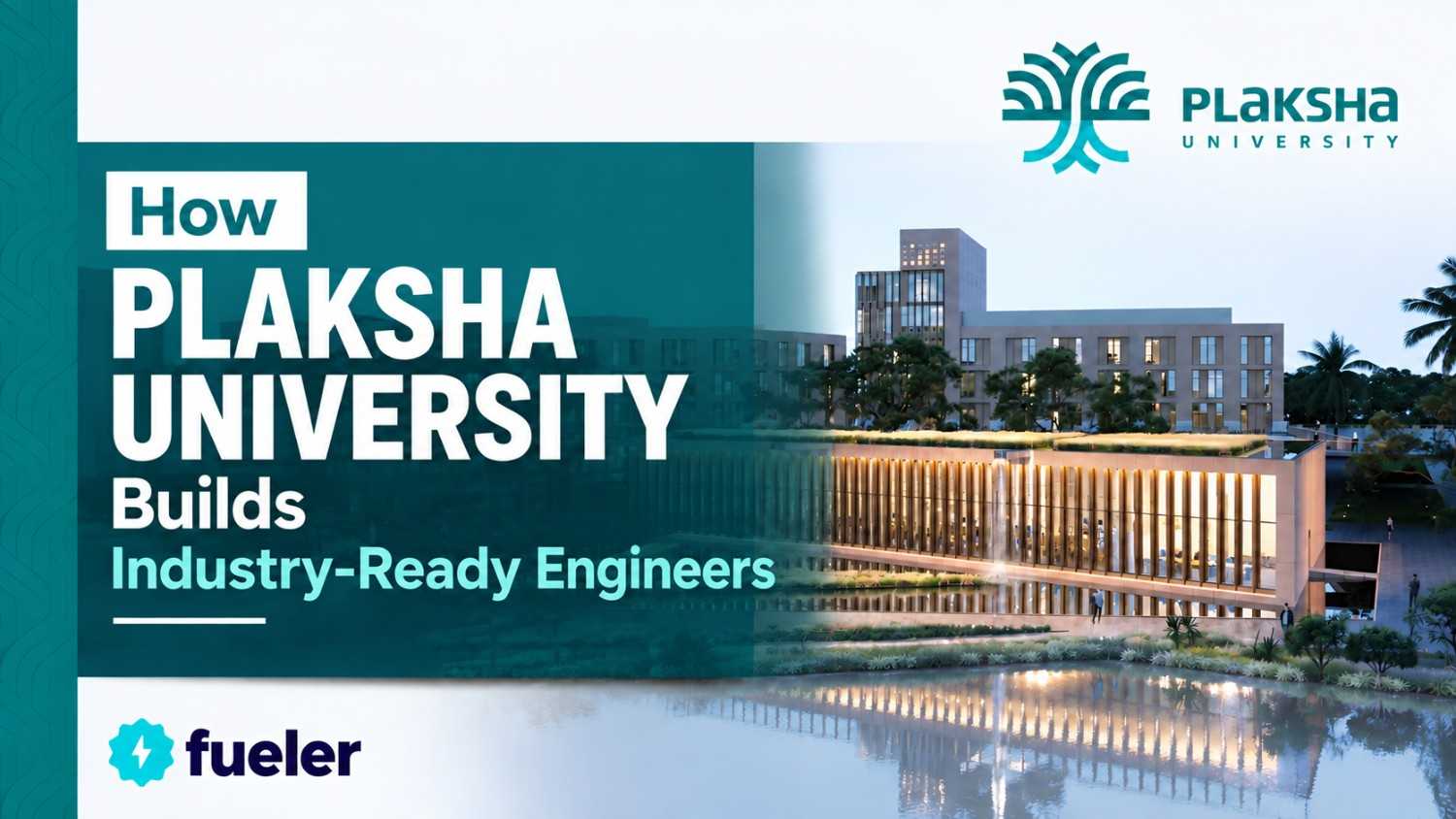
How Plaksha University Builds Industry-Ready Engineers

Riten Debnath
31 Aug, 2026
Last updated: August 2026
Most engineering colleges in India are trapped in a blueprint designed decades ago. Students spend four years memorizing theoretical syntax, writing out pre-assigned lab manuals, and cramming for written exams. Then, in their final semester, companies test them on actual software development, system design, and production engineering skills they were never taught in a classroom.
I’m Riten, founder of Fueler, a skills-first portfolio platform building the career infrastructure for 100 million creative professionals. Fueler connects talented individuals with companies through assignments, portfolios, and projects, not just resumes or CVs. Think of it as Dribbble/Behance for work samples combined with AngelList for hiring infrastructure.
In my work evaluating how early-stage talent transitions into high-impact product and engineering teams, one reality is clear: top technology companies and fast-growing startups no longer care about degree titles or test scores. They are hired for execution. When I began looking at how modern Indian universities are rebuilding technical education around live execution, how Plaksha University builds industry-ready engineers emerged as a clear blueprint.
Instead of treating industry exposure as a last-minute placement prep course, Plaksha weaves real-world problem-solving, product design, and hands-on lab execution into every year of its BTech programs. Here is an analytical breakdown of how the university systematically prepares engineering students for the modern technology landscape.

Quick Answer Summary
- What it is: A project-centric, interdisciplinary engineering education framework designed to replace legacy rote learning with real-world technical execution.
- Who it is for: BTech students seeking direct careers in software development, machine learning, robotics, biotechnology, product management, and technical consulting.
- Core Interdisciplinary Majors: BTech in Computer Science & Artificial Intelligence, Robotics & Autonomous Systems, Biological Systems Engineering, and Data Science, Economics & Business.
- Practical Training Mechanisms: Maker spaces, industry-backed labs (Dixon IoT Lab, ARK Foundation Robotics Lab), capstone projects, and direct corporate mentorship.
- Key Takeaway: Students graduate with production-ready software repositories, physical hardware prototypes, and verified proof of work instead of just an academic transcript.
- Best Suited For: Students who want to skip textbook-heavy memorization and build high-impact technical careers or launch tech ventures.
What Does "Industry-Ready" Mean at Plaksha University?
At standard technical universities, "industry readiness" usually translates to a few weeks of campus placement training, mock aptitude tests, and basic coding interview bootcamps. At Plaksha University, industry readiness is treated as a core architectural design choice of the four-year degree.
Instead of isolating engineering into rigid, legacy departments (like mechanical, civil, or electrical engineering), Plaksha structures its academic majors around future technology demands.
Undergraduates work across fields combining artificial intelligence with hardware sensors, or data science with economic decision-making. From day one, students are exposed to real tools used by modern engineering teams: git version control, full-stack software architectures, cloud computing platforms, advanced microcontrollers, and CAD modeling suites.
At Fueler, we see how companies evaluate early-stage engineering hires. Tech leads do not evaluate candidates based on their ability to write code on a whiteboard during an exam. They look at GitHub commits, live product deployments, system design choices, and real project documentation. Plaksha formats its entire curriculum around generating these exact project artifacts.
Key Facts Table
Detailed Explanation: The 4 Pillars of Plaksha's Industry Readiness
To understand how Plaksha University builds industry-ready engineers, you have to look at the structural mechanics of its academic and practical environment. The institution relies on four distinct operational pillars.
1. Interdisciplinary Majors Built for Modern Tech Roles
- What it is: Four core majors Computer Science & Artificial Intelligence, Robotics & Autonomous Systems, Biological Systems Engineering, and Data Science, Economics & Business that combine computing, physical hardware, and business strategy.
- Why it matters: Real-world software engineering rarely exists in a vacuum. A machine learning engineer working at a mobility startup needs to understand embedded hardware, map APIs, and consumer economics simultaneously.
- How students learn: Rather than spending two years on generic basic science lectures, students take integrated courses like Computational Thinking, Applied Machine Learning, and Connected Systems early in their degree.
- Industry impact: Students build a multi-skilled foundation that matches actual cross-functional team structures in high-growth companies.
2. Hands-On Maker Culture and Advanced Labs
- What it is: Open-access fabrication spaces and specialist research facilities, including the Dixon IoT Lab and the ARK Foundation Robotics Lab.
- Why it matters: Engineering cannot be mastered solely through lectures. Students need to build, break, and fix physical systems and software pipelines.
- How students learn: Undergraduates work with modern sensors, industrial microcontrollers, biological testing equipment, and autonomous drone setups. They move from software simulation to deploying hardware in real environments.
- Industry impact: Graduates enter engineering teams already knowing how to work with production hardware, edge devices, and complex software deployments.
3. Corporate Co-Designed Curricula and Mentor Access
- What it is: Plaksha's academic structure is developed in consultation with global technology leaders, enterprise executives, and prominent academic advisors from institutions like MIT and UC Berkeley.
- Why it matters: Traditional university curriculums take up to five years to update, rendering taught tools obsolete by the time students graduate. Plaksha adjusts its coursework continuously based on industry trends.
- How students learn: Corporate executives participate in guest lectures, project reviews, and mentorship sessions facilitated through the Office of Corporate Partnerships and Careers (CPC).
- Industry impact: Students learn industry-standard workflows, code optimization techniques, and business communication directly from active practitioners.
4. Year-Long Grand Challenge Capstones
- What it is: A comprehensive, year-long capstone project during the final year where students solve complex, real-world problems.
- Why it matters: Standard mini-projects lasting a few weeks usually result in generic clone apps or superficial research papers. A year-long capstone forces students to navigate complete engineering lifecycles.
- How students learn: Student teams partner with industry sponsors or research centers to build working solutions such as AI-driven water management dashboards, autonomous field robots, or quantitative financial algorithms.
- Industry impact: The final capstone serves as a public demonstration of skill, providing tangible proof of work that hiring managers can evaluate directly.
How It Works: The Four-Year Engineering Transformation
Plaksha structures the BTech experience to systematically shift students from learners into independent builders.
Year 1: Foundation and Systems Thinking
- Students learn foundational concepts in computer science, mathematical modeling, design principles, and data analysis.
- Early hands-on exposure in maker spaces introduces rapid prototyping tools, 3D printing, basic circuits, and modern software environments.
- Interdisciplinary projects encourage students to approach engineering challenges through a systems-level lens.
Year 2: Major Specialization and Applied Labs
- Students dive into their chosen major (CS & AI, Robotics, Biotech, or Data Science & Business).
- Practical coursework takes place inside specialized labs like the Dixon IoT Lab or biological systems facilities.
- Students begin building custom applications, training machine learning models, and assembling integrated hardware systems.
- Year 3: Industry Projects and Advanced Electives
- Students tackle complex technical challenges, optimization problems, and advanced systems design.
- Through hackathons, industry competitions, and research assignments, teams test their solutions against real-world constraints.
- Students begin assembling their personal portfolios of technical work, preparing for corporate internships and capstone drives.
Year 4: Capstone Execution, Industry Deployment, and Careers
- Final-year students execute their year-long Grand Challenge Capstone project.
- Teams present their finished products, software repositories, and research papers to corporate partners, venture funds, and hiring managers.
- Students transition directly into technical roles, R&D positions, graduate programs, or early-stage venture founding.
Benefits of a Practical Engineering Education
Choosing an execution-focused engineering program provides distinct structural advantages over traditional lecture-heavy degrees:
- Job-Ready Technical Skills: You learn modern tools, frameworks, and deployment workflows while in college, eliminating the long onboarding curve typical for fresh graduates.
- Tangible Proof of Work: Rather than listing completed courses on a resume, you leave college with documented software repositories, hardware builds, and analytical case studies. At Fueler, we see that applicants who share live project links and functional portfolios get reviewed significantly faster by engineering leaders.
- Strong Interdisciplinary Perspective: You gain the ability to collaborate across traditional boundaries such as writing AI algorithms for hardware systems or analyzing business metrics alongside software architecture.
- Direct Access to Recruiting Networks: Close ties with top corporate partners (including Amazon, BCG, McKinsey, Sarvam AI, and Flipkart) open direct hiring and internship channels.
- Adaptability to Evolving Tech Stack: Learning through problem-solving ensures you can pick up new programming languages, frameworks, and AI tools as industry standards evolve.
Challenges and Limitations
While a practical, project-heavy model is highly effective, it comes with real demands that candidates should evaluate carefully:
- High Academic and Project Workload: Managing continuous project deadlines, lab sessions, and code reviews requires rigorous time management.
- Comfort with Ambiguity: Unlike traditional colleges where homework problems have fixed, single-answer solutions, project-based engineering involves open-ended challenges where initial attempts often fail.
- Fewer Legacy Mass-Recruitment Drives: Plaksha focuses on high-impact technical, product, and consulting roles rather than mass IT service recruitment drives. Students seeking traditional mass-recruitment setups may find the expectations different.
- Requires Strong Personal Drive: World-class facilities and labs are available on campus, but student outcomes ultimately depend on how actively individuals utilize those resources.
Comparison Table: Engineering Training Models
Fees and Financial Considerations
Plaksha's infrastructure, specialized research labs, and faculty model are reflected in its fee structure.
- Tuition & Campus Costs: The overall annual fee (covering academic tuition, residential accommodation, and lab access) generally ranges between ₹7,00,000 and ₹9,36,000 per year, depending on the admission cycle and housing choices.
- Financial Aid & Need-Based Scholarships: To ensure financial constraints do not keep talented builders away, Plaksha provides need-based financial aid covering up to 100% of tuition for eligible students.
- Value & Return on Investment: ROI should be evaluated by career outcomes. Placement metrics show strong results, with graduates stepping into roles at firms like Amazon, BCG, Arcesium, McKinsey, Flipkart, and deep-tech startups.
Career Opportunities
Plaksha's interdisciplinary engineering majors prepare graduates for a wide range of technical and analytical roles:
- Software Development & AI Engineering: Building scalable software systems, machine learning models, and cloud infrastructure.
- Robotics & Embedded Systems Engineering: Designing autonomous hardware, mechatronic setups, and IoT networks.
- Associate Product Manager (APM): Bridging technical architecture, user experience, and business metrics.
- Data Scientist & Quantitative Analyst: Processing complex datasets, building predictive engines, and driving strategic decisions.
- Deep Tech Founder / Early Operator: Commercializing campus research or joining high-growth startups in founder's office roles.
Who Should Choose This?
- Students who learn best by building real software, hardware, and systems rather than memorizing lecture notes.
- Aspirants who want to master future-focused fields like AI, Robotics, Data Science, and Biotech.
- Builders who want to exit college with a public portfolio of verified proof of work.
- Candidates targeting high-impact engineering, product, or consulting roles at top technology companies.
- Self-driven individuals comfortable working in collaborative, cross-disciplinary team environments.
Who Should Avoid This?
- Students who prefer a traditional, lecture-based learning environment with clear, predictable written exams.
- Candidates seeking a low-stress academic experience without frequent project deadlines.
- Anyone looking strictly for traditional IT service mass-recruitment placements.
- Learners who struggle in open-ended, hands-on environments that require self-direction.
Final Thoughts
The gap between what traditional engineering colleges teach and what modern tech companies actually require has never been wider. Companies no longer have the time or incentive to train fresh graduates on basic software engineering workflows or systems thinking. They expect new hires to contribute from day one.
In evaluating how Plaksha University builds industry-ready engineers, the key difference is its structural alignment with real-world execution. By combining interdisciplinary majors, modern maker facilities, corporate mentorship, and year-long capstones, Plaksha ensures that learning happens through building.
Whether you aim to join a top technology firm, launch a deep-tech startup, or pursue graduate research, your success will depend on your ability to demonstrate real execution. Focus on building verified proof of work throughout your college years; that portfolio will open more doors than any written test score ever could.
Key Takeaways
- Plaksha replaces legacy departmental silos with interdisciplinary majors focused on AI, Robotics, Data Science, and Biotech.
- Practical learning is driven by open-access maker spaces and labs like the Dixon IoT Lab and ARK Foundation Robotics Lab.
- Curricula are co-designed and continuously updated in consultation with global academia and corporate leaders.
- Final-year students complete a year-long Grand Challenge Capstone project solving real industry problems.
- Undergraduates build tangible proof of work (code repositories, hardware MVPs, and analytical reports) throughout their degree.
- Need-based financial aid of up to 100% tuition coverage ensures access for qualified students regardless of background.
- Graduates are recruited by top tech firms, strategy consultancies, and high-growth deep tech startups.

FAQs
How does Plaksha University make engineering students industry-ready?
Plaksha integrates hands-on project building, interdisciplinary majors, industry-backed labs, corporate mentorship, and year-long capstones directly into the four-year BTech curriculum.
What BTech majors are offered at Plaksha University?
Plaksha offers four interdisciplinary BTech majors: Computer Science & Artificial Intelligence, Robotics & Autonomous Systems, Biological Systems Engineering, and Data Science, Economics & Business.
Do Plaksha engineering students work on real corporate projects?
Yes, students complete real-world projects and a year-long Grand Challenge Capstone sponsored by industry partners, building functional software and hardware solutions.
Which companies recruit engineering graduates from Plaksha University?
Top recruiters across tech, consulting, and analytics include Amazon, Boston Consulting Group (BCG), McKinsey, Flipkart, Sarvam AI, Arcesium, and fast-growing startups.
How does proof of work help Plaksha graduates during job placements?
Documented project repositories, working prototypes, and case studies demonstrate real execution capabilities to hiring managers, providing a major edge over traditional resume applicants.
What should you do next?
You've read the article. Now turn your skills into proof of work and unlock more opportunities.
Build your proof of work portfolio
Create a clean portfolio with projects, assignments, resumes, and AI stack details that companies actually want to see.
Create your Fueler portfolio →Apply through assignments, not resumes
Stand out by solving real tasks from companies hiring on Fueler.
Explore assignments →Get discovered by companies
Make your work public and let recruiters discover your skills through actual projects instead of keywords.
Get discovered →