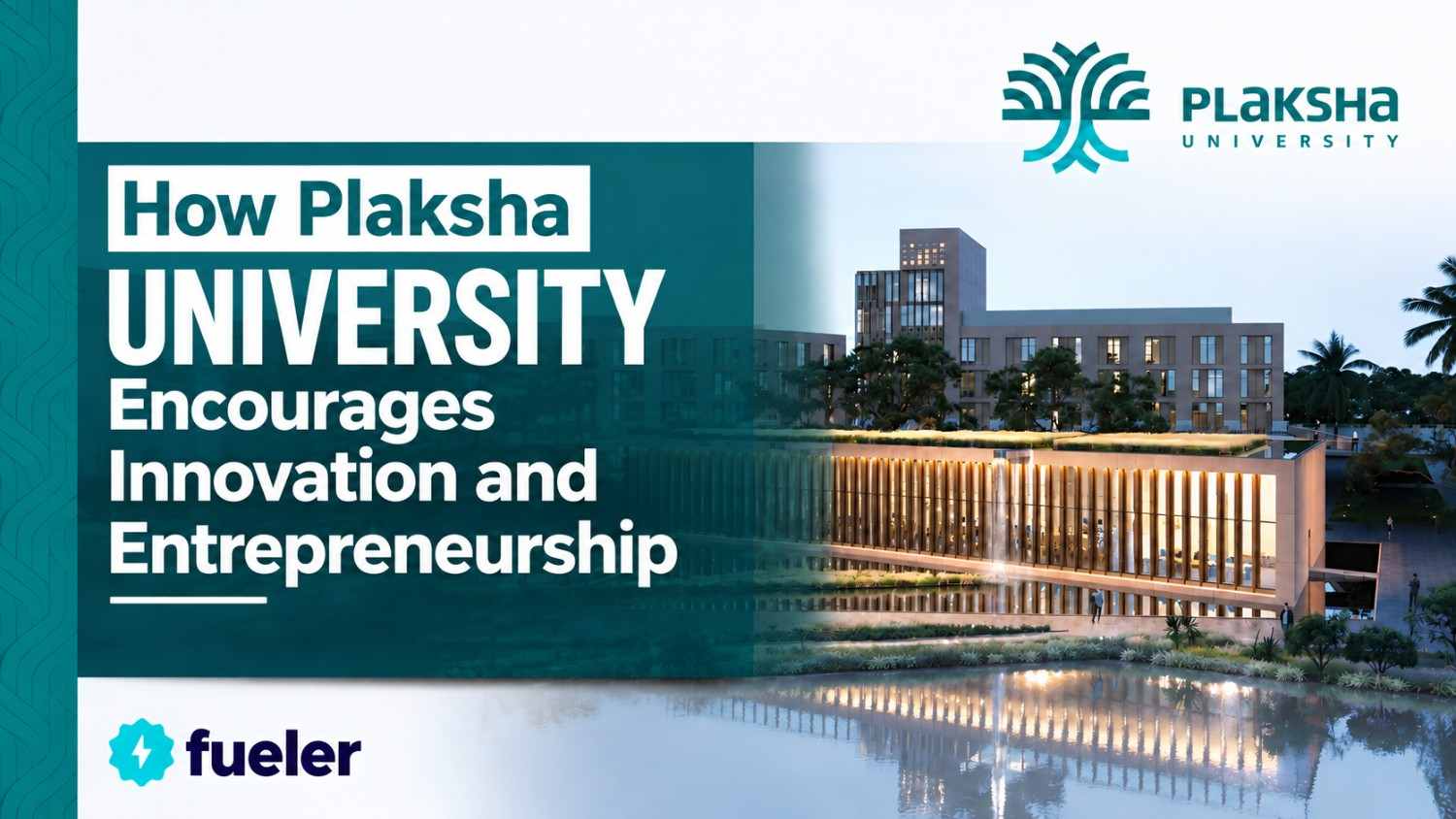
How Plaksha University Encourages Innovation and Entrepreneurship

Riten Debnath
31 Aug, 2026
Last updated: August 2026
Most higher education institutions claim to foster innovation, but their structural setup tells a different story. If you look closely at standard engineering colleges across India, entrepreneurship is relegated to an annual pitch competition, a guest lecture by an alumnus, or an optional elective taken in the final semester. The campus environment remains optimized for semester exams, theoretical assignments, and traditional corporate placement drives.
I’m Riten, founder of Fueler, a skills-first portfolio platform building the career infrastructure for 100 million creative professionals. Fueler connects talented individuals with companies through assignments, portfolios, and projects, not just resumes or CVs. Think of it as Dribbble/Behance for work samples combined with AngelList for hiring infrastructure.
In my day-to-day work tracking how early-stage talent transitions into high-growth startup ecosystems, one pattern stands out: founders do not build successful ventures because they scored high marks in written exams. They succeed because they have had early, hands-on practice in identifying market gaps, building working prototypes, validating unit economics, and executing under uncertainty.
When examining how new-age institutions are attempting to bridge this gap, how Plaksha University encourages innovation and entrepreneurship became a compelling case study. Plaksha has designed an environment where venture creation is not an extracurricular activity; it is integrated directly into the academic framework, supported by collective philanthropy, and backed by over 60 active startup founders and corporate executives.
Here is an analytical, experience-backed guide detailing how Plaksha systematically turns engineering students into builders and founders.

Quick Answer Summary
- What it is: An interdisciplinary entrepreneurial ecosystem that embeds venture creation, prototyping labs, and investor mentorship directly into four-year BTech and postgraduate programs.
- Who it is for: Undergraduates, fellows, and early-stage innovators looking to launch deep tech startups, commercialize research, or build high-impact products.
- Core Mechanisms: Info Edge Center for Entrepreneurship, Plaksha Incubation Centre, Minor in Tech Entrepreneurship, and the Grand Challenge Capstone.
- Founder Ecosystem: Direct access to over 60 global founders, venture capitalists, and CXOs (including leaders from Info Edge, Innov8, Zomato, and Genpact) who serve as donors, board members, and active mentors.
- Key Takeaway: You do not have to wait until graduation to build a venture; Plaksha provides micro-grants, legal assistance, and incubation support while you complete your degree.
- Best Suited For: Students who want to build proof of work through live commercial products, seed-funded startups, or early-stage venture teams.
What is Plaksha University's Entrepreneurial Framework?
Understanding how Plaksha University encourages innovation and entrepreneurship requires looking past standard campus incubator marketing. The university does not treat entrepreneurship as a side desk inside a business school. Instead, it uses a technical, challenge-led framework where engineering, data science, and business strategy overlap.
In traditional setups, a student with a startup idea often faces a structural choice: focus on maintaining their CGPA or skip classes to build their product. Plaksha eliminates this tension by aligning academic credits with venture creation.
Through programs like the Minor in Tech Entrepreneurship, students study Product-Market Fit, Design Thinking, Entrepreneurial Finance, and Cap Table Management as part of their official course load. They earn credits for conducting real customer interviews, testing minimum viable products (MVPs), and modeling customer acquisition costs (CAC) against lifetime value (LTV).
This structural integration is critical for early talent. At Fueler, we see that founders hire and invest based on verified proof of work. When a student can showcase a live product, a validated business model, or open-source software built during their undergraduate years, their credibility transforms completely.
Key Facts Table
Detailed Explanation: How Innovation is Built Into the Campus Fabric
To evaluate how Plaksha University encourages innovation and entrepreneurship, you must look closely at its structural components. The university operates a multi-layered support system designed to move students from raw ideas to scalable ventures.
1. The Info Edge Center for Entrepreneurship
- What it is: The central hub on campus dedicated to fostering an entrepreneurial mindset, funding early-stage student ideas, and driving startup activity.
- Why it matters: Most university cells are run by academic administrators who have never built a company. The Info Edge Center operates with direct input from industry leaders who understand market realities.
- How students use it: Students access micro-grants for hardware components, cloud hosting, and prototyping materials. They also attend structured founder clinics, pitch sessions, and product validation sprints.
- Real-world implications: Student teams test their hypotheses with real users early on, reducing the risk of building products nobody wants.
2. Plaksha Incubation Centre
- What it is: A dedicated, non-profit incubation entity designed to help student and faculty teams formalize their startups.
- Why it matters: Transitioning from a project to an incorporated company requires legal compliance, cap table structuring, trademarking, and IP protection.
- How students use it: Selected student ventures receive formal incubation status, co-working space, legal assistance, and access to angel investor networks.
- Real-world implications: Undergraduates graduate not just with a degree, but as legal founders of registered business entities with structured equity.
3. Collective Philanthropy & Founder Mentorship
- What it is: Plaksha was built by a collective of over 60 tech entrepreneurs, VCs, and corporate leaders, including leaders from Info Edge, Genpact, Innov8, Zomato, and BCG.
- Why it matters: Startup founders need access to networks. Having institutional trustees who are active angel investors and operators gives students direct feedback loops.
- How students use it: Through office hours, advisory sessions, and capstone reviews, students present their proof of work directly to leaders who fund and scale companies.
- Real-world implications: The traditional distance between a college student and an active venture capitalist is removed.
4. Specialized Prototyping Facilities
- What it is: Facilities like the Dixon IoT Lab, ARK Foundation Robotics Lab, and Molbio IVD Lab give hardware and deep tech founders space to build physical MVPs.
- Why it matters: Software startups are easy to prototype on a laptop, but deep tech, IoT, and biotech ventures require expensive equipment.
- How students use it: Undergraduates use these labs to build autonomous surface craft, custom optical sensors, microclimate monitoring devices, and diagnostic kits.
- Real-world implications: Students create defendable physical intellectual property instead of relying solely on wrapper applications.
How It Works: The Venture Creation Process for Students
Plaksha structures the journey from a student's first year to graduation as a step-by-step pipeline.
Phase 1: Problem Discovery & Systems Thinking (Year 1)
- Students learn foundational engineering, programming, and data analysis skills across interdisciplinary courses.
- Faculty present open-ended industry and societal challenges in clean energy, health, water, and automation.
- Students form cross-disciplinary teams to explore user needs and technical feasibility.
Phase 2: Prototyping & Entrepreneurial Coursework (Year 2)
- Students enroll in courses under the Minor in Tech Entrepreneurship, such as Design Thinking and Business Innovation.
- Teams use maker spaces and specialist labs to build basic hardware or software prototypes.
- Students submit proposals to the Info Edge Center for micro-grant funding to test their concepts.
Phase 3: Market Validation & Venture Testing (Year 3)
- Teams complete modules in Product-Market Fit and Entrepreneurial Finance, dissecting unit economics, CAC, and LTV.
- Students run real pilot tests, collect user feedback, and refine their MVPs.
- Mentors from the founding group and startup ecosystem critique customer acquisition strategies and pitch decks.
Phase 4: Capstone, Incubation, & Seed Pitching (Year 4)
- Student teams dedicate their Grand Challenge Capstone project to refining their venture full-time.
- High-potential teams enter the Plaksha Incubation Centre for legal incorporation, IP filing, and cap table setup.
- Graduating teams pitch to angel investors, venture funds, and institutional accelerators during campus demo sessions.
Benefits of Building a Startup While Studying
Setting up a business inside an institution like Plaksha offers advantages over trying to launch a venture independently:
- Risk-Free Prototyping Environment: You get access to advanced lab infrastructure, testing equipment, and high-performance computing without spending your own capital.
- Academic Credit for Venture Work: Rather than working on your startup secretly after hours, your product development, market validation, and user research count toward your degree requirements.
- Direct Proof of Work: Even if your student venture pivots or fails, you leave college with a public portfolio of real products, codebases, and customer research. At Fueler, we see that early-stage tech companies hire candidates who demonstrate this exact hands-on execution capability over those with standard academic resumes.
- Early Capital & Institutional Support: Micro-grants, prototyping funds, and travel grants remove initial financial bottlenecks for young founders.
- High-Trust Founder Networks: Being backed by an ecosystem of 60+ founders opens doors to early customer introductions, pilot partnerships, and investor meetings that solo college founders rarely get.
Challenges and Limitations
Entrepreneurship inside a university is not a guaranteed shortcut to success. Students must navigate distinct hurdles:
- High Pressure and Time Management: Balancing rigorous BTech coursework in computer science, robotics, or data science alongside building an early-stage company requires extreme discipline.
- Deep Tech Reality: Building hardware, robotics, or healthcare ventures takes longer than launching a simple mobile application. Regulatory approvals, supply chain delays, and testing cycles can frustrate young founders.
- Venture Failure Risk: Most student ventures will not reach venture-scale outcomes. If you evaluate your college success solely by whether your startup gets funded, you risk burnout.
- Self-Driven Requirement: The incubation center, grants, and mentors exist on campus, but no one will force you to use them. Students who lack internal drive often default back to passive classroom attendance.
Comparison Table: Entrepreneurial Support Models
Fees and Financial Considerations
Building a venture at Plaksha occurs within the standard undergraduate degree framework.
- Academic Cost: Annual tuition and residential fees generally range between ₹7,00,000 and ₹9,36,000 per year, depending on the academic year and category.
- Financial Aid Security: Plaksha provides need-based financial aid covering up to 100% of tuition fees for families with annual incomes below ₹50 Lakhs. This ensures students from diverse financial backgrounds can access prototyping facilities and startup support without financial stress.
- Micro-Grants & Seed Support: The Info Edge Center for Entrepreneurship provides equity-free micro-grants for early-stage customer discovery, software tools, and hardware materials, allowing teams to test ideas before raising outside capital.
- ROI Evaluation: ROI should be measured by personal growth and portfolio strength. Students graduate either as funded startup founders or as highly capable technical operators who command strong compensation in the hiring market.
Career Opportunities
Students who go through an interdisciplinary, entrepreneurial engineering program build skills that lead to diverse career paths:
- Startup Founder / Co-founder: Launching a deep tech, software, or hardware venture straight out of the Plaksha Incubation Centre.
- Founder's Office & Chief of Staff: Early-stage unicorns and high-growth startups actively seek graduates who understand both technical architecture and business operations.
- Product Manager (APM Roles): Courses in Product-Market Fit, Design Thinking, and User Research prepare graduates directly for entry-level product roles in tech companies.
- Venture Capital Analyst: Understanding business innovation, cap tables, and tech evaluation makes graduates strong candidates for early-stage VC analyst positions.
- R&D and Innovation Engineer: Corporate R&D labs seek engineers who know how to take a concept from rapid prototyping to functional deployment.
Who Should Choose This?
- Students who want to build real products, software repositories, and businesses while earning an engineering degree.
- Aspiring entrepreneurs who want direct access to active startup founders, VCs, and micro-grant funding.
- Independent learners who thrive in open-ended, problem-solving environments rather than standard lecture halls.
- Candidates interested in deep tech, hardware, IoT, and biotech ventures that require advanced lab setups.
- Students looking to create verified proof of work that makes them stand out to high-growth tech companies.
Who Should Avoid This?
- Students who prefer a traditional, passive academic route focused strictly on textbook exams and CGPA.
- Candidates seeking a low-stress environment without technical ambiguity or project deadlines.
- Anyone looking solely for mass-recruitment campus hiring into entry-level software maintenance roles.
- Students who lack the self-motivation to seek out faculty mentors, maker labs, and incubation resources.
Final Thoughts
Entrepreneurship cannot be taught purely through lectures and slides. You do not learn how to handle customer rejections, manage product roadmaps, or balance a cap table by reading a textbook. You learn by building real things in the open.
When examining how Plaksha University encourages innovation and entrepreneurship, the key difference lies in its institutional structure. By combining collective founder philanthropy, specialized lab spaces, academic credit for venture creation, and dedicated incubation, Plaksha gives students the space to execute early.
Whether your student project turns into a seed-funded startup or serves as the foundation of your professional career, the outcome is the same: you exit with real proof of work. In today’s fast-moving technology ecosystem, that proof of work is the most valuable asset you can build.
Key Takeaways
- Plaksha University embeds startup creation into its engineering curriculum through academic minors, labs, and capstones.
- The Info Edge Center for Entrepreneurship provides mentorship, micro-grants, and validation programs.
- Plaksha Incubation Centre operates as a dedicated non-profit entity to help student teams register companies and manage IP.
- Students get direct mentorship from an ecosystem of 60+ global founders, corporate leaders, and VC trustees.
- Specialized labs (Robotics, IoT, Biotech, Clean Energy) allow students to build complex hardware and deep tech MVPs.
- Need-based financial aid (covering up to 100% of tuition) ensures background does not limit entrepreneurial access.
- The focus on real projects allows every student to graduate with verified proof of work.

FAQs
How does Plaksha University help undergraduate students start a company?
Plaksha supports student founders through the Info Edge Center for Entrepreneurship, offering micro-grants, prototyping labs, founder mentorship, and formal incorporation support via the Plaksha Incubation Centre.
Can I earn academic credit for working on my startup at Plaksha?
Yes, through the Minor in Tech Entrepreneurship and the year-long Grand Challenge Capstone, students earn official BTech credits for product design, market validation, and venture building.
Who mentors student entrepreneurs at Plaksha University?
Students receive direct guidance from Plaksha’s founding group of 60+ tech leaders, startup CEOs, VC investors, and global faculty members.
Does Plaksha provide funding for early-stage student ideas?
Yes, student teams can access non-dilutive micro-grants for initial prototyping and customer validation, along with connections to angel networks and pre-seed investors.
What happens if my student startup fails while at university?
Even if a venture fails, the execution process builds verified proof of work, including working code, hardware prototypes, and market data, that makes graduates highly attractive to top tech employers.
Why 100,000+ professionals use Fueler
Fueler helps professionals showcase proof of work through projects, assignments, case studies, and achievements.
- Thousands of professionals use Fueler to create their digital portfolio
- Thousands of projects are published on Fueler. Check here
- Startups and Companies hire through proof of work on Fueler
- Used by freelancers, creators, marketers, video editors, writers, designers, and product managers
Our mission is to help the next 100 million professionals build a verified professional identity through proof of work

What should you do next?
You've read the article. Now turn your skills into proof of work and unlock more opportunities.
Build your proof of work portfolio
Create a clean portfolio with projects, assignments, resumes, and AI stack details that companies actually want to see.
Create your Fueler portfolio →Apply through assignments, not resumes
Stand out by solving real tasks from companies hiring on Fueler.
Explore assignments →Get discovered by companies
Make your work public and let recruiters discover your skills through actual projects instead of keywords.
Get discovered →