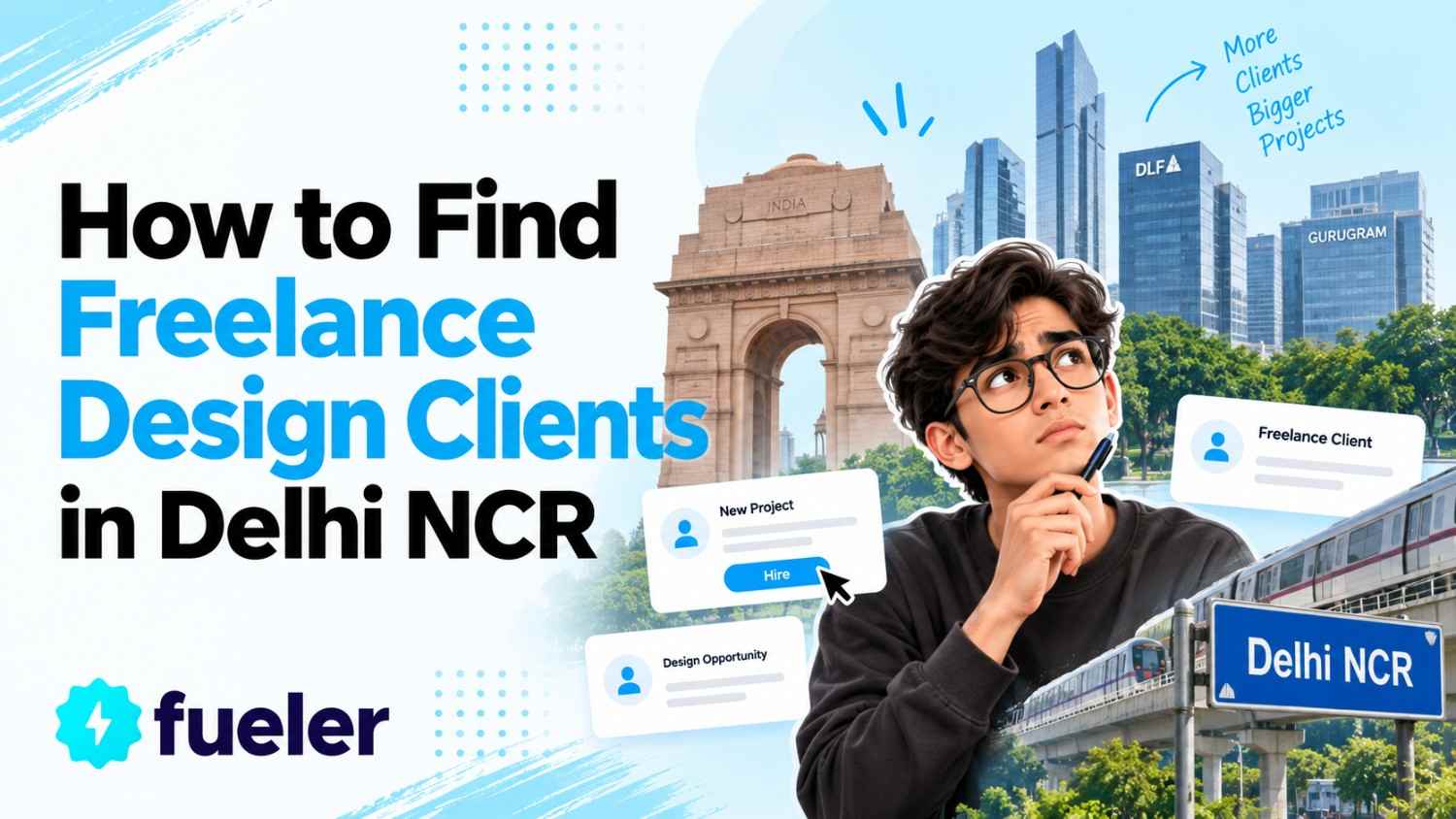
How to Find Freelance Design Clients in Delhi NCR in 2026
Riten Debnath
11 Sep, 2026
Delhi NCR is one of India's biggest markets for freelance designers. Delhi, Gurgaon, Noida, Ghaziabad, and Faridabad have startups, SaaS companies, D2C brands, agencies, manufacturing businesses, real estate companies, media businesses, ecommerce brands, and established companies that regularly need design support.
The opportunity is also much broader than traditional graphic design. A freelance designer in Delhi NCR can work on branding, graphic design, UI/UX, product design, presentations, packaging, advertising creatives, websites, social media design, and other visual communication projects. The challenge is finding businesses that actually need these services and showing them proof that you can solve their design problems.
I’m Riten, founder of Fueler, a skills-first portfolio platform building the career infrastructure for 100 million creative professionals. Fueler connects talented individuals with companies through assignments, portfolios, and projects, not just resumes or CVs. Think of it as Dribbble/Behance for work samples combined with AngelList for hiring infrastructure.
Before you start outreach, build a portfolio that clearly shows what you can do. You can learn more about building a proof-of-work portfolio and how designers can build proof of work.
In this guide, I will explain how to find freelance design clients in Delhi NCR in 2026, which businesses to target, how Delhi differs from Gurgaon and Noida, how to approach agencies and startups, how to build a portfolio, how to price your services, and how to turn your first client into repeat business.
Why Delhi NCR Is a Strong Market for Freelance Designers
Delhi NCR should not be treated as one single market. Each part of the region has a slightly different business ecosystem.
Gurgaon has a strong presence of startups, SaaS companies, fintech businesses, ecommerce brands, consulting companies, and large technology organisations. Noida has a large technology, IT services, media, digital business, and startup ecosystem. Delhi has a wider mix of D2C brands, professional services, media companies, startups, agencies, creators, and established businesses. Ghaziabad and Faridabad also offer opportunities among manufacturers, local businesses, suppliers, and service companies.
This gives designers several client segments to explore. A startup may need a brand identity and pitch deck. A SaaS company may need product design. A D2C brand may need packaging and advertising creatives. A manufacturing company may need catalogues and product presentations. An agency may need additional design capacity for its client projects.
The key is to identify the business problem first and then position your design service as the solution.
1. Choose Your Design Specialisation
One of the first things I would do as a freelance designer is avoid saying, "I do every type of design."
You can have multiple skills, but your positioning should still be clear. A client should understand within a few seconds what type of work they can hire you for.
You could position yourself around graphic design, UI/UX, product design, branding, presentation design, D2C design, packaging, social media creatives, or advertising design.
You can still accept other projects. Your specialisation simply gives your portfolio and outreach a clear direction.
Why It Matters
Specialisation makes it easier for the right client to understand your value. Instead of competing with every designer in Delhi NCR, you can become known for solving a specific type of design problem.
2. Understand the Delhi NCR Design Market
Your prospecting becomes stronger when you understand what each part of Delhi NCR offers.
Gurgaon is useful for designers targeting SaaS, fintech, startups, ecommerce, consulting, and technology businesses. Noida has opportunities across IT, technology, media, digital businesses, startups, and B2B companies. Delhi has a broad mix of consumer brands, agencies, professional services, D2C businesses, media, creators, and established companies.
Ghaziabad and Faridabad can be useful if your services are relevant to manufacturers, industrial businesses, suppliers, local brands, and service companies.
Why It Matters
You can make your outreach more specific when you know what type of business is common in the area you are targeting.
3. Target Delhi NCR Startups
Startups are one of the strongest segments for freelance designers because their design requirements can change quickly.
An early-stage startup may need a logo, brand identity, pitch deck, website, social media templates, and launch creatives. As it grows, it may need product design, landing pages, advertising creatives, investor presentations, and new campaign assets.
Instead of searching only for startups posting freelance design jobs, look for startups that have recently launched a product, raised funding, entered a new market, changed their positioning, or started hiring.
These events often create new design requirements.
Fueler's current Delhi NCR content also highlights startups, SaaS, fintech, ecommerce, and technology businesses as important markets for freelance designers.
Why It Matters
You can often find opportunities before a company formally posts a freelance requirement by identifying business events that naturally create design work.
4. Find SaaS and Technology Companies in Gurgaon and Noida
SaaS and technology companies can be particularly useful for UI/UX and product designers.
These businesses may need dashboard improvements, onboarding flows, landing pages, product interfaces, design systems, website redesigns, or new product features.
If your strength is product or UI/UX design, build portfolio projects that demonstrate how you solve user problems instead of showing only attractive screens.
For example, show the original problem, user flow, wireframes, design decisions, final interface, and prototype.
Why It Matters
Product companies care about usability and business outcomes, not just visual appearance.
5. Work With D2C and Ecommerce Brands
D2C brands need design across almost every part of their marketing.
A growing brand may need packaging, product graphics, social media creatives, website banners, email graphics, advertisements, marketplace creatives, campaign designs, and launch assets.
Instead of approaching these brands with "I am a freelance designer," identify one specific opportunity.
You could point out inconsistent advertising creatives, outdated packaging, weak product visuals, or a lack of consistency across social media.
Then show a relevant portfolio project.
Why It Matters
D2C businesses can become recurring clients because they continuously launch products and campaigns.
6. Approach Agencies for Freelance Design Work
Agencies can become an important source of freelance design projects.
A creative agency may need additional graphic design support. A marketing agency may need campaign creatives. A branding agency may need help with identity systems. A digital agency may need UI/UX support.
Delhi NCR has agencies working across branding, advertising, digital marketing, design, content, video, and social media.
When approaching an agency, do not send every project you have ever created.
Show the type of work that matches their clients.
If the agency works with D2C brands, show advertising, packaging, and social media work. If it works with SaaS businesses, show UI/UX and product projects.
Why It Matters
A strong agency relationship can give you access to several client projects instead of requiring you to find every end client yourself.
7. Target Manufacturing and Industrial Businesses
Manufacturing businesses are often overlooked by designers because their marketing may not look as visually exciting as a startup or D2C brand.
But they still need design.
Manufacturers can need product catalogues, brochures, presentations, packaging, trade-show material, product sheets, website graphics, social media content, and sales presentations.
If you target this segment, focus your portfolio on clarity, information hierarchy, product communication, and professional visual systems.
Why It Matters
Manufacturing businesses can offer a less crowded market for designers who understand how to communicate technical or product-heavy information.
8. Build a Portfolio Before You Start Outreach
You do not need twenty clients before you can create a strong freelance design portfolio.
If you are starting out, create three to five projects around the type of work you want to sell.
For example, create:
- A startup brand identity
- A D2C product campaign
- A SaaS dashboard redesign
- A manufacturing product catalogue
- A pitch deck for a fictional startup
The projects can be self-initiated as long as you clearly label them as concepts.
For each project, explain the problem, your role, your approach, the design decisions, and the final output.
A portfolio should show how you think, not just what your final designs look like.
Why It Matters
Clients want evidence that you can solve problems, not simply evidence that you know Photoshop, Illustrator, Canva, or Figma.
9. Build Proof of Work Instead of Only Listing Skills
A resume can say that you know Figma.
A portfolio can show what you actually built in Figma.
That difference matters.
Fueler's approach is built around showing actual projects and proof of work rather than relying only on resumes. A current Fueler example specifically highlights Chandan Das's graphic design portfolio, where recruiters can inspect illustrations, branding work, and the design process.
Your portfolio should answer three simple questions:
What was the problem?
What did you do?
What was the outcome?
If you have genuine results, include them. If you do not have results, do not invent them.
Why It Matters
Proof of work makes it easier for a client or recruiter to judge your actual ability.
10. Use LinkedIn to Find Decision-Makers
LinkedIn can help you identify the people who actually make design outsourcing decisions.
Search for:
- Founders
- Marketing managers
- Brand managers
- Creative directors
- Agency founders
- Growth marketers
- Product managers
- Design leads
- Ecommerce heads
- Social media managers
Do not send the same message to everyone.
First understand the company. Look at its product, website, social media, advertising, and current visual identity.
Then identify one design problem you could help solve.
Why It Matters
Personalised outreach gives the prospect a reason to respond instead of making you look like another freelancer sending a generic sales message.
11. Use Instagram to Find D2C and Consumer Brands
Instagram is especially useful for finding businesses that depend heavily on visual communication.
Search for Delhi and NCR-based D2C brands, restaurants, fashion brands, beauty businesses, jewellery brands, creators, fitness companies, interior brands, and other consumer businesses.
Look at how consistently they use their visual identity.
If the brand has strong products but inconsistent creatives, you may have an opportunity.
You can approach them with one or two specific observations rather than simply saying that you are available for freelance work.
Why It Matters
You can often discover design problems before the business itself starts looking for a designer.
12. Create Self-Initiated Projects Around Delhi NCR Businesses
If you want Delhi NCR clients, make your portfolio relevant to Delhi NCR business problems.
For example, create a fictional Gurgaon SaaS brand identity, a Noida technology company's website redesign, a Delhi D2C packaging system, or a Faridabad manufacturing catalogue.
These projects do not need to be real client projects.
The purpose is to demonstrate how you would solve the type of problem that your target client has.
Why It Matters
Relevant self-initiated work helps potential clients understand what you could do for their business.
13. Offer a Small Design Audit
A design audit can be a good way to start a conversation.
For a D2C brand, you could identify inconsistencies in its advertising creatives. For a startup, you could identify problems in its pitch deck. For a SaaS company, you could point out usability problems in a product flow. For a manufacturing company, you could explain how its catalogue could become easier to navigate.
Keep the audit short.
You are demonstrating your thinking, not giving away an entire project for free.
Why It Matters
A useful observation gives the prospect a concrete reason to talk to you.
14. Start With a Small Paid Assignment
A client may like your portfolio but still be uncertain about hiring you for a large project.
A small paid assignment can reduce that risk.
You could offer to design one campaign creative, one landing page, a few social media assets, a presentation redesign, or a small product flow.
Define the scope, deliverables, timeline, revisions, and payment before starting.
Why It Matters
A small paid project gives both sides an opportunity to evaluate how well they work together.
15. Create Clear Freelance Design Packages
Instead of creating a completely different offer for every prospect, create a few clear packages.
For example, you could create a startup brand package, D2C creative package, SaaS UI package, pitch deck package, or monthly design retainer.
Why It Matters
Packages make your services easier to understand and make it simpler for clients to decide what they actually need.
16. How Much Should a Freelance Designer Charge in Delhi NCR?
There is no single freelance designer rate for Delhi NCR.
Your pricing depends on your design specialisation, experience, project complexity, number of deliverables, revisions, deadline, client type, and whether you are providing strategy as well as execution.
You can use different pricing models depending on the project.
Always clarify the number of deliverables, revisions, timeline, formats, source files, and scope before giving a final quote.
Why It Matters
Good pricing starts with clear scope. Many freelance problems happen because the designer and client have different expectations about what the project includes.
17. Build Relationships With Other Freelancers
You do not have to find every client alone.
Build relationships with copywriters, marketers, developers, photographers, video editors, social media managers, and consultants.
A developer may know a startup that needs UI/UX design. A copywriter may have a website project that needs a designer. A marketing consultant may work with a D2C brand that needs advertising creatives.
You can also collaborate with agencies that need additional creative capacity.
Why It Matters
A strong professional network can become a consistent source of qualified referrals.
18. What Recruiters Can Explore on Fueler
Recruiters looking for a freelance designer in Delhi NCR should not restrict their search to one design discipline.
A startup may need UI/UX. A D2C brand may need graphic design. A SaaS company may need product design. A manufacturing business may need visual communication. An agency may need someone who can work across several creative formats.
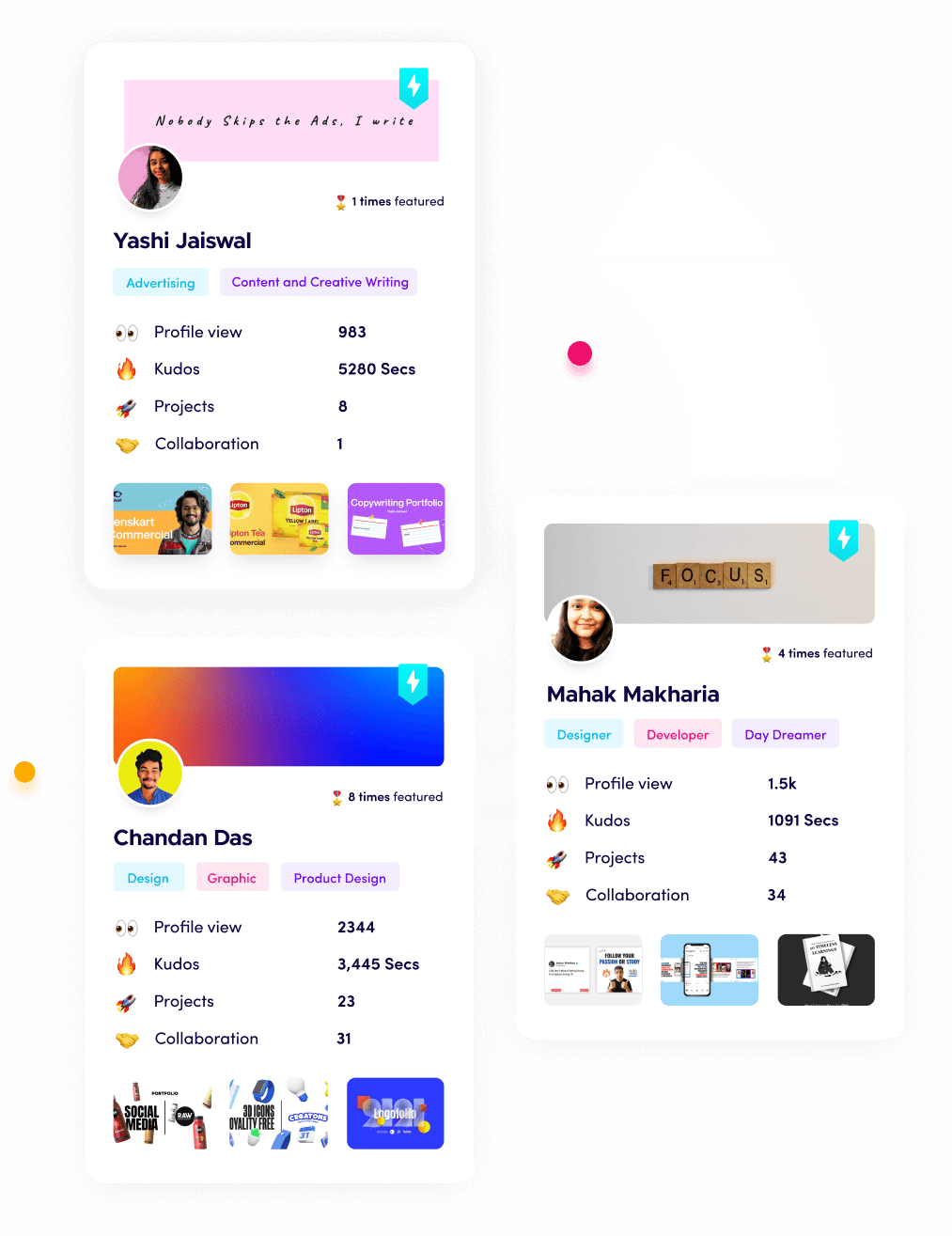
The following profiles are selected from the design profile pool for this article. The profile descriptions are based on the visible design category or work available on Fueler. They should be treated as portfolio examples, not claims about current availability or location.
Fueler itself is built around public proof of work, allowing recruiters to evaluate actual projects rather than relying only on resume keywords.
Why It Matters
For design hiring, the work is often the strongest signal. Recruiters can inspect actual projects, understand the candidate's design range, and decide whether the portfolio matches the requirement.
19. Use Personalised Outreach
Your outreach should not be a long explanation of your career.
Use a simple structure:
Observation → Design Opportunity → Relevant Proof → Offer
For example:
"I noticed that your recent product campaign uses different visual styles across Instagram and your website. I work on visual systems for growing brands and recently worked on a similar campaign. I can share a short audit with three ideas that could make the campaign more consistent."
The important part is that you have actually looked at the company.
Why It Matters
Personalised outreach makes the conversation about the client's business rather than your need for freelance work.
20. Turn One Project Into Repeat Work
Your first project should not automatically be the end of the relationship.
If you design a campaign for a D2C brand, ask whether they need monthly creative support. If you create a pitch deck for a startup, they may later need website graphics or social media assets. If you work with an agency on one project, they may need additional freelance support later.
Do excellent work first.
Then look for the next logical problem you can solve.
Why It Matters
Repeat clients reduce the amount of time you need to spend searching for new projects.
21. Follow a 30-Day Plan to Find Clients
If I were starting as a freelance designer in Delhi NCR today, I would divide the first month into four stages.
Track your outreach, replies, portfolio views, calls, assignments, and closed projects.
If people are not replying, improve your targeting or outreach.
If people reply but do not hire you, review your portfolio, offer, pricing, or sales process.
Why It Matters
Client acquisition becomes easier when you treat it as a system instead of something you do only when you urgently need money.
Final Thoughts
Finding freelance design clients in Delhi NCR is not about sending your portfolio to every company you can find.
It is about finding businesses with design problems and showing them that you can solve those problems.
Gurgaon can be useful for SaaS, fintech, startups, ecommerce, and technology companies. Noida has opportunities across technology, IT services, media, and digital businesses. Delhi has a broad mix of D2C brands, agencies, creators, professional services, startups, and established companies. Ghaziabad and Faridabad can also be useful markets for manufacturing and local businesses.
The key is to choose your direction.
If you are a graphic designer, build around branding, campaigns, advertising, packaging, or visual communication. If you are a UI/UX designer, show websites, apps, dashboards, and user flows. If you are a product designer, demonstrate how you understand users and solve product problems.
Build proof of work before you start aggressive outreach.
Create relevant self-initiated projects if you do not have enough client work. Research businesses before contacting them. Offer useful observations instead of generic sales messages. Start with smaller paid assignments when appropriate, and turn successful projects into long-term relationships.
I also believe that creative hiring should focus more on what people can actually do. That is why Fueler is built around portfolios, assignments, projects, and proof of work rather than only resumes.
You do not need hundreds of clients to build a freelance design career.
You need strong work, clear positioning, consistent outreach, and the discipline to keep improving.
Frequently Asked Questions
1. How can I find freelance design clients in Delhi NCR in 2026?
You can find clients through startups, SaaS companies, D2C brands, agencies, manufacturers, ecommerce businesses, creators, LinkedIn, referrals, direct outreach, and portfolio-based platforms. Start by choosing a specific design service and targeting businesses that regularly need that type of work.
2. Which area of Delhi NCR is best for freelance designers?
There is no single best area. Gurgaon is useful for startups, SaaS, fintech, ecommerce, and technology companies. Noida has strong opportunities across technology, IT services, media, and digital businesses. Delhi has a wider mix of D2C, agencies, startups, professional services, creators, and established businesses.
3. What should I include in a freelance design portfolio?
Include three to five strong projects that match the type of clients you want. Explain the problem, your role, your design process, final output, and genuine results where available. Self-initiated projects are also useful when they are clearly labelled as concepts.
4. How much should a freelance designer charge in Delhi NCR?
There is no fixed rate. Pricing depends on your specialisation, experience, project complexity, number of deliverables, revisions, timeline, and client type. You can charge per project, per deliverable, per package, or through a monthly retainer.
5. How can I get high-paying freelance design clients in Delhi NCR?
Build a specialised portfolio and target businesses with a clear need for your expertise. Instead of competing only on price, demonstrate that you understand the client's business problem and can independently solve it. Strong proof of work, personalised outreach, repeat clients, and agency relationships can help you move toward higher-value projects.
Why 100,000+ professionals use Fueler
Fueler helps professionals showcase proof of work through projects, assignments, case studies, and achievements.
- Thousands of professionals use Fueler to create their digital portfolio
- Thousands of projects are published on Fueler. Check here
- Startups and Companies hire through proof of work on Fueler
- Used by freelancers, creators, marketers, video editors, writers, designers, and product managers
Our mission is to help the next 100 million professionals build a verified professional identity through proof of work
What should you do next?
You've read the article. Now turn your skills into proof of work and unlock more opportunities.
Build your proof of work portfolio
Create a clean portfolio with projects, assignments, resumes, and AI stack details that companies actually want to see.
Create your Fueler portfolio →Apply through assignments, not resumes
Stand out by solving real tasks from companies hiring on Fueler.
Explore assignments →Get discovered by companies
Make your work public and let recruiters discover your skills through actual projects instead of keywords.
Get discovered →