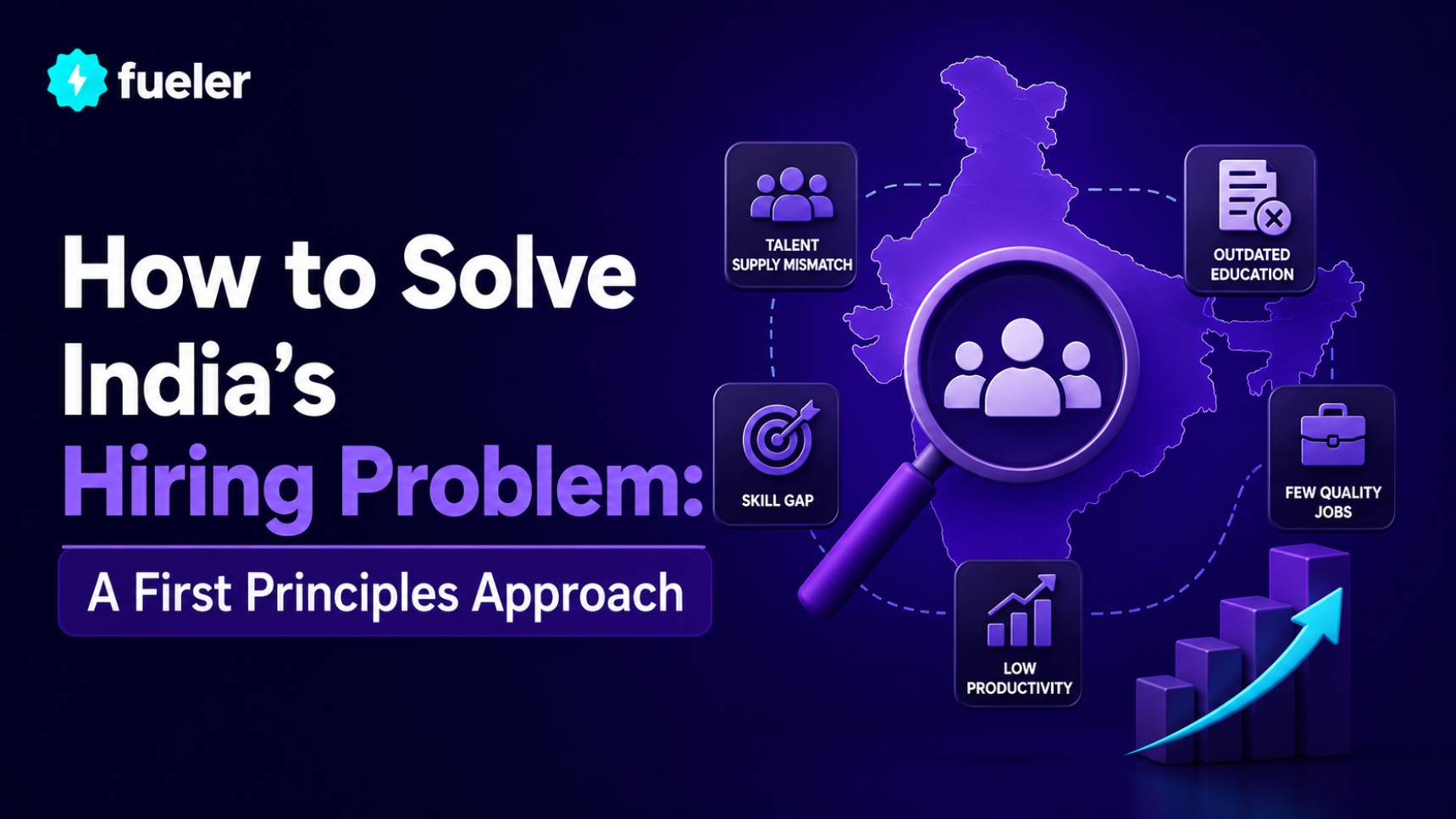
How to Solve India's Hiring Problem: A First Principles Approach

Riten Debnath
10 May, 2026
Hey, this is Riten. When I started building Fueler, I spent a lot of time talking to both founders and job seekers. One thing became very clear: the hiring system in India is not just difficult, it is fundamentally broken.
We have over 1.4 billion people. We have millions of graduates every year. Yet, companies keep saying they cannot find "good talent," and talented people keep saying they cannot find "good jobs." This is a massive gap.
As the founder of Fueler, I look at this problem every day. To fix it, we cannot just make better resumes or faster job boards. We have to use First Principles Thinking. This means we have to keep away all our old ideas and look at the basic truths of work and hiring.
What is First Principles Thinking?
First Principles thinking is a way of solving problems by breaking them down into their most basic parts. Instead of doing things because "that is how they have always been done," you look at the "physics" of the problem.
If we look at hiring in India through this lens, we have to ask two simple questions:
- What is a job?
- What is hiring?
A job is simply a set of problems that a company needs someone to solve.
Hiring is the process of trying to predict if a person can solve those problems before they actually start working.
Today, most companies use degrees and resumes to make this prediction. But is a degree a good way to predict if someone can write code, close a sales deal, or design a website? Usually, the answer is no. A degree proves that you can stay in school for four years. A resume proves that you know how to use a computer to write about yourself. Neither of these proves you can do the work.
The Core Problem: Signal vs. Noise
In a country as big as India, companies get thousands of applications for a single role. This creates a "noise" problem. To save time, companies use filters. They look for "Tier 1" colleges like IITs or IIMs. They look for big brand names on a resume.
These are called proxies. A proxy is a shortcut. Because it is hard to check if 5,000 people are actually good at marketing, companies assume that if someone went to a famous college, they must be good.
But this "proxy culture" hurts everyone. It hurts the "hidden gems" who are incredibly talented but did not go to a famous school. And it hurts companies because they end up hiring people who are good at taking exams but not good at solving real-world business problems.
Deconstructing the Solution
To solve the hiring crisis in India, we need to move from Proxies to Proof. We need a system where your work speaks louder than your college degree. Here is how that looks when we build it from the ground up.
1. Proof of Work Over Resumes
A resume is just a list of claims. Anyone can write that they are a "Social Media Expert" or a "Python Developer." But a Portfolio is a collection of evidence.
At Fueler, we believe in the "Proof of Work" model. If you are a developer, show me the code you wrote. If you are a writer, show me the articles you published and how many people read them. When a company can see what you have actually built, they don't need to guess if you are good. The evidence is right there.
2. Assignments as the Ultimate Filter
Interviews are often just a test of how well you can talk. Some people are great at talking but struggle when they actually have to sit down and work.
The first principles solution is Assignment-based hiring. Instead of asking a candidate, "How would you solve this problem?", you give them a small, real-world task. You ask them to actually solve it. This is a "work simulation."
When a company hires through assignments, they are testing the exact skills needed for the job. This removes bias. It doesn't matter where the person is from or what their last name is. If their assignment is the best, they are the best person for the job.
3. Ability Over Pedigree
We need to stop obsessed with "where" someone learned and start focusing on "what" they can do. In the digital age, anyone with an internet connection can learn almost anything. Some of the best engineers and designers I know are self-taught.
A first principles approach values Velocity of Learning. In a fast-changing world, how fast you can learn a new skill is more important than what you learned five years ago in college.
How Fueler is Changing the Game
We didn't build Fueler just to be another job site. We built it to be the infrastructure for this new way of thinking.
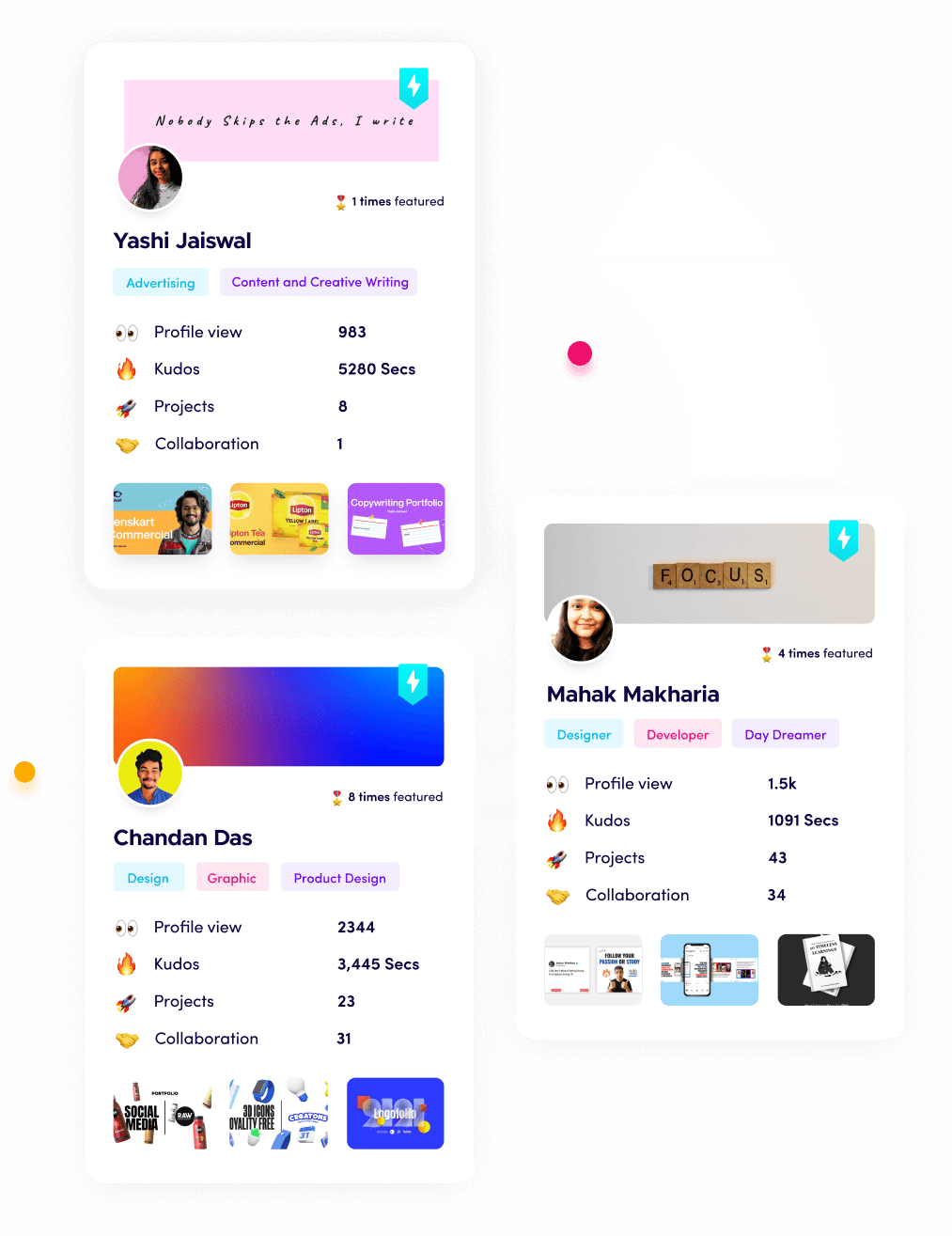
Fueler helps individuals create a professional portfolio that focuses on "Artifacts." An artifact is a specific piece of work: a project, a design, a report, or a piece of code. By documenting these artifacts, you create a "Proof of Work" that is impossible to ignore.
For companies, we are making it easy to hire through assignments. Instead of reading 1,000 resumes, a founder can look at 10 portfolios and give those people a real task to complete. This makes hiring faster, fairer, and much more accurate.
The Future of Work in India
If we solve the hiring problem, we unlock the true potential of India. Imagine a country where a student in a small village can get a job at a top startup in Bangalore just because they built an amazing project and documented it on their portfolio.
This isn't just a dream. It is starting to happen. We are moving toward a world where:
- Resumes are dead: They will be replaced by live, proof-based portfolios.
- Degrees are optional: Your skills and your projects will be your true degree.
- Hiring is fair: Assignments will ensure that the most capable person wins, regardless of their background.
The "Hiring Problem" is really just an information problem. Companies don't have the right information about candidates, so they rely on old, outdated signals. By using first principles and focusing on Proof of Work, we provide the right information.
We are building a world where your work tells your story. And that is a world where everyone has a fair shot at success.
Frequently Asked Questions on Hiring
What is the best way to get a job in India without a degree?
The best way is to build a "Proof of Work" portfolio. Focus on creating real projects that solve problems for businesses. Use platforms like Fueler to document your work and show it to hiring managers. When you show what you can do, your degree becomes much less important.
How does assignment-based hiring work for candidates?
In assignment-based hiring, a company gives you a small task related to the job you applied for. This could be writing a blog post, fixing a bug in code, or creating a marketing plan. It allows you to prove your skills in a real-world scenario instead of just talking about them in an interview.
Why are companies moving away from traditional resumes?
Traditional resumes often contain fake or exaggerated information. They also don't show the quality of a person's work. Companies are moving toward portfolios and assignments because they provide verifiable proof of skill, which reduces the risk of making a bad hire.
How can I build a professional portfolio as a student?
Start by documenting every project you do, even if it is for a class or a hobby. Upload your designs, code, or writing to a portfolio platform. Explain the problem you were trying to solve and the results you achieved. This makes your skills visible to recruiters before you even graduate.
Is skill-based hiring better than degree-based hiring?
Yes, because skill-based hiring focuses on actual performance. While degrees show that you can learn in a structured environment, skill-based hiring through assignments and portfolios shows that you can deliver results in a professional environment. This leads to better matches between employees and companies.
What is Fueler Portfolio?
Fueler is a career portfolio platform that helps companies find the best talent for their organization based on their proof of work. You can create your portfolio on Fueler. Thousands of freelancers around the world use Fueler to create their professional-looking portfolios and become financially independent. Discover inspiration for your portfolio
Sign up for free on Fueler or get in touch to learn more.

What should you do next?
You've read the article. Now turn your skills into proof of work and unlock more opportunities.
Build your proof of work portfolio
Create a clean portfolio with projects, assignments, resumes, and AI stack details that companies actually want to see.
Create your Fueler portfolio →Apply through assignments, not resumes
Stand out by solving real tasks from companies hiring on Fueler.
Explore assignments →Get discovered by companies
Make your work public and let recruiters discover your skills through actual projects instead of keywords.
Get discovered →