India Doesn't Have a Talent Problem. It Has a Visibility Problem

Riten Debnath
11 Jun, 2026
A few days ago, I read an article by David Oks titled Why China Got Rich and India Didn't. It is one of those articles that stays with you long after you finish reading it. While the article discusses economic growth, education, and development, I could not stop thinking about its implications for talent, careers, and hiring in India.
As the founder of Fueler, a platform that helps companies hire through assignments and proof of work, I spend most of my time thinking about one question: Why do so many talented people struggle to get opportunities despite having the skills to succeed?
The article helped me look at this question from a different angle.
The common narrative is that India has a skill gap. We often hear that graduates are unemployable, that companies cannot find good talent, and that there is a mismatch between education and industry requirements. While there is some truth to these concerns, I believe they hide a much bigger reality.
India does not have a talent problem.
India has a visibility problem.
The country is full of capable people who are building products, creating content, designing brands, writing code, solving business problems, and learning new skills every day. Yet many of these individuals remain invisible to the very opportunities they deserve. Their work exists, their skills exist, and their ambition exists. What is missing is a system that makes their capabilities visible.
What China's Growth Story Really Teaches Us
One of the key ideas from David Oks' article is that China's rise was not only driven by factories, infrastructure, or government reforms. Long before China became an economic powerhouse, it invested heavily in human capital. It focused on improving literacy, education, workforce participation, and the overall capability of its people. When economic opportunities expanded, millions of people were already prepared to contribute productively.
This idea of human capital is incredibly important.
Every country has natural resources. Some have oil. Some have minerals. Some have geographical advantages. But in the modern economy, the most valuable resource is human capability. A nation's growth depends on how effectively it can help its people learn, create, and contribute.
India has one of the largest pools of human capital in the world. We have one of the youngest populations globally. Millions of students graduate every year. Thousands of startups are launched annually. The internet has made knowledge more accessible than ever before. Today, a student in Agartala, Indore, or Coimbatore can learn the same skills as someone studying in Bangalore, Delhi, or Mumbai.
The barriers to learning have fallen dramatically.
The barriers to opportunity have not.
India Has Talent. So Why Do Opportunities Feel Scarce?
This is where the problem begins.
A student may spend hundreds of hours learning design. A developer may build side projects after work. A marketer may run successful campaigns for small businesses. A writer may publish dozens of thoughtful articles online. Yet when it comes time to apply for a job, much of this work often remains hidden behind a one-page resume.
The traditional hiring system was designed for a world where information was scarce. Employers needed shortcuts. Degrees, college names, and previous company brands became signals of quality because there was no easy way to evaluate actual capability.
Today, however, we live in a completely different world.
The internet allows people to showcase their work publicly. Projects can be shared. Assignments can be documented. Case studies can be published. Portfolios can be created. For the first time in history, it is possible to evaluate talent based on evidence rather than assumptions.
Yet much of hiring still relies on outdated signals.
The Real Problem Is Visibility
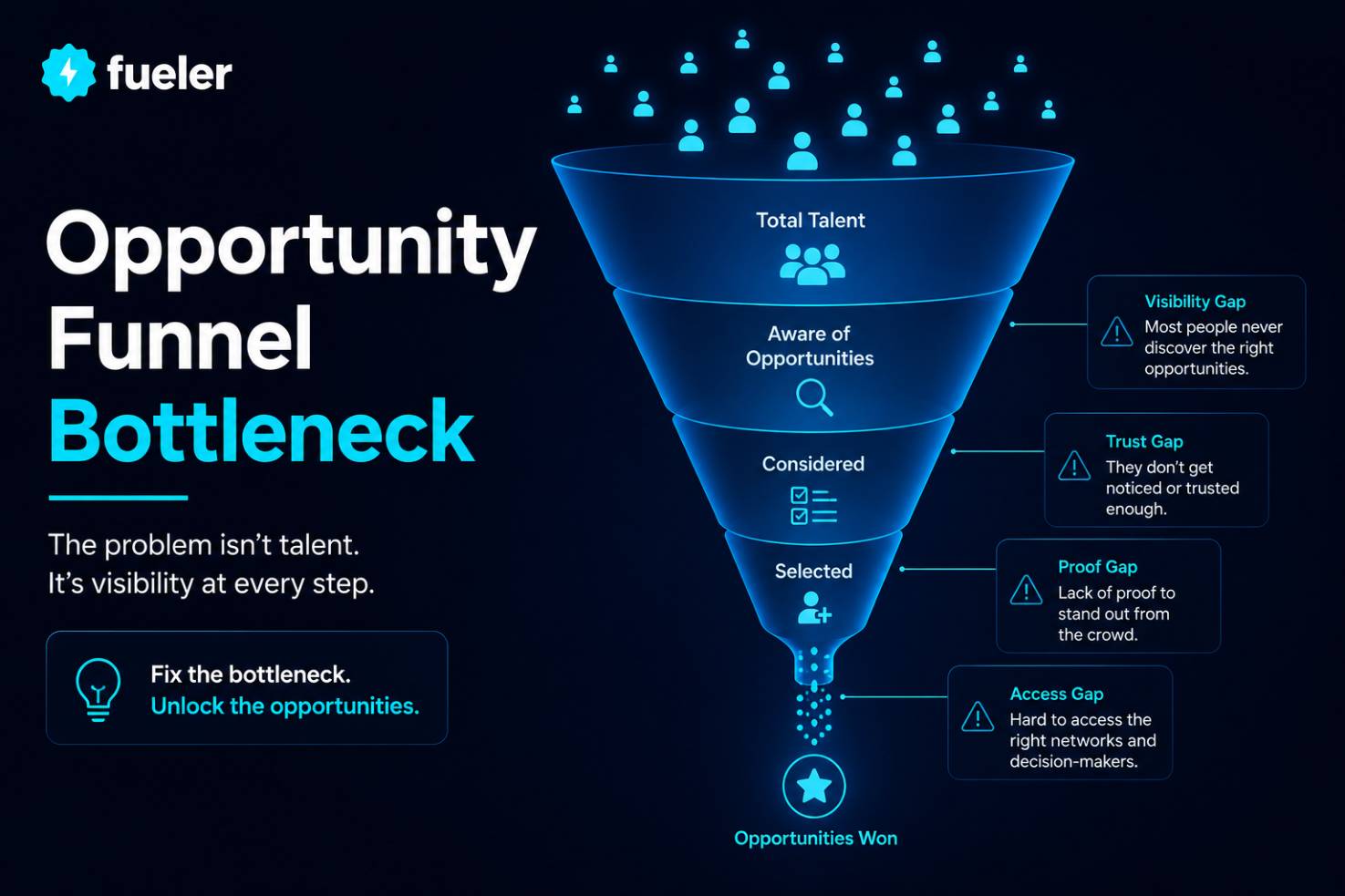
Fueler Opportunity Funnel Bottleneck
This creates an unfortunate situation where talented individuals are often overlooked, not because they lack skills, but because they lack visibility.
I have personally seen this happen countless times.
At Fueler, we regularly come across students who have built impressive projects but struggle to get interview calls. We see freelancers who have delivered excellent results for clients but cannot effectively showcase their work to employers. We see self-taught professionals who possess practical skills that rival experienced employees but find it difficult to compete against candidates with stronger credentials on paper.
The issue is not capability.
The issue is discoverability.
Imagine two candidates applying for the same role. One has a prestigious degree and a polished resume. The other has completed real assignments, solved practical problems, documented projects, and built a strong portfolio of work. In many hiring systems today, the first candidate often gets attention faster because the signal is easier to recognize.
But what if employers could see actual evidence of skill before making a decision?
What if portfolios became more important than resumes?
What if completed assignments mattered more than claimed experience?
What if proof of work became the primary hiring signal?
Why Traditional Hiring Signals Are Breaking
These questions are becoming increasingly relevant as technology changes the nature of work.
Artificial intelligence is making information abundant. Basic knowledge is becoming easier to access. In such a world, the ability to demonstrate practical capability becomes far more valuable than simply listing qualifications.
Employers are increasingly looking for outcomes, not claims.
They want to know whether a designer can design, whether a marketer can market, whether a writer can write, and whether a developer can build.
The most reliable way to answer these questions is through proof of work.
The Rise of Proof of Work
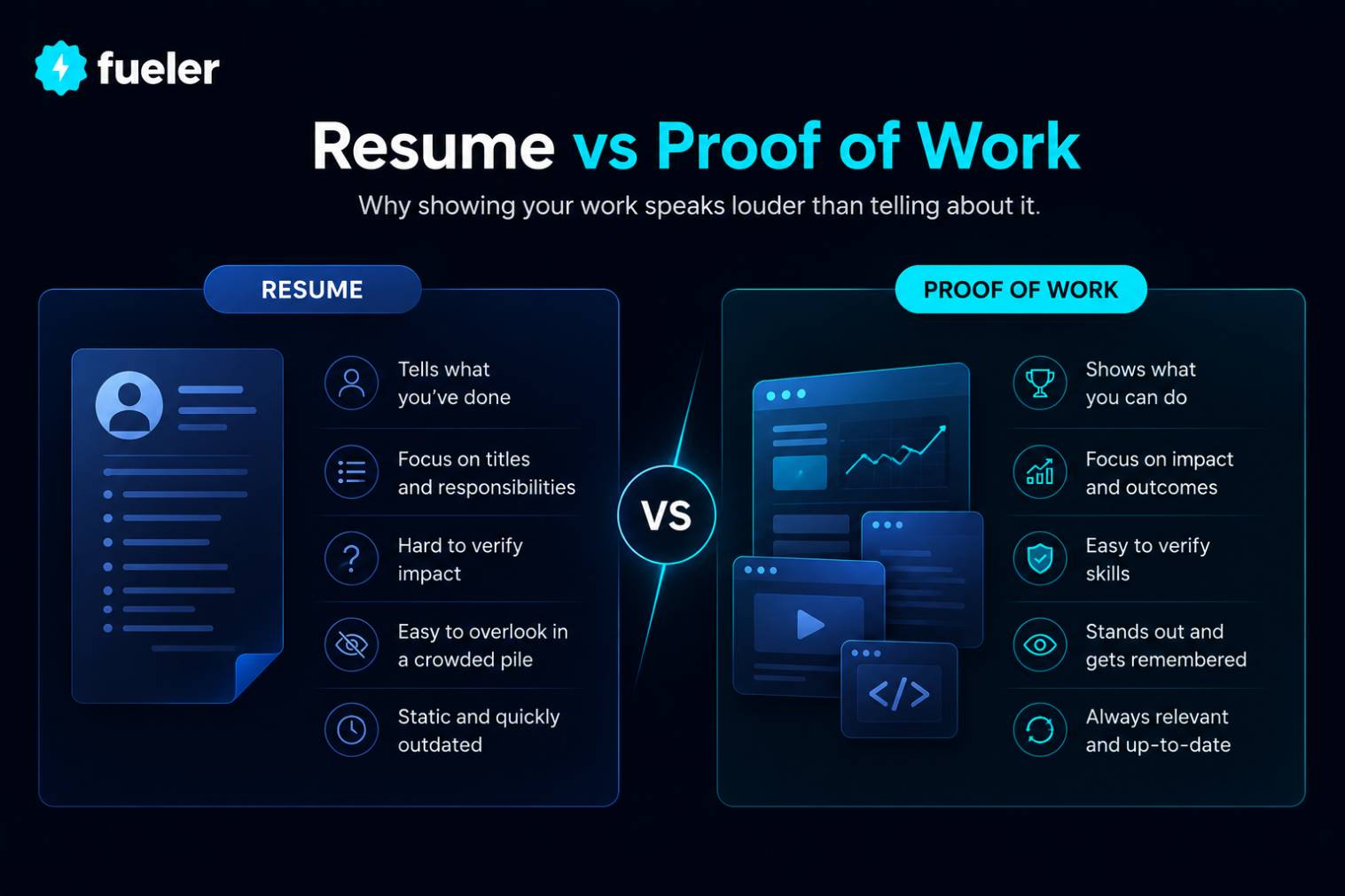
Resume vs Proof of Work
Proof of work is not a new concept. Builders, artists, creators, and entrepreneurs have relied on portfolios for decades. What is changing is the scale at which proof of work can be applied across professions.
A software engineer can showcase applications they have built. A content writer can share published articles. A growth marketer can demonstrate campaign results. A product manager can document problem-solving frameworks. A student can complete assignments that mirror real-world challenges.
Every project becomes evidence.
Every assignment becomes proof.
Every piece of work becomes a signal.
Why Assignment-Based Hiring Creates Better Outcomes
This shift has implications far beyond individual careers.
When talent becomes easier to discover, opportunity becomes more accessible. When opportunity becomes more accessible, economic participation increases. When more people participate productively in the economy, growth accelerates.
This is why I believe talent visibility is not just a hiring problem. It is a human capital problem.
A country cannot fully benefit from its talent if that talent remains hidden.
Talent Visibility Is an Economic Growth Problem
India's next phase of growth will not come only from technology, venture capital, or government policy. It will come from unlocking the productive potential of millions of individuals who already possess valuable skills but struggle to connect with meaningful opportunities.
That requires better career infrastructure.
Just as roads help goods move efficiently across a country, career infrastructure helps talent move efficiently toward opportunity. We need systems that make skills visible, achievements verifiable, and capabilities discoverable. We need hiring methods that reward demonstrated ability rather than relying entirely on credentials. Most importantly, we need platforms that help people showcase what they can actually do.
Why India Needs Better Career Infrastructure
This belief is one of the reasons we are building Fueler.
Our vision extends beyond creating portfolios. We want to create a future where work speaks louder than resumes, where assignments help companies discover hidden talent, and where opportunity is distributed based on capability rather than pedigree.
The internet has already democratized learning.
A teenager with a smartphone can access world-class knowledge.
The next challenge is democratizing opportunity.
A talented student from a small town should have the same chance to prove themselves as someone from a top university. A self-taught professional should be able to compete with candidates from prestigious institutions. Someone's work should carry more weight than the logo on their degree.
Building a Future Where Work Speaks Louder Than Resumes
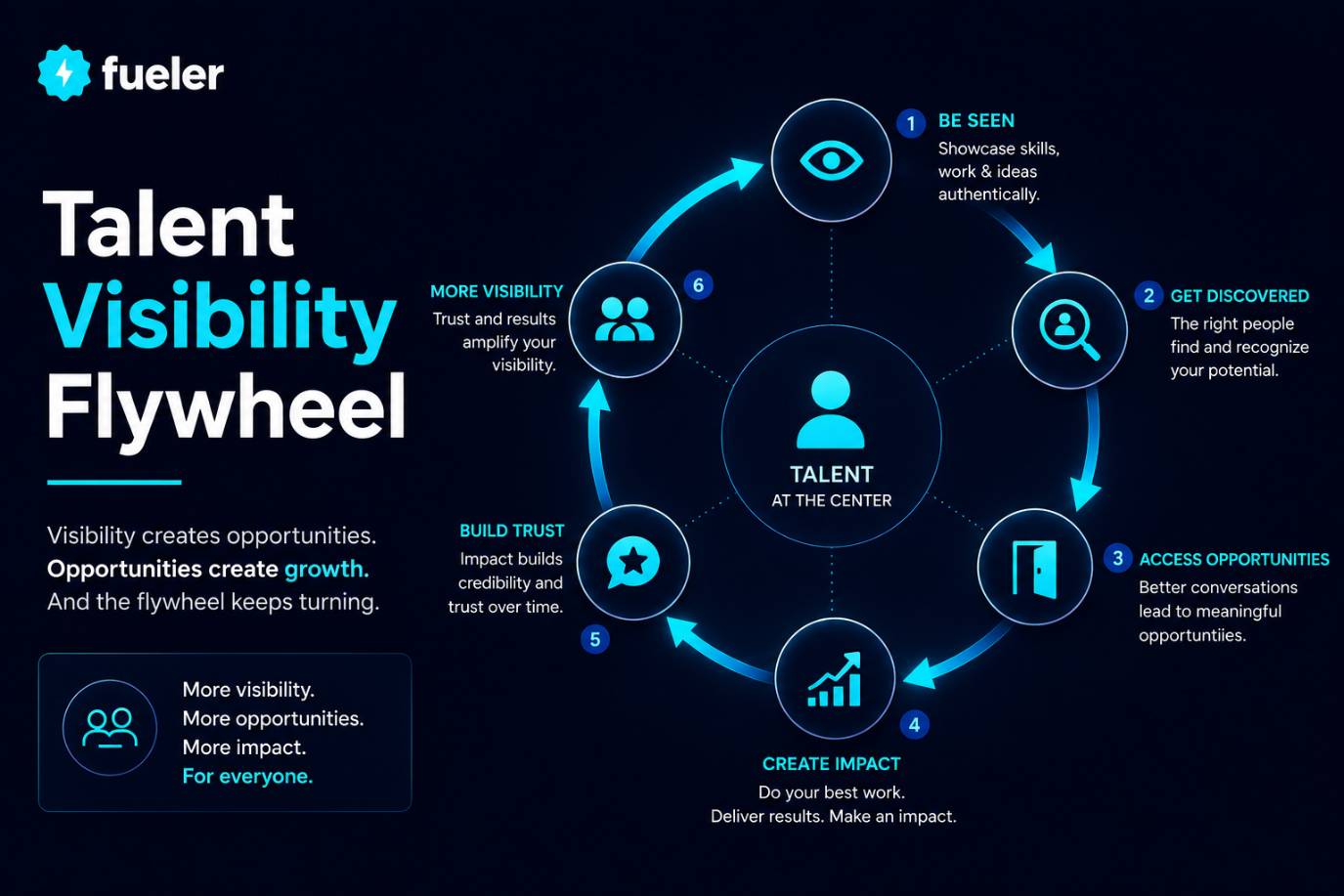
Talent Visibilty Flywheel
That future is possible.
In many ways, it is already beginning.
Companies are increasingly adopting skills-based hiring. Portfolios are becoming more important. Assignment-based assessments are becoming more common. Employers are recognizing that potential often exists beyond traditional talent pools.
The momentum is moving in the right direction.
But there is still a long way to go.
Conclusion: India's Biggest Opportunity Is Already Here
The lesson I took from David Oks' article is not simply about China and India. It is about the importance of investing in people and creating systems that allow their capabilities to translate into real economic value.
Human capital matters. But human capital alone is not enough. People must also be visible.
Because talent that remains hidden cannot create impact. Talent that remains hidden cannot access opportunity.
Talent that remains hidden cannot contribute at its full potential.
India does not have a shortage of talent. It has millions of talented people waiting to be discovered.
And solving that visibility problem may be one of the most important opportunities of our generation.
Related Reading
If you're interested in building proof of work and creating a stronger professional presence, these resources may help:
Personal Branding for Students
How to Build a Portfolio That Gets You Hired
FAQs
What is proof of work in hiring?
Proof of work refers to real projects, assignments, case studies, and outcomes that demonstrate a candidate's skills instead of relying only on resumes and qualifications.
Why do many talented people struggle to get jobs in India?
Many skilled individuals struggle because employers cannot easily evaluate their capabilities. A lack of visibility often becomes a bigger challenge than a lack of skill.
What is assignment-based hiring?
Assignment-based hiring is a recruitment approach where candidates complete practical tasks that help employers assess real-world skills and problem-solving abilities.
Why are portfolios becoming important for careers?
Portfolios help professionals showcase actual work, making it easier for employers to evaluate skills, experience, and potential.
How can students make their skills visible to recruiters?
Students can build projects, document assignments, publish their work online, create portfolios, and consistently share proof of work that demonstrates their abilities.
What is Fueler Portfolio?
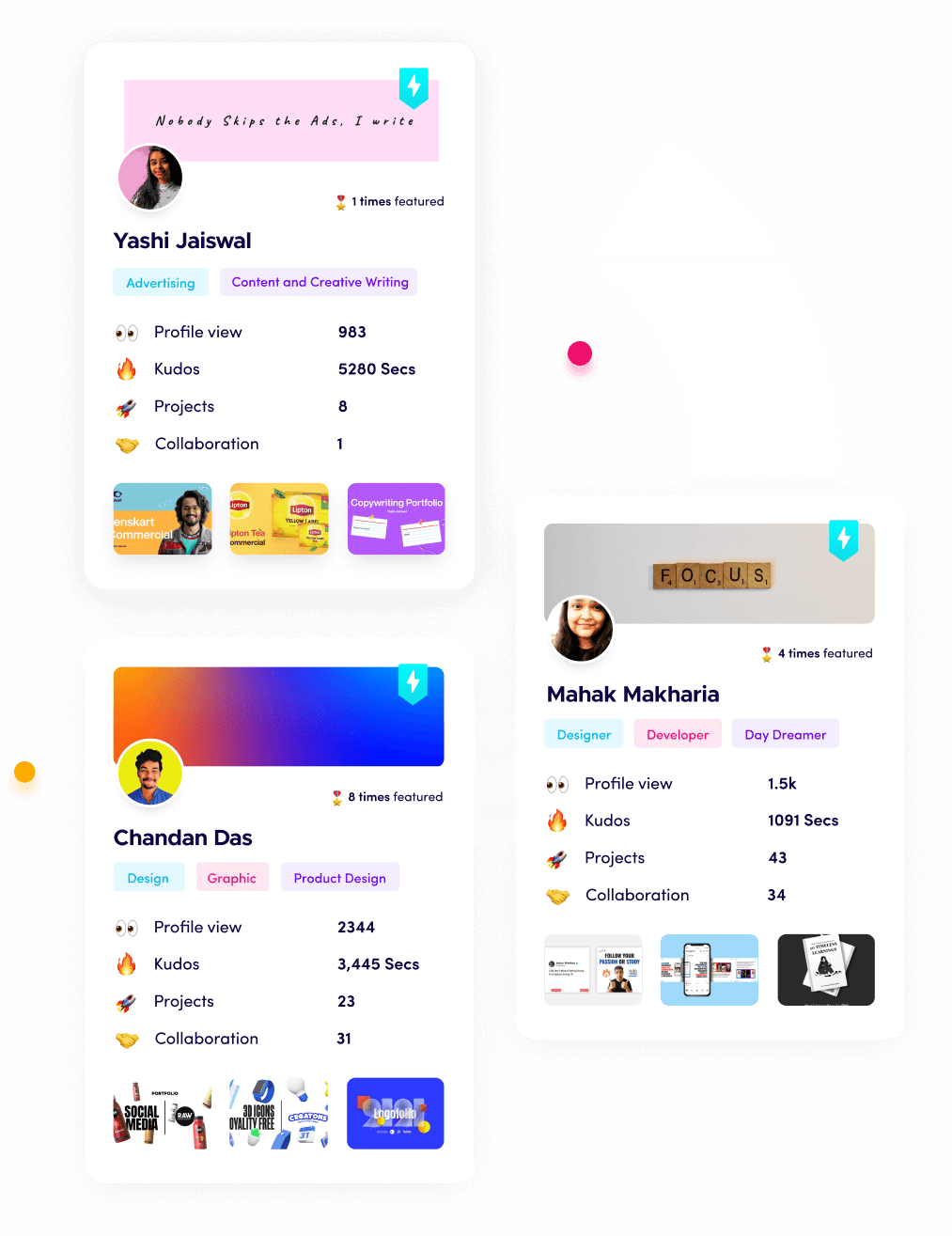
Fueler is a career portfolio platform that helps companies find the best talent for their organization based on their proof of work. You can create your portfolio on Fueler. Thousands of freelancers around the world use Fueler to create their professional-looking portfolios and become financially independent. Discover inspiration for your portfolio
Sign up for free on Fueler or get in touch to learn more.

What should you do next?
You've read the article. Now turn your skills into proof of work and unlock more opportunities.
Build your proof of work portfolio
Create a clean portfolio with projects, assignments, resumes, and AI stack details that companies actually want to see.
Create your Fueler portfolio →Apply through assignments, not resumes
Stand out by solving real tasks from companies hiring on Fueler.
Explore assignments →Get discovered by companies
Make your work public and let recruiters discover your skills through actual projects instead of keywords.
Get discovered →