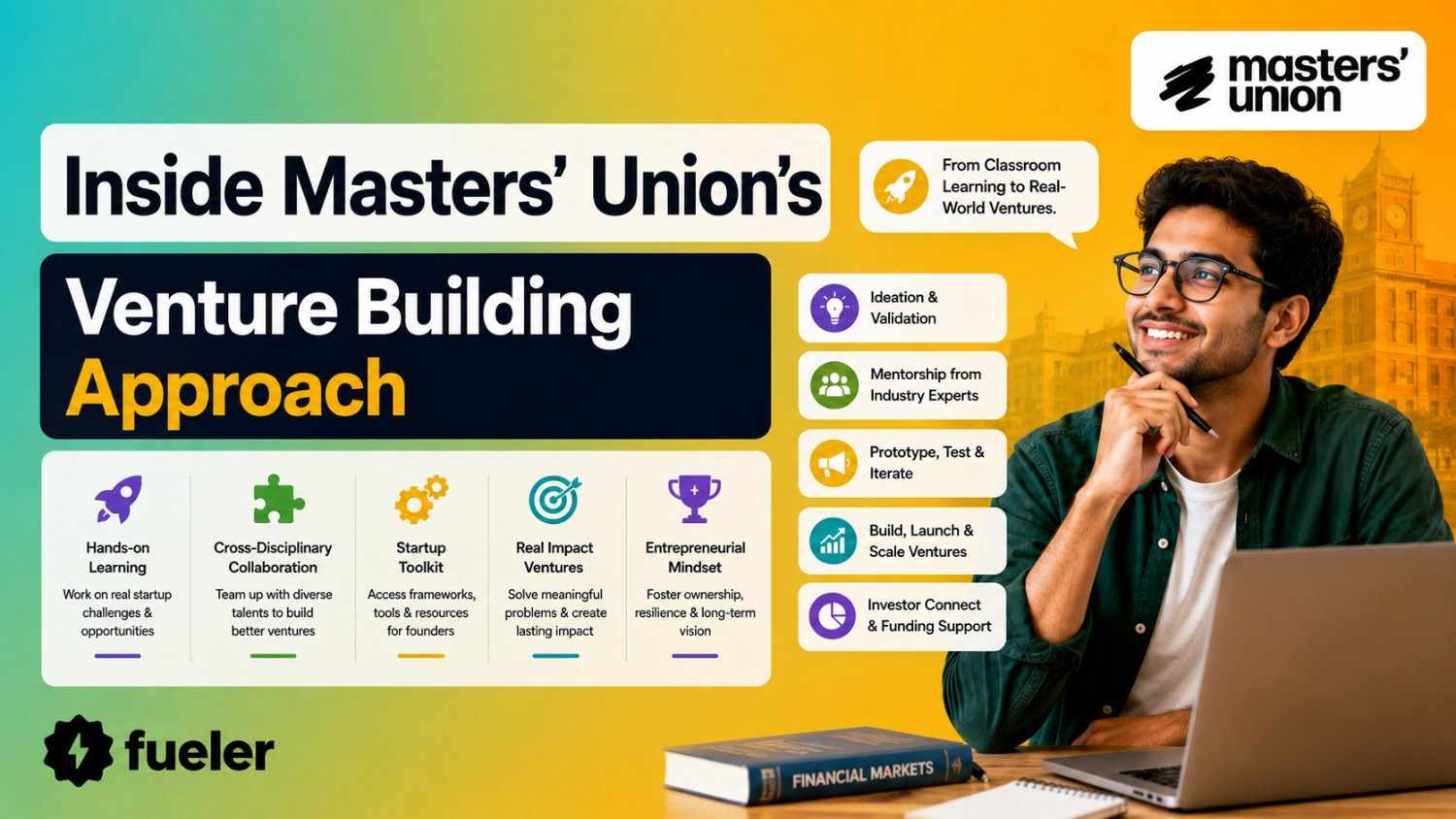
Inside Masters' Union's Venture Building Approach

Riten Debnath
18 Aug, 2026
Last updated: August 2026
Every time I sit down with early-stage founders or ambitious grads, the conversation lands on the exact same frustration: traditional business schools are stuck in a time capsule. You spend two years paying massive tuition fees just to read case studies about companies built in the 1990s, write 50-page theoretical business plans, and memorize formulas for written exams. Then, on day one at a real startup, someone asks you to run a paid campaign, audit unit economics, or talk to churned users, and you completely freeze because you've never actually operated anything live.
I’m Riten, founder of Fueler, a skills-first portfolio platform building the career infrastructure for 100 million creative professionals. Fueler connects talented individuals with companies through assignments, portfolios, and projects, not just resumes or CVs. Think of it as Dribbble/Behance for work samples combined with AngelList for hiring infrastructure.
Building Fueler from scratch taught me an undeniable truth: real business muscle isn't built in quiet lecture halls. It's forged in production environments when you ship a raw product, manage real ad spend, handle actual revenue, and deal with live user feedback.
That is why the Masters' Union venture-building approach caught my attention. Instead of treating business like an academic subject to study, Masters' Union turns the program into a live testing ground where students run dropshipping sprints, build tech products, deploy real capital, and pitch directly to active venture capital firms.

Quick Answer Summary
- Who it is for: Aspiring founders, future Chiefs of Staff, Product Managers, and operators who learn best through execution.
- Cost: Ranges from ₹20 Lakhs to ₹30+ Lakhs (depending on the specific program length like PGP TBM or UG), with institutional stipends and seed grants available.
- Key Takeaway: Graduates leave with a portfolio of live projects, real-world revenue numbers, or operational experience instead of a theoretical resume.
- Best Suited For: Individuals seeking a high-intensity alternative to traditional MBAs who want immediate, hands-on experience in the tech and startup ecosystem.
What is the Masters' Union Venture Building Model?
The Masters' Union venture building approach is an experiential educational framework that swaps traditional passive lectures for live company creation. Instead of taking exams on marketing theories or reading textbooks about supply chains, students receive micro-capital, form execution teams, and build real businesses.
This setup blends the structure of an academic institution with the speed of a startup incubator. Students experience the end-to-end operational loop: identifying real market gaps, building minimum viable products (MVPs), running growth experiments, and balancing unit economics.
In modern hiring environments, especially in tech corridors like Gurgaon or Bangalore proof of work trumps degrees every single time. Founders and hiring managers do not ask what classes you took; they ask what you have shipped, what distribution channels you tested, and how you responded when your product broke. This matches our core philosophy at Fueler: your verified output and project portfolio reflect your true capabilities far better than lines of text on a CV.
Key Facts Table
Detailed Explanation of the Venture Building Model
The Dropshipping & E-Commerce Sprint
The venture building journey often starts with low-barrier, high-feedback execution challenges like the Dropshipping Challenge. Students receive a modest budget and are tasked with setting up an e-commerce platform, sourcing products, building digital storefronts, and running paid performance campaigns.
This challenge strips away high-level abstractions. You learn customer acquisition costs (CAC), return on ad spend (ROAS), conversion rate optimization (CRO), and payment gateway integration under real market constraints. When ad budget bleeds without generating sales, you do not consult a textbook; you audit your targeting, refine your ad copy, and fix your checkout flow.
The Venture Initiation Programme (VIP)
The core engine of this ecosystem is the Venture Initiation Programme (VIP). VIP runs across multiple terms, requiring student teams to conceive, launch, and attempt to scale full-fledged businesses.
Students move from customer discovery (conducting 50+ user interviews to isolate actual pain points) to shipping a working MVP. The focus shifts rapidly from "idea validation" to acquisition metrics, retention loops, and path-to-profitability. This stage mimics the pressure cooker environment of real venture-backed startups.
Mentorship from Operators, Not Academics
A central pillar of this model is who leads the sessions. Rather than tenured professors who have spent decades away from active markets, classes and reviews are led by current operators, startup founders, domain experts, and active venture capitalists.
When a student team encounters distribution roadblocks or regulatory hurdles, their advice comes from practitioners who solved those exact issues the previous week in their own companies. This feedback loop ensures students absorb operational tradecraft rather than outdated theory.
Demo Day and External Capital Access
The venture building loop culminates in an official Demo Day. Student teams present their live businesses backed by actual traction data, revenue numbers, or active user retention metrics to external angel investors, micro-VCs, and institutional funds.
For ventures showing strong Product-Market Fit (PMF) signals, Demo Day serves as an actual pre-seed fundraising environment. Students whose ventures do not secure external capital still walk away with a rich portfolio of built products, failed experiments, and operational insights.
How It Works: Step-by-Step
[Problem Discovery] ➔ [MVP Development] ➔ [Go-To-Market Execution] ➔ [Scale / Pitch at Demo Day]
- Problem Discovery & Idea Validation: Teams conduct deep customer interviews, map industry landscapes, and identify clear, underserved market problems.
- Prototyping & MVP Build: Using no-code tools, full-stack development, or physical prototyping, teams ship a basic, functional product within weeks.
- Go-To-Market (GTM) Experiments: Students deploy small-budget campaigns across search, social media, content channels, or outbound B2B tactics to validate buyer intent.
- Iterative Refinement: Armed with initial user analytics and conversion drop-off points, teams pivot their product features or positioning.
- Scaling & Unit Economics: The focus shifts to retention, repeat purchases, organic referral loops, and maintaining positive contribution margins.
- Demo Day Pitching: High-traction startups pitch to active angel investors and venture capital firms for pre-seed institutional backing.
Practical Benefits
- Verified Proof-of-Work: Instead of presenting a generic resume listing courses, you graduate with live web links, campaign track records, and operational achievements. This fits seamlessly with platforms like Fueler, where showcasing your real assignments and live builds opens doors faster than any degree.
- Comfort with Financial Risk: Spending real seed money and tracking loss/gain builds a calm mindset around financial decisions that lectures can never replicate.
- Cross-Functional Fluency: You learn how tech development, growth marketing, legal compliance, and customer support intersect in a live business.
- Immediate Ecosystem Integration: Direct interactions with visiting founders, angel investors, and venture partners remove the traditional barriers between students and industry networks.
Challenges and Limitations
Despite its strengths, the venture building model is not a silver bullet for everyone.
- High Ambiguity and Stress: If you thrive on structured syllabi, predictable study guides, and clear-cut answers, the messy nature of startup execution will feel overwhelming.
- Capital and Operational Risk: Building a real product means facing public failure, product bugs, poor campaign returns, and zero sales.
- Distraction from Pure Academic Depth: Students seeking traditional academic research, deep theoretical literature, or formal tenure-track preparation will find this approach too tactical and execution-focused.
Comparison: Masters' Union vs. Traditional Business Programs
Fees and Financial Commitment
- Tuition Fees: Programs like the Post Graduate Programme in Technology and Business Management (PGP TBM) cost approximately ₹20 Lakhs to ₹25+ Lakhs (plus applicable taxes and hostel expenses).
- Founders' Fellowship Support: To mitigate financial stress during execution phases, Masters' Union provides a Founders' Fellowship offering an approximate stipend of ₹50,000 per month for selected student entrepreneurs.
- Seed Grants & Funds: Programs offer access to micro-grants or internal venture funds (like the MU Ventures fund ecosystem) to finance initial prototypes, ad spend, and distribution experiments.
Career Opportunities and Roles
Graduates of this model generally target high-ownership roles across the startup ecosystem:
- Founder's Office / Chief of Staff: Working directly alongside startup CEOs to execute strategic initiatives, manage cross-functional projects, and scale business operations.
- Product Manager (PM): Leading product discovery, user research, wireframing, and cross-team development sprints.
- Growth & Performance Marketer: Managing customer acquisition channels, running paid experiments, optimizing conversion funnels, and lowering CAC.
- Venture Capital Analyst / Associate: Evaluating early-stage business models, analyzing unit economics, and conducting market research using first-hand builder experience.
Who Should Choose This?
- Aspiring entrepreneurs who want to build a business with access to seed capital, mentors, and network support.
- Early professionals who want to transition into high-growth startup roles like Founder's Office or Product Management.
- Self-starters who learn best through trial-and-error, messy execution, and rapid feedback loops.
- Candidates seeking a strong project portfolio to prove their skills directly to hiring managers.
Who Should Avoid This?
- Individuals who prefer predictable academic routines, standardized exams, and detailed lectures.
- Anyone seeking a low-stress, purely theoretical education without market exposure.
- Students looking exclusively for traditional corporate management roles in legacy, slow-moving industries.
Final Thoughts
Education works best when it matches real-world execution. The Masters' Union venture-building approach reflects a fundamental shift in how business skills are developed. By removing the buffer between classroom learning and real market conditions, it forces students to build muscle memory around execution, distribution, and resilience.
Whether your venture succeeds or fails during the program, the real asset you build is your personal capability profile. Having live projects, real campaign data, and shipped products to show for your effort creates leverage that standard degrees cannot match. Platforms like Fueler were built precisely for this era, allowing builders to present their projects, assignments, and real-world results directly to the companies and investors looking for proven operators.
Key Takeaways
- The venture building model replaces passive case studies with live company creation.
- Students test real capital across dropshipping challenges, MVP builds, and go-to-market sprints.
- Mentorship is provided directly by active founders, industry leaders, and active investors.
- Financial safety nets like the Founders' Fellowship help de-risk early-stage experimentation.
- The ultimate career outcome is verified proof-of-work, positioning graduates for high-ownership roles like Chief of Staff or Product Manager.

FAQs
What is the Masters' Union Venture Building Approach?
It is a hands-on learning model where students conceive, launch, and attempt to scale real businesses as a central requirement of their curriculum, guided by active startup mentors and micro-seed grants.
Do students keep the equity of the startups they build?
Yes, student teams retain ownership of the businesses they build during the program. The institution's primary focus is providing educational guidance, capital access, and operational mentorship.
What happens if a student's startup fails during the program?
Failure is treated as a core learning outcome. Students document their insights, analyze what went wrong with their unit economics or GTM strategies, and apply those lessons to new builds or job opportunities.
How does this model prepare students for non-founder roles?
Building a venture teaches end-to-end execution, financial literacy, and product design. These exact skills make graduates exceptionally strong candidates for Chief of Staff, Product Management, and Growth Marketing positions.
Is previous business or coding experience required to join?
No prior business ownership or coding expertise is required. Teams blend diverse backgrounds, leveraging no-code solutions, AI tools, and peer collaboration to execute projects from scratch.
Why 100,000+ professionals use Fueler
Fueler helps professionals showcase proof of work through projects, assignments, case studies, and achievements.
- Thousands of professionals use Fueler to create their digital portfolio
- Thousands of projects are published on Fueler. Check here
- Startups and Companies hire through proof of work on Fueler
- Used by freelancers, creators, marketers, video editors, writers, designers, and product managers
Our mission is to help the next 100 million professionals build a verified professional identity through proof of work

What should you do next?
You've read the article. Now turn your skills into proof of work and unlock more opportunities.
Build your proof of work portfolio
Create a clean portfolio with projects, assignments, resumes, and AI stack details that companies actually want to see.
Create your Fueler portfolio →Apply through assignments, not resumes
Stand out by solving real tasks from companies hiring on Fueler.
Explore assignments →Get discovered by companies
Make your work public and let recruiters discover your skills through actual projects instead of keywords.
Get discovered →