An Introduction to Datasets: Types, Sources, and Uses

Team Fueler
01 Feb, 2026
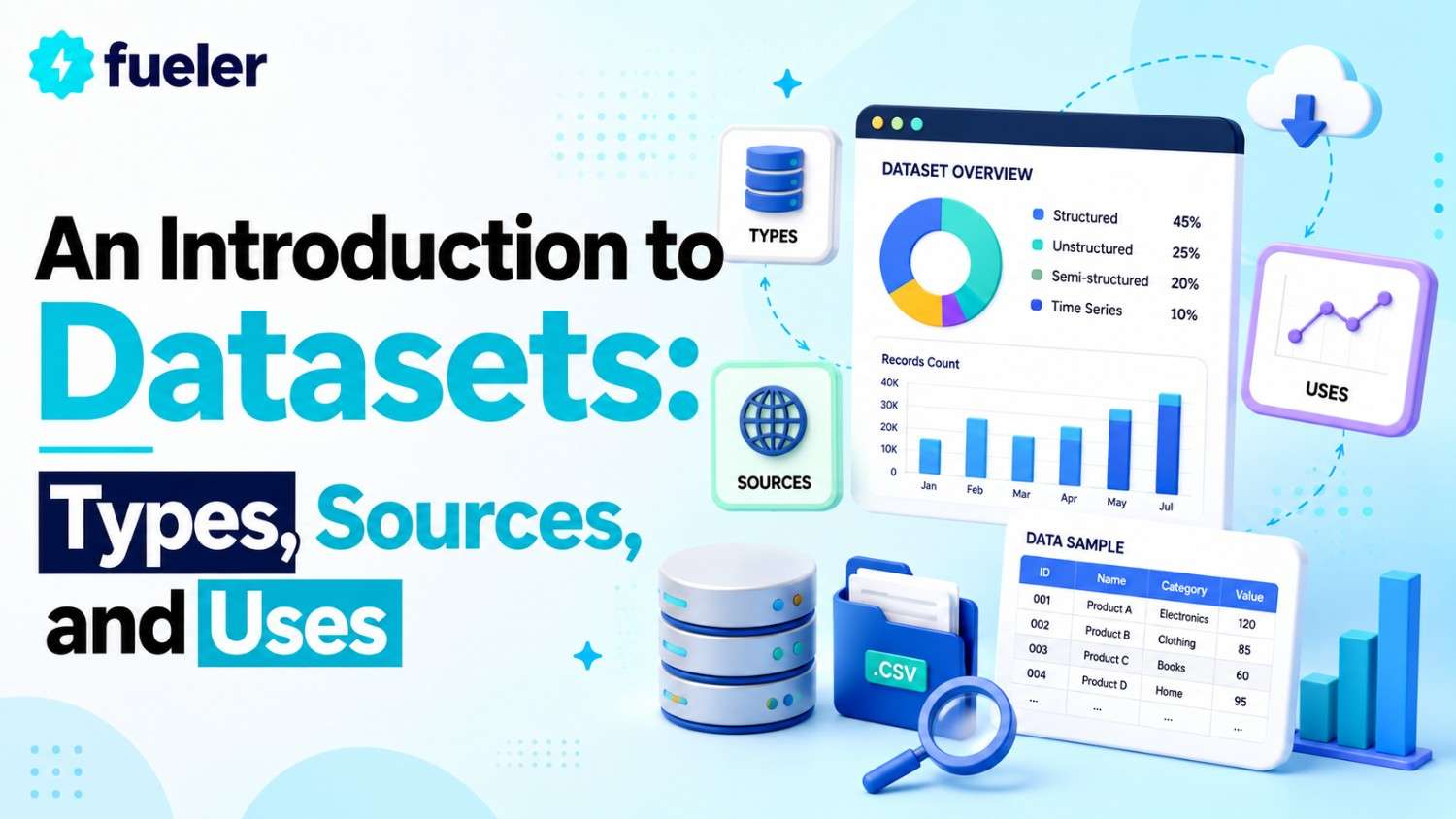
Remember the most basic definition of a dataset? Yes, a collection of related information put together for a purpose. This has not changed. However, the scope of dataset types and sources has changed.
Moreover, the era in which datasets were mainly understood as organized information or records for reporting and analysis is expiring. Question is: Are you aware of this?
If you are yet to update your understanding of datasets, here you go!
Types of Datasets
Datasets are not classified in just one way. Some classify them based on time, like static, time-series, and real-time datasets. Others prefer classifying them based on purpose, source, or data type. Nonetheless, the most popular classification criteria has always been based on structure.
The usual dataset types based on structure have been structured, semi-structured, and unstructured for the longest. Now, there are two additional types. And, these two redefine how we view datasets. Let’s break it down.
1. Structured datasets
Just like the name, structured datasets occur in a defined or predictable format, usually in table format. The columns house the data attributes while the rows host the data records.
Most of these datasets are stored in relational databases or spreadsheets. They are easy to clean, query, and analyze, making them the backbone of business analytics and reporting.
2. Semi-structured datasets
These datasets are pretty flexible. They start out as structured and loosen out to accommodate unstructured data. For instance, log files, JSON files or API responses.
Semi-structured dataset formatting facilitates optimal information exchange between applications. Some say they serve as a bridge between structured and unstructured data, powering system integrations with little to no need for data conversion.
3. Unstructured datasets
Emails, images, audio files, videos, text documents, and social media posts fall under this category. No pre-defined format at all.
The data is inconsistent and messy. For this reason, such datasets were mostly ignored. But now they are the most influential and valuable data types because AI systems can analyze them.
The available AI systems crunch these datasets down, generating relevant content, translating languages, or predicting customer behavior.
4. Labeled vs. unlabeled datasets
These two are specifically meant for AI and machine learning systems. While the data pieces in a labeled dataset have tags or annotations that tell AI what each piece represents, unlabeled datasets do not have annotations.
You’ll need labeled datasets when training AI models that learn through the supervised learning technique. But do note that creating labeled datasets is time consuming. This is the reason unlabeled datasets came into the picture, specifically after the introduction of the unsupervised learning approach.
As AI takes over most of the digital business operations, most of the previously mentioned dataset types are being modified to fit AI’s learning needs. As you’ll come to see, businesses have invested much in research to find new sources of datasets to power AI’s capabilities.
Sources and Uses of Datasets
Prior to widespread AI adoption, sourcing datasets was mainly operational. Now, it is a strategic endeavor. Even the most pre-dominant source of datasets is being reshaped to accommodate the current demand for AI-training datasets.
Yes, I’m speaking of publicly available or open-source datasets. These are mainly prepared and maintained by research institutions, organizations, universities, and governments. Such datasets are now being restructured or even merged to build datasets for AI.
Other sources of datasets include:
1. Web and platform data sources
Sources include social media networks, e-commerce websites, web apps, forums, and other publicly accessible websites. Most businesses have been using data from these sources for market research, trend analysis, and competitive intelligence.
Now, the scope of use has widened. Since the data is diverse and continuously evolving, it has become a critical element for AI systems. AI models ingest the data, helping them stay up-to-date and reflect current behavior, trends, and language patterns.
2. Internal or first-party data sources
Organization or business databases fall under this category of data sources. To be precise, the data that organizations or businesses generate during operations or decision making. This data is termed as internal or first-party.
Traditionally, the data from this source was limited to internal performance tracking, reporting, and decision making. It is now used to train, personalize, and optimize in-house AI models.
3. Third-party and commercial data sources
Sometimes, there is not enough public, open-source, or internal data to build a specific dataset. In that case, you source data from a commercial or third-party data source like data vendors or partner companies.
Commercial data providers collect and enrich data for various purposes including social media analytics, industry-specific competitor analysis, and more. Before sourcing data, ensure you have thought the purpose through. This way, you’d avoid a bad investment.
4. Sensor, devices, and machine-generated data
This includes data from connected devices, sensors, or automated hardware systems. For example, GPS tracker, smart home devices, IoT sensors, industrial machinery, and wearables.
Data from sensors and machines is mostly used for operational reporting, monitoring, and troubleshooting issues when they arise. Some businesses have integrated AI analytics models to help with real-time data analysis for optimizing processes and predicting failures before they even occur. Determining the right platform often involves researching Omni Analytics alternatives to find a solution that scales effectively with the sheer volume of telemetry produced by modern manufacturing floors.
5. Synthetic data
At times, accessing real data is sensitive, restricted by laws, expensive, or completely challenging. For instance, medical or aviation data. That’s where synthetic data comes in!
Synthetic data is generated through rules, simulations, or AI prompting. The data mimics real world data patterns and statistical patterns, making them relevant in various applications.
Before AI, synthetic data use was rare. It was used mainly for filling small data gaps or testing systems. This has changed drastically. Massive synthetic data generation powers AI training, testing, and fine-tuning. A good example is businesses preparing synthetic customer records to train models without exposing customer personal data.
Closing Words
Look around and you’ll realize that businesses no longer treat datasets as just another tool fueling analytics and reporting. Datasets are powering intelligence systems, helping businesses spot opportunities, stay ahead of trends, or even predict sales. However, there’s a catch!
If you don’t understand what has changed at the most basic level, you’re more likely to get confused. That’s why we’ve prepared this piece just for you. Use it to refresh your memory.
From dataset types to sources and uses, we’ve covered the essentials. As you digest it all, remember, dataset-use ethics still apply. Adhere to ethical dataset usage practices to avoid legal issues, especially when it comes to collecting and using private or protected data.
What is Fueler Portfolio?
Fueler is a career portfolio platform that helps companies find the best talent for their organization based on their proof of work. You can create your portfolio on Fueler. Thousands of freelancers around the world use Fueler to create their professional-looking portfolios and become financially independent. Discover inspiration for your portfolio
Sign up for free on Fueler or get in touch to learn more.

What should you do next?
You've read the article. Now turn your skills into proof of work and unlock more opportunities.
Build your proof of work portfolio
Create a clean portfolio with projects, assignments, resumes, and AI stack details that companies actually want to see.
Create your Fueler portfolio →Apply through assignments, not resumes
Stand out by solving real tasks from companies hiring on Fueler.
Explore assignments →Get discovered by companies
Make your work public and let recruiters discover your skills through actual projects instead of keywords.
Get discovered →