Machine Learning Integration Challenges for Modern Businesses

Riten Debnath
08 Jul, 2026
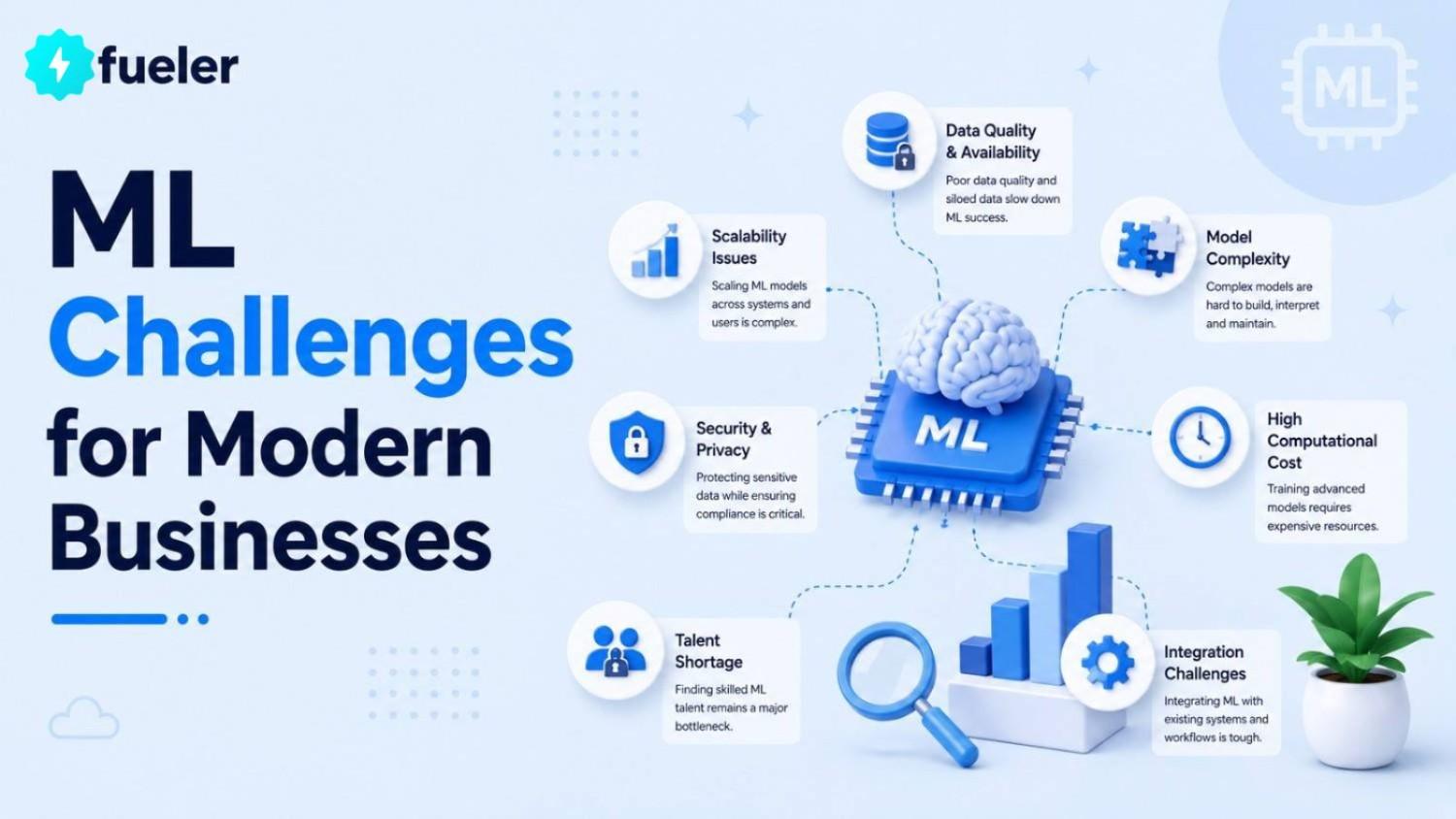
Last updated: July 2026
Building a data-driven business sounds incredible on paper, but integrating machine learning into production pipelines is where most companies quietly lose millions of dollars. The transition from a clean Jupyter notebook to a live, revenue-generating system breaks more infrastructure than most technical leaders care to admit. In 2026, the challenge isn't training a model; it's stopping that model from bleeding capital, hallucinating data, and breaking customer trust the moment it hits the real world.
I’m Riten, founder of Fueler, a skills-first portfolio platform that connects talented individuals with companies through assignments, portfolios, and projects, not just resumes/CVs. Think Dribbble/Behance for work samples + AngelList for hiring infrastructure.
Over the years, I’ve seen hundreds of builders struggle with the gap between writing code and shipping systems that scale. Moving machine learning from an isolated experimental sandbox to a core business operation requires a radical shift in how you handle data, talent, and infrastructure.
Here is exactly what goes wrong when modern businesses attempt ML integration, and how you can navigate these challenges to build resilient, production-grade intelligence systems.
1. High Latency in Live Model Inference Pipelines
Traditional backend architectures are built for deterministic software, but machine learning introduces heavy, probabilistic computations that crush standard servers. When you route live user traffic through complex models without optimization, response times skyrocket, destroying the user experience.
- Synchronous API bottlenecks occur when legacy microservices block the entire application thread while waiting for heavy model predictions to finish, leading to timeout errors and high user drop-off rates during peak traffic times.
- Vector database mismatches happen when engineering teams attempt to store high-dimensional model embeddings in traditional relational databases, which lack the specialized indexing algorithms required for sub-millisecond similarity search and retrieval.
- Aggressive payload serialization delays slow down production pipelines when massive, uncompressed JSON files are passed between microservices instead of using optimized, lightweight binary transport protocols like gRPC or Protocol Buffers.
- Cold start infrastructure latency plagues serverless architectures when sudden traffic spikes force uninitialized cloud instances to boot up and load gigabytes of heavy model weights into memory simultaneously.
- Edge compute processing constraints arise when large, unquantized models are pushed directly to client devices, resulting in severe device battery drain, overheating, and sluggish local interface performance.
Why It Matters
If your core architecture cannot support live model inference efficiently, your predictive features will remain slow experiments rather than reliable business assets that drive user retention and operational efficiency.
2. Silent Failures Triggered by Concept and Data Drift
Models are trained on static historical snapshots, but real-world data constantly evolves. The most dangerous part of this evolution is that it doesn't trigger standard software error codes; your systems stay online while generating wildly inaccurate outputs.
- Shifting consumer behavior patterns quietly render training datasets obsolete, causing automated recommendation engines to suggest irrelevant items because historical interactions no longer align with current macroeconomic trends.
- Upstream application schema updates introduce broken feature inputs when product teams alter front-end database columns without communicating changes to the downstream machine learning data pipeline.
- Extreme seasonal anomalies distort automated inventory forecasting models when short-term, viral internet trends or sudden weather disruptions cause unprecedented purchasing spikes that the model misinterprets as permanent market growth.
- Data pipeline feedback loops corrupt long-term model accuracy when an algorithm's own historical outputs are inadvertently fed back into its training loop, compounding early prediction biases over time.
- Label acquisition delays prevent teams from validating live model accuracy because the actual real-world outcome of a prediction might not be known or measurable for weeks after the inference occurs.
Why It Matters
Unmonitored drift turns your automation into a liability. Operating with decayed models means making critical inventory, pricing, or risk decisions based on hallucinated trends, quietly bleeding capital every hour.
3. High Cost of Fragmented MLOps Infrastructure
Many organizations stitch together disjointed open-source tools, cloud services, and custom scripts to manage their machine learning life cycle. This fragmented approach creates an incredibly fragile pipeline that requires constant manual intervention to keep running.
- Monolithic tool sprawl forces data scientists and DevOps engineers to spend more time building custom integration wrappers than optimizing model architectures, stalling the deployment of new features.
- Manual pipeline reproduction failures occur when environments lack standardized containerization, making it nearly impossible to replicate a model's exact training conditions across different cloud servers.
- Prohibitive cloud compute bills pile up rapidly when teams lack automated resource provisioning, leaving expensive GPU instances running idle long after heavy training jobs have finished executing.
- Brittle continuous integration setups fail to automatically test incoming code updates against live data profiles, allowing broken or unoptimized model versions to slip directly into production environments.
- Decentralized asset management leads to lost intellectual property when teams fail to implement a unified model registry, resulting in duplicate training efforts across different business units.
Why It Matters
A broken MLOps pipeline acts as a tax on your technical talent. Instead of shipping revenue-generating features, your highest-paid engineers spend their weeks debugging brittle infrastructure and manually moving files.
4. The Data Quality and Preparation Bottleneck
Sourcing, cleaning, and labeling data remains the single most time-consuming phase of any machine learning initiative. Most companies possess massive volumes of data, but it is trapped in disorganized, unstandardized silos that are useless for model training.
- Inconsistent data formatting across disparate corporate departments forces engineering teams to build complex, high-maintenance ETL pipelines to normalize basic customer information before training can begin.
- Prohibitive data labeling costs derail project budgets when specialized workflows require manual annotation from domain experts, creating severe development bottlenecks for niche industry applications.
- Unbalanced training datasets cause severe model bias issues, where an algorithm excels at predicting common baseline scenarios but fails catastrophically when encountering critical, low-frequency edge cases.
- Strict data privacy compliance mandates restrict engineers from accessing production datasets for debugging purposes, complicating the replication of real-world bugs in secure sandboxed environments.
- Synthetic data generation risks introduce artificial biases into the development pipeline when teams rely too heavily on simulated data that fails to capture the chaotic nuances of real-world environments.
Why It Matters
No amount of algorithmic optimization can salvage a model trained on low-quality inputs. Resolving data fragmentation is the only way to move from speculative R&D to reliable, automated business operations.
5. Lack of Standardized Governance and Compliance Auditing
Regulated industries face strict legal requirements regarding data usage, user privacy, and automated decision-making. Operating machine learning models without a clear, auditable trail of how data was processed and how decisions were made exposes a business to massive compliance liabilities.
- Black-box algorithm obscurity prevents compliance teams from explaining why a model rejected a credit application or flagged a transaction, violating strict consumer transparency regulations.
- Untracked training data lineage makes it impossible to prove exactly which datasets were used to train specific model versions, risking severe regulatory fines during formal data privacy audits.
- Inadequate bias mitigation protocols allow historical human prejudices embedded within training data to be automated and amplified at scale, leading to discriminatory output patterns.
- Vague security access controls allow unauthorized internal users to view sensitive training sets, increasing the risk of accidental insider data leaks and intellectual property theft.
- Lack of formal decommissioning workflows leaves abandoned, unmonitored models running on legacy servers, creating unpatched security vulnerabilities and unnecessary operational overhead across corporate networks.
Why It Matters
In 2026, compliance is not optional. Failing to build explainability and lineage tracking into your machine learning systems risks severe regulatory penalties, legal challenges, and catastrophic damage to your brand's market reputation.
6. Technical Debt in Feature Engineering and Management
Feature engineering involves transforming raw data into meaningful inputs for a model. Without a centralized framework to manage these variables, different product teams end up building redundant code, creating massive technical debt and system contradictions.
- Redundant feature calculation wastes valuable cloud compute cycles when multiple engineering teams independently write identical data transformation scripts for different machine learning projects.
- Training-serving skew occurs when features are calculated using offline batch processing during model training but are calculated using real-time streaming tools in production, causing unpredictable prediction errors.
- Undocumented feature dependencies create highly fragile systems where modifying a single database column upstream unintentionally breaks dozens of dependent machine learning models downstream.
- Stale feature stores provide outdated values to live models during real-time inference because the underlying data synchronization jobs are scheduled too infrequently to capture immediate user actions.
- Storage cost escalation occurs when organizations continuously save historical feature iterations without implementing automated lifecycle policies to purge obsolete data records from cloud object storage.
Why It Matters
Centralizing your feature management is essential for long-term scalability. Without a unified system, your engineering team will spend more time fixing broken variables than shipping actual business value.
7. Skill Gaps and Friction Between Cross-Functional Teams
Successfully deploying machine learning requires smooth collaboration between data scientists, software engineers, and DevOps specialists. These groups often speak different technical languages and operate with completely different priorities, leading to massive organizational friction.
- Isolated research mindsets lead data scientists to optimize for academic accuracy metrics while ignoring practical engineering constraints like API latency, server memory limits, and deployment costs.
- Software engineering handoff friction stalls production timelines when developers are forced to completely rewrite poorly structured, unoptimized Python research code into production-grade languages like C++ or Go.
- DevOps visibility gaps occur when traditional system administrators lack the specialized monitoring tools needed to track internal model metrics like prediction confidence scores and matrix dimensions.
- Misaligned project key performance indicators create organizational friction when data science teams prioritize model novelty while business leaders demand immediate, measurable returns on infrastructure investments.
- Inadequate post-deployment ownership definitions leave live models unmanaged when teams fail to establish who is responsible for troubleshooting algorithms when automated predictions begin failing in production.
Why It Matters
Technology is rarely the true bottleneck; organizational structure is. Breaking down the walls between research and operations is the only way to ensure your machine learning investments actually make it to production.
8. Security Vulnerabilities and Adversarial Exploitation
Production machine learning systems introduce unique attack vectors that traditional cybersecurity frameworks are completely unequipped to handle. Malicious actors can manipulate model behavior through subtle input alterations or reverse-engineer proprietary algorithms.
- Adversarial data injection attacks trick live models into making catastrophic categorization errors by introducing micro-manipulations to inputs that remain completely invisible to human content reviewers.
- Proprietary model inversion exploits allow attackers to reconstruct sensitive training data records or steal intellectual property by systematically analyzing the pattern of public API prediction outputs.
- Data poisoning vulnerabilities compromise long-term system integrity when malicious actors intentionally flood public data collection points with corrupted inputs to ruin the next model training cycle.
- Supply chain dependency threats introduce severe security vulnerabilities when engineering teams blindly pull unverified pre-trained open-source model weights from public public repositories without conducting deep code audits.
- Insecure prompt injection vulnerabilities override internal system guidelines in LLM deployments, allowing unauthorized users to bypass safety filters and extract restricted corporate database records through the application interface.
Why It Matters
An insecure model is an enterprise vulnerability. As machine learning handles more core business automation, securing your pipelines against specialized algorithmic attacks is just as critical as protecting your standard database walls.
How Does This Connect to Building a Strong Career or Portfolio?
In 2026, anyone can run a script to train a model. True professional credibility comes from proving you can ship, monitor, and scale code in messy, unpredictable production environments. Documenting how you solved real-world pipeline failures, handled data drift, or optimized API latency builds undeniable proof of work. Sharing these system architectures on Fueler shows companies you understand execution visibility and business outcomes, positioning you far ahead of candidates who only display clean, hypothetical classroom projects on traditional resumes.
Final Thoughts
The real value of machine learning lies entirely in its transition from a research experiment to a live, automated system. Success requires a deliberate focus on low-latency infrastructure, strict data governance, clean MLOps pipelines, and cross-functional team alignment. As architectures evolve throughout 2026, the builders who focus on structural reliability over algorithmic novelty will be the ones who drive actual business growth. Treat production engineering as a core discipline, build defensively, and ensure your deployment frameworks are as dynamic as the real-world data they are designed to process.
FAQ
What are the main causes of high latency in live machine learning pipelines?
High latency is typically caused by forcing heavy computational models through legacy backend architectures, using slow relational databases instead of optimized vector storage, or passing massive, uncompressed JSON payloads across microservices instead of using lightweight binary streaming protocols.
How do you detect and fix data drift in production models?
Data drift is detected by continuously monitoring incoming production features against baseline training data distributions using statistical profiling. It is resolved by building automated alerts, setting up continuous training pipelines, and introducing updated datasets that reflect shifting real-world behaviors.
Why do standard software engineering tools fail to manage MLOps?
Standard software tools are built to track static code changes rather than dynamic, data-dependent systems. They cannot manage the complex dependencies between code versions, massive binary model weights, changing data pipelines, and real-time prediction performance metrics.
What is training-serving skew and how do you prevent it?
Training-serving skew occurs when data features are processed using offline batch processing during training but are calculated using live streaming pipelines in production. It is prevented by using a centralized feature store to unify data definitions across both environments.
How can businesses protect production models from adversarial attacks?
Businesses can protect models by implementing input validation filters, conducting regular adversarial vulnerability testing, masking confidence scores on public API endpoints, and auditing open-source model weights before integrating them into production pipelines.
Why 100,000+ professionals use Fueler
Fueler helps professionals showcase proof of work through projects, assignments, case studies, and achievements.
- Thousands of professionals use Fueler to create their digital portfolio
- Thousands of projects are published on Fueler. Check here
- Startups and Companies hire through proof of work on Fueler
- Used by freelancers, creators, marketers, video editors, writers, designers, and product managers
Our mission is to help the next 100 million professionals build a verified professional identity through proof of work

What should you do next?
You've read the article. Now turn your skills into proof of work and unlock more opportunities.
Build your proof of work portfolio
Create a clean portfolio with projects, assignments, resumes, and AI stack details that companies actually want to see.
Create your Fueler portfolio →Apply through assignments, not resumes
Stand out by solving real tasks from companies hiring on Fueler.
Explore assignments →Get discovered by companies
Make your work public and let recruiters discover your skills through actual projects instead of keywords.
Get discovered →