Masters' Union Admission Process Explained (Step-by-Step Guide)

Riten Debnath
16 Aug, 2026
Last updated: August 2026
The admissions landscape in India is experiencing a quiet, structural shift. Traditional B-school applications often feel like an assembly line: score high on a standardized test, submit a two-page PDF resume, pass a quick panel interview, and wait for a decision. But modern hiring managers and startup leaders care far less about static exam ranks and far more about what you can actually build, test, and ship.
I’m Riten, founder of Fueler, a skills-first portfolio platform building the career infrastructure for 100 million creative professionals. Fueler connects talented individuals with companies through assignments, portfolios, and projects, not just resumes or CVs. Think of it as Dribbble/Behance for work samples combined with AngelList for hiring infrastructure.
When evaluating alternative, high-growth business education programs like the flagship Post Graduate Programme in Technology and Business Management (PGP TBM) at Masters' Union, you quickly notice that their selection process mirrors modern tech hiring rather than legacy academic admissions. In this guide, we break down every stage of the updated selection funnel so you know precisely what the admissions committee looks for, how to present your proof of work, and how to navigate each milestone.
Quick Answer Summary
- Application Essentials: Comprehensive online application form requiring academic transcripts, work history, a clear resume, and a mandatory Video-Based Response (VBR).
- Entrance Pathway: Submitting national/global entrance scores (CAT, GMAT, or GRE) or taking the proprietary Masters' Union Business Aptitude and Assessment Test (MU-BAAT).
- Video Evaluation: An on-the-spot video essay prompt designed to test communication, spontaneous problem-solving, and structured thinking under time constraints.
- Interview & AI Assessment: A live personal interview with industry practitioners (CXOs, founders, and faculty) paired with an on-site AI critical-thinking assessment.
- Selection Decision: Candidates are classified into three outcomes: Accepted, Waitlisted, or Rejected.
- Target Profile: Built for ambitious professionals, fresh graduates, and startup builders who value practical portfolios, product building, and hands-on business execution over pure textbook theory.

What is the Masters' Union Selection Process?
The Masters' Union admissions process is a multi-stage evaluation mechanism designed to screen applicants for academic competence, analytical thinking, leadership potential, and real-world execution ability.
Context
Instead of relying solely on percentile scores from traditional entrance exams, the selection model focuses heavily on real-world proof of work. The program expects candidates to actively display problem-solving capabilities, domain projects, and entrepreneurial instincts right from the application stage.
Why It Matters
In today's fast-moving startup and technology ecosystem, companies rarely hire based on paper degrees alone. They want evidence of impact, whether you have built a product, run a growth experiment, or managed a cross-functional project. At Fueler, we see this every day: candidates who showcase verified work samples stand out significantly compared to those relying on static text resumes. Masters' Union uses this exact philosophy to select its cohort.
How It Differs From Alternatives
- Practitioner Panels: Personal interviews are conducted by active founders, CEOs, and managing directors rather than strictly academic tenured professors.
- On-the-Spot Video Testing: Candidates record spontaneous responses to unseen prompts rather than submitting heavily polished, ghostwritten essays.
- AI Assessment Integration: On the interview day, applicants undergo an AI-driven critical thinking and problem-solving evaluation.
- Flexible Aptitude Testing: Candidates with competitive CAT, GMAT, or GRE scores can bypass the written test round, while others take the specialized MU-BAAT.
Key Facts Table
Detailed Explanation: The Core Evaluation Pillars
To understand how the admissions team evaluates thousands of applications, you need to look at the specific qualities they test across each stage. The selection committee measures applicants across four core pillars:
Pillar 1: Analytical & Quantitative Competence
Whether you take CAT, GMAT, GRE, or the internal MU-BAAT, the committee needs to know you can handle financial modeling, data analysis, and quantitative problem-solving.
- What it tests: Numerical reasoning, data interpretation, pattern recognition, and logical deduction.
- Why it matters: Business operations in technology and quick commerce rely on data-driven decision-making. If you cannot interpret unit economics or user funnel metrics, you will struggle in high-growth roles.
- How to approach it: Ensure your basic quantitative and logical concepts are solid. If your standardized test scores are below par, taking the MU-BAAT gives you a fresh, dedicated opportunity to demonstrate quantitative strength.
Pillar 2: Spontaneous Communication & Structure
Through the Video-Based Response (VBR), the selection process tests how clearly you communicate under pressure without a prepared script.
- What it tests: Verbal clarity, thought structure, composure, and authentic motivation.
- Why it matters: In leadership roles like Founder’s Office or Product Management, you often have to explain complex problems to team members or executives with zero prep time.
- How to approach it: Focus on framework-based speaking: state your core point first, provide 2 to 3 supporting reasons, and conclude concisely.
Pillar 3: Real-World Proof of Work & Track Record
Your resume, academic documents, and personal background materials form your primary profile footprint.
- What it tests: Execution ability, curiosity, leadership initiatives, and tangible achievements.
- Why it matters: Grades alone do not prove you can launch a product or manage a budget. Showing actual projects such as teardowns, case study wins, code repositories, or growth assignments proves you are an active builder.
- How to approach it: Link directly to public work samples, case studies, or interactive portfolios. Demonstrating live proof of work on platforms like Fueler allows evaluators to review actual deliverables rather than relying solely on bullet points on a static document.
Pillar 4: Practitioner Alignment & Business Acumen
The final stage brings you face-to-face with industry practitioners for an in-depth personal interview and an on-site AI assessment.
- What it tests: Industry awareness, strategic thinking, coachability, and long-term career clarity.
- Why it matters: Founders and CXOs want to teach students who are intrinsically motivated, resilient, and ready to take operational ownership in modern business environments.
- How to approach it: Know the current trends in technology, business models, and startup ecosystems. Be prepared to analyze real-world business problems on the spot.
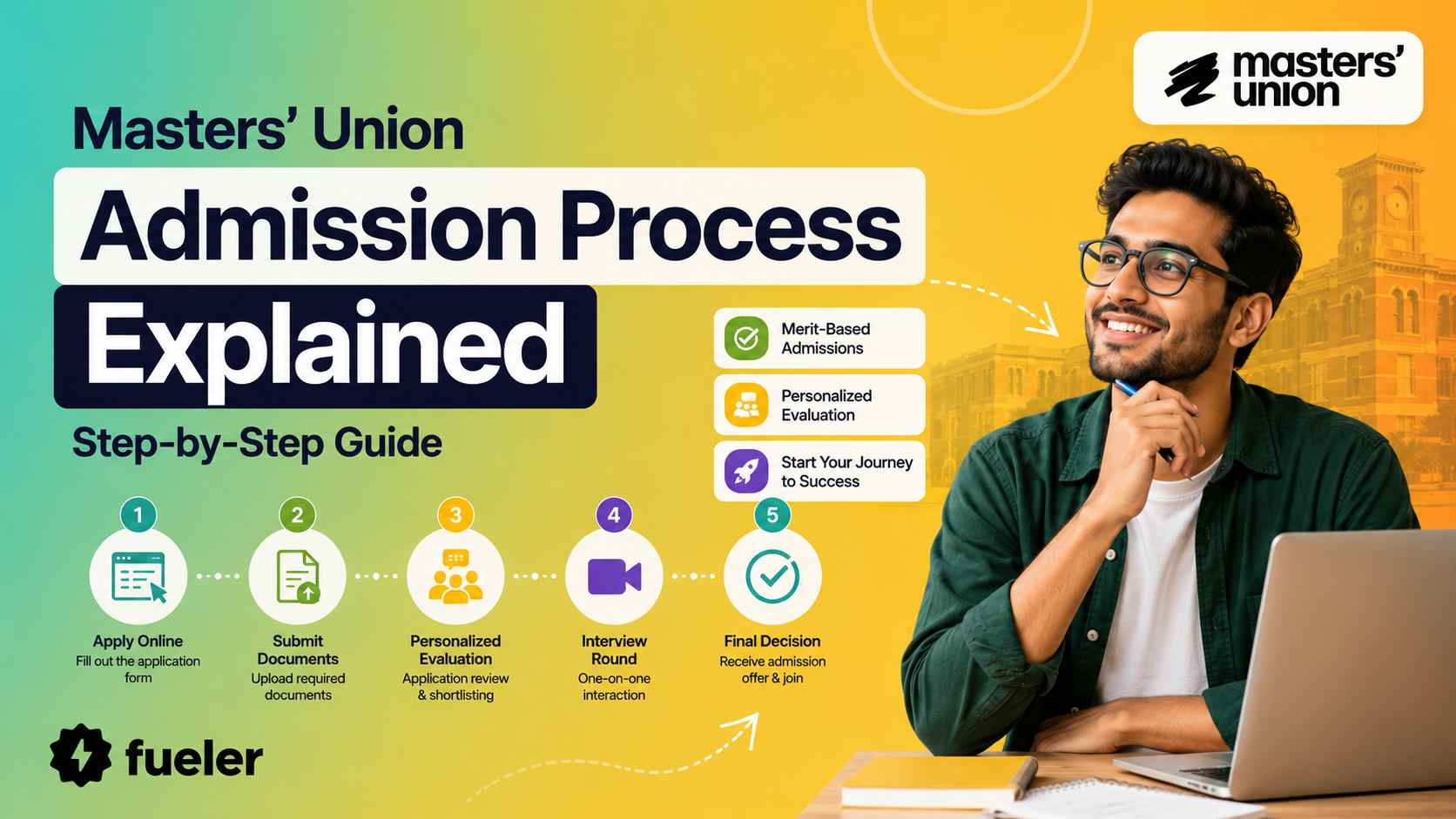
Step-by-Step Admission Process Guide
The admissions workflow runs systematically from online registration to final enrolment. Here is the step-by-step breakdown:
Step 1: Application Form Submission & Document Upload
Applicants begin by registering on the official portal and filling out their personal, academic, and professional details.
- Personal & Academic Details: Input your Class 10, 12, and undergraduate grades. Freshers and experienced candidates both apply, though most of the cohort typically brings 1 to 5 years of professional work experience.
- Resume & Documentation: Upload a concise, well-formatted resume alongside supporting academic marksheets and certificates.
- Test Score Selection: If you already possess valid scores from CAT, GMAT, or GRE, you can enter them directly to support your application.
- Application Fee: Pay the required fee for the corresponding round (typically ranging from ₹3,000 in Round 1 to ₹4,000 in later rounds).
Step 2: The Video-Based Response (VBR)
After submitting the base application, candidates are directed to complete a short, prompt-driven video assessment.
- The Prompt: You receive a random question on the spot assessing your thought process, ethical reasoning, or career motivation.
- Preparation & Recording: You get 1 minute to collect your thoughts, followed by 2 to 4 minutes to record your answer on video.
- Key Focus: Evaluation focuses on how logically you structure your ideas, how clearly you express them, and your overall confidence under pressure.
Step 3: Taking the MU-BAAT (If Applicable)
If you do not submit a CAT, GMAT, or GRE score, or if you feel your existing score does not accurately represent your ability, you must take the Masters' Union Business Aptitude and Assessment Test (MU-BAAT).
- Format: Conducted online during a designated exam window within 7 days of the round deadline.
- Sections: Includes quantitative reasoning, data interpretation, logical reasoning, verbal ability, and case-let-based business comprehension.
- Objective: Serves as a standardized benchmark for academic readiness across diverse applicant backgrounds.
Step 4: Profile Shortlisting
The admissions committee reviews the combined academic track record, entrance test performance, resume, work samples, and the video essay. Shortlisted applicants receive an invitation for the Personal Interview round with details on location or online schedule.
Step 5: Personal Interview & AI Assessment
Shortlisted candidates move into the final evaluation phase, which combines human insight with analytical tools.
- The AI Assessment: On the day of the interview, candidates complete an automated exercise at the venue designed to evaluate analytical processing, critical reasoning, and problem-solving abilities.
- The Personal Interview: A 30 to 45 minute conversation with a panel of startup founders, corporate executives, and faculty members. Panels dig into your past experience, test your understanding of business models, and evaluate how quickly you adapt to new challenges.
Step 6: Final Admission Decision & Enrollment
After synthesizing performance across all stages, the selection committee releases outcomes categorized under three heads:
- Accepted: Candidate receives an official offer letter specifying fee deadlines and merit scholarship decisions.
- Waitlisted: Candidate is placed on an unranked waitlist and re-evaluated as seats become available.
- Rejected: Candidate is not offered admission for the current academic year.
Round-Wise Timeline & Dates
The application timeline is divided into three distinct rounds. Applying in earlier rounds is generally recommended due to seat availability and early access to merit-based scholarships.
Practical Benefits of This Selection Model
- Comprehensive Evaluation: Candidates with modest test scores can still secure admission if they demonstrate exceptional real-world execution, solid communication, and strong portfolios.
- No Ghostwritten Essay Traps: On-the-spot video prompts ensure everyone competes on authentic, unscripted communication abilities.
- Direct Practitioner Feedback: Interacting with active founders and executives during interviews provides immediate, real-world context on industry expectations.
- Multiple Testing Pathways: You can present CAT, GMAT, or GRE scores, or rely on the internal MU-BAAT exam to show analytical aptitude.
Challenges and Limitations
- High Spontaneous Pressure: Unscripted video responses and on-the-spot case-lets can be demanding for candidates accustomed to memorized answers.
- Requires Concrete Evidence of Effort: Simply listing past job titles on a static resume is insufficient; candidates must demonstrate what they actually achieved or built.
- Competitive Cohort Sizing: Selective seat capacity across rounds means late applicants face stiffer competition for remaining spots.
Comparison: Masters' Union vs Traditional B-School Admissions
Program Fees and Tuition Breakdown
Understanding the fee layout helps you prepare your financial planning alongside your application strategy.
- Tuition Fee: Standard tuition for the 16-month PGP TBM stands at approximately ₹28,48,160.
- Admission & Security Fees: Admission fees and non-refundable deposits add roughly ₹90,000.
- Total Program Cost: Total base fees equal approximately ₹29,38,160 (excluding taxes, living costs, and personal accommodation in NCR).
- Scholarships: Merit-based and need-based scholarships are available for exceptional founders, diversity candidates, top entrance scorers, and outstanding creative builders.

Who Should Apply?
- Early-career professionals (1 to 5 years of experience) seeking fast-track roles in tech leadership, Product Management, or Founder's Office.
- Ambitious fresh graduates who possess strong proof of work, side projects, or case competition achievements.
- Startup aspirants, family business successors, and builders who prefer practical execution over academic lectures.
- Candidates who can demonstrate clear, logical communication and thrive under spontaneous evaluation.
Who Should Avoid Applying?
- Candidates looking exclusively for legacy public-sector management degrees or tenure-track academic research careers.
- Applicants who rely solely on memorized test templates and hesitate when asked to speak spontaneously on video or in interviews.
- Individuals who prefer traditional, purely theoretical lecture-based classroom instruction over active, project-driven learning.
Final Thoughts
The Masters' Union admission process reflects where modern business education is heading. By looking beyond static test scores and placing heavy emphasis on spontaneous communication, analytical agility, and verified proof of work, the program selects candidates ready for the modern workplace.
If you are planning to apply, focus on clarity over polish. Present your projects openly, build a clear record of your work on platforms like Fueler, practice structured thinking for the video response, and approach the CXO interview as a genuine business discussion. Candidates who present authentic execution ability will always stand out in this selection process.
Key Takeaways
- Multiple Test Options: You can submit valid CAT, GMAT, or GRE scores, or take the internal MU-BAAT exam.
- Spontaneous Video Prompt: The Video-Based Response (VBR) tests clear thinking and unscripted verbal communication.
- Practitioner-Led Interviews: Panels consist of active industry CEOs, startup founders, and managing directors.
- Integrated AI Testing: Shortlisted applicants undergo an on-site AI assessment evaluating critical reasoning.
- Proof of Work Focus: Concrete projects, live app metrics, and tangible portfolios weigh heavily in profile evaluation.
- Three Application Rounds: Applying in earlier cycles maximizes seat availability and financial award considerations.
FAQs
Is CAT or GMAT mandatory for Masters' Union admission?
No, CAT, GMAT, or GRE scores are not mandatory. If you do not have a valid score, you can take the online Masters' Union Business Aptitude and Assessment Test (MU-BAAT).
What is the Video-Based Response (VBR) round?
The VBR is a short video recording completed during the application process. Candidates receive an on-the-spot prompt and get 1 minute to prepare and 2–4 minutes to record their answer.
Who conducts the personal interviews at Masters' Union?
Personal interviews are conducted by a panel of active industry practitioners, including startup founders, CEOs, managing directors, venture capitalists, and senior business faculty members.
Can freshers without work experience apply?
Yes, fresh graduates can apply. While many students bring 1 to 5 years of work experience, exceptional freshers with strong academic records, projects, and execution ability are accepted.
What is evaluated during the on-site AI Assessment?
The AI Assessment takes place on interview day to evaluate a candidate’s critical thinking, logical deduction, and analytical decision-making capabilities using automated problem-solving modules.
What should you do next?
You've read the article. Now turn your skills into proof of work and unlock more opportunities.
Build your proof of work portfolio
Create a clean portfolio with projects, assignments, resumes, and AI stack details that companies actually want to see.
Create your Fueler portfolio →Apply through assignments, not resumes
Stand out by solving real tasks from companies hiring on Fueler.
Explore assignments →Get discovered by companies
Make your work public and let recruiters discover your skills through actual projects instead of keywords.
Get discovered →