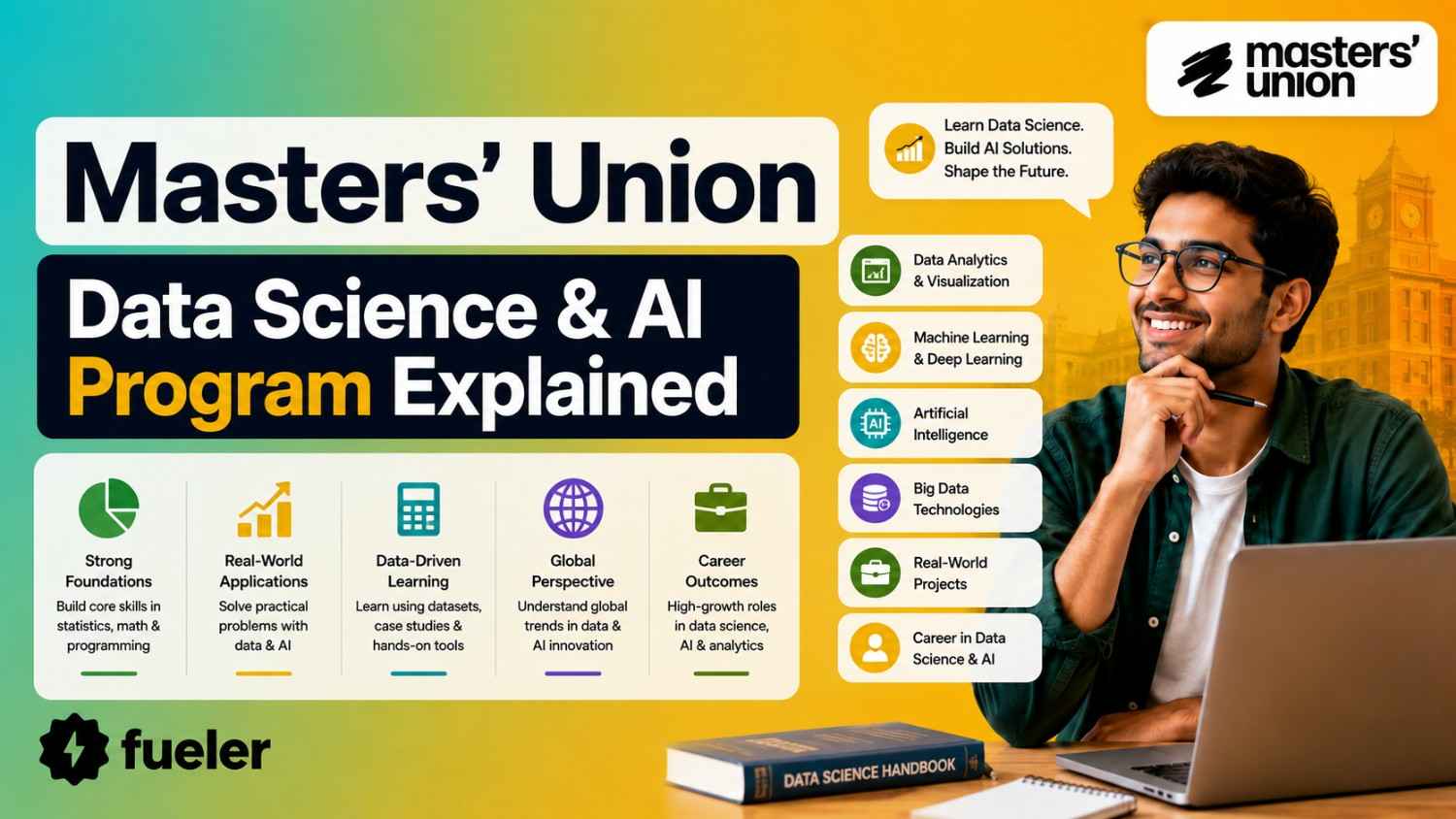
Masters' Union Data Science & AI Program Explained

Riten Debnath
17 Aug, 2026
Last updated: August 2026
For years, technical education followed a predictable formula. Students spent four years sitting in crowded lecture halls, solving mathematical proofs on blackboards, and writing pseudocode on paper. By the time they graduated with a computer science or data science degree, the technology stack used in real tech companies had completely evolved.
The arrival of production-grade Artificial Intelligence and LLM-driven software development pushed this gap to a breaking point. Today, fast-growing tech companies and venture-backed startups do not hire people just because they know basic Python syntax or can define what a neural network is. They hire engineers and analysts who can deploy machine learning models to production, fine-tune LLMs, pipeline complex data, and solve actual business problems on day one.
I’m Riten, founder of Fueler, a skills-first portfolio platform building the career infrastructure for 100 million creative professionals. Fueler connects talented individuals with companies through assignments, portfolios, and projects, not just resumes or CVs. Think of it as Dribbble/Behance for work samples combined with AngelList for hiring infrastructure.
In my work at Fueler, I witness the shifting hiring landscape every day. Tech leads and hiring managers consistently pass over resumes filled with static GPA scores in favor of candidates who share a link to a live GitHub repository, a deployed web app, or a verified project portfolio. This industry-wide demand for execution is why the Masters' Union Data Science & AI Program caught my attention. It completely flips traditional technical education on its head, swapping theoretical exams for product deployment and outclass engineering challenges.

Quick Answer Summary
- Who It Is For: Class 12 graduates with a background in mathematics, aspiring data scientists, AI engineers, product analysts, and tech founders.
- Cost: Base tuition of ₹52.50 Lakhs over 4 years, with additional hostel and one-time admission fees.
- Key Takeaway: Shifts learning from passive coding exams to building and deploying real AI products, fine-tuning open-source models, and spending a full year in industry immersion.
- Best Suited For: Practical learners who want to build a public portfolio of production-ready AI tools while learning in Gurugram's tech ecosystem.
What is the Masters' Union Data Science & AI Program?
The Masters' Union Data Science & AI Program is an applied 4-year undergraduate track built specifically for the post-AI software landscape. Rather than teaching computer science as a branch of pure mathematics, this program approaches data science and artificial intelligence as applied tools for solving real business problems.
Contextually, traditional engineering colleges teach data structures, linear algebra, and software theory in isolation. Students often graduate without ever deploying an API, setting up a vector database, or configuring a cloud pipeline. The Masters' Union program fixes this disconnect by having students build production-ready projects from their very first term.
Why does this matter? Because artificial intelligence has shifted from a niche academic research field to core business infrastructure. Modern tech companies require professionals who understand the entire data lifecycle from data ingestion and cleaning to model deployment, monitoring, and business integration. By blending technical depth with business context, this program trains students to operate effectively at the intersection of technology and business strategy.
Key Facts Table
Detailed Explanation
To get to the absolute core of what makes the Masters' Union Data Science & AI Program distinct, you have to look at how the curriculum maps to real-world engineering teams. It abandons standard academic silos to mirror how modern product teams build and release software.
Applied AI and Generative Models
Instead of spending an entire year studying basic algorithms before writing code, students begin working with modern AI frameworks from day one.
You learn to build functional software products by integrating foundation models, utilizing APIs, and creating custom conversational agents. As you progress, the focus moves from simply calling external APIs to understanding model architecture, fine-tuning open-source models (like Llama and Mistral), and implementing Retrieval-Augmented Generation (RAG) to handle custom enterprise datasets.
Data Engineering and Cloud Pipelines
A machine learning model is only as good as the pipeline feeding it data. Traditional computer science tracks often ignore data engineering, leaving graduates unable to handle dirty, unstructured real-world data.
In this track, students learn how to extract, transform, and load (ETL) large data streams. You work with SQL databases, NoSQL stores, and vector databases used for semantic search. Understanding how to structure data architectures, handle API rate limits, and deploy cloud infrastructure ensures your data models function reliably in live environments.
Classical Machine Learning and Predictive Analytics
While generative models capture headlines, modern businesses still run on classical predictive analytics.
Students build strong foundations in regression, classification, decision trees, clustering, and time-series forecasting. You learn how to take raw transactional data from e-commerce platforms or financial systems and predict customer churn, optimize pricing models, or forecast inventory demands. This bridges the gap between raw numbers and business decisions.
Software Engineering and Deployment (MLOps)
Writing a Python script in a Jupyter Notebook is completely different from running a model in production.
This program emphasizes Machine Learning Operations (MLOps). Students learn how to containerize applications using Docker, build robust backend APIs, manage version control on GitHub, and monitor model drift over time. Learning proper software deployment practices prevents your work from staying trapped on a local laptop.
How It Works
The 4-year journey moves step-by-step from beginner product development to full-scale industry integration.
Year 1: Foundational Coding, Applied AI, and Product Prototypes
- Learn core programming languages like Python and SQL alongside web fundamentals.
- Participate in hands-on building challenges, such as deploying functional AI chatbots for real users.
- Master foundational mathematics, including linear algebra, probability, and descriptive statistics.
Year 2: Data Engineering, Classical ML, and Vector Systems
- Build end-to-end data pipelines to clean, store, and query large datasets.
- Train, evaluate, and tune classical machine learning algorithms on real business datasets.
- Work with vector databases, embeddings, and semantic search frameworks to handle unstructured text data.
Year 3: Advanced Deep Learning, MLOps, and Venture Projects
- Study neural network architectures, computer vision basics, and natural language processing.
- Set up automated deployment pipelines, CI/CD workflows, and continuous model monitoring.
- Launch capstone tech projects or build internal data products to solve real operational problems.
Year 4: Full-Year Industry Immersion
- Spend your final year working directly inside corporate tech teams, growth startups, or research labs.
- Apply your skills to real-world production codebases and high-volume data architecture.
- Build a comprehensive, publicly accessible proof-of-work portfolio highlighting deployed systems, GitHub repos, and data case studies.
Benefits
Choosing a practical, project-focused technical degree delivers several clear advantages for early tech careers.
- Immediate Proof of Work: Rather than graduating with only a degree certificate, you exit with a public portfolio of live applications, fine-tuned models, and public repositories. Platforms like Fueler demonstrate that tech recruiters prioritize these verified artifacts over traditional credentials.
- Direct Access to Gurugram's Tech Hub: Studying in DLF Cyberpark places students in the same building complex as major technology companies, unicorn startups, and venture capital offices.
- Practitioner-Led Learning: Modules are taught and mentored by working data scientists, engineering leads, and AI founders who bring current production tools directly into class.
- Integrated Business Literacy: You learn how data science impacts unit economics, customer acquisition costs, and operational efficiency, making you far more valuable to product managers and founders.
- Full-Year Work Experience: The mandatory fourth-year industry immersion means you enter the full-time job market with a year of real corporate experience already under your belt.
Challenges and Limitations
It is essential to weigh the trade-offs before enrolling in a high-investment technical program.
- High Tuition Investment: With base tuition set at ₹52.50 Lakhs, the overall cost is significantly higher than traditional public engineering universities.
- Fast-Paced, Self-Directed Environment: Because the focus is on building continuous projects, passive students who expect step-by-step textbook instructions will feel overwhelmed.
- Non-Traditional Campus Setup: The campus is embedded within a corporate park. If you want a traditional university experience with sprawling sports fields and large residential quarters, this environment will feel very different.
- Math and Logic Prerequisites: Despite the heavy focus on modern software tools, mastering machine learning still requires strong quantitative skills in calculus, linear algebra, and probability.
Comparison: Masters' Union vs Traditional Engineering Degrees
Here is how this applied AI track compares to traditional engineering paths in India.
Fees and Cost Breakdown
Understanding the complete financial commitment helps you plan your educational investment accurately.
Tuition and Mandatory Fees
- Base Tuition Fee: ₹52.50 Lakhs spread across the 4-year program duration.
- One-Time Admission Fee: Approximately ₹1.80 Lakhs payable upon joining.
Living and Accommodation Expenses
- Hostel Fees: Approximately ₹20.88 Lakhs for 4 years depending on selected room type and amenities.
- Additional Costs: Living expenses, personal computing hardware, software cloud credits, and daily transport in Gurugram.
Financial Aid and Return on Investment (ROI)
- Scholarships: Merit-based scholarships are available based on entrance test performance (such as JEE, SAT, or MUSAT scores).
- Career ROI: To justify this financial investment, students should aggressively focus on securing roles in high-paying engineering teams, product analytics divisions, or venture-backed AI startups.
Career Opportunities
Graduates trained in applied AI and data engineering can target several high-growth technical roles across modern industries.
- AI Product Engineer: Building, fine-tuning, and integrating AI models into customer-facing software products.
- Data Scientist: Analyzing complex enterprise datasets, building predictive models, and optimizing business operations.
- Machine Learning Operations (MLOps) Engineer: Managing continuous model integration, cloud infrastructure, containerization, and data monitoring.
- Product Analyst / Growth Analytics Manager: Using quantitative data to track product usage, optimize user funnels, and guide product roadmap decisions.
- Technical Founder / AI Entrepreneur: Launching custom software products or automated B2B services using modern AI stacks.
Who Should Choose This Program?
- Students passing Class 12 with a strong math background who want to build real software products immediately.
- Learners who prefer hands-on building, public portfolio creation, and continuous project work over memorizing exam theory.
- Aspiring AI engineers and data scientists who want to spend their final year working inside actual tech companies.
- Future technical founders who want direct access to Gurugram's startup ecosystem and industry mentors.
Who Should Avoid This Program?
- Students seeking a low-cost traditional engineering degree with minimal upfront financial commitment.
- Individuals who prefer pure theoretical computer science research or plan to pursue academic doctorates immediately.
- Learners who struggle in fast-paced environments where self-initiative and active building are required.
- Candidates looking for a classic rural or semi-urban campus experience with traditional academic structures.
Final Thoughts
The tech industry has permanently moved past evaluating candidates purely on academic degrees. Today, your ability to write clean code, handle complex data pipelines, and deploy working AI applications is what secures high-impact roles.
The Masters' Union Data Science & AI Program offers a compelling alternative to traditional engineering degrees by treating software education like a modern apprenticeship. However, the program itself is simply a framework. Your ultimate career trajectory will depend on how consistently you build, document your code, and share your work publicly. On platforms like Fueler, we see proof every day that a well-documented portfolio of real projects will outshine any static degree when stepping into the tech world.
Key Takeaways
- The program is a 4-year applied undergraduate degree focused on software development, data engineering, and artificial intelligence.
- Includes a structured 3-year campus building phase followed by a full 1-year industry immersion.
- Faculty consists of active industry practitioners, software engineers, and tech founders.
- Total base tuition is ₹52.50 Lakhs over 4 years, excluding hostel and living expenses.
- Students build a public, production-ready portfolio of deployed apps, APIs, and machine learning models.
- Best suited for self-driven learners targeting fast-track tech roles in software engineering, MLOps, and AI product development.

Frequently Asked Questions (FAQs)
What is the Masters' Union Data Science & AI Program?
It is a 4-year undergraduate track combining computer science, data engineering, and machine learning, featuring 3 years of hands-on building and 1 year of full industry immersion.
What are the eligibility requirements for this program?
Applicants must have completed Class 12 with Mathematics and are evaluated through standardized test scores (such as JEE, SAT, or MUSAT) alongside personal interviews.
What is the fee structure for the program?
The base tuition fee is ₹52.50 Lakhs for 4 years, plus a one-time admission fee of ₹1.80 Lakhs and optional hostel costs of around ₹20.88 Lakhs.
How does the 1-year industry immersion work?
During the fourth year, students work directly inside corporate tech divisions, growth startups, or research teams to gain full-time production experience before graduating.
What roles can graduates target after finishing?
Graduates can enter roles such as AI product engineer, data scientist, MLOps engineer, product analyst, or technical startup founder.
Why 100,000+ professionals use Fueler
Fueler helps professionals showcase proof of work through projects, assignments, case studies, and achievements.
- Thousands of professionals use Fueler to create their digital portfolio
- Thousands of projects are published on Fueler. Check here
- Startups and Companies hire through proof of work on Fueler
- Used by freelancers, creators, marketers, video editors, writers, designers, and product managers
Our mission is to help the next 100 million professionals build a verified professional identity through proof of work

What should you do next?
You've read the article. Now turn your skills into proof of work and unlock more opportunities.
Build your proof of work portfolio
Create a clean portfolio with projects, assignments, resumes, and AI stack details that companies actually want to see.
Create your Fueler portfolio →Apply through assignments, not resumes
Stand out by solving real tasks from companies hiring on Fueler.
Explore assignments →Get discovered by companies
Make your work public and let recruiters discover your skills through actual projects instead of keywords.
Get discovered →