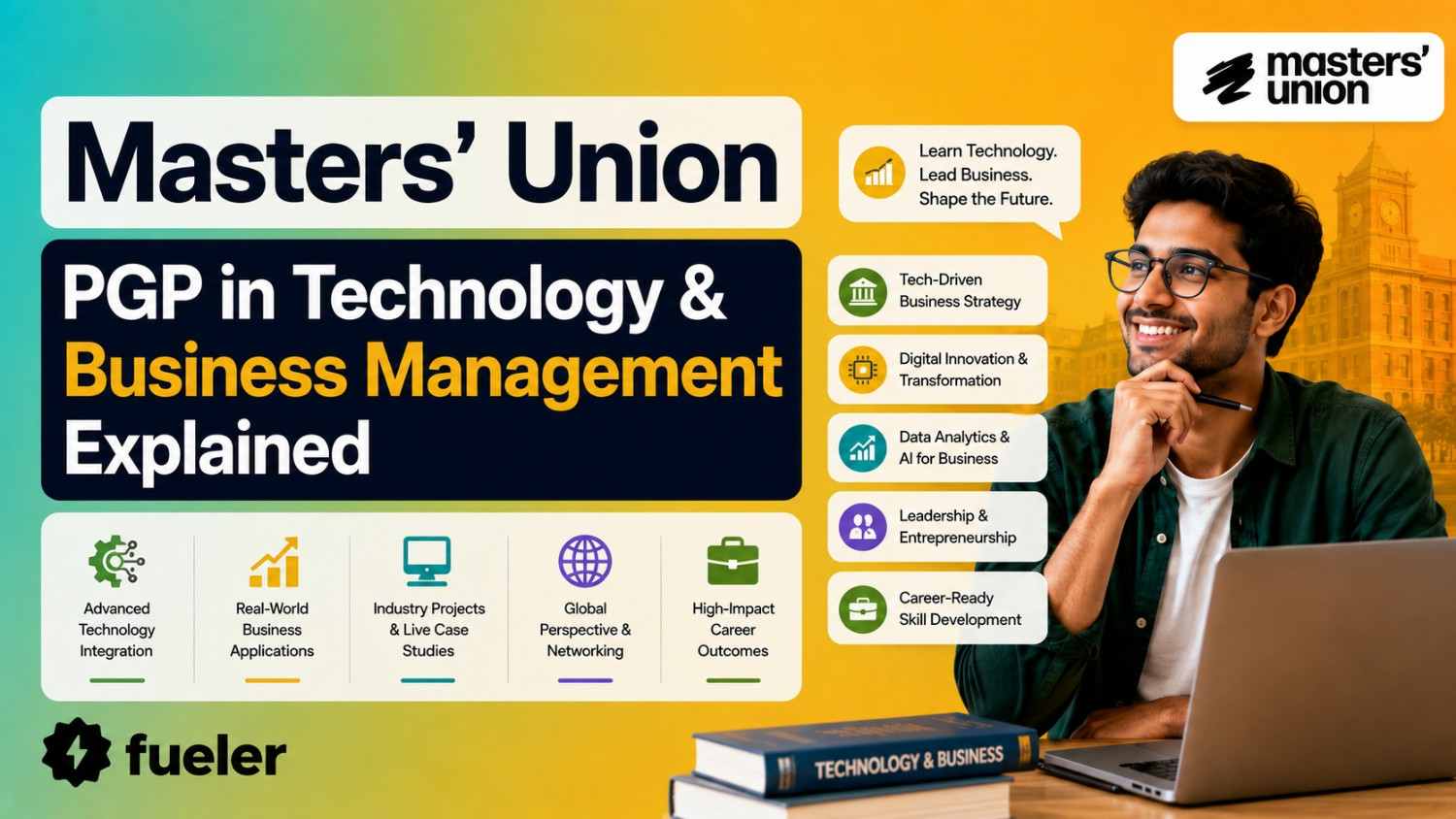
Masters' Union PGP in Technology & Business Management Explained

Riten Debnath
17 Aug, 2026
Last updated: August 2026
If you are considering a transition into product management, growth marketing, startup strategy, or the founder’s office, traditional management programs often miss the mark. A standard two-year MBA spends months analyzing legacy corporate structures and writing static case studies. However, fast-paced tech startups and venture-backed companies operate on rapid execution, real-time metrics, and verified proof of work.
I’m Riten, founder of Fueler, a skills-first portfolio platform building the career infrastructure for 100 million creative professionals. Fueler connects talented individuals with companies through assignments, portfolios, and projects, not just resumes or CVs. Think of it as Dribbble/Behance for work samples combined with AngelList for hiring infrastructure.
In my daily interactions with hiring managers, founders, and venture partners, the hiring rule in tech is clear: paper degrees do not secure senior startup roles; execution does. Candidates need to show live growth funnels, product specifications, and operational outcomes. This reality makes the Masters' Union Post Graduate Programme (PGP) in Technology & Business Management one of the most discussed business programs in India.

Quick Answer Summary
- Who It Is For: Professionals with 1 to 5 years of experience, fresh graduates with exceptional project track records, aspiring tech founders, and professionals pivoting into Product Management or Growth roles.
- Cost: The tuition fee is approximately ₹32.75 Lakhs, with total expenses (including living costs and taxes) ranging between ₹38 Lakhs and ₹43 Lakhs.
- Key Takeaway: Students swap traditional written exams for hands-on execution, including running dropshipping businesses, managing student investment funds, building software products, and completing a 3-month industry immersion.
- Best Suited For: Ambitious professionals who learn by building, want direct access to active VCs and CEOs, and plan to build a proof-of-work portfolio to enter high-growth technology companies.
What is Masters' Union PGP in Technology & Business Management?
The Masters' Union PGP in Technology & Business Management (PGP-TBM) is a 16-month flagship post-graduate program that serves as a modern alternative to traditional MBA degrees. Located inside DLF Cyberpark, Gurugram, the institute operates directly within a primary corporate and tech ecosystem rather than an isolated suburban campus.
The program relies on industry practitioners rather than tenured academic professors. Classes are taught by active startup CEOs, Venture Capital partners, Product Heads, and C-Suite executives.
The PGP-TBM approaches business as a craft learned through practice. From the first quarter, students run live e-commerce experiments, analyze real cap tables, build No-Code applications, and manage marketing spend. The core goal is to graduate candidates who possess functional skills in technology, business analytics, user acquisition, and financial modeling.
Key Facts Table
Detailed Explanation: Masters' Union PGP in Technology & Business Management Explained
To evaluate the Masters' Union PGP-TBM, you must look at how its structure differs from legacy business education. Traditional MBA programs rely on case discussions about events that happened decades ago. The PGP-TBM focuses on immediate execution, live market conditions, and modern tech tools.
Here is an in-depth breakdown of how the 16-month program operates across its core pillars:
1. The Core Pedagogy: Learning from Practitioners
Instead of academic scholars, the faculty includes managing directors, startup founders, and corporate leaders. Instructors bring their active playbooks into the classroom.
When students study growth marketing, they analyze real performance campaigns. When studying venture capital, they review active pitch decks and term sheets with investors. Feedback is provided based on market realities rather than standardized grading keys.
2. Micro-Businesses, Dropshipping, and Content Challenges
During the initial terms, student cohorts participate in practical execution sprints designed to teach business levers:
- The Dropshipping Challenge: Teams launch an e-commerce platform from scratch with zero inventory. They source products, set up storefronts, write copy, manage ad budgets, and handle customer queries. This process teaches supply chain management, unit economics, and customer acquisition.
- The Creator-preneur Sprint: Students build, distribute, and monetize media platforms or content channels. This teaches audience distribution, organic growth, and brand positioning.
3. The Venture Initiation Programme (VIP)
For students targeting entrepreneurship or early-stage startup leadership, the Venture Initiation Programme serves as an internal incubator. Student teams progress through market research, product wireframing, MVP development using No-Code platforms, and early go-to-market testing.
The program culminates in a Demo Day, where student founders present their live traction and revenue metrics directly to angel networks and early-stage VC funds.
4. Student-Managed Investment Fund
Finance modules are grounded in managing real capital. Students evaluate companies, build financial models, run risk scenarios, and allocate actual funds. Handling real investments provides practical experience in equity analysis, asset allocation, and market dynamics.
5. 3-Month Industry Immersion & Internship
The final quarter includes a mandatory 3-month industry immersion. Students work inside high-growth tech startups, venture capital firms, or corporate strategy units. This immersion allows candidates to apply their skills in real operational environments, often leading to pre-placement offers (PPOs).
6. Building Proof of Work for the Hiring Market
Startups and tech firms hire based on verified execution capability rather than paper resumes. Throughout the 16 months, students complete real-world projects, including product teardowns, growth audits, UI/UX wireframes, and financial models.
By publishing these project outcomes on platforms like Fueler, candidates present a verified portfolio to prospective employers. Showing a live dashboard, ad campaign metrics, or a working product specification gives students a clear advantage during interviews.
How It Works
The 16-month journey follows an execution framework designed to transition candidates into tech operators:
- Term 1 - Business & Tech Foundations: Students cover financial accounting, business statistics, No-Code development, AI-driven workflows, and digital marketing setups.
- Term 2 - Execution Sprints & Micro-Ventures: Cohorts manage live dropshipping stores, run content monetization challenges, and handle investment portfolios.
- Term 3 - Advanced Specializations & VIP: Students select concentrations in Product Management, Growth, Finance, or VC while building their core startup ventures.
- Term 4 - Industry Immersion & Placement: Students complete a 3-month internship inside partner firms, present on Demo Day, and secure full-time roles.
Benefits
Enrolling in an execution-focused post-graduate program offers distinct professional advantages:
- Tangible Portfolio Generation: Students graduate with verifiable case studies, live app prototypes, and ad campaign performance data published on platforms like Fueler.
- Direct Access to Industry Leaders: Studying under active founders, CEOs, and VCs creates organic networking and mentorship opportunities.
- Modern Toolstack Mastery: Curricula adapt rapidly to cover modern tools, including product analytics platforms, performance ad managers, AI frameworks, and No-Code tools.
- Location Advantage: Based in DLF Cyberpark, Gurugram, students operate alongside major tech platforms, venture funds, and corporate headquarters.
- High Career Mobility: The practical curriculum prepares candidates for high-growth roles, including Product Manager, Chief of Staff, and Growth Lead.
Challenges and Limitations
Applicants should weigh the following factors when considering the program:
- High Total Cost: Total expenses ranging between ₹38 Lakhs and ₹43 Lakhs require a clear financial plan and confidence in post-graduation outcomes.
- High Pace and Stress: Managing live business operations, ad budgets, and project deadlines alongside coursework creates an intense environment.
- Non-Traditional Academic Credential: The institute operates as an autonomous, industry-led b-school rather than a traditional state university, making it less ideal for legacy public sector roles.
Comparison Table
Fees and Cost Structure
The financial commitment for the PGP-TBM breaks down as follows:
- Base Tuition Fee: Approximately ₹32.75 Lakhs.
- One-Time Admission & Security Fees: Roughly ₹90,000.
- Hostel & Accommodation Costs: Off-campus living, food, and local transit in Gurugram typically add ₹5.2 Lakhs to ₹6.7 Lakhs over 16 months.
- Scholarships: Financial aid and merit-based grants are awarded through the MU-BAAT selection process to support top candidates.
Career Opportunities
Graduates of the PGP-TBM transition into key roles across tech companies, venture firms, and startups:
- Product Manager: Defining product roadmaps, writing PRDs, analyzing user churn, and managing development sprints.
- Chief of Staff / Founder's Office: Working alongside startup CEOs to run cross-functional operations, monitor business metrics, and lead strategy.
- Growth Marketing Lead: Building acquisition funnels, scaling performance ad campaigns, and optimizing conversion rates.
- Venture Capital Analyst / Associate: Evaluating startup business models, conducting market research, and managing portfolio support.
- Entrepreneur / Founder: Scaling independent ventures launched during the Venture Initiation Programme.
Who Should Choose This?
The PGP-TBM is well-suited for candidates who:
- Have 1 to 5 years of work experience and want to pivot into Product, Growth, or Strategy roles.
- Learn best by executing real-world projects rather than reading textbooks.
- Plan to launch a startup or join an early-stage venture.
- Value direct mentorship from active tech leaders, VCs, and founders.
- Want to build an undeniable portfolio on Fueler that showcases real project outcomes to top hiring teams.
Who Should Avoid This?
You should consider alternative options if you:
- Prefer structured, traditional academic environments focused on theoretical case studies.
- Seek careers strictly in legacy public-sector firms or traditional corporate hierarchies that require standard university degrees.
- Are uncomfortable with fast deadlines, open-ended business problems, and team-based execution.
Final Thoughts
The hiring market for business and tech roles has undergone a structural shift. Employers across fast-growing tech companies no longer hire based on paper degrees alone; they hire based on verified execution capability.
Programs like the Masters' Union PGP-TBM reflect this change by turning business education into an active operational experience. When students complement this training by organizing their live campaigns, product teardowns, and wireframes into a public portfolio on Fueler, they stand out to hiring managers. If your goal is to lead product teams, scale growth, or build a company, gaining 16 months of verified proof of work is a proven path forward.
Key Takeaways
- The Masters' Union PGP-TBM is a 16-month, practitioner-led management program in DLF Cyberpark, Gurugram.
- The faculty consists of active CEOs, startup founders, product leaders, and venture capital partners.
- Students build live dropshipping stores, run content platforms, manage real funds, and launch ventures.
- Includes a mandatory 3-month industry immersion inside tech startups or corporate units.
- Total estimated budget ranges between ₹38 Lakhs and ₹43 Lakhs.
- Publishing live project metrics on Fueler helps students prove their skills and secure roles in Product Management, Growth, or the Founder's Office.

FAQs
What is the duration of the Masters' Union PGP-TBM program?
The program spans 16 months, consisting of 13 months of intensive on-campus business training and a mandatory 3-month industry immersion internship inside a tech startup or corporate firm.
Which entrance exams are accepted for PGP-TBM admissions?
Masters' Union accepts scores from its proprietary exam, MU-BAAT, as well as CAT, GMAT, and GRE scores, followed by a detailed application review and personal interview.
How much does the PGP-TBM cost in total?
The base tuition fee is approximately ₹32.75 Lakhs. Including admission fees, taxes, food, and housing in Gurugram, total expenses range between ₹38 Lakhs and ₹43 Lakhs.
What career outcomes can students expect after completing the program?
Graduates secure roles such as Product Manager, Chief of Staff, Growth Marketing Lead, Venture Capital Analyst, or Business Operations Lead across tech startups and corporate firms.
How does proof of work help PGP-TBM students get hired?
Tech hiring teams prioritize practical execution over paper resumes. Showcasing live project data, ad campaign performance, and product teardowns on platforms like Fueler gives candidates verifiable proof of capability.
Why 100,000+ professionals use Fueler
Fueler helps professionals showcase proof of work through projects, assignments, case studies, and achievements.
- Thousands of professionals use Fueler to create their digital portfolio
- Thousands of projects are published on Fueler. Check here
- Startups and Companies hire through proof of work on Fueler
- Used by freelancers, creators, marketers, video editors, writers, designers, and product managers
Our mission is to help the next 100 million professionals build a verified professional identity through proof of work

What should you do next?
You've read the article. Now turn your skills into proof of work and unlock more opportunities.
Build your proof of work portfolio
Create a clean portfolio with projects, assignments, resumes, and AI stack details that companies actually want to see.
Create your Fueler portfolio →Apply through assignments, not resumes
Stand out by solving real tasks from companies hiring on Fueler.
Explore assignments →Get discovered by companies
Make your work public and let recruiters discover your skills through actual projects instead of keywords.
Get discovered →