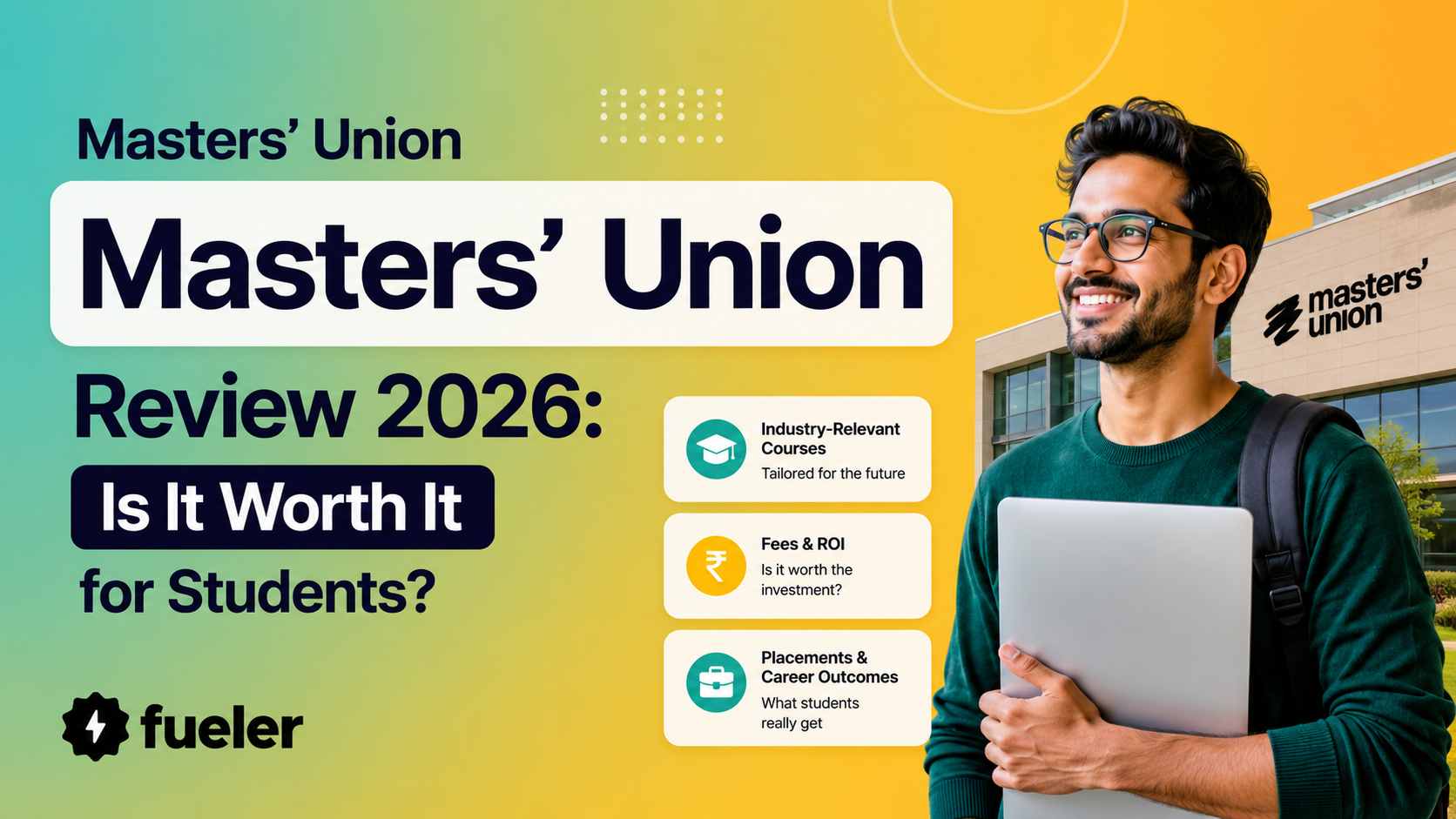
Masters' Union Review 2026: Is It Worth It for Students?

Riten Debnath
16 Aug, 2026
Last updated: August 2026
For years, traditional business schools in India operated on a predictable, comfortable formula: study legacy case studies, memorize management theories, clear written exams, and wait for campus recruiters to scan your two-page PDF resume.
Then came a fundamental shift in how modern companies hire.
Fast-growing startups, venture capital funds, and tech enterprises stopped asking candidates what they studied and started asking what they have actually built. Today’s market does not reward theoretical knowledge; it rewards execution, speed, and real proof of work.
I’m Riten, founder of Fueler, a skills-first portfolio platform building the career infrastructure for 100 million creative professionals. Fueler connects talented individuals with companies through assignments, portfolios, and projects, not just resumes or CVs. Think of it as Dribbble/Behance for work samples combined with AngelList for hiring infrastructure.
Running Fueler brings me face-to-face with founders, product leaders, and growth executives every single day. The consensus is clear: companies want operators who can launch campaigns, analyze data, manage product roadmaps, and drive P&L from day one.
That is why Masters' Union, a practitioner-led business and technology institute located in Cyber Park, Gurugram, sparked intense debate when it launched. Ditching traditional academic professors in favor of active CXOs, tech leaders, and investors, it promised a radical alternative to the conventional MBA.
Is Masters' Union genuinely transforming Indian business education, or is it a high-priced marketing experiment? Let's analyze the entire ecosystem using real data, placement outcomes, and industry realities.
Quick Answer Summary
- Who It Is For: Ambitious undergraduates, working professionals, career switchers, and aspiring startup founders looking to step into high-growth tech or operational roles.
- Cost: PGP tuition and fees range between ₹32.75 Lakhs to ₹37.5 Lakhs, while 4-year undergraduate programs cost around ₹52.5 Lakhs (excluding living costs).
- Placement Outcomes: Average domestic package stands at ₹33.39 LPA for the PGP cohort, with top international offers reaching ₹1.28 Cr.
- Key Takeaway: Highly effective for proactive builders who thrive on networking and portfolio creation, but requires a significant financial commitment.
- Best Suited For: Students who prioritize real-world projects, live business experiments, and industry connections over traditional textbook exams.

What is Masters' Union?
Masters' Union is an autonomous, industry-focused business and tech education institute situated in DLF Cyberpark, Gurugram. Instead of operating like a conventional university bound by rigid academic frameworks, it functions as a hybrid between an advanced business school and a startup accelerator.
The core idea is simple: business education should be taught by people who are actively doing business. Rather than relying on full-time academic researchers, the faculty at Masters' Union consists of corporate leaders, venture capitalists, product directors, and startup founders.
Students are trained through hands-on business challenges, real capital management, and live industry assignments. The entire pedagogy shifts the focus from passing written exams to creating a tangible portfolio of work.
Key Facts Table
Masters' Union Review: Detailed Explanation
Evaluating whether an institute like Masters' Union is worth your time and money requires looking far beyond its promotional campaigns. You need to analyze the underlying mechanics of its educational model.
1. The Faculty Paradigm: Active CXOs vs. Academic Professors
In traditional b-schools, professors spend most of their time publishing research papers. While academic research has its place, it rarely keeps pace with modern growth tactics, AI integrations, or real-time consumer shifts.
At Masters' Union, classes are led by active practitioners. A module on performance marketing might be taught by a growth head from a quick-commerce platform, while a product strategy course could be run by a product leader at Google or Flipkart. This gives students direct exposure to current workflows, modern tech stacks, and live industry problems.
2. Pedagogy Built Around Proof of Work
Theoretical exams do not tell a recruiter if you can actually do the job. Masters' Union builds its curriculum around real-world execution:
- E-Commerce Dropshipping Challenge: Student teams receive initial capital to source products, run digital marketing campaigns, optimize landing pages, and attempt to turn a profit within weeks.
- Student-Managed Investment Fund: Students manage real capital, pitch investment theses, and perform due diligence under the guidance of active VC partners.
- Product Teardowns & Launches: Students build and publish live projects, launching product prototypes on platforms like Product Hunt.
This aligns closely with what we see at Fueler: when candidates showcase verifiable proof of work such as live campaigns, UX audits, or product teardowns, their resume credentials become secondary. Recruiters hire the person who has already demonstrated they can do the work.
3. Cyber Park Location Advantage
The choice of Cyberpark in Gurugram is strategic. Because the campus sits right inside a major corporate hub, industry leaders can drop by for lectures or discussions after work. Networking is integrated into daily campus life rather than restricted to a once-a-year guest lecture series.

Existing Courses Offered
Masters' Union has expanded its academic ecosystem across both undergraduate and postgraduate levels:
1. PGP in Technology & Business Management (PGP-TBM)
- Duration: 16 Months
- Target Audience: Professionals with 1–5 years of work experience aiming to transition into Product Management, Founder's Office, Strategy, or Tech Operations.
- Core Focus: Advanced business strategy, financial modeling, product management, generative AI tools, and growth marketing.
2. PGP Young Leaders Cohort (YLM)
- Duration: 16 Months
- Target Audience: Fresh graduates and early professionals with under 1 year of work experience.
- Core Focus: Fundamental business management, practical digital execution, communication, and fast-paced career entry.
3. Undergraduate Program in Technology & Business Management
- Duration: 4 Years (Full-Time)
- Specializations: Tech & Business Management, Data Science & AI, Psychology & Marketing, Finance & Economics.
- Core Focus: Blending computer science fundamentals, design thinking, liberal arts, and business strategy for high school graduates.
4. Specialized Executive & Certificate Programs
- Duration: 5 to 15 Months (Hybrid/Part-time options)
- Options: Applied AI Systems, UI/UX Design, Family Business Leadership, and Growth Engineering.
How It Works: Admission Process
Admission to Masters' Union focuses on aptitude, leadership potential, and execution drive:
- Application Submission: Complete the online application highlighting your academic history, work experience, and personal achievements.
- Entrance Test (MUSAT): Candidates take the internal Masters' Union Scholarship Aptitude Test (MUSAT). Alternatively, scores from CAT, GMAT, GRE (for PGP) or SAT, JEE, CUET (for UG) can be submitted.
- Video Essay Submission: Applicants submit a concise video response answering prompt-based questions to demonstrate communication skills and problem-solving clarity.
- In-Person / Online Interview: A deep-dive interview conducted by industry executives, founders, or alumni to evaluate domain interest, business intuition, and cultural fit.
Evaluation weightage generally breaks down as: Interview (40%) + Test Scores (30%) + Candidate Profile (20%) + Video Essay (10%).
Practical Benefits
- Portfolio-First Graduate Profile: Instead of leaving with only a degree certificate, graduates possess an active portfolio of campaigns, teardowns, and live business metrics. Presenting these project samples on platforms like Fueler gives candidates a distinct edge during recruitment.
- Direct Access to Startup Founders: Industry leaders are primary course instructors rather than distant guest speakers.
- Rapid Career Pivots: Offers a clear path for professionals from traditional engineering or service backgrounds to pivot into high-paying Tech, Strategy, or Founder's Office roles.
- Updated Curriculum: The teaching framework evolves quickly to incorporate real-world tools, including SQL, no-code platforms, and AI workflows.
Challenges & Limitations
Prospective students should carefully weigh these limitations before applying:
- High Tuition Investment: The fees represent a substantial financial commitment, requiring a clear financial plan or student loan strategy.
- Non-Traditional Academic Credential: Masters' Union operates as an autonomous, industry-driven institute rather than a traditional UGC-accredited state university. If your goal is to pursue a PhD or apply for traditional government jobs, you will need to check specific credit equivalency requirements.
- High-Paced Environment: The intense focus on real-world projects and tight deadlines requires strong self-motivation. It is not designed for passive learners who expect traditional lecture-based teaching.
Masters' Union vs Traditional Top MBAs
Fees, Total Costs & ROI Breakdown
Here is a breakdown of the overall investment required:
1. PGP in Technology & Business Management (PGP-TBM)
- Tuition & Admission Fees: Approximately ₹32.75 Lakhs to ₹37.5 Lakhs
- Living Expenses (Gurugram): ~₹5 Lakhs to ₹6.5 Lakhs (depending on housing and personal preferences)
- Total Estimated Budget: ~₹38 Lakhs to ₹44 Lakhs
2. Undergraduate Program (4 Years)
- Tuition Fees: ~₹52.5 Lakhs
- Total Estimated Budget (with living costs): ~₹62 Lakhs to ₹66 Lakhs
Return on Investment (ROI)
With an average domestic PGP CTC of ₹33.39 LPA, most PGP graduates achieve a payback period of 1.5 to 2.5 years. However, taking out heavy loans means you should have a clear career plan and take full advantage of campus networking opportunities.
Career Opportunities & Placement Outcomes
Placement reports highlight strong demand across tech, startup, and growth sectors:
Overall Placement Figures
- Average Domestic CTC: ₹33.39 LPA
- Highest Domestic CTC: ₹1.28 Crore PA
- Top 25% Average CTC: ₹54.80 LPA
- Average International CTC: ₹64 LPA (with 30 international and remote offers secured across UAE, US, and Europe)
Salary Breakdown by Roles
Who Should Choose Masters' Union?
- Aspiring Startup Founders: Candidates who want access to mentorship, investor networks, and real execution frameworks to build their own companies.
- Professionals Seeking Tech Pivots: Engineers, consultants, or operations professionals aiming to transition directly into Product Management, Strategy, or Founder's Office roles.
- Action-Oriented Builders: Students who prefer learning through real projects, live business challenges, and public portfolio creation over traditional textbook studies.
Who Should Avoid Masters' Union?
- Candidates Seeking Public Sector Roles: Anyone looking for conventional government jobs, PSU management positions, or policy roles that require a traditional UGC-stamped master's degree.
- Risk-Averse Learners: Individuals who prefer the security of legacy university names and traditional academic structures.
- Passive Students: Anyone who expects a diploma alone to land them a job without actively building projects, networking, and creating proof of work.
Final Thoughts
The modern job market has changed permanently. Brand credentials on a resume still matter, but fast-growing tech companies and venture-backed startups prioritize execution capability above all else.
Masters' Union has successfully demonstrated that practitioner-led education can deliver strong real-world outcomes. While the financial investment is significant, the access to active business leaders, live project experience, and strategic Cyber Park location offer undeniable value.
Whichever educational path you choose, remember that your career growth ultimately relies on your ability to demonstrate real capability. Publish your work, document your projects, and build a public portfolio that clearly displays what you can deliver.
Key Takeaways
- Practitioner Faculty: Courses are taught directly by active CXOs, VCs, and tech leaders rather than academic professors.
- Cyber Park Advantage: Located in Gurugram, giving students constant, direct access to corporate hubs and tech ecosystems.
- Strong Salary Outcomes: Flagship PGP domestic packages average ₹33.39 LPA, with top international offers reaching ₹1.28 Cr.
- Substantial Investment: Program costs range from ₹32.75 L for PGP to ₹52.5 L for 4-year undergraduate tracks, requiring clear financial planning.
- Portfolio Driven: Success at Masters' Union relies on building live campaigns, running business experiments, and creating verifiable proof of work.
Frequently Asked Questions (FAQs)
What is the average package at Masters' Union?
The domestic average package for the PGP in Technology & Business Management stands at ₹33.39 LPA, while the top 25% of the batch averages ₹54.80 LPA.
Is Masters' Union an approved university degree?
Masters' Union offers autonomous, industry-focused postgraduate and undergraduate certificates designed around practical skills, rather than traditional UGC-accredited state university degrees.
How much do programs cost at Masters' Union?
The PGP tuition fee is between ₹32.75 Lakhs and ₹37.5 Lakhs, while 4-year undergraduate programs cost around ₹52.5 Lakhs, excluding living expenses.
What entrance exams are accepted for admission?
Masters' Union accepts its internal test (MUSAT) along with CAT, GMAT, and GRE for PG programs, or SAT, JEE, and CUET for UG courses.
Who hires graduates from Masters' Union?
Top recruiters include tech giants, quick-commerce platforms, and VC firms like Google, Microsoft, Razorpay, Zomato, Zepto, CRED, and Antler.
Why 100,000+ professionals use Fueler
Fueler helps professionals showcase proof of work through projects, assignments, case studies, and achievements.
- Thousands of professionals use Fueler to create their digital portfolio
- Thousands of projects are published on Fueler. Check here
- Startups and Companies hire through proof of work on Fueler
- Used by freelancers, creators, marketers, video editors, writers, designers, and product managers
Our mission is to help the next 100 million professionals build a verified professional identity through proof of work

What should you do next?
You've read the article. Now turn your skills into proof of work and unlock more opportunities.
Build your proof of work portfolio
Create a clean portfolio with projects, assignments, resumes, and AI stack details that companies actually want to see.
Create your Fueler portfolio →Apply through assignments, not resumes
Stand out by solving real tasks from companies hiring on Fueler.
Explore assignments →Get discovered by companies
Make your work public and let recruiters discover your skills through actual projects instead of keywords.
Get discovered →