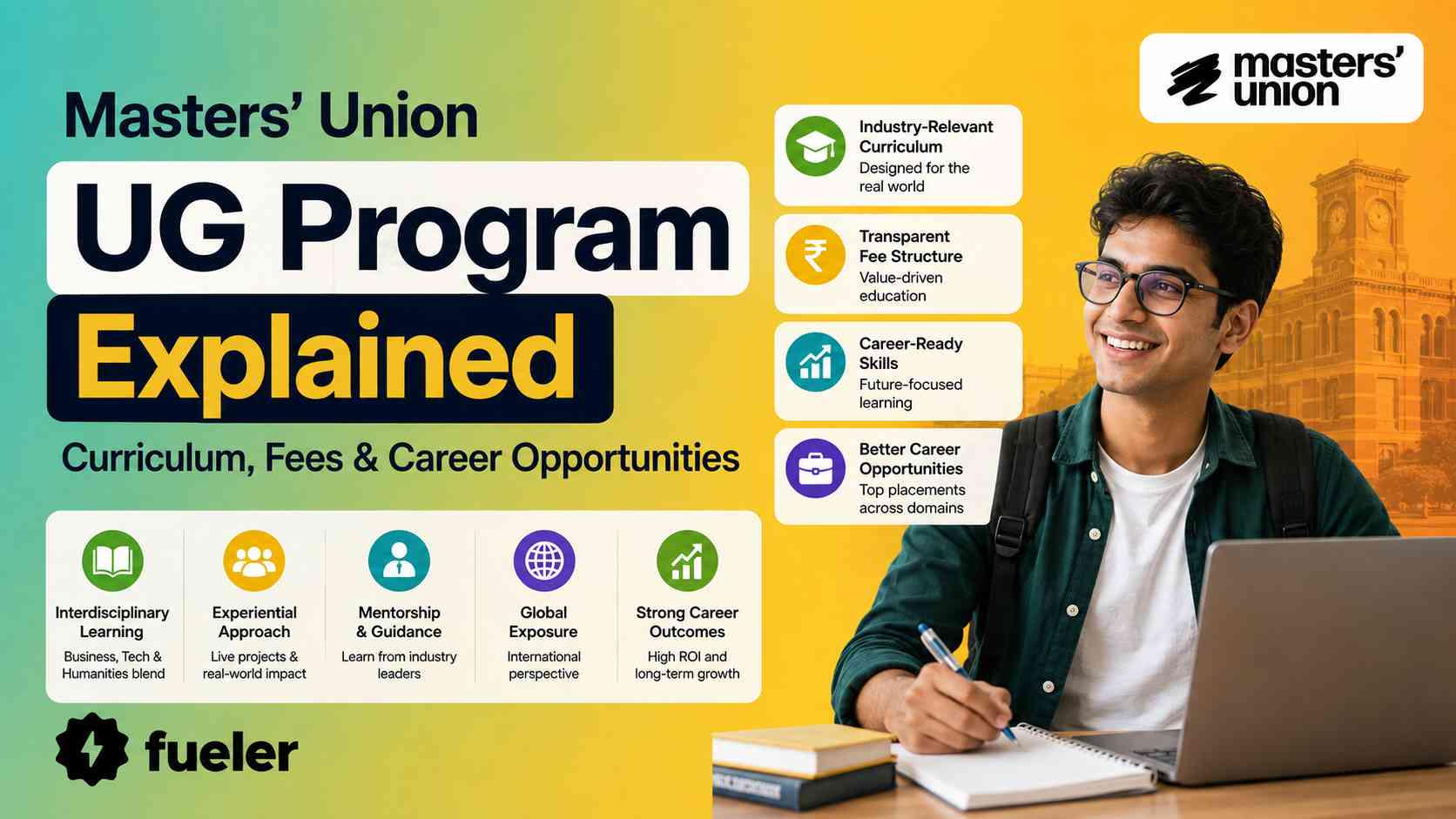
Masters' Union UG Program Explained: Curriculum, Fees & Career Opportunities

Riten Debnath
17 Aug, 2026
Last updated: August 2026
Is a traditional four-year degree still the smartest launching pad for someone who wants to build, lead, or scale a tech startup straight out of high school? Or are hands-on, practitioner-led undergraduate models taking over?
I’m Riten, founder of Fueler, a skills-first portfolio platform building the career infrastructure for 100 million creative professionals. Fueler connects talented individuals with companies through assignments, portfolios, and projects, not just resumes or CVs. Think of it as Dribbble/Behance for work samples combined with AngelList for hiring infrastructure.
When the Masters' Union UG Program launched, it immediately caught my attention because it mirrors the exact shift we observe across the global startup ecosystem. Traditional college programs teach business out of 10-year-old textbooks. Modern tech companies, venture capital firms, and high-growth startups do not care about exam marksheets; they hire based on proof of work, execution capacity, and real-world problem-solving.
This detailed guide breaks down the Masters' Union UG Program covering its curriculum structure, fee breakdown, placement trends, global tracks, and whether it makes financial sense for you.
Quick Answer Summary
- Who it is for: High school pass-outs (Class 12), gap-year students, and aspiring founders who prefer building projects over memorizing theory.
- Cost: Baseline tuition fees range around ₹52.5 Lakhs, with overall accommodation and program tracks pushing total expenses between ₹54 Lakhs and ₹67.5 Lakhs.
- Key Takeaway: You trade standard academic lectures for hands-on business runs, direct mentorship from industry leaders, and live product launches.
- Best Suited For: Students targeting roles in the Founder's Office, Product Management, Growth Marketing, or launching their own venture.

What is the Masters' Union UG Program?
The Masters' Union UG Program is a four-year, full-time undergraduate course located in DLF Cyberpark, Gurugram. Unlike classic BBA or B. Tech degrees taught by career academics, this program is delivered directly by CXOs, tech founders, product heads, and venture capitalists.
The core premise is straightforward: business education should happen inside the business ecosystem. Rather than writing essays on market strategy, students run dropshipping stores, build no-code digital apps, design performance ads, and audit actual corporate P&L statements.
The curriculum bridges technology and management. Students learn programming, data analytics, product architecture, financial modeling, and venture scaling simultaneously. It caters to a generation of students who do not want to wait until graduation to start creating value.
Key Facts Table
Detailed Explanation
Year 1: Foundations of Technology and Business
The first year focuses on building fundamental competencies across software, business design, and data. Students do not spend hours listening to theoretical economics; they are introduced to Python, database management, digital product design, and microeconomics through practical application.
YEAR 1 TIMELINE
Term 1: Code & Web Basics ──► Term 2: Dropshipping Sprint ──► Term 3: Data & Analytics
During Year 1, students participate in the Dropshipping Challenge. They receive seed capital to set up e-commerce stores, source products, run Meta and Google ads, handle customer logistics, and track net profit margins. This exposes teenagers to unit economics, ad-spend optimization, and inventory supply chains within their first six months.
Year 2: Specializations and No-Code Product Builds
In the second year, students choose focused specialization tracks such as Data Science & AI, Tech & Business Management, Marketing & Psychology, or Finance. The emphasis shifts from basic technical literacy to product deployment.
Students are expected to build and ship functional web applications using no-code engines, APIs, and low-code infrastructure. At Fueler, we see how high-growth startups evaluate young talent: they skip standard resume lines and look directly at what you have built, launched, and managed. Masters' Union builds this habit into the academic schedule.
Year 3: Startup Incubation and Venture Grants
Year 3 moves beyond simulated classroom exercises into live venture development. Students who want to build startups can pitch to the in-house Venture Fund for seed grants, incubator space, and direct access to angel investors.
STUDENT VENTURE INCUBATION CYCLE
Pitch Idea ──► Secure Seed Grant ──► Build MVP ──► Test Customer Acquisition ──► Scale / Pivot
For students not taking the founder path, Year 3 involves consulting projects for enterprise brands and fast-growing unicorns. They analyze user drop-offs, optimize retention metrics, write SQL queries for real datasets, and present findings directly to company leadership teams.
Year 4: Global Immersion and Career Placement
The final year prepares students for corporate roles or scaling their established startups. Students can spend semesters abroad at partner hubs in North America, Europe, or East Asia to study international supply chains and cross-border SaaS operations.
YEAR 4 TRAJECTORY
The remainder of the year is devoted to apprenticeships, corporate integrations, and career placements. Students build a portfolio of verified projects and campaigns, product teardowns, code repositories, and financial models to present to hiring managers.
How It Works
- Applied Learning Modules: Terms run on intensive, focused blocks where students master one subject at a time by building a working output rather than taking end-of-term exams.
- Practitioner-Led Instruction: Classes are taught by active industry operators, VC partners, growth leads, product leaders, and startup engineers who bring current frameworks into the room.
- Out-of-Class Challenges: Students run live e-commerce stores, manage student investment funds, and create content campaigns.
- Portfolio Construction: Every assignment produces a public artifact. Students publish case studies, code bases, and market research online to document their skills.
- Industry Placement Network: Recruiters interact with students throughout the four years via live industry projects, bypassing traditional resume screens.
Benefits
- Verified Proof of Work: Graduates finish four years with a live portfolio of products, marketing campaigns, and business teardowns rather than a list of course codes.
- Direct Ecosystem Access: Being located in DLF Cyberpark, Gurugram, puts students inside India's major tech and startup hub alongside top funds and corporate headquarters.
- Operator Mentorship: Learning directly from active founders and executives offers realistic insights into how companies operate today.
- Modern Skill Set: The curriculum updates constantly to include AI tools, no-code development, performance marketing, and modern data analytics.
- Early Venture Launch: Students get access to seed funding, feedback, and legal infrastructure to launch real businesses while still in college.
Challenges / Limitations
- High Financial Commitment: Total costs reaching ₹54 to ₹67.5 Lakhs make this program a major investment that requires careful financial planning.
- Intense Workload: The fast-paced environment and continuous project drops are demanding for students seeking a classic college experience.
- Evolving Academic Brand: As a newer institution compared to decades-old universities, recognition is concentrated heavily within tech, VC, and startup ecosystems rather than traditional PSU or government routes.
- Non-Traditional Structure: Students who thrive in structured, exam-driven academic environments may find the open-ended, project-based setup challenging.
Comparison Table
Fees and Cost Analysis
Evaluating the Masters' Union UG Program requires looking closely at total cost versus expected outcomes.
- Tuition Fees: The baseline program fee sits around ₹52.5 Lakhs for the four-year track.
- Living & Accommodation Expenses: Hostel, housing, and food options in and around Cyberpark, Gurugram, add between ₹9.9 Lakhs and ₹13.2 Lakhs over four years.
- One-Time Deposits: Admission, registration, and lab security deposits total roughly ₹1.8 Lakhs.
- Scholarships: Merit-based and need-based financial assistance options exist via the MU-SAT entrance track, which can offset tuition costs based on test scores and applicant profiles.
Career Opportunities
Graduates target modern tech, venture-backed, and corporate roles where multi-disciplinary execution is needed:
- Founder’s Office & Chief of Staff: Working directly with startup CEOs on operations, fundraising, and cross-functional projects.
- Associate Product Manager (APM): Translating customer needs into tech requirements and working with design and engineering teams.
- Growth Marketing Specialist: Managing performance ad budgets, building retention loops, and driving customer acquisition.
- Data Analyst: Querying product databases, running experiments, and delivering business intelligence dashboards.
- Venture Capital Analyst: Evaluating early-stage startups, running sector research, and supporting investment due diligence.

Who Should Choose This?
- Aspiring startup founders who want to launch products with dedicated incubation support while pursuing a degree.
- High school graduates who prefer hands-on coding, building, and marketing over memorizing textbook chapters.
- Students targeting high-growth roles like APM, Founder's Office, or Growth Marketing straight out of college.
- Self-driven learners who enjoy working in fast-paced, collaborative environments.
- Candidates who want direct access to industry leaders, startup operators, and venture investors.
Who Should Avoid This?
- Students seeking a traditional, low-stress university experience focused on exam-based evaluations.
- Candidates targeting government sector exams, public administration, or traditional PSU career paths.
- Families looking for low-cost undergraduate education options without taking on major financial commitments.
- Learners who struggle in unstructured environments where success depends on proactive project execution.
Final Thoughts
The Masters' Union UG Program represents a clear shift in how business education is delivered for the modern startup economy. It replaces static lectures with active building, live product drops, and direct industry mentorship.
If your goal is to work in high-growth tech companies, join a Founder's Office, or build your own company, learning through execution is far more effective than reading case studies written decades ago.
However, given the total financial investment of ₹54L to ₹67.5L, families should evaluate the cost carefully against their expectations. At Fueler, we see every day that long-term career success comes down to your verified proof of work. Whether you enroll in a program like Masters' Union or take an independent path, building real projects remains the most reliable way to stand out.
Key Takeaways
- Masters' Union offers a 4-year undergraduate program in Tech and Business Management located in Gurugram.
- The faculty consists of active industry practitioners, startup founders, CXOs, and venture capitalists.
- Total program costs range from ₹54 Lakhs to ₹67.5 Lakhs, including tuition, living, and registration fees.
- Learning is driven by real-world challenges, including e-commerce store drops, product launches, and consulting sprints.
- Top career paths include Founder's Office, Product Management, Growth Marketing, and Data Analytics.
- Merit and need-based scholarships are available via the MU-SAT entrance test process.
FAQs
What is the Masters' Union UG Program?
It is a 4-year undergraduate degree combining business management, technology, data analytics, and real-world startup execution taught directly by industry practitioners.
What is the total cost of the Masters' Union UG Program?
Baseline tuition is around ₹52.5 Lakhs, while total costs reach between ₹54 Lakhs and ₹67.5 Lakhs, including accommodation, living expenses, and deposits.
What entry exams are accepted for admission?
Admissions accept scores from the internal MU-SAT entrance test, as well as SAT, JEE Main, or CUET scores, followed by profile evaluation and personal interviews.
What career roles do graduates typically pursue?
Graduates target fast-growing roles including Founder's Office, Associate Product Manager (APM), Growth Marketer, Data Analyst, and Venture Capital Analyst.
Are scholarships available for undergraduate students?
Yes, Masters' Union provides both merit-based and need-based scholarships awarded through performance in the MU-SAT exam, JEE/SAT scores, and candidate profile reviews.
Why 100,000+ professionals use Fueler
Fueler helps professionals showcase proof of work through projects, assignments, case studies, and achievements.
- Thousands of professionals use Fueler to create their digital portfolio
- Thousands of projects are published on Fueler. Check here
- Startups and Companies hire through proof of work on Fueler
- Used by freelancers, creators, marketers, video editors, writers, designers, and product managers
Our mission is to help the next 100 million professionals build a verified professional identity through proof of work

What should you do next?
You've read the article. Now turn your skills into proof of work and unlock more opportunities.
Build your proof of work portfolio
Create a clean portfolio with projects, assignments, resumes, and AI stack details that companies actually want to see.
Create your Fueler portfolio →Apply through assignments, not resumes
Stand out by solving real tasks from companies hiring on Fueler.
Explore assignments →Get discovered by companies
Make your work public and let recruiters discover your skills through actual projects instead of keywords.
Get discovered →