Meta is Reportedly in Talks to Invest in Cred

Riten Debnath
19 Jun, 2026
Big news broke this week. Meta is reportedly in talks to invest in Kunal Shah's Cred. The number being discussed is around a $4 billion valuation. Nothing is signed yet. But the signal is loud.
When a company like Meta starts circling an Indian fintech, it tells you where attention and money are moving in 2026. India's payments space is becoming one of the most contested markets on the planet. And the people who build inside it early tend to win big.
So here is the real question for you. If Cred is about to enter a new chapter, how do you get a seat at that table? Not by waiting. By building.
I'm Riten, founder of Fueler, a portfolio platform that helps professionals get hired through proof of work and projects instead of just resumes. I've watched hundreds of people skip the line at top startups by showing work before anyone asked for it. Let me show you how to do the same with Cred.
What We Know About the Meta and Cred Deal
Let me keep this clean and factual. Here is what has been reported so far.
Meta is reportedly in talks to invest in Cred at a valuation of around $4 billion, according to a Moneycontrol report. The structure is still open. Reports suggest a few paths are being explored: fresh primary capital of tens of millions of dollars, a possible full acquisition at a lower valuation, and even a potential operating role for founder Kunal Shah at Meta. No final deal has been decided.
For context, $4 billion sits slightly above Cred's revised $3.5 billion valuation in 2025. It is still below the $6.4 billion peak the company hit in 2022.
Why does Meta care? Its interest appears tied to its India digital payments ambitions. Think about what Meta already owns: discovery on Facebook and Instagram, commerce on WhatsApp, and a clear need for payments infrastructure underneath all of it. Cred could be a strong piece in that puzzle. Treat this as context, not confirmation. Nothing here is final.
The Cred basics also matter if you want to work there. Cred was founded by Kunal Shah in 2018 and is headquartered in Bengaluru. It serves creditworthy Indian consumers. In FY25, operating revenue hit ₹2,735 crore, up 16% year on year. Operating losses fell 51% to ₹298 crore. Monthly transacting users rose to 1.26 crore. Total payment value processed rose 23% year on year to ₹8.5 lakh crore.
Read those numbers again. This is a company that is scaling and trimming losses at the same time. Companies in that phase hire fast, and they hire for impact.
Why companies are likely to prefer proof of work over resumes
Here is something most job seekers miss. A company drawing Meta-level interest is not short on applicants. It is short on signal.
When a startup is scaling across marketing, growth, product, design, and content, the hiring teams are flooded. Everyone sends the same resume. Same template. Same buzzwords. A resume tells them what you claim. It does not show them how you think.
Proof of work flips that. Instead of saying "I'm good at growth," you show a growth teardown of their own product. Instead of saying "I can design," you redesign one of their flows. Now you are not a candidate in a pile. You are a person who already did the job.
This is the whole idea behind building a career portfolio that actually gets jobs. You move the proof to the front. You let the work do the talking before you ever send an email.
Founders notice this fast. I've seen people get replies from busy CEOs in a day, not because of a referral, but because the work was undeniable. That is the lane I want you in with Cred.
How to Build Proof of Work for Cred, by Department
Now the practical part. You do not need a job at Cred to build for Cred. You can study their product, pick a problem, and ship a small, sharp piece of work around it.
Below is one concrete proof-of-work idea for each major function. Pick the one that matches the role you want. Keep it focused. One strong project beats five weak ones.
Marketing
Cred is known for a premium brand and bold campaigns. So speak that language. Here are five things you could build:
- Campaign teardown. Break down one Cred ad or launch. What worked, what you would change, and why. Show you understand their taste, not just theory.
- Sample campaign for a feature. Pick a real or imagined Cred feature and create a full campaign concept, with copy, hooks, and creative direction.
- Referral campaign redesign. Cred grew on word of mouth. Design a sample referral program with the offer, the message, and the share moment.
- Brand voice and positioning doc. Write a short guide that captures Cred's tone and how you would extend it to a new product line.
- Ad creative set. Build three to five ad creatives for a single feature, each with a hook, a headline, and a one-line note on who it targets.
Go-to-Market (GTM)
Cred ships new products often, from rewards to payment features. Show you can take an idea from zero to live. Five ideas:
- Full GTM plan for a feature. Pick one feature and define the launch message, the channel mix, the rollout timeline, and the first 30-day success metrics.
- Ideal customer profile doc. Map who the feature is for, segment them clearly, and explain which segment to win first and why.
- Pricing and packaging proposal. Suggest how a new Cred product could be priced or bundled, with the logic behind each choice.
- Partnership and channel strategy. Cred works with banks and D2C brands. Propose two or three partnerships and how each one drives users.
- Launch playbook. Build a step-by-step plan for launch week, including pre-launch teasers, launch-day actions, and the metrics you would watch.
Growth
Open the Cred app and study the journey. Growth roles are won by people who think in loops and tests. Five things you could build:
- Onboarding funnel teardown. Map the signup flow, call out two or three drop-off points, and propose a fix for each.
- Retention experiments. Suggest three experiments to bring users back, each with a clear hypothesis and the metric that would prove it worked.
- Referral loop redesign. Rework how Cred turns one happy user into two, with the incentive, the trigger, and the share path.
- Activation audit. Define the "aha moment" for a new Cred user and propose how to get more people there faster.
- Lifecycle messaging audit. Review the notifications and emails a user might get, then design a better sequence with test ideas.
Design
Cred has one of the highest design bars in Indian tech, so this is your chance to match it. Five ideas to build:
- Redesign one flow. Rework a single screen or flow in the Cred app, paired with a short case study that explains every choice.
- New feature concept. Design a feature Cred does not have yet, from the idea to the core screens, with your reasoning.
- Design system audit. Study Cred's components and spacing, then document what makes the system work and where you would refine it.
- Microinteraction concept. Design one small animation or interaction, like a reward reveal, and explain how it adds delight.
- Usability teardown. Find a friction point in the app, explain the problem in plain words, and show your improved version.
If you want a model for how to present these, look at how designers create their portfolio on Fueler and study the way they document choices.
Product
Show a product team you can find the real problem, not just add features. Five things you could build:
- PRD for a new feature. Frame the user problem, propose the solution, sketch the core flow, and list what to build first versus later.
- Product teardown. Pick one existing Cred flow, explain what it does well, and point out where it could be sharper.
- Competitive analysis. Compare Cred with one or two rivals on a single job, and show where Cred can pull ahead.
- User research synthesis. Talk to five Cred users, or run a short survey, then write up the patterns and what they mean for the product.
- Roadmap proposal. Suggest the next three features in order, with the reason each one earns its slot and the risk you would watch.
Content
Cred has a sharp voice and a smart, curious audience. Content roles are won by samples, not by claims. Five ideas:
- Social post set. Write five posts in Cred's voice for one product or theme. Aim for clarity and wit over fluff.
- Newsletter draft. Write one full newsletter issue a Cred user would actually open and read to the end.
- Content calendar. Plan two weeks of content across channels, with the topic, format, and goal for each piece.
- SEO article. Write one search-friendly piece around a Cred theme, like rewards or credit scores, that could rank and bring in readers.
- Community or video idea. Pitch a recurring content format, like a short series or a community ritual, with a sample script or post.
How to Package and Pitch Your Proof of Work to Cred
Building the work is half the job. Packaging it well is the other half.
A pile of files on your laptop helps no one. You need a public link you can drop into an email, a DM, or an application in one line. That is why a Fueler portfolio beats a cold resume every time. A resume gets skimmed. A live portfolio gets clicked, explored, and remembered.
Here is a simple way to pitch it once your work is live and public.
- Keep your message short. Two or three lines. Lead with the work, not your bio. Something like: "I built a growth audit of the Cred onboarding flow with three experiment ideas. Here's the link. Would love your thoughts." That is it.
- Send it to the right people. Hiring managers for the function. Team leads. Sometimes the founder, if the work is strong enough to earn that. On a tight job hunt, two sharp DMs beat fifty generic applications.
- Make the link do the heavy lifting. When someone opens it, they should instantly see who you are, what you can do, and proof you have done it. That is the standard I'd hold you to.
If you want a structured path for this, I'd point you to our guide on how to build a proof-of-work portfolio on Fueler step by step. It walks through the exact flow from raw work to a public link.
How to Build Your Proof of Work Portfolio on Fueler
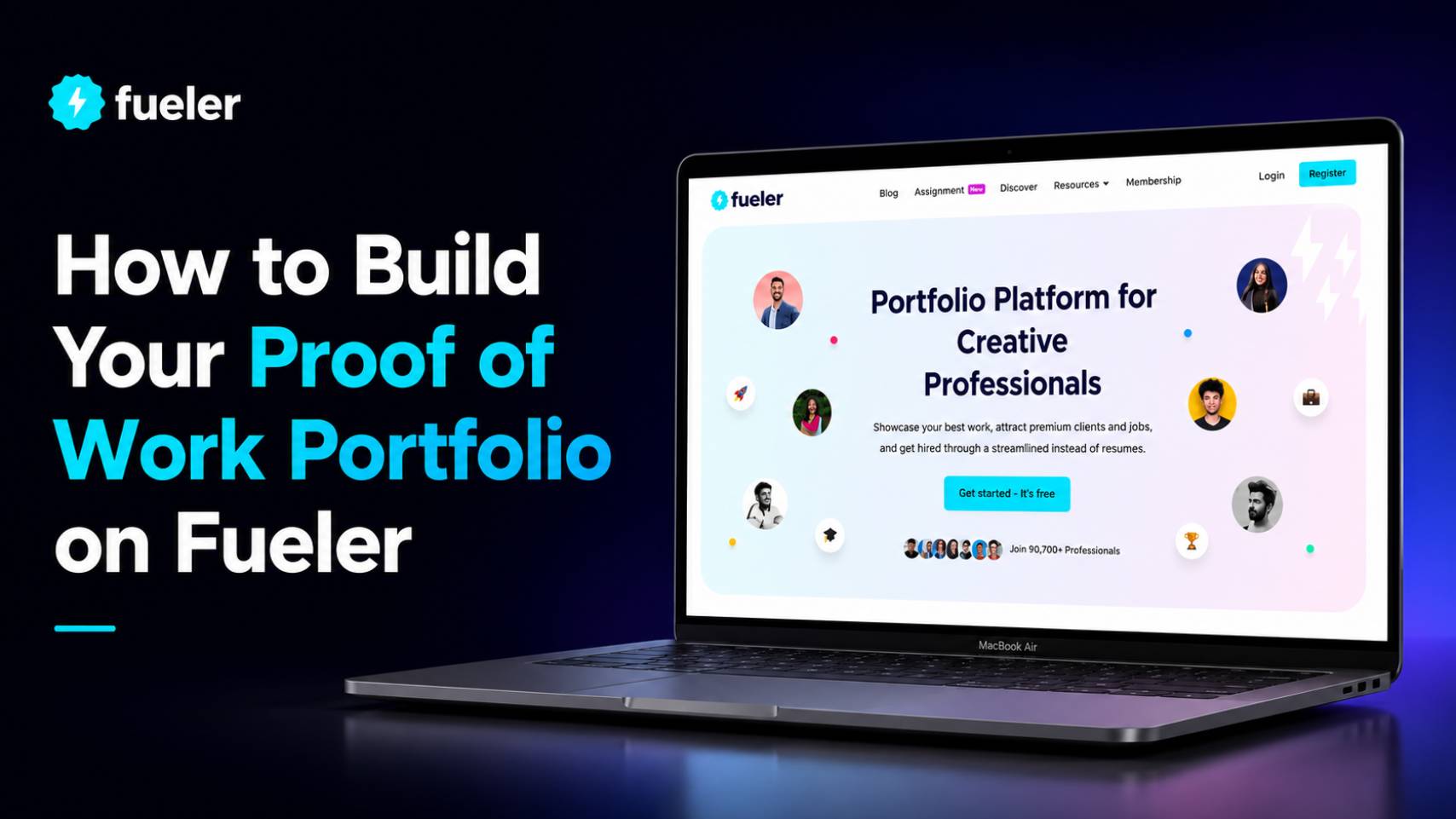
Let me make this concrete. Here is how I'd set up your portfolio so it lands with a team like Cred. I built Fueler for exactly this moment.
- Sign up on Fueler.io. It takes a minute to get started.
- Choose a professional handle. Keep it clean and simple, not something kiddish you'll regret sending to a founder.
- Add a clear profile picture. Use the same quality you'd put on LinkedIn. People judge fast, so give them a reason to trust you.
- Write a strong header. This is the first thing anyone sees. In a line or two, say who you are, what you do, and what you've shipped. Make it sharp.
- Add a short bio. Fill in the rest of your story in plain words, so people know who they're dealing with.
- Add your skills and social links. People do check your socials, and it quietly builds credibility. Skipping this is a missed signal.
- Set up your Device Configuration. Find it in your dashboard. Remote-first companies, and many startups hire remote, want to see you have a solid setup. A strong setup gives you quiet leverage.
- Add your projects. Think that Cred growth audit or design case study. Give each one a clear title and a detailed description. Don't just show the final output. Walk through your process, your thinking, the tools you used, and what went into the build. Companies want to see how you work, not only what you made.
Add your AI Stack to each project. Show how you used AI in the work, what prompts or tools sped you up, and where your own judgment shaped the result. Here's how to add your AI stack on Fueler so it reads as a skill, not a shortcut.
That is the full setup. If you want a shorter mental model to follow while you build, this 6-step formula that works while creating your Fueler portfolio is worth a read before you publish.
Final Thoughts
Here is the truth I keep coming back to. The Meta and Cred news is exciting, but it is not the point. The point is what it signals.
Money and talent are flowing into India's payments space. Companies in this lane are scaling, and they are hungry for people who can do the work, not just describe it. That opening will not stay open forever.
You do not need permission to start. You do not need a referral. You need one strong piece of proof of work, made public, sent to the right person. That is how people skip the line, and it is the whole reason I built Fueler.
Pick a function. Build one project around Cred this week. Put it online. Then send it. The deal may or may not happen. Your skill, and the proof of it, is yours either way.
Frequently Asked Questions
1. Is Meta really investing in Cred?
As of now, it is reported but not confirmed. Meta is reportedly in talks to invest in Cred at a valuation of around $4 billion, according to a Moneycontrol report. The structure is still open, with options like fresh capital, a full acquisition at a lower price, or even a role for Kunal Shah at Meta being explored. No final deal has been announced. Treat it as a strong signal of where India's payments market is heading, not as a done deal. Always check the latest news before you quote any number as final.
2. How do I get a job at Cred without a referral?
You build proof of work before you apply. Study their product, pick one real problem, and ship a focused project around it, like a growth audit, a redesign, or a launch plan. Put it on a public portfolio. Then send a short, direct message to the right hiring manager or team lead with the link. A referral helps, but undeniable work gets replies on its own. The goal is to walk in as someone who has already done a slice of the job, not as one more resume in a crowded inbox.
3. What is proof of work in hiring?
Proof of work is evidence that you can actually do a job, shown through real projects, assignments, and samples instead of just claims on a resume. A resume tells a company what you say about yourself. Proof of work shows them how you think and what you can build. It could be a case study, a teardown, a product document, a design, or a campaign. In a competitive market, proof of work is the fastest way to stand out, because it removes the guesswork for the person hiring you.
4. How do I build a portfolio to apply to startups like Cred?
Start with one strong project tied to the company or role you want. Document your process clearly, not just the result. Then host it on a public portfolio you can share in one link. On Fueler, you set a professional handle, add a clear header and bio, list your skills and socials, and upload projects with detailed write-ups of your thinking and tools. Add your AI stack too. The aim is a link that proves, in under a minute, that you can do the work. That link beats a cold resume in almost every case.
5. Does Cred hire based on assignments?
Many fast-scaling startups, including in fintech, use assignments and real-world tasks as part of hiring, because they reveal far more than a resume does. While exact processes vary by team and change over time, the safest move is to show proof of work upfront so you are ready either way. If you arrive with a relevant project already built, you often shorten or skip parts of the test. Build the work first, make it public, and let it speak before any formal assignment lands in your inbox.
What should you do next?
You've read the article. Now turn your skills into proof of work and unlock more opportunities.
Build your proof of work portfolio
Create a clean portfolio with projects, assignments, resumes, and AI stack details that companies actually want to see.
Create your Fueler portfolio →Apply through assignments, not resumes
Stand out by solving real tasks from companies hiring on Fueler.
Explore assignments →Get discovered by companies
Make your work public and let recruiters discover your skills through actual projects instead of keywords.
Get discovered →