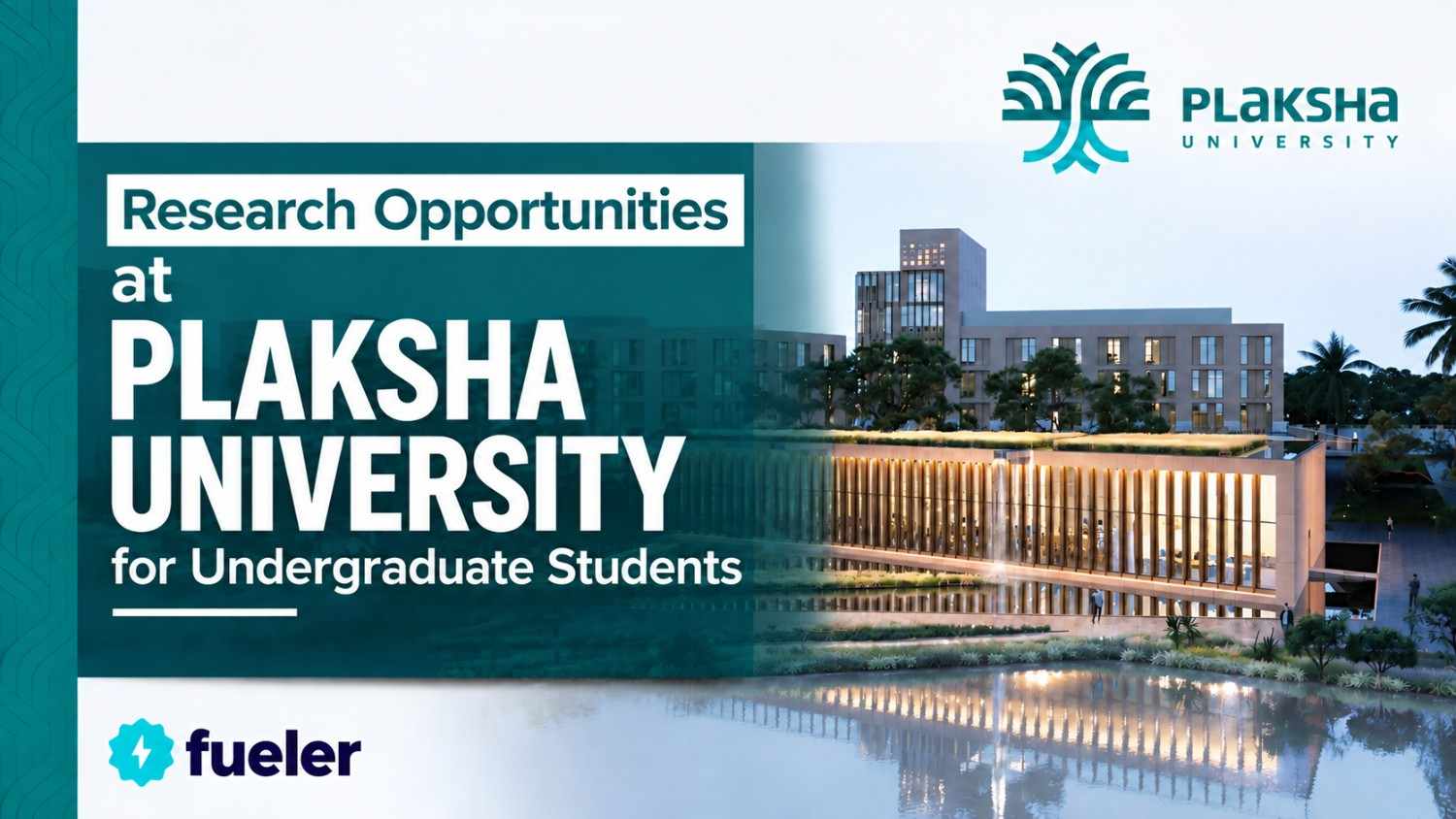
Research Opportunities at Plaksha University for Undergraduate Students

Riten Debnath
31 Aug, 2026
Last updated: August 2026
Most traditional engineering colleges treat undergraduate research as a side project reserved for final-year students filling out resume bullet points. If you walk onto a typical campus in India, research laboratories are locked away for PhD scholars, while undergraduates are confined to rigid textbook curriculums and pre-scheduled lab manuals.
I’m Riten, founder of Fueler, a skills-first portfolio platform building the career infrastructure for 100 million creative professionals. Fueler connects talented individuals with companies through assignments, portfolios, and projects, not just resumes or CVs. Think of it as Dribbble/Behance for work samples combined with AngelList for hiring infrastructure.
In my work tracking how early-stage talent transitions into high-impact startup roles, I consistently see one trend: traditional degrees fail to give students proof of work. When I started digging into how alternative higher education models are tackling this gap, research opportunities at Plaksha University for undergraduate students caught my attention. Plaksha is attempting to rewire technical education by integrating hands-on research, cross-disciplinary projects, and industry-backed centers right from year one.
Here is an analytical, experience-backed guide to how undergraduate research actually functions at Plaksha, what the ecosystem offers, and whether it aligns with your career trajectory.

Quick Answer Summary
- What it is: A hands-on, interdisciplinary research ecosystem built into four-year BTech programs (Computer Science & AI, Robotics & Autonomous Systems, Biological Systems Engineering, and Data Science, Economics & Business).
- Who it is for: Undergraduates looking to build proof of work through patents, lab projects, papers, and startup prototypes rather than theoretical exam scores.
- Key Centers: Indorama Ventures Center for Clean Energy, Center for Water Security, Center for Sustainable and Precision Agriculture, and Center for Equitable and Personalized Health.
- Cost & Funding: Regular BTech tuition applies, with research grants, seed funding for student ventures, and international travel grants for selected projects (e.g., IEEE competitions).
- Key Takeaway: You start working on real industrial and scientific problems in your first and second year instead of waiting for a master's degree.
- Best Suited For: Students planning for top global master's/PhD programs, R&D roles in deep tech startups, or founding tech-led companies.
What is Undergraduate Research at Plaksha University?
At most Indian universities, "research" for a BTech student means writing a literature review or executing a lab experiment where the outcome is already printed on the back page of a manual. At Plaksha University, undergraduate research is structured as an active problem-solving framework.
Instead of isolating fields into strict silos like mechanical engineering, civil engineering, or computer science, Plaksha forces students to solve grand global challenges using cross-disciplinary tools.
For example, a student working on water security does not just test pH levels in a chemistry lab. They write machine learning algorithms to optimize sewage treatment plants, use spatial sensors to track urban pollutants, and deploy autonomous surface vehicles to gather data from open water bodies.
This structural shift matters because the tech industry no longer hires based on grade point averages alone. Modern recruiters in high-growth startups and R&D labs look for verified proof of work. At Fueler, we see founders completely bypass traditional resumes when a student can show actual software repositories, hardware schematics, or published research papers. Plaksha designs its undergraduate curriculum so that research becomes an engine for generating that exact proof of work.
Key Facts Table
Detailed Explanation: The Core Research Ecosystem
To evaluate research opportunities at Plaksha University for undergraduate students, you need to understand how their specialized labs and dedicated research centers operate. These facilities do not exist purely for faculty output; undergraduates actively run experiments, program hardware, and process data inside them.
1. ARK Foundation Robotics Lab
- What it is: A specialized facility dedicated to building autonomous drones, ground vehicles, and underwater robots.
- Why it matters: Most university robotics labs restrict access to basic Lego kits or simple microcontrollers. This lab provides industry-grade mechatronics, sensor fusion setups, and testing rigs.
- How undergraduates participate: Students design tethered drones for public health applications (such as targeted vector control) and autonomous surface craft for environmental sampling.
- Real-world implications: Undergraduates build autonomous field systems using computer vision and machine learning rather than just simulating code on a screen.
2. Center for Water Security & WaTeR Lab
- What it is: A transdisciplinary center focused on urban water monitoring, wastewater treatment, and resource recovery.
- Why it matters: Clean water management is one of South Asia’s most pressing engineering challenges.
- How undergraduates participate: Students work on hand-held optical sensors designed to detect heavy metals like Chromium, Arsenic, and Uranium in drinking water at sub-ppm levels. They also help deploy AI models to optimize energy usage in Sewage Treatment Plants.
- Real-world implications: Student research connects directly to industrial deployment. Campus installations powered by IoT dashboards track live water quality, translating lab work into real proof of work.
3. Dixon IoT Lab
- What it is: An applied Internet of Things facility created in partnership with electronic manufacturing leaders.
- Why it matters: It bridges the gap between hardware engineering and software analytics.
- How undergraduates participate: Students build real-world IoT networks. For example, through an MoU with the Punjab Police, researchers and undergraduates design sensor suites to monitor road safety and reduce accidents.
- Real-world implications: Students work on real infrastructure data instead of running artificial benchmark tests.
4. Indorama Ventures Center for Clean Energy & Microclimate Lab
- What it is: A research hub driving decarbonization, energy efficiency, smart grid design, and microclimate management.
- Why it matters: Urban heat islands and rising cooling demands require non-traditional building materials and smart power distribution.
- How undergraduates participate: Students collect thermal data, design energy modeling algorithms, and evaluate smart building retrofits.
- Real-world implications: Undergraduates enter clean-tech, sustainability engineering, and energy analytics careers with direct project exposure.
How It Works: The Undergraduate Research Journey
Plaksha does not wait until your final year to introduce research methodologies. The journey is integrated into the core learning path across all four years.
Year 1: Foundation and Challenge Discovery
- Students take core courses covering computational thinking, basic electronics, data science, and design principles.
- Faculty expose students to active research projects across the four core centers.
- Students learn to write code, design basic prototypes, and read scientific literature.
Year 2: Lab Integration & Faculty Apprenticeship
- Students join specialized labs like the Dixon IoT Lab or Molbio IVD Lab as research assistants or project members.
- Teams start building functional prototypes and collecting field data.
- Students submit proposals to internal and external design competitions (e.g., IEEE AP-S Design Contest).
Year 3: Industry & Interdisciplinary Projects
- Research expands into industry-backed projects supported by external grants or MoUs.
- Students combine disciplines—such as using computer vision (CS) to guide autonomous drones (Robotics) for crop analysis (Agriculture).
- Teams document their findings into proof of work portfolios to showcase to potential employers or venture funds.
Year 4: Capstone, Commercialization, or Academic Publication
- Students complete a year-long capstone project focused on original research or deep tech venture creation.
- Projects with commercial potential transition into the Plaksha Center for Entrepreneurship for seed support.
- Research-focused teams publish their findings in peer-reviewed journals or apply for global master's/PhD programs.
Benefits of Undergraduate Research
Taking part in active research early in your college life offers clear advantages over standard textbook learning:
- Production-Grade Proof of Work: Instead of presenting a generic online course certificate, you can show live hardware builds, GitHub repositories, or published papers. At Fueler, we see that applicants who demonstrate real project artifacts get noticed far faster by hiring managers than those with static resumes.
- Direct Access to Top Faculty: Faculty members at Plaksha bring research backgrounds from institutions like MIT, Cambridge, Purdue, and IISc. Undergraduates work directly with professors rather than being filtered through layers of PhD scholars.
- Cross-Disciplinary Skill Sets: You do not just write code or assemble circuits in isolation. You learn how biological systems, software algorithms, mechatronics, and environmental science intersect.
- Stronger International Applications: Top global universities look for original research capacity when evaluating candidates for MS and PhD programs. Having actual lab experience gives you a distinct advantage.
- Pathways to Deep Tech Founding: If your research leads to a practical innovation, you can translate your intellectual property into a venture with support from Plaksha’s entrepreneurship ecosystem.
Challenges and Limitations
Research-driven programs are not the right fit for every student. You should weigh these real challenges before enrolling:
- High Workload and Ambiguity: Unlike traditional colleges where passing exams relies on memorizing fixed notes, research requires dealing with constant trial and error. Experiments fail, and code breaks.
- Fewer Legacy Campus Placement Pipelines: Plaksha is a newer institution compared to legacy IITs or NITs. While corporate partnerships are growing rapidly across tech, consulting, and analytics, traditional mass-recruitment campus drives are not the primary focus.
- Requires High Self-Drive: Research facilities, labs, and mentors are readily available, but nobody forces you to use them. If you do not actively seek out faculty projects, you risk missing the core value of the ecosystem.
- Niche Career Focus: If your only goal is to secure a standard IT maintenance or entry-level software testing job, an intensive research-heavy BTech environment might demand far more effort than necessary.
Comparison Table: Research Models
Fees and Financial Considerations
Undergraduate research at Plaksha is integrated directly into the BTech degree structure.
- BTech Tuition & Hostel Fees: Plaksha’s fee structure reflects its private infrastructure, modern lab facilities, and global faculty model. Total annual costs (covering tuition, accommodation, and campus amenities) generally fall between ₹7,00,000 and ₹9,00,000 per year.
- Financial Aid & Scholarships: Plaksha offers need-based and merit-based financial aid to ensure qualified candidates are not turned away due to financial constraints.
- Research & Travel Support: Selected undergraduate projects receive institutional grants. For instance, student teams competing in international events (like the IEEE AP-S Design Contest in the USA) have received prototyping funds ($1,500) and travel stipends ($6,000).
- Return on Investment (ROI): The ROI should be measured by the strength of your output. Graduates entering R&D roles, deep tech startups, consulting firms, or top-tier global graduate programs can leverage their proof of work to command higher starting salaries and fellowship awards.
Career Opportunities
Engaging in rigorous undergraduate research opens up distinct career tracks across multiple industries:
- Deep Tech & AI Engineering: Building autonomous systems, specialized AI models, or IoT infrastructure leads naturally to roles in robotics companies, autonomous vehicle firms, and AI labs.
- Biotech & Diagnostic Healthcare: Work done inside labs like the Molbio IVD Lab prepares students for R&D positions in healthcare tech, medical devices, and diagnostics startups.
- Clean Energy & Climate Tech: The global shift toward net-zero drives strong demand for engineers who understand microclimates, grid modernization, and smart energy systems.
- Core Product Management & Founder's Office: Early-stage deep tech startups value engineers who can break down complex technical problems and build real solutions.
- Global Academia & R&D: Direct lab experience makes candidates competitive for fully funded Master's and PhD programs at top global institutions.
Who Should Choose This?
- Students who learn best by building real things rather than memorizing textbooks.
- Aspirants planning to apply for higher studies (MS/PhD) at premier global universities.
- Future founders looking to invent deep tech intellectual property during their degree.
- Learners comfortable working across multiple domains, such as mixing biology with machine learning or robotics with environmental science.
- Students who want to build a comprehensive proof of work portfolio to stand out in the job market.
Who Should Avoid This?
- Students looking for a traditional, low-stress degree focused purely on passing semester exams.
- Candidates who prefer strict departmental boundaries and clear, fixed instruction manuals.
- Anyone seeking a simple route into basic IT maintenance or mass-recruitment corporate roles.
- Students who struggle in open-ended, self-directed environments with high technical ambiguity.
Final Thoughts
The traditional engineering education model in India is reaching an inflection point. Simply holding a degree is no longer a guaranteed ticket into high-impact tech roles. Companies want to see what you can actually build, test, and ship.
When you review research opportunities at Plaksha University for undergraduate students, the core value comes down to early exposure. Getting access to specialized labs, faculty mentors, and real-world industrial problems during your undergraduate years lets you build a personal portfolio of meaningful achievements.
Whether you plan to launch a startup, join an R&D team, or pursue advanced academia, treat your undergraduate years as an opportunity to build real proof of work. That proof of work will matter far more than any title on a paper degree.
Key Takeaways
- Plaksha University embeds undergraduate research into its four-year BTech curriculum from the start.
- Research focuses on solving real challenges across Clean Energy, Water Security, Agriculture, and Healthcare.
- Undergraduates get direct access to modern facilities, including the ARK Foundation Robotics Lab and Dixon IoT Lab.
- Faculty bring research experience from global institutions like MIT, Cambridge, IISc, and IITs.
- Hands-on lab work helps students build verifiable proof of work (patents, code, prototypes, and papers).
- Selected student teams receive grants to present their research and prototypes at international conferences.
- The program is ideal for self-driven students aiming for deep tech careers, global higher education, or startup founding.

FAQs
What research opportunities at Plaksha University for undergraduate students exist in Year 1?
First-year undergraduates join interdisciplinary challenge projects, learn fundamental computational tools, and work as junior lab assistants under faculty mentorship across core centers.
Can undergraduate students publish research papers at Plaksha University?
Yes, undergraduates working in labs like the WaTeR Lab or Robotics Lab co-author research papers with faculty for international peer-reviewed journals and global conferences.
Do undergraduates get funding for independent research projects at Plaksha?
Plaksha provides lab access, prototyping grants, and travel support for top student projects competing in national and international innovation challenges.
How does undergraduate research at Plaksha help in global master's applications?
Direct experience with real-world lab research, published papers, and mentor recommendations from global faculty significantly strengthen graduate school applications.
What industries recruit students with undergraduate research backgrounds from Plaksha?
Graduates move into deep tech startups, AI research teams, robotics firms, climate-tech companies, and strategy consulting roles that value advanced problem-solving.
Why 100,000+ professionals use Fueler
Fueler helps professionals showcase proof of work through projects, assignments, case studies, and achievements.
- Thousands of professionals use Fueler to create their digital portfolio
- Thousands of projects are published on Fueler. Check here
- Startups and Companies hire through proof of work on Fueler
- Used by freelancers, creators, marketers, video editors, writers, designers, and product managers
Our mission is to help the next 100 million professionals build a verified professional identity through proof of work

What should you do next?
You've read the article. Now turn your skills into proof of work and unlock more opportunities.
Build your proof of work portfolio
Create a clean portfolio with projects, assignments, resumes, and AI stack details that companies actually want to see.
Create your Fueler portfolio →Apply through assignments, not resumes
Stand out by solving real tasks from companies hiring on Fueler.
Explore assignments →Get discovered by companies
Make your work public and let recruiters discover your skills through actual projects instead of keywords.
Get discovered →