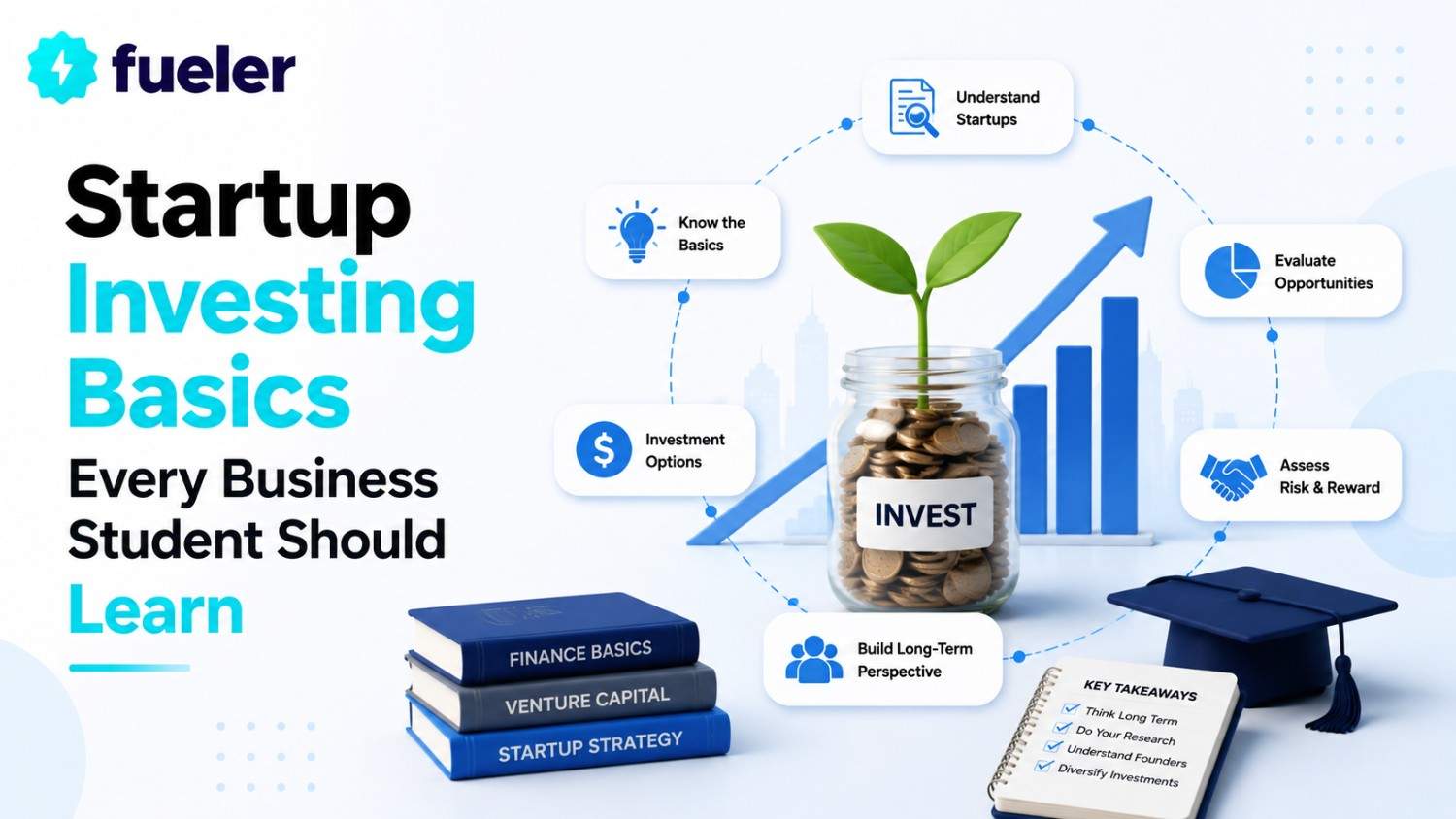
Startup Investing Basics Every Business Student Should Learn

Riten Debnath
18 Jul, 2026
Last updated: July 2026
Traditional business school textbooks do an excellent job of teaching you how to analyze public company balance sheets, calculate the weighted average cost of capital for enterprise giants, and predict mature market movements. However, these academic frameworks completely break down the second you step into the world of early-stage private equity and venture capital. Evaluating a pre-revenue company requires a completely different operational playbook than managing an established corporate entity.
I’m Riten, founder of Fueler, a skills-first portfolio platform building the career infrastructure for 100 million creative professionals. Fueler connects talented individuals with companies through assignments, portfolios, and projects, not just resumes or CVs. Think of it as Dribbble/Behance for work samples combined with AngelList for hiring infrastructure.
In this deep dive, we are bypassing the generic textbook definitions to explore the tactical realities of early-stage private transactions in 2026. You will learn the exact mechanics of equity distribution, cap table management, deal structures, and risk mitigation strategies used by modern venture capitalists and angel networks.
By the end of this article, you will possess a practical framework to evaluate high-growth startups, identify real commercial traction, and understand how early-stage capital is deployed in the modern tech ecosystem.
Core Evaluation Frameworks for Early Stage Venture Capital
Analyzing an early-stage company requires looking past traditional financial statements because most startups lack historical revenue data. Investors focus heavily on evaluating the underlying market dynamics, the unit economics of the product, and the long-term scalability of the business model.
- Total Addressable Market (TAM) Calculation requires a rigorous bottom-up analysis multiplying the total number of target customers by the realistic annual contract value, rather than relying on lazy top-down industry research percentage estimates that fail to capture actual commercial realities.
- The CAC to LTV Ratio serves as the ultimate health check for a startup's business model, proving whether the lifetime value of a customer safely exceeds three times the cost of acquiring that specific user over a sustained operational period.
- Net Revenue Retention (NRR) measures a startup's ability to retain and expand revenue from its existing customer base over time, acting as the primary indicator of true product-market fit and long-term customer satisfaction.
- Monthly Active User (MAU) Growth velocities must be cross-referenced closely with daily engagement retention metrics to ensure that user acquisition numbers reflect genuine product utility rather than temporary paid marketing spend spikes that mask low retention.
- Burn Multiple Efficiency calculates how much gross cash a startup spends to generate a single dollar of Net New Annual Recurring Revenue (ARR), highlighting structural operational discipline and capital runway sustainability.
Why It Matters
Understanding traction signals allows analysts to project real enterprise value, optimize capital efficiency, and predict long-term viability in competitive tech sectors.
Deciphering the Core Mechanics of Early Stage Deal Structures
Navigating the early stages of startup financing requires an absolute mastery of private deal instruments, moving far beyond standard corporate equity shares. Modern operators rely heavily on convertible instruments that delay formal valuation discussions until an institutional venture capital firm leads a priced round.
- Simple Agreements for Future Equity (SAFEs) allow early-stage investors to inject capital into a startup without establishing an immediate pre-money valuation, converting into preferred stock during the company's next priced institutional funding round based on agreed conversion triggers.
- Convertible Promissory Notes act as short-term debt instruments that accumulate interest over time and feature a mandatory maturity date, automatically converting into company equity if specific financing milestones are achieved by the operational team.
- Valuation Caps establish a maximum effective valuation at which an early investor's capital will convert into equity, ensuring that early financial backers receive a significantly higher share percentage if the startup's valuation skyrockets later.
- Discount Rates provide early financing partners with a structural reward for taking on extreme early-stage risk, typically granting a 15% to 20% price per share reduction compared to future institutional investors in the next round.
- Priced Equity Seed Rounds involve the formal creation and issuance of new preferred stock classes, requiring intense legal due diligence, explicit pre-money valuation agreements, and clearly defined shareholder voting rights from day one of the transaction.
Why It Matters
Selecting the wrong investment instrument directly stalls operational execution, complicates future institutional fundraising, and ruins long-term cap table health.
Analyzing Cap Table Dynamics and Dilution Realities
A capitalization table is the single source of truth detailing who owns what percentage of a private company, tracking founders, employees, and investors. Managing equity distribution requires balancing the need for incoming capital with the preservation of clean corporate governance structures across multiple funding rounds.
- The Employee Stock Option Pool (ESOP) must be carefully carved out before new investment rounds, typically reserving 10% to 15% of total equity to attract world-class executive talent during crucial growth phases of the company.
- Pro-Rata Investment Rights grant early-stage investors the legal option to participate in future funding rounds to maintain their exact ownership percentage, preventing aggressive dilution by massive late-stage venture funds entering the mix.
- Fully Diluted Share Counts calculate the total number of common shares outstanding after accounting for all convertible notes, SAFEs, warrants, and unvested employee stock options currently active on the company ledger.
- Founder Equity Vesting Schedules protect the company by distributing stock ownership over a standard four-year period with a one-year cliff, ensuring long-term operational commitment to the enterprise before full ownership is granted.
- Post-Money Valuation Tracking updates the total implied worth of the company immediately after a funding round closes, directly reflecting the new capital injected into the corporate bank account alongside existing asset valuations.
Why It Matters
Understanding dilution dynamics enables future financiers to structure clean, fair deals that preserve operational incentives while maximizing long-term investment returns.
Deconstructing Venture Capital Fund Economics and Power Laws
Venture capital operates on a mathematical distribution model that is completely alien to traditional asset classes like real estate or public equities. The industry is governed strictly by the Power Law, meaning that a tiny fraction of investments generate the vast majority of financial returns.
- Limited Partners (LPs) act as the primary foundational capital sources for venture capital funds, consisting of institutional endowments, corporate pension schemes, sovereign wealth vehicles, and ultra-high-net-worth family offices seeking alternative asset exposure.
- The 2-and-20 Fee Structure provides venture capital firms with a 2% annual management fee to cover operational expenses alongside a 20% carried interest profit-share allocation upon successful fund liquidity events.
- The Power Law Distribution dictates that out of a standard portfolio, a single breakout company will return more capital than all other investments combined, driving the entire financial return profile of the fund.
- Fund Lifecycle Horizons typically span a strict ten-year period, requiring general partners to deploy capital in the first few years and harvest liquidity through acquisitions or public listings in the final years.
- General Partners (GPs) assume full legal liability for managing the fund's deployment strategy, executing due diligence, sitting on startup boards, and driving operational value creation across the portfolio companies.
Why It Matters
Recognizing these structural incentives explains the intense pressure startups face to achieve massive scale or risk becoming completely irrelevant to their institutional backers.
Understanding Liquidation Preferences and Governance Control
Economic terms grab the headlines, but control terms dictate who actually runs the company when challenges arise. Liquidation preferences determine the exact order of payouts during an acquisition, ensuring investors get paid before common shareholders.
- Standard 1x Liquidation Preferences guarantee that preferred investors receive their initial investment amount back first during a sale, protecting their downside risk before any common stock holders receive a single dollar.
- Board of Directors Composition shifts control away from founders by allocating specific seats to lead investors, giving institutional backers a direct vote on major corporate actions and executive hiring decisions.
- Protective Provisions function as veto rights for investors, preventing founders from selling the company, changing corporate bylaws, or issuing new shares without explicit approval from the preferred shareholders.
- Right of First Refusal (ROFR) gives the company or its primary investors the legal right to purchase shares from founders before they can sell them to an outside secondary market buyer.
- Drag-Along Rights enable a majority shareholder block to force all other shareholders to approve a sale of the company, preventing minority holders from blocking a lucrative acquisition.
Why It Matters
Mastering control terms ensures that founders do not accidentally lose operational command of their entity during subsequent funding interventions.
Documenting Due Diligence and Corporate Governance Frameworks
Before a check is written, investors conduct rigorous due diligence to verify every operational and legal claim made by the startup. Business students must learn how to audit corporate cleanlines, verifying intellectual property ownership and employment contracts.
- Intellectual Property (IP) Assignment ensures that all code, designs, and patents created by founders and early employees are legally owned by the corporate entity rather than the individual creators.
- Customer Contract Audits verify the legal binding status, termination clauses, and actual monthly recurring revenue values claimed by the startup team during initial pitch presentations.
- Financial Auditing Workflows cross-reference bank statements with internal accounting software to ensure no hidden liabilities, outstanding tax debts, or unrecorded shareholder agreements exist.
- Regulatory Compliance Verifications check that the startup operates legally within its industry, holding all necessary licenses and adhering to data privacy laws like GDPR or CCPA.
- Employment and Contractor Agreements confirm that all past and present team members have signed proper non-disclosure and non-compete clauses that safeguard the company's proprietary assets.
Why It Matters
Clean corporate governance minimizes legal risk and accelerates the closing process, allowing the startup to deploy capital into growth initiatives immediately.
Designing the Investment Thesis and Portfolio Strategy
Professional investing requires a clear, repeatable framework known as an investment thesis to guide capital allocation. A strong thesis outlines the specific industries, geographies, stages, and business models an investor will target.
- Sector Focus Specialization concentrates capital and expertise within specific industries like fintech, AI infrastructure, or B2B SaaS, allowing investors to develop deep topical authority and better evaluate incoming deals.
- Geographic Optimization Strategies target specific tech hubs or emerging markets where talent costs are lower and market expansion opportunities remain unexploited by larger coastal funds.
- Stage-Gate Deployment Frameworks map out exactly how much capital will be reserved for follow-on rounds in winning portfolio companies versus initial check sizes for new investments.
- Founder Profile Benchmarking analyzes the historical execution capabilities, technical domain expertise, and operational velocity of the founding team to predict future product delivery success.
- Macroeconomic Trend Alignment ensures the investment thesis capitalizes on long-term structural shifts in technology, consumer behavior, and regulatory frameworks rather than short-lived hype cycles.
Why It Matters
A well-defined portfolio strategy prevents emotional investing, ensures disciplined capital deployment, and maximizes the probability of hitting fund-returning winners over time.
How Does This Connect to Building a Strong Career or Portfolio?
Understanding the mechanics of startup investing is not just for aspiring venture capitalists; it is a mandatory framework for any modern professional looking to build a high-growth career. When you understand how investors evaluate traction, deal structures, and operational velocity, you can apply those exact same frameworks to your own professional proof of work.
Modern hiring managers operate exactly like venture capitalists; they are investing capital (salary) into an asset (you) and looking for a clear return on investment. By documenting your projects, assignments, and case studies publicly on platforms like Fueler, you provide the visible proof of execution that eliminates hiring risk. Showing that you understand unit economics, cap table realities, and growth metrics makes you instantly valuable to startup founders who need operators, not just resume writers.
Final Thoughts
The landscape of early-stage private equity demands a shift from academic financial theory to real-world operational execution. Success in this ecosystem relies entirely on verifying real commercial traction signals, managing capitalization tables with absolute discipline, and understanding the mathematical reality of the power law. As the private markets continue to evolve, the professionals, founders, and investors who win are those who focus deeply on visible proof of work and verifiable project execution.
FAQ
What are the best early-stage investment structures in 2026?
Most pre-seed and seed rounds rely heavily on SAFEs (Simple Agreements for Future Equity) and convertible notes to defer formal valuation discussions until an institutional priced round occurs.
How do investors calculate a startup's true market size?
Investors use a rigorous bottom-up calculation by multiplying the total number of realistic target customers by the average annual contract value, avoiding lazy top-down industry generalizations.
Can a messy capitalization table ruin a startup's funding chances?
Yes, institutional venture capital firms routinely walk away from deals if the cap table features poorly distributed equity, unmotivated founders, or unresolvable corporate governance issues.
What is the power law distribution in venture capital?
The power law is a mathematical reality where a tiny minority of investments- often just one breakout portfolio company generates the vast majority of financial returns for the entire fund.
Why do investors care about founder vesting schedules?
Vesting schedules protect the enterprise by ensuring that founders earn their equity stake over a standard four-year period, securing their long-term operational commitment to the company.
Why 100,000+ professionals use Fueler
Fueler helps professionals showcase proof of work through projects, assignments, case studies, and achievements.
- Thousands of professionals use Fueler to create their digital portfolio
- Thousands of projects are published on Fueler. Check here
- Startups and Companies hire through proof of work on Fueler
- Used by freelancers, creators, marketers, video editors, writers, designers, and product managers
Our mission is to help the next 100 million professionals build a verified professional identity through proof of work

What should you do next?
You've read the article. Now turn your skills into proof of work and unlock more opportunities.
Build your proof of work portfolio
Create a clean portfolio with projects, assignments, resumes, and AI stack details that companies actually want to see.
Create your Fueler portfolio →Apply through assignments, not resumes
Stand out by solving real tasks from companies hiring on Fueler.
Explore assignments →Get discovered by companies
Make your work public and let recruiters discover your skills through actual projects instead of keywords.
Get discovered →