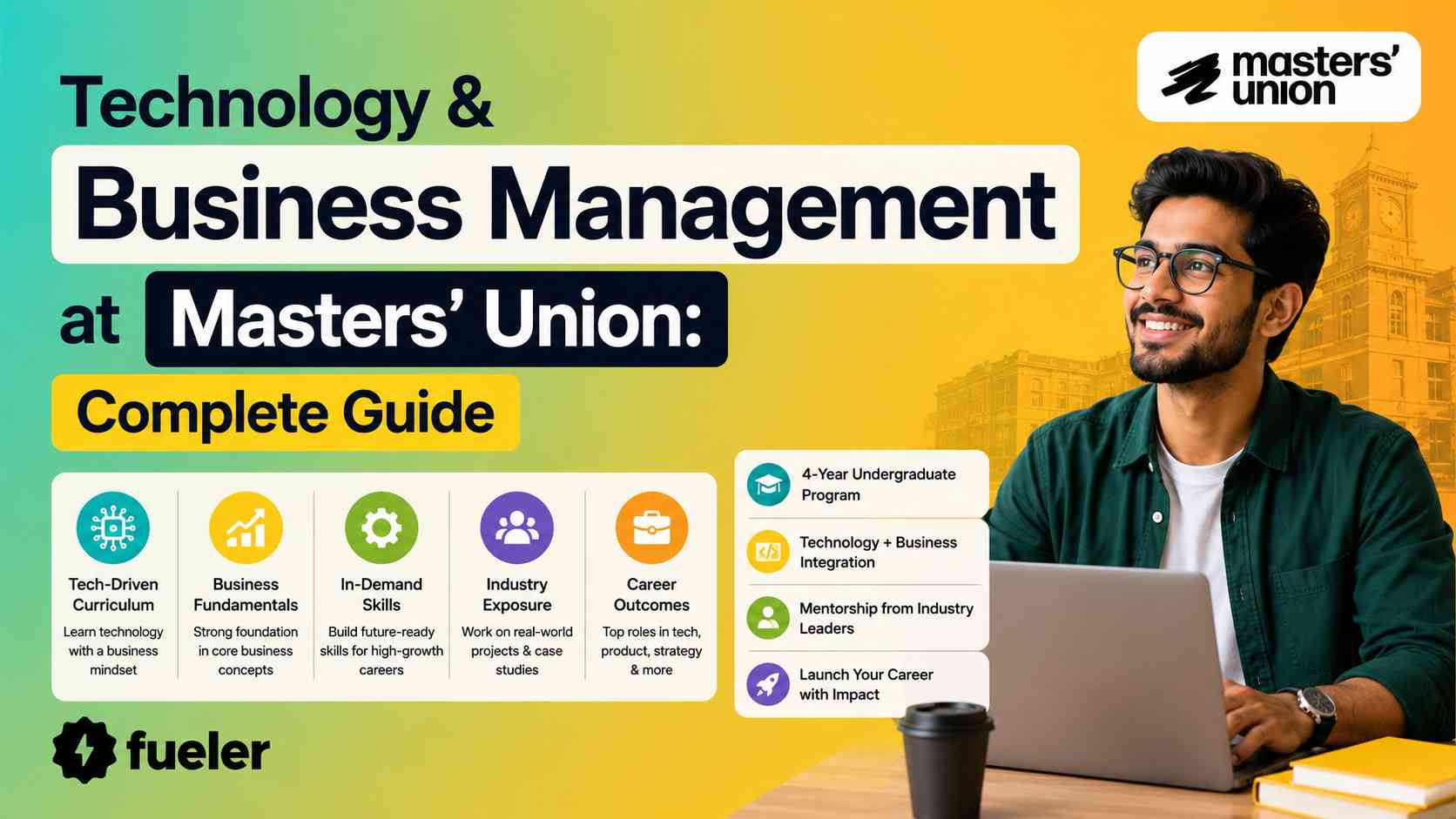
Technology & Business Management at Masters' Union: Complete Guide

Riten Debnath
17 Aug, 2026
Last updated: August 2026
Is relying on a 50-year-old university syllabus still a viable strategy for someone who wants to lead product teams, launch venture-backed startups, or work directly alongside CEOs straight out of school? Or does modern business demand an entirely different model of education built on real-world execution?
I’m Riten, founder of Fueler, a skills-first portfolio platform building the career infrastructure for 100 million creative professionals. Fueler connects talented individuals with companies through assignments, portfolios, and projects, not just resumes or CVs. Think of it as Dribbble/Behance for work samples combined with AngelList for hiring infrastructure.
Every single week at Fueler, we see fast-growing tech companies skip candidates with high GPA scores to hire individuals who can show proof of work, a launched app, a live ad campaign, or a structured product teardown. When I first audited the Technology & Business Management program at Masters' Union, it stood out because it rejects passive textbook learning in favor of real business drops, live data analytics, and operator mentorship.
This complete guide breaks down the UG Program in Technology & Business Management at Masters' Union, covering its curriculum design, hands-on challenges, fee breakdown, career paths, and real-world ROI.
Quick Answer Summary
- Who It Is For: High school graduates (Class 12) and gap-year students aiming for careers in tech, startup operations, product management, or entrepreneurship.
- Cost: Baseline tuition fee sits at ₹52.5 Lakhs. Total program outlay ranges between ₹54.3 Lakhs and ₹67.5 Lakhs depending on accommodation and living tracks.
- Key Takeaway: Replaces traditional classroom exams with dropshipping drops, live consulting challenges, and startup incubation grants.
- Best Suited For: Proactive builders who prefer building public portfolios, shipping products, and gaining CXO mentorship over standard textbook learning.

What is Technology & Business Management at Masters' Union?
The Technology & Business Management program at Masters' Union is a 4-year practitioner-led undergraduate degree delivered at DLF Cyberpark in Gurugram. Instead of traditional academic professors, the course is designed and taught by active industry operators including startup founders, product leads, data heads, and venture capitalists.
TRADITIONAL COLLEGE MODEL
Rote Memorization ──► Written Exams ──► Static Resumes ──► Unprepared Graduates
MASTERS' UNION UG MODEL
Hands-on Coding & Ops ──► Live Business Drops ──► Proof-of-Work Portfolios ──► Job-Ready Operators
The core philosophy of this program is "learning business by running business." Students do not just read case studies on how companies grow. They write code, analyze P&L statements, design product wireframes, run performance marketing campaigns, and pitch to active seed investors.
The curriculum bridges the gap between software development and core management. It is tailored for students who want to build a career in fast-growing sectors without waiting four years to gain actual work experience.
Key Facts Table
Detailed Explanation
The curriculum of the Technology & Business Management program breaks down into a structured, four-year roadmap combining classroom instruction with real-world execution.
CURRICULUM ROADMAP OVERVIEW
Year 1: Tech & Business Fundamentals + First Paycheck & Dropshipping Challenges
Year 2: Advanced Data, Product Architecture + Local Business Consulting Challenge
Year 3: Venture Scaling & Growth Strategy + Entrepreneurship 0-to-1 Capstone
Year 4: Global Immersion / Corporate Apprenticeship + Industry Placements
Year 1: Building Tech and Business Foundations
The first year focuses on breaking down the traditional divide between software engineering and business operations. Students begin learning how code powers modern enterprises alongside fundamental financial literacy.
- What: Core courses cover Introduction to Programming (Python/Web Development), Business Statistics, Fundamentals of Accounting, Management Strategy, and Public Speaking.
- Why: You cannot lead a tech company or manage developers if you do not understand software architecture and financial mechanics.
- How: Learning is structured around project-based terms. Rather than sitting for written theoretical midterms, students build functional apps, audit balance sheets, and present business strategies.
- Out-of-Class Intervention: Students complete the First Paycheck Challenge and the Dropshipping Sprint. They receive small amounts of seed capital, launch live e-commerce stores, run digital ad campaigns, manage supplier logistics, and aim to generate actual revenue within their first few months.
Year 2: Applied Analytics, Product Design, and Local Consulting
Year 2 shifts focus to scaling systems, user psychology, and leveraging data for decision-making.
- What: Students dive into Managerial Economics, Corporate Finance, Business Analytics using Python, Social Media Marketing, UX Research, and Product Prototyping.
- Why: Modern tech operations require quantitative skills knowing how to run SQL queries, interpret A/B tests, and optimize customer acquisition costs.
- How: Students use tools like Figma, Python libraries, SQL databases, and no-code builders to create consumer-facing prototypes and analytics dashboards.
- Out-of-Class Intervention: The Local Consulting Challenge forces students into the field. Teams partner with local businesses, retail brands, or logistics providers in Gurugram to audit their operations, redesign menus, optimize delivery routes, or implement digital inventory tracking.
Year 3: Advanced Strategy, AI, and Venture Incubation
The third year focuses on scaling business operations, leveraging artificial intelligence, and building venture-backed models.
- What: Modules cover Venture Capital & Valuation, Artificial Intelligence in Business, Platform Economics, Omnichannel Management, and Advanced Big Data Analytics.
- Why: High-level operators need to understand how tech platforms scale, how capital is raised, and how modern AI tools optimize workflow automation.
- How: Students build machine learning models, analyze global macroeconomic trends, and study platform dynamics (e.g., how companies like Uber or Amazon manage multi-sided markets).
- Out-of-Class Intervention: Through the Entrepreneurship Capstone, students go from 0 to 1. They build a Minimum Viable Product (MVP), test user distribution, manage P&L statements, and pitch directly to active venture capitalists for seed grants. At Fueler, we see that students who document this entire build journey online stand out immediately to recruiters who value self-starters over standard resume submitters.
Year 4: Industry Apprenticeship and Career Execution
The final year acts as a bridge directly into the startup and tech corporate workforce.
- What: The fourth year centers on an extended Industry Training / Apprenticeship program or continuing to scale an established student venture.
- Why: Classroom learning, no matter how practical, needs to be validated inside real corporate environments with actual budget constraints and team dynamics.
- How: Students work inside high-growth tech firms, D2C brands, venture funds, or corporate strategy departments. They participate in executive coaching, receive public speaking and personal branding guidance, and complete final career placements.
How It Works
- Applied Term Blocks: Academic quarters are broken down into intensive sprints where students focus on mastering one tech or business discipline through active project drops.
- CXO-Led Classes: Courses are delivered by active industry professionals CEOs, Product Directors, VC partners, and CMOs bringing current operational frameworks into the classroom.
- Out-of-Class Challenges: Students run live e-commerce stores, consult for regional businesses, launch media channels, and manage real capital.
- Portfolio Construction: Every module produces a public assets deployed web app, an ad campaign performance report, a SQL dashboard, or a venture pitch deck.
- Direct Recruitment Connections: Companies recruit throughout the four years via live industry projects, bypassing standard resume screens.
Benefits
- Verified Proof-of-Work: Graduates leave with real public proof of their execution capabilities, published code, ad stats, live products, and consulting deliverables.
- Ecosystem Proximity: Studying at DLF Cyberpark puts students in immediate physical proximity to major tech firms, venture capital offices, and unicorn headquarters.
- Contemporary Tech Stack: The curriculum updates constantly to teach modern toolsPython, AI frameworks, SQL, Figma, digital ad platforms, and no-code stack tools.
- Operator Mentorship: Direct access to over 200+ CXO mentors gives students realistic insights into how modern tech businesses hire and operate.
- Early Entrepreneurship Launchpad: Aspiring founders can test ideas, access student-led investment funds, and receive startup guidance while earning their degree.
Challenges / Limitations
- Significant Financial Outlay: With total costs between ₹54.3 Lakhs and ₹67.5 Lakhs, this program represents a significant financial commitment.
- High Pace and Workload: The fast-moving, project-focused environment can be intense for students who prefer structured academic routines.
- Evolving Academic Recognition: Masters' Union is an operator-led institution; its primary reputation lives within tech, VC, and startup circles rather than traditional government or PSU hiring tracks.
- Requires High Self-Drive: Students who need step-by-step guidance may find open-ended challenges (like launching a business in six weeks) overwhelming.
Comparison Table
Fees and Cost Analysis
Prospective students and parents need to evaluate the complete financial commitment required for the 4-year duration.
- Tuition Fees: The baseline academic tuition fee stands at ₹52.5 Lakhs for the full 4-year degree.
- One-Time Payments: Includes non-refundable admission, registration, and lab access fees of around ₹1.8 Lakhs.
- Hostel and Living Costs: Accommodation options surrounding Cyberpark in Gurugram range from ₹9.9 Lakhs to ₹13.2 Lakhs depending on room setup and meal plans over four years.
- Scholarships: Financial support options (merit-based and need-based) are available via the MU-SAT entrance track, which can subsidize tuition costs for top-performing applicants.
Career Opportunities
The Technology & Business Management curriculum is explicitly designed to prepare students for hybrid tech-business roles:
- Founder’s Office & Chief of Staff: Working alongside tech CEOs to handle strategic projects, operational audits, and expansion campaigns.
- Associate Product Manager (APM): Designing product specs, conducting UX research, running A/B experiments, and coordinating engineering teams.
- Growth Marketing Specialist: Managing customer acquisition budgets, running performance ads, and optimizing retention loops.
- Business Intelligence & Data Analyst: Querying complex databases using Python and SQL to build operational dashboards for leadership teams.
- Venture Capital Analyst: Analyzing market trends, conducting due diligence on early-stage startups, and evaluating financial models.

Who Should Choose This?
- Aspiring startup founders who want dedicated incubation support, seed grant opportunities, and VC access while pursuing a degree.
- High school students who thrive on hands-on project builds, coding, and real-world execution rather than passive lectures.
- Candidates targeting modern roles like APM, Growth Lead, or Founder's Office straight out of college.
- Learners who actively enjoy working in collaborative, fast-paced environments.
- Students looking to build a multi-disciplinary skill set spanning software, business, data, and design.
Who Should Avoid This?
- Students seeking a traditional, exam-focused university experience with low daily pressure.
- Candidates planning to sit for traditional civil service exams, government sector posts, or public administration roles.
- Families seeking low-budget undergraduate programs without taking on significant financial outlays.
- Individuals who struggle in open-ended environments where success requires personal initiative and active problem-solving.
Final Thoughts
The Technology & Business Management program at Masters' Union reflects how business education is adapting to the demands of the modern tech economy. By swapping traditional lectures for active building, real e-commerce drops, and direct CXO mentorship, it focuses on developing functional operators over theoretical test-takers.
However, given the total financial investment of ₹54.3L to ₹67.5L, applicants should carefully evaluate their financial plans and long-term career goals.
At Fueler, we see every day that modern tech companies, venture-backed startups, and growth agencies care less about test scores and more about what you have actually built. Whether you choose a specialized degree like Masters' Union or take a self-directed path, building a verified portfolio of real projects remains the most effective way to launch your career.
Key Takeaways
- Masters' Union offers a 4-year practitioner-led undergraduate degree in Technology & Business Management in Gurugram.
- The program is taught by active startup founders, CXOs, and venture capitalists.
- Total expenses range from ₹54.3 Lakhs to ₹67.5 Lakhs over four years, including tuition and hostel fees.
- Students complete real-world challenges, including dropshipping drops, local consulting projects, and startup capstones.
- Graduates target roles in Product Management, Founder's Office, Growth Marketing, and Venture Capital.
- Merit and need-based financial support options are available through the MU-SAT entrance evaluation.
FAQs
What is the Masters' Union UG Technology & Business Management program?
It is a 4-year practitioner-led undergraduate degree blending computer programming, data analytics, business management, and live startup execution in DLF Cyberpark, Gurugram.
How much does the Technology & Business Management program cost?
Baseline tuition is ₹52.5 Lakhs. Including registration fees and hostel accommodation, the total program cost ranges between ₹54.3 Lakhs and ₹67.5 Lakhs.
What entrance exams are valid for admission?
Admissions accept the internal MU-SAT entrance exam, as well as valid scores from SAT, JEE Main, or CUET, followed by profile evaluation and personal interviews.
What career roles can students pursue after graduating?
Graduates are prepared for hybrid tech-business roles such as Associate Product Manager (APM), Founder's Office, Growth Marketer, Data Analyst, and Venture Capital Analyst.
Does Masters' Union offer financial assistance for undergraduate students?
Yes, Masters' Union provides both merit-based and need-based scholarships awarded through performance in the MU-SAT entrance test, national standardized exam scores, and profile reviews.
Why 100,000+ professionals use Fueler
Fueler helps professionals showcase proof of work through projects, assignments, case studies, and achievements.
- Thousands of professionals use Fueler to create their digital portfolio
- Thousands of projects are published on Fueler. Check here
- Startups and Companies hire through proof of work on Fueler
- Used by freelancers, creators, marketers, video editors, writers, designers, and product managers
Our mission is to help the next 100 million professionals build a verified professional identity through proof of work
What should you do next?
You've read the article. Now turn your skills into proof of work and unlock more opportunities.
Build your proof of work portfolio
Create a clean portfolio with projects, assignments, resumes, and AI stack details that companies actually want to see.
Create your Fueler portfolio →Apply through assignments, not resumes
Stand out by solving real tasks from companies hiring on Fueler.
Explore assignments →Get discovered by companies
Make your work public and let recruiters discover your skills through actual projects instead of keywords.
Get discovered →