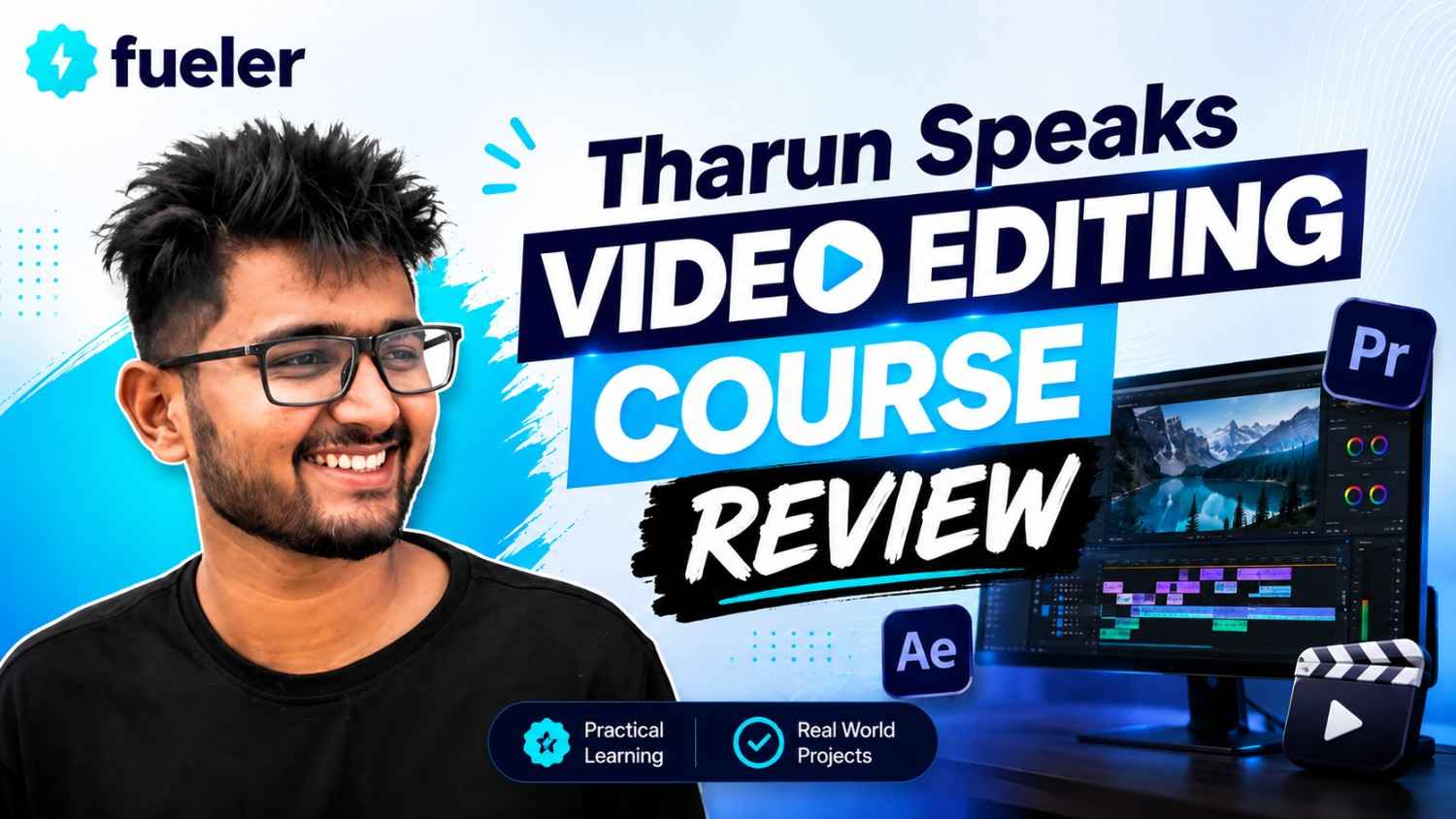
Tharun Speaks Video Editing Course Review 2026: Is It Worth It?

Riten Debnath
10 Aug, 2026
Last updated: August 2026
Most high-paying creative skills today share a dirty secret: nobody cares where you went to school, what degree you hold, or what your resume looks like. If you want to work with top creators, fast-growing startups, or international media brands, you only need to answer one question: Can you make content that holds human attention?
Video has become the default language of the internet. Whether it is a founder building in public on X, an influencer launching a consumer brand on Instagram, or a SaaS company running performance ads on YouTube, video production sits at the core of online growth. Yet, despite thousands of free tutorials available online, the internet is flooded with mediocre editors who struggle to land a single paying client.
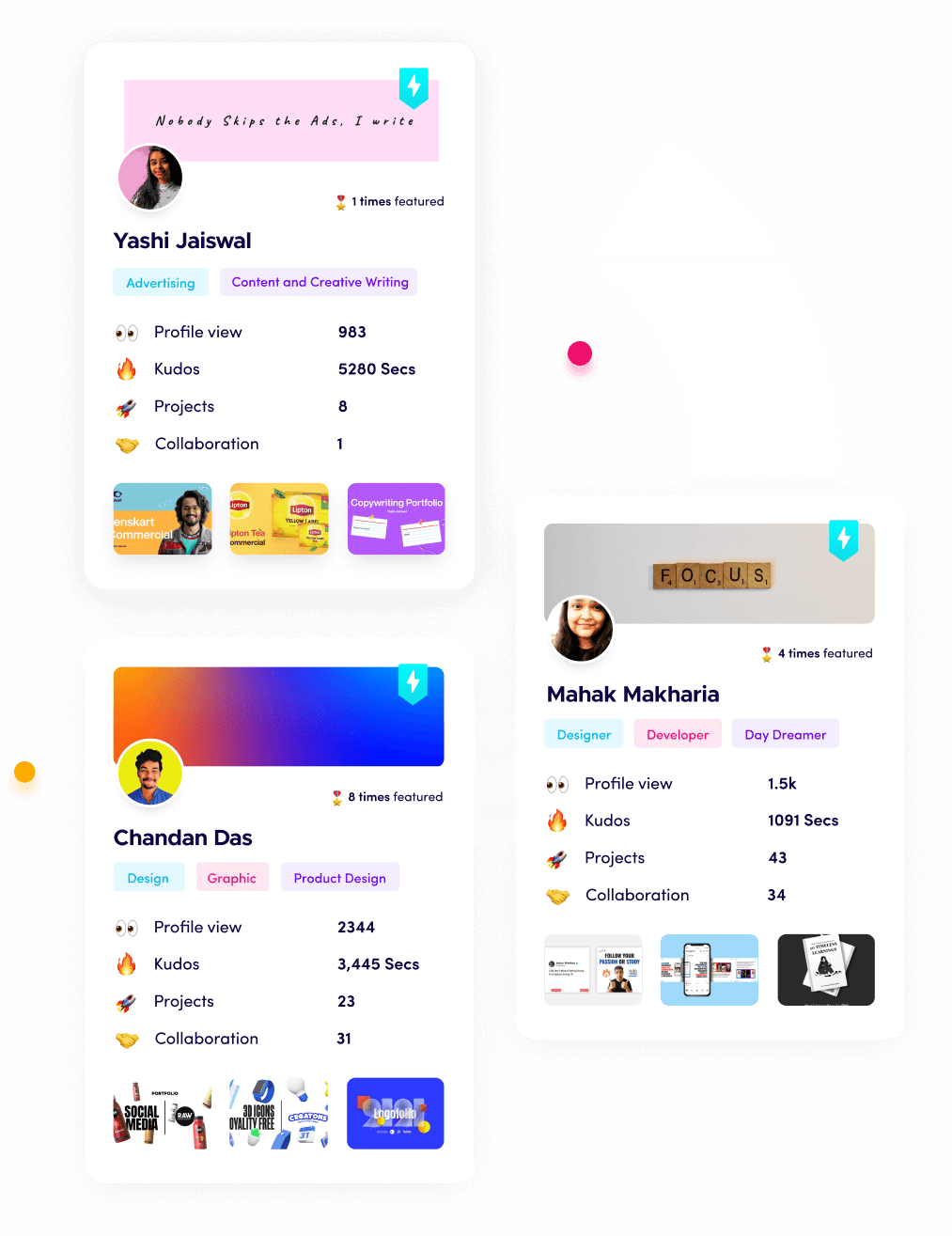
I’m Riten, founder of Fueler, a skills-first portfolio platform building the career infrastructure for 100 million creative professionals. Fueler connects talented individuals with companies through assignments, portfolios, and projects, not just resumes or CVs. Think of it as Dribbble/Behance for work samples combined with AngelList for hiring infrastructure.
Every week at Fueler, I review hundreds of proof-of-work profiles submitted by young video editors applying for remote roles, creator retainers, and agency projects. What I see regularly is a massive disconnect. Beginners spend months learning complex software shortcuts, but they lack fundamental storytelling, sound design polish, and the business acumen required to pitch clients effectively.
That brings us to structured learning programs like the Tharun Speaks Video Editing Cohort (often updated through iterations like Cohort 12.0 to Cohort 16.0). Created by YouTuber Tharun Naik (popularly known as Tharun Speaks), this program claims to transform complete beginners into job-ready, client-closing video editing professionals.
In this comprehensive 2026 review, I will break down every single aspect of this course: the curriculum, pricing tiers, live mentorship, placement assistance, limitations, and whether it is worth your time and hard-earned money.
Quick Answer Summary
- Definition: A live, community-driven online video editing cohort designed by Tharun Speaks that teaches video editing, motion graphics, sound design, color grading, and client acquisition.
- Who It Is For: High school students, college undergraduates, fresh graduates, and self-taught editors looking to monetize their skill through freelancing or full-time roles.
- Program Cost: Pricing ranges across three tiers: Essential (₹4,999), Elite (₹6,999), and Ultimate (₹14,999).
- Key Tools Covered: Adobe Premiere Pro, Adobe After Effects, DaVinci Resolve, and modern AI video tools.
- Key Takeaway: Highly valuable for beginners needing structure, accountability, premium editing assets, and outreach frameworks; less necessary for experienced editors who already possess a strong proof-of-work portfolio.
- Best Suited For: Creative aspirants who struggle with self-learning from unstructured YouTube videos and want direct mentorship, edit feedback, and placement opportunities.
What is the Tharun Speaks Video Editing Cohort?
The Tharun Speaks Video Editing Cohort is an online, cohort-based learning program focused on turning video editing into a commercial career. Unlike traditional online video courses that hand you 50 pre-recorded videos and leave you to figure things out on your own, a cohort-based model operates like an intensive bootcamp. You join alongside a group of peers, follow a synchronized schedule, submit weekly assignments, and receive feedback from active industry mentors.
To understand why this program exists, you have to look at how video consumption has evolved. A few years ago, video editing was split into two separate buckets: traditional long-form filmmaking and basic YouTube vlogging. Today, video editing encompasses vertical short-form content (Reels, Shorts, TikToks), high-retention video essays, kinetic typography, podcast repurposing, and commercial brand storytelling.
The cohort addresses this shift by providing an end-to-end framework. It starts with basic timelines and cuts, moves into advanced motion graphics and sound engineering, and concludes with business execution, teaching students how to build a portfolio, reach out to prospects, negotiate rates, and retain clients.
What makes this program fundamentally different from a YouTube playlist is the operational discipline. You are not just learning where buttons are in Adobe Premiere Pro; you are participating in live edit battles, completing real-world briefs, getting your timeline reviewed frame by frame, and discovering how to present your work publicly so clients actually hire you.
Key Facts Table
Detailed Explanation
1. Software Mastery & Workspace Efficiency
The curriculum begins by tackling the biggest roadblock for beginners: software overload. Many aspiring editors open Adobe Premiere Pro, get intimidated by the hundreds of panels and tracks, and quit before making their first cut.
The program breaks down workspace management, teaching you how to configure your timeline, organize raw footage, use keyboard shortcuts, and set up project files efficiently. The module covers critical technical fundamentals that self-taught editors often ignore, including video resolutions, aspect ratios, frame rates (FPS), metadata, and color spaces.
Why does this matter in the real world? When a client sends you 50 GB of mixed footage from different cameras, knowing how to organize project bins and proxy files prevents software crashes and saves hours of rendering time. Efficiency is what allows a professional editor to deliver three polished Reels a day instead of spending three days on one.
2. Narrative Editing & Motion Graphics
Cutting out long pauses and silences is simple, but keeping a viewer engaged for ten minutes requires an understanding of narrative pacing. The cohort spends significant time on assembling clips, using J-cuts and L-cuts, masking, text styling, keyframe animation, and transition dynamics.
Once students master basic timeline flow in Premiere Pro, the training integrates Adobe After Effects for motion graphics. You learn how to build custom lower thirds, kinetic typography, animated graphs, screen overlays, and motion callouts.
For example, when an educational YouTuber explains a financial concept, a plain voiceover can feel dry. But when that explanation is accompanied by pop-up text, dynamic chart animations, and smooth visual transitions, viewer retention spikes. The course teaches you how to design these exact visual elements from scratch.
3. Sound Design and Color Grading
Visuals attract viewers, but poor audio makes them click away instantly. One of the strongest parts of the Tarun Speaks curriculum is its deep focus on audio engineering and sound design.
Students learn voiceover equalization, background noise reduction, audio ducking, and layering sound effects (SFX). You are taught how to use swooshes, subtle hits, risers, and ambient textures to give videos a cinematic feel. The course guides you on where to source royalty-free music legally and how to match video cut rhythms to musical beats.
In addition to audio, the course introduces color correction and color grading using Premiere Pro and DaVinci Resolve. You learn how to fix improper exposure, match skin tones across different shots, apply Look-Up Tables (LUTs), and perform chroma keying (green screen removal) cleanly. This gives flat camera footage a rich, commercial look.
Raw Camera Footage ➔ Exposure & Skin Tone Correction ➔ Color Grading (LUTs) ➔ Clean Commercial Polish
4. Short-Form Content & AI Integration
Vertical content on Instagram Reels, YouTube Shorts, and TikTok requires a completely different approach than horizontal videos. The first three seconds of a vertical video dictate whether a user scrolls past or stays to watch.
The cohort analyzes short-form content mechanics in depth. You learn how to write on-screen visual hooks, design auto-captions, add fast-paced cutaways, and create seamless loops.
Furthermore, the course addresses the influence of AI in modern video editing. Rather than treating AI as a threat, the modules show you how to leverage tools like auto-reframing, AI voice enhancement, automated transcriptions, and generative fill. This allows you to work faster and focus your creative energy on high-level storytelling rather than tedious manual work.
5. Portfolio Construction & Client Acquisition
You can be the best video editor in the world, but if nobody knows you exist, you will not earn an income. The final phase of the course transitions from technical execution to business development.
Students learn how to curate their best edits into a focused proof-of-work portfolio. The course walks you through cold outreach strategies, teaching you how to find prospective clients on X, LinkedIn, and Instagram, write personalized pitch emails, and offer value-first sample edits.
At Fueler, this is a methodology we strongly advocate. When applying for creative work, sending a PDF resume rarely works. But when an applicant attaches a clean, live Fueler portfolio link featuring 4-5 well-edited video samples with clear descriptions of what they contributed, employers pay attention immediately. The cohort embeds this exact skills-first, portfolio-driven mindset into its students.
How It Works
- Course Onboarding: Upon enrolling in your chosen tier (Essential, Elite, or Ultimate), you gain access to the private learning dashboard and community groups on Discord/Telegram.
- Module Execution: You watch studio-quality recorded modules covering software installation, cutting techniques, motion graphics, audio design, and color grading.
- Weekly Live Problem-Solving: Every week, Tharun and his team conduct live sessions to answer technical doubts, review assignment submissions, and break down trending editing styles.
- Hands-On Assignments & Edit Battles: You are given raw footage from real creator projects to edit. You can participate in community edit battles to test your skills against peers and win prizes.
- Mentor Review & Refinement: Mentors provide feedback on your timelines, highlighting areas where your pacing, text choices, or sound effects need adjustment.
- Portfolio Setup & Pitching: You package your completed assignments into a public portfolio and begin reaching out to real-world clients using the outreach templates provided in the course.
Benefits
- Structured Learning Path: Takes you through a clear, 44-module progression so you never waste time wondering what to learn next.
- Practical Asset Packages: Enrollment includes editing assets such as sound effect libraries, transition presets, lower-third templates, and overlay packs valued between ₹5,000 and ₹10,000.
- Active Community & Networking: Surrounding yourself with hundreds of active learners creates natural accountability and opens up collaborative opportunities.
- Direct Mentor Feedback: Instead of working in a vacuum, you receive real feedback from experienced editors who tell you exactly why a cut feels off or how to fix audio peaking.
- Focus on Monetization: The curriculum does not treat video editing purely as an art form; it treats it as a service business designed to generate income.
- Placement Pipeline (Ultimate Tier): Eligible students in the top tier get direct access to placement opportunities paying up to ₹30,000 per month with hiring partners.
Challenges / Limitations
While the course offers solid value, it is important to be realistic about its limitations:
- Hardware Requirements Are Strict: Video editing software like Adobe Premiere Pro and After Effects requires a decent computer setup. If you attempt to run these programs on a budget laptop with 4GB RAM and no dedicated graphics card, your timeline will lag and render times will be frustratingly slow.
- Significant Time Commitment Required: Watching the 44 modules is only 20% of the work. The remaining 80% comes from editing footage, trying out effects, and revising your cuts. If you cannot commit 10–15 hours per week, you will fall behind.
- Outreach Requires High Resilience: The course gives you cold email frameworks and pitching strategies, but it cannot send the emails for you. Getting client retainers requires reaching out to dozens of prospects and dealing with rejection before landing your first paying job.
- Tier Gating: Key features like direct placement assistance, personal learning managers, and dedicated mentorship are restricted to the higher-priced Elite and Ultimate tiers.
Comparison Table
Fees, Cost & ROI Analysis
When evaluating any educational investment, the central question is always about return on investment (ROI). Let’s analyze the cost breakdown across the three enrollment tiers available:
- Essential Track (₹4,999): Gives you the core learning foundationally pre-recorded studio lectures, weekly live classes, and access to the general learner community. This track is best if you are self-disciplined and simply want a structured curriculum without needing hands-on mentor reviews.
- Elite Track (₹6,999): Adds dedicated mentor feedback, social media masterclasses, access to edit battles, and ₹5,000 worth of editing assets. This provides the best overall balance of price and guided mentorship for most beginners.
- Ultimate Track (₹14,999): Designed for students who want maximum hand-holding. It includes a Personal Learning Manager to track your progress, placement access for roles paying up to ₹30,000 per month, a private group with Tharun, and ₹10,000 worth of assets.
Calculating the Real-World ROI
Is ₹4,999 to ₹14,999 worth it? Let me put this into context from what we see daily on Fueler:
- The going rate for editing a single high-quality Instagram Reel or YouTube Short ranges between ₹1,000 and ₹3,500 ($15 to $40) for a beginner-to-intermediate freelancer.
- A single monthly client retainer for editing 8 to 10 short-form videos typically pays between ₹12,000 and ₹25,000 ($150 to $300).
- If you enroll in the Elite tier (₹6,999) and secure just one client who pays you for a bundle of 6 Reels, your entire course investment is paid off immediately. Everything you earn after that is pure profit.
In the creative ecosystem, your ROI depends entirely on how quickly you put your skills into public view. If you finish the course, build a public proof-of-work portfolio on Fueler, and pitch 5 creators a day, recovering your tuition fee is straightforward.
Career Opportunities
Completing this training opens up several distinct career paths across the creator economy and tech sector:
- Short-Form Content Specialist: Focus on editing high-retention Reels, Shorts, and ad creatives for direct-to-consumer (D2C) brands, SaaS companies, and influencers.
- Estimated Salary: ₹25,000 – ₹55,000 per month (Full-time) or $20 – $40 per hour (Freelance).
- YouTube Main Track Editor: Work with established content creators to assemble long-form vlogs, video essays, podcasts, and educational tutorials.
- Estimated Salary: ₹35,000 – ₹80,000 per month per creator retainer.
- Motion Graphics Artist: Focus on kinetic text, visual effects, title sequences, and graphic animations using After Effects.
- Estimated Salary: ₹4,000,000 – ₹9,000,000 annually in mid-level agency roles.
- Performance Ad Editor: Edit conversion-focused video ads for e-commerce stores, growth marketing agencies, and media buyers.
- Estimated Salary: ₹40,000 – ₹90,000 per month.
- Agency Owner / Lead Editor: Build your own video production boutique, hire junior editors trained through similar cohorts, and manage international client accounts.
- Income Potential: Scale beyond ₹1,500,000+ annually based on client retainer volume.
Who Should Choose This?
- Absolute Beginners: People who have zero prior experience with Adobe Premiere Pro or After Effects and want a guided, step-by-step path.
- Students & Fresh Graduates: Anyone looking to acquire a valuable digital skill alongside their college degree to earn independent income.
- Struggling Self-Learners: Editors who have watched dozens of random YouTube tutorials but still feel lost when assembling a complete video project.
- Freelancers Seeking Client Acquisition Tactics: Creative professionals who can edit reasonably well but do not know how to cold email, pitch value, or close paid retainers.
- Portfolio Builders: Creators who want to complete structured assignments using real footage so they can immediately showcase proof of work on platforms like Fueler.
Who Should Avoid This?
- People Without Proper Hardware: Anyone who does not own a computer capable of running demanding editing applications smoothly.
- Advanced Editors: Professionals who already understand multi-cam editing, advanced color grading in DaVinci Resolve, complex motion graphics, and active client management.
- Passive Learners: Students who expect that buying the course will magically land them a job without spending dozens of hours practicing edits and sending cold pitches.
- Film School Aspirants: Anyone looking strictly for traditional cinema direction, screenwriting, set lighting, and feature film production.
Final Thoughts
The internet economy has flattened traditional career barriers. You no longer need an expensive film degree or connections in media hubs to make a comfortable living with video editing. What you need is a sharp set of technical skills, a clear understanding of viewer psychology, and the discipline to put your work in front of people who need it.
The Tharun Speaks Video Editing Cohort delivers a well-rounded, practical, and highly accessible roadmap. It eliminates the confusion of self-learning, equips you with essential assets, and teaches you the business side of freelancing that most courses ignore.
If you are serious about pursuing this path, my strongest advice is to focus relentlessly on output. Do not just watch the lectures; edit every assignment, participate in every edit battle, and publish your work publicly. Build a clean, organized portfolio on Fueler that displays your best projects, attached assets, and editing workflows. When your proof of work is obvious, clients and employers will find you naturally.
Key Takeaways
- The Tharun Speaks Video Editing Cohort is a structured, 44+ module live online course covering Adobe Premiere Pro, After Effects, DaVinci Resolve, and AI tools.
- Course pricing is split into three main tiers: Essential (₹4,999), Elite (₹6,999), and Ultimate (₹14,999).
- Unlike passive courses, it offers weekly live problem-solving sessions, edit battles, asset packs worth up to ₹10,000, and placement access.
- The curriculum covers technical editing, audio engineering, color correction, short-form Reels creation, and client acquisition.
- Landing just one freelance client paying ₹12,000 to ₹15,000 for a short series of videos fully recovers your course investment.
- Long-term career success requires a decent computer setup, hours of hands-on timeline practice, and a live proof-of-work portfolio.
FAQs
What software tools are taught in the Tharun Speaks Video Editing Cohort?
The course teaches Adobe Premiere Pro for primary video assembly, Adobe After Effects for motion graphics and animation, DaVinci Resolve for color grading, and modern AI tools for automated editing workflows.
Do I need prior video editing experience to join this program?
No prior editing experience is necessary. The course starts from foundational topics like workspace setup and timeline trimming before progressing into advanced motion graphics, sound design, and client acquisition.
What is the difference between the Essential, Elite, and Ultimate course tiers?
Essential (₹4,999) includes core lectures and live classes. Elite (₹6,999) adds dedicated mentors, edit battles, and ₹5,000 in asset packs. Ultimate (₹14,999) offers placement access, personal managers, and ₹10,000 in assets.
Does the Tharun Speaks Video Editing Cohort guarantee job placements?
Placement access is available specifically in the Ultimate tier, connecting top-performing students with hiring partners for video editing roles paying up to ₹30,000 per month based on portfolio quality.
How do I showcase my video editing projects to land clients after the course?
You can build a public proof-of-work portfolio on Fueler by embedding your finished video edits, detailing the software tools used, describing your creative process, and sharing the link directly with prospective clients.
Why 100,000+ professionals use Fueler
Fueler helps professionals showcase proof of work through projects, assignments, case studies, and achievements.
- Thousands of professionals use Fueler to create their digital portfolio
- Thousands of projects are published on Fueler. Check here
- Startups and Companies hire through proof of work on Fueler
- Used by freelancers, creators, marketers, video editors, writers, designers, and product managers
Our mission is to help the next 100 million professionals build a verified professional identity through proof of work

What should you do next?
You've read the article. Now turn your skills into proof of work and unlock more opportunities.
Build your proof of work portfolio
Create a clean portfolio with projects, assignments, resumes, and AI stack details that companies actually want to see.
Create your Fueler portfolio →Apply through assignments, not resumes
Stand out by solving real tasks from companies hiring on Fueler.
Explore assignments →Get discovered by companies
Make your work public and let recruiters discover your skills through actual projects instead of keywords.
Get discovered →