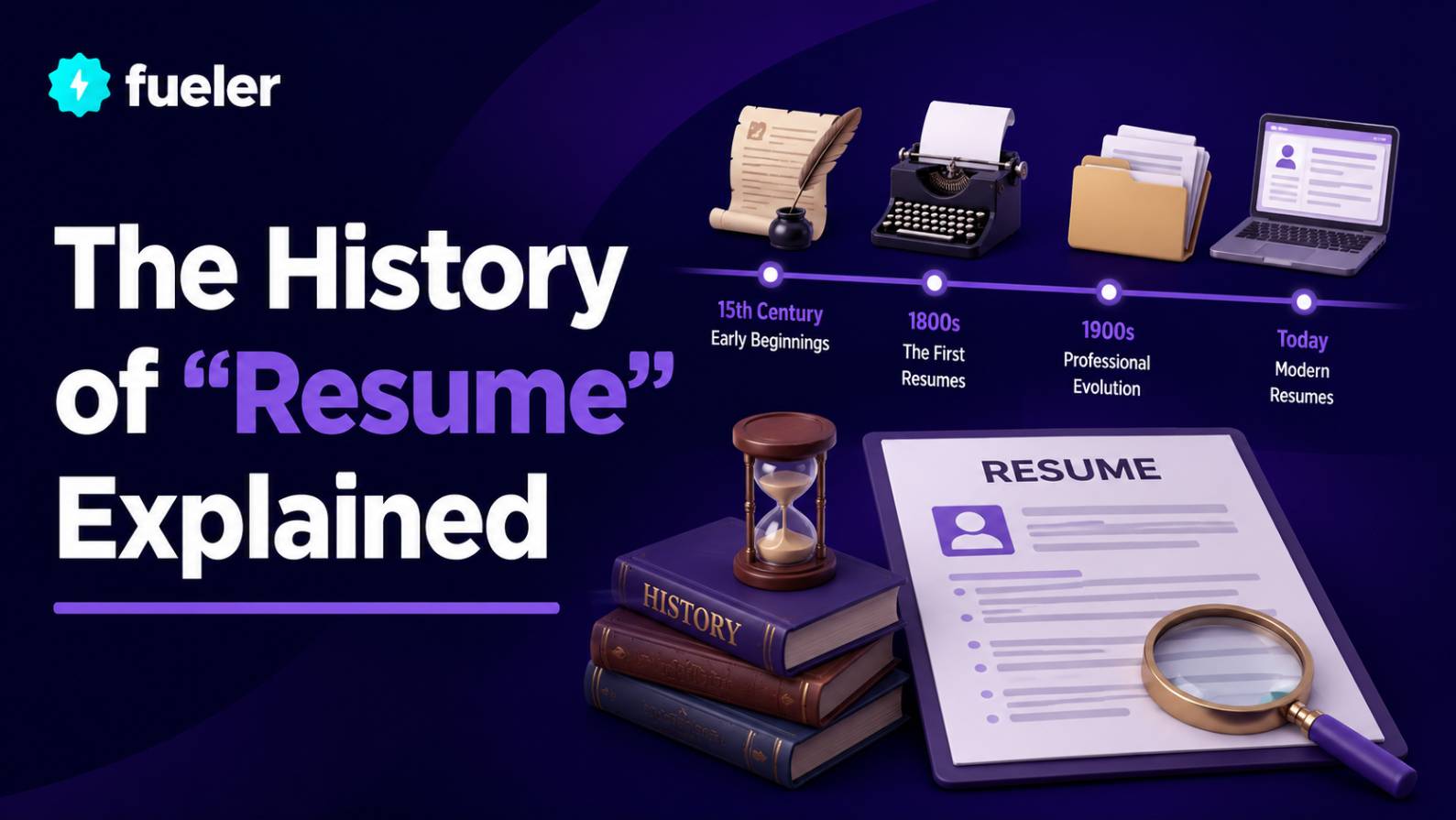
The History of "Resume" Explained

Riten Debnath
10 May, 2026
Imagine you are living in the year 1482. You are 30 years old, highly skilled, and you need a job. The city of Milan is on the verge of war, and the Ruler of Milan, Ludovico Sforza, is looking for people who can help him win.
If you were Leonardo da Vinci, what would you do?
You would sit down and write a letter. But this was not just any letter. This was the world's very first documented resume.
For over 500 years, job seekers have copied this exact same process. We write down our skills on a piece of paper, hand it to a stranger, and pray they hire us. As the founder of Fueler, a platform built to help companies hire through real proof of work and assignments, I have spent years studying how people show their talent.
The truth is surprising. The way we look for work has changed very little since the Renaissance. But the world around us has changed completely.
Let us look at how the resume started, how it changed over five centuries, and why the traditional resume is finally dying today.
The Birth of the Resume (1482)
The word résumé comes from the French language, and it means to summarize. But the format actually started in Italy. When Leonardo da Vinci applied for a job with the Duke of Milan, he did something incredibly smart. He did not talk about his feelings. He did not write a long story about his childhood.
Instead, he focused entirely on what the Duke needed.
Milan was afraid of attacks. Because of this, da Vinci wrote an 11-point letter. 10 out of those 11 points explained his skills as a military engineer. He wrote about his ability to build safe bridges, unattackable armored cars, powerful catapults, and advanced ships.
Do you know what he put at the very bottom of the page? He mentioned that he could also paint and sculpt as well as anyone else during times of peace.
Think about that for a second. One of the greatest artists in human history treated his art like a minor hobby because he knew his employer cared more about military defense. This teaches us the number one rule of job hunting: always talk about the problems your employer needs to solve.
The Slow Years: Letters and Recommendations (1500s to 1800s)
After da Vinci, the idea of a written profile spread slowly. For a long time, only wealthy people or highly skilled craftsmen used them.
In the 1500s, an English lord traveling through Europe might give a handwritten piece of paper to a host. This paper was called a letter of introduction. It was a way to say, “I am a honest person, you can trust me in your home.”
By the 1800s, the Industrial Revolution changed the world. Huge factories opened up. Railways connected distant cities. People started moving from small farms into big cities to find work.
During this era, if you wanted a good job in an office, you needed a letter of recommendation. You would ask your previous boss or a respected leader in your town to write a letter praising your character. If you did not know important people, it was very hard to get a good job. Talent was hidden behind social status.
The Corporate Boom and Standardization (1900 to 1950)
The 20th century changed everything. Businesses grew into massive global companies. Suddenly, managers had to hire hundreds of people at the same time. They could no longer sit down and read long, handwritten letters of introduction. They needed a quick way to sort through people.
By the 1930s, resumes became a standard requirement for formal job openings.
However, these early resumes looked very different from what we use today. Companies wanted to see your statistics. Resumes from this period often included:
- Your exact weight and height
- Your religion
- Your marital status (whether you were married or single)
- A photograph of your face
Employers used these details to make fast decisions. Many of these requirements were unfair and subjective, but it was the only system they had to manage the huge volume of applicants.
By the 1950s, the resume became mandatory. It turned into a strict professional profile. You were expected to list your school, your previous job titles, and even your personal hobbies like playing golf or gardening. The resume became a formal piece of paper that defined your entire identity.
The Digital Age and the Problem with Words (1980 to 2000s)
When the internet arrived in the late 1990s, everyone thought job hunting would become simple. Websites like Monster and Craigslist allowed people to post jobs online, and workers could send their resumes instantly via email.
But this created a brand new problem: information overload.
Instead of receiving 20 paper resumes in the mail, a hiring manager would suddenly receive 2,000 digital resumes in their email inbox for a single job opening. No human being had the time to read all of them.
To solve this, companies built software called Applicant Tracking Systems, or ATS. This software acts like a digital gatekeeper. It scans resumes for specific keywords. If your resume does not have the exact words the computer is looking for, your application is automatically rejected. A real human being will never even see it.
Because of this, modern job hunting became a game of trying to trick a computer algorithm. People started loading their resumes with fancy buzzwords like synergy, hardworking, and team player.
This is where the system broke. A resume is just a list of words. Anyone can write that they are an expert at coding or a master of marketing on a piece of paper. But words do not prove talent.
Why the Traditional Resume is Failing Modern Workers
We are using a 500-year-old tool to solve a modern problem. It just does not work anymore.
When I look at the hiring landscape today, I see thousands of talented individuals who graduate from school, build great things, but get rejected because their resume layout does not pass a computer test. This is heartbreaking.
A piece of paper cannot show your passion. It cannot show how you solve a difficult problem under pressure. It cannot show the quality of your code, the beauty of your designs, or the depth of your research.
Furthermore, the traditional resume creates a massive trust gap. Studies show that a high percentage of people stretch the truth on their resumes. They claim roles they did not have or exaggerate their achievements. Because of this, companies are terrified of making a bad hire based on a piece of paper alone.
The Future: Proof of Work and Portfolio-Driven Hiring
The world is moving away from what you say you can do, and moving toward what you can actually prove. This is why we are building Fueler.
We believe that your proof of work is your true resume. Instead of writing a bullet point that says “Good at social media marketing,” you should show the actual campaigns you ran, the graphics you designed, and the data of how many users you attracted.
The future of hiring relies on proof. Modern companies do not want to read a long history of where you sat for eight hours a day. They want to see your skills in action.
This is why more and more top brands are using assignments during the interview process. An assignment lets you show your talent in real-time. It levels the playing field. It does not matter what school you went to or who your parents know. If you can complete the assignment with high quality, you get the job.
If Leonardo da Vinci were alive today, he would not send a text-only PDF file to a company. He would send a link to a digital portfolio showing his actual 3D models, his engineering blueprints, and his paintings. He would use his proof of work to stand out.
The era of telling is over. The era of showing has begun.
High-Intent Frequently Asked Questions
What should a modern professional resume include today?
A modern resume should focus on clear achievements and measurable results rather than daily tasks. Include your contact details, a specific professional summary, your work history with data, and key technical skills. To stand out even more, include links to your real proof of work or public portfolio so managers can see your skills.
How do I make my resume pass the ATS screening?
To pass the ATS screening, match the wording on your resume to the specific job description. Use simple formatting without complex tables, charts, or unusual fonts that can confuse the software. Keep your section titles standard, using common terms like Work Experience and Education.
What is the difference between a resume and a CV?
A resume is a short, one or two-page summary of your skills and work history targeted for a specific job. A CV, which stands for Curriculum Vitae, is a longer, detailed document that covers your entire career history, academic publications, honors, and certifications.
Why are companies moving away from traditional resumes?
Companies are moving away from traditional resumes because simple text documents do not guarantee real skill or honesty. Many organizations now prefer proof of work, digital portfolios, and practical assignments to see how an applicant actually handles real job tasks before making a final hiring decision.
How can I showcase my work experience if I am a fresher?
If you are a fresher without formal job experience, focus on building a public portfolio of your projects. You can share school work, personal projects, freelance jobs, or open-source contributions. Displaying your skills through live proof of work helps employers trust your capabilities.
What is Fueler Portfolio?
Fueler is a career portfolio platform that helps companies find the best talent for their organization based on their proof of work. You can create your portfolio on Fueler. Thousands of freelancers around the world use Fueler to create their professional-looking portfolios and become financially independent. Discover inspiration for your portfolio
Sign up for free on Fueler or get in touch to learn more.

What should you do next?
You've read the article. Now turn your skills into proof of work and unlock more opportunities.
Build your proof of work portfolio
Create a clean portfolio with projects, assignments, resumes, and AI stack details that companies actually want to see.
Create your Fueler portfolio →Apply through assignments, not resumes
Stand out by solving real tasks from companies hiring on Fueler.
Explore assignments →Get discovered by companies
Make your work public and let recruiters discover your skills through actual projects instead of keywords.
Get discovered →