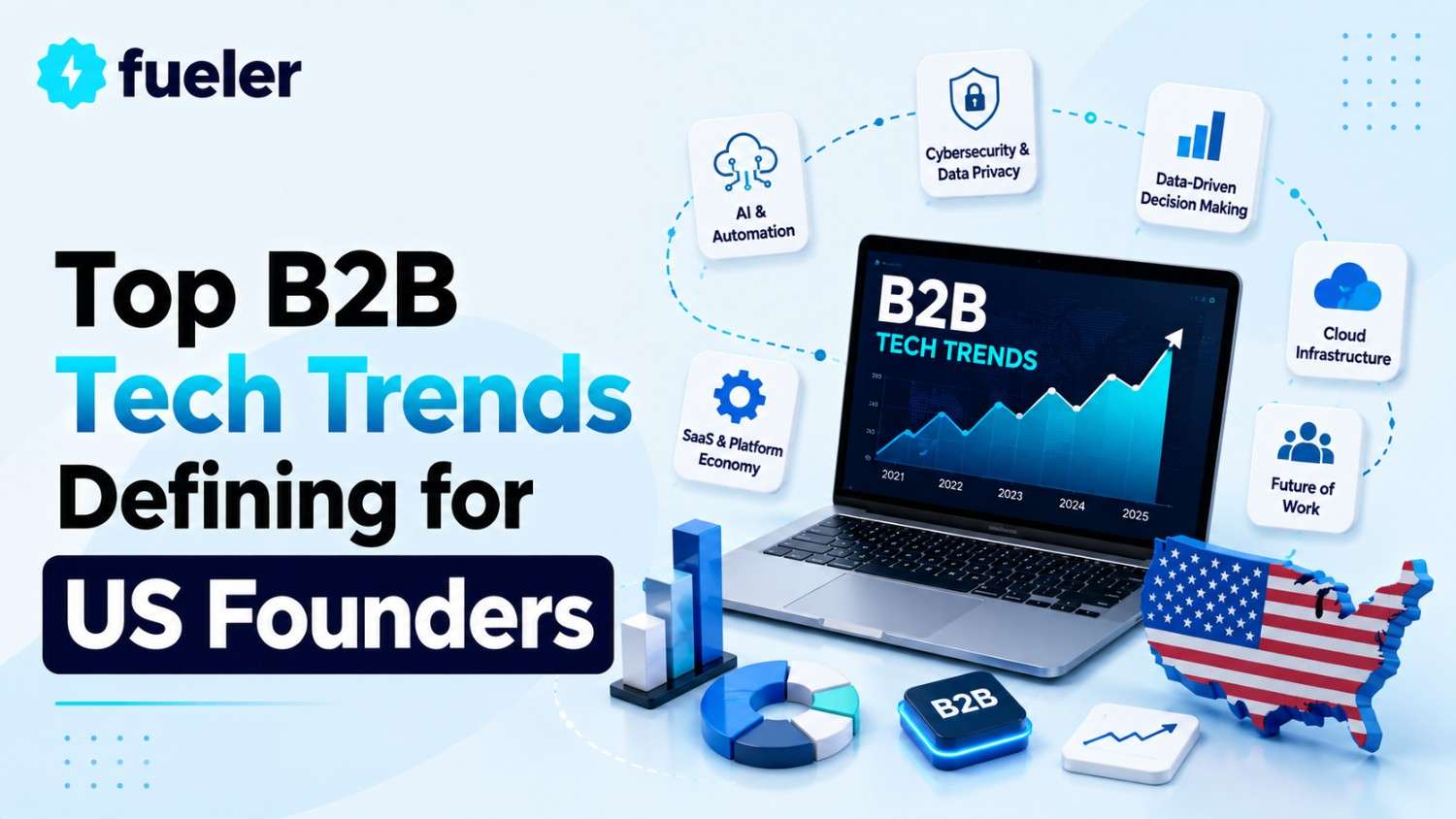
Top B2B Tech Trends Defining 2026 for US Founders

Riten Debnath
05 Dec, 2025
Discover the game-changing B2B technologies shaping the future of startups in 2026.
In the rapidly evolving tech landscape, US founders must stay ahead of cutting-edge tools and strategies that drive growth and efficiency. In 2026, several B2B technology trends are not just shaping competitiveness but redefining how startups scale and operate. This blog explores the top trends redefining the B2B space, giving founders the insights to leverage these trends for success.
I’m Riten, founder of Fueler - a skills-first portfolio platform that connects talented individuals with companies through assignments, portfolios, and projects, not just resumes/CVs. Think Dribbble/Behance for work samples + AngelList for hiring infrastructure
1. AI-Driven Customer Engagement Platforms
Artificial intelligence is reshaping customer interactions, making experiences more personalized, timely, and effective than ever before.
- AI platforms analyze vast customer data to predict needs and preferences, enabling startups to deliver targeted, timely recommendations that increase satisfaction and retention. These systems continuously learn from interactions, improving accuracy and relevance steadily.
- Sophisticated chatbots powered by natural language processing can handle complex queries, allowing 24/7 customer support without sacrificing quality. This automation elevates customer service while allowing human teams to focus on high-impact issues.
- Predictive analytics tools help sales teams identify the hottest leads by scoring prospects based on behavior patterns, boosting conversion rates and reducing wasted outreach efforts.
- Integrated AI CRM tools streamline workflows by syncing customer data across platforms, ensuring smooth handoffs between sales, marketing, and support teams for a consistent journey.
- By adapting in real time to feedback and interaction data, AI engagement systems refine their approach, ensuring customers receive dynamic, context-aware communication that feels personal and empathetic.
Why it matters: AI-driven platforms empower US founders to enhance customer experience with proactive, intelligent communication that builds stronger relationships and drives revenue growth in a highly competitive market.
2. Advanced Account-Based Marketing (ABM) Solutions
ABM technologies allow startups to hyper-focus their marketing efforts on strategic, high-potential customers rather than broad demographics.
- These solutions deliver highly personalized campaign content tailored to the unique pain points and goals of target accounts, increasing relevance and conversion likelihood substantially.
- Real-time monitoring of account engagement enables marketers to adjust messaging instantly in response to interactions, optimizing campaign impact continuously throughout the buyer’s journey.
- Multi-channel orchestration across email, social media, websites, and events maintains consistent, coordinated communication that reinforces brand presence and trust with key decision-makers.
- AI-powered analytics detect subtle buying signals earlier than traditional methods, allowing sales and marketing teams to engage leads at the perfect moment with maximum effect.
- Seamless integration with CRM and sales enablement tools aligns marketing efforts with sales outreach, creating a unified approach that accelerates deal closure and revenue growth.
Why it matters: ABM enables founders to allocate marketing resources smartly, focusing on the right customers with precision and improving overall efficiency and effectiveness in acquiring high-value business clients.
3. Workflow Automation and Collaboration Tools
Scalable startups rely on workflow automation and collaboration platforms to enhance productivity and maintain smooth operations as teams grow and disperse.
- Platforms like ClickUp and Monday.com provide robust project management features such as customizable workflows and visual task dependencies, ensuring that teams can plan and execute complex projects without confusion or delays.
- Automation capabilities send timely notifications, status updates, and approval reminders automatically, reducing manual follow-ups and freeing up time for strategic work.
- Integration with communication tools such as Slack and Microsoft Teams fosters seamless real-time collaboration, especially critical for remote or hybrid teams dispersed across locations and time zones.
- Advanced analytics on these platforms give leaders insights into team throughput, resource allocation, and potential bottlenecks, enabling proactive adjustments that keep projects on track.
- The availability of low-code or no-code workflow builders empowers non-technical staff to automate repetitive tasks themselves, accelerating innovation and efficiency across departments.
Why it matters: Efficient workflow and collaboration platforms allow US founders to scale operations without sacrificing agility, ensuring their teams deliver high-impact results consistently and adapt quickly to changes.
4. Enhanced Data Privacy and Security Technologies
With increasing cyber threats and regulatory demands, startups must prioritize advanced data security to protect their assets and customer trust.
- Next-generation encryption technologies secure data during transfer and storage, making breaches more difficult and safeguarding sensitive business and customer information.
- Identity and access management (IAM) tools enforce strict authentication and authorization protocols, ensuring that only authorized personnel can access critical systems and data.
- Continuous threat detection platforms monitor network activity in real-time, identifying anomalies that may indicate attacks and enabling swift incident response before damage occurs.
- Secure API management ensures safe connections between multiple SaaS applications, preventing vulnerabilities from integration points that are common attack vectors.
- Compliance automation tools help startups adhere to evolving privacy laws like GDPR and CCPA by managing audits, reporting, and data subject requests efficiently.
Why it matters: Strong and dynamic data security not only protects startups from costly breaches and legal penalties but also builds confidence with customers and partners, which is invaluable in the B2B environment.
5. Cloud-Native and Serverless Architectures
Modern startups are adopting cloud-native approaches and serverless technologies to build flexible, scalable systems without the hassle of managing underlying infrastructure.
- Cloud-native designs emphasize microservices and containerization, enabling development teams to build modular applications that can be updated and scaled independently to meet demand.
- Serverless computing abstracts away server management tasks, allowing startups to focus on code and business logic while automatically scaling resources based on real-time usage.
- This approach reduces operational costs by shifting from fixed infrastructure to pay-as-you-go models, which is especially beneficial for startups with fluctuating workloads.
- Enhanced developer productivity results from faster deployment cycles and simplified infrastructure management, accelerating time-to-market for new features and products.
- Built-in cloud security and compliance features at the platform level help startups meet regulatory requirements without complex configurations.
Why it matters: Embracing cloud-native and serverless architectures allow US founders to build resilient, cost-effective solutions that scale effortlessly as their businesses grow in 2026 and beyond.
Fueler offers an innovative platform that supports startups and professionals alike by enabling skills-first hiring through verified portfolios of real projects and assignments, a perfect match for the tech-savvy trends shaping hiring and growth strategies today.
Final Thoughts
The B2B tech landscape in 2026 is defined by intelligent automation, precision marketing, seamless collaboration, rigorous security, and scalable infrastructure. US founders leveraging these trends will not only enhance operational efficiency but also unlock new growth avenues and competitive advantages critical for success.
Frequently Asked Questions
What are the top B2B tech trends US founders must watch in 2026?
Key trends include AI-driven customer engagement, advanced ABM solutions, workflow automation, data security enhancements, and cloud-native architectures.
How does AI improve customer engagement in B2B startups?
AI personalizes interactions by predicting customer needs, automating support, and refining outreach for more effective, timely communication.
Why is account-based marketing important for startups?
ABM targets high-value clients with personalized campaigns, improving conversion rates and marketing resource allocation.
What benefits do workflow automation tools provide to startups?
They enhance productivity by automating processes, facilitating remote collaboration, and giving leadership actionable insights.
How do enhanced data privacy technologies impact startup success?
Strong security builds customer trust, prevents costly breaches, and ensures compliance with strict regulations.
What should you do next?
You've read the article. Now turn your skills into proof of work and unlock more opportunities.
Build your proof of work portfolio
Create a clean portfolio with projects, assignments, resumes, and AI stack details that companies actually want to see.
Create your Fueler portfolio →Apply through assignments, not resumes
Stand out by solving real tasks from companies hiring on Fueler.
Explore assignments →Get discovered by companies
Make your work public and let recruiters discover your skills through actual projects instead of keywords.
Get discovered →