Top 10 Product Management Courses with Global Acceptance (2026)

Riten Debnath
14 Mar, 2026
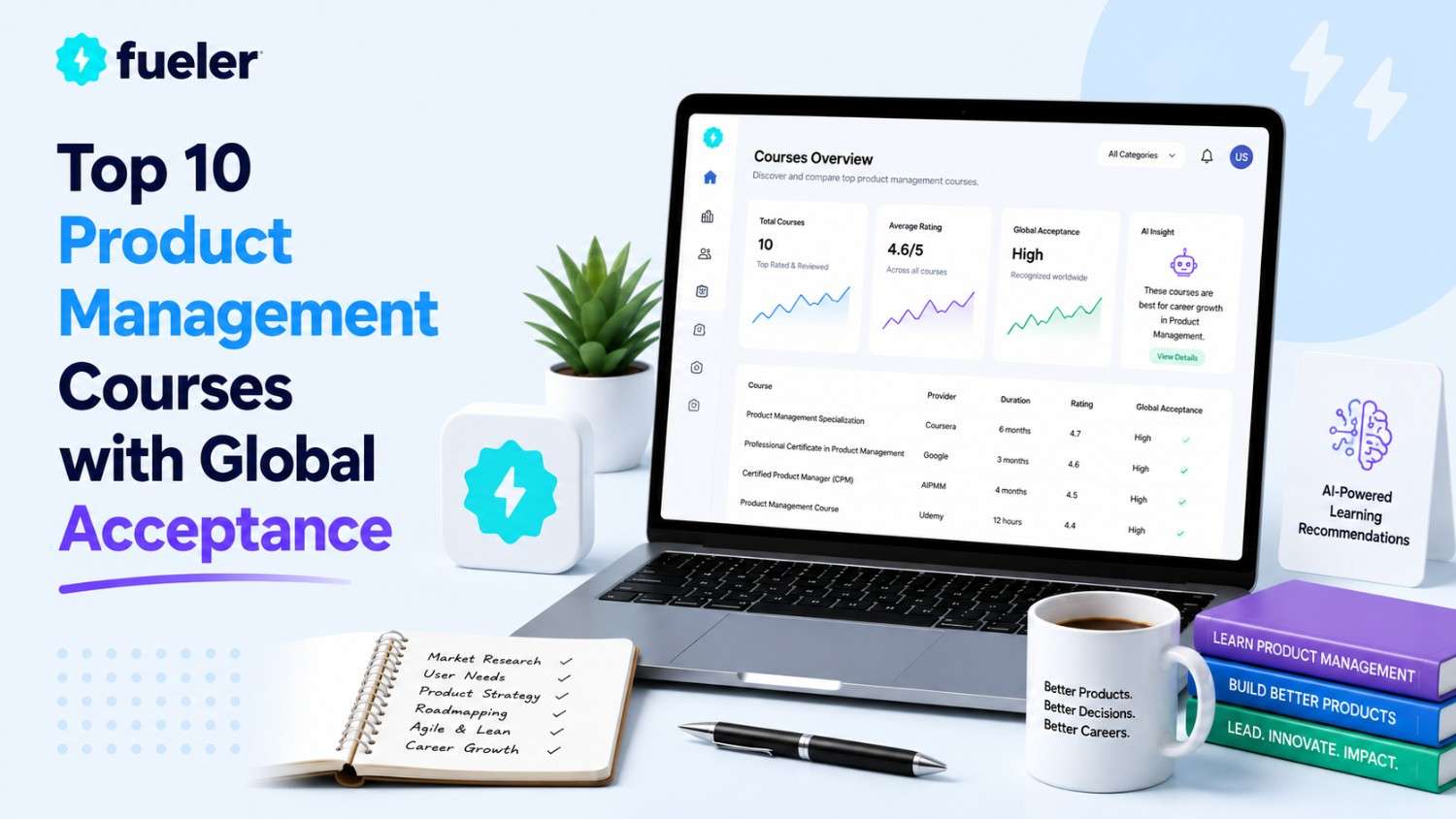
So, you want to be a Product Manager? You want to be the person who sits in meetings, nods wisely at charts, and somehow convinces everyone that "we should build a button that is slightly more blue"? It is a great career, really. You get paid to talk to smart people, solve problems, and occasionally wonder why users are doing absolutely nothing as you expected. But before you can start managing products, you need to actually learn how to do it without accidentally breaking the entire company strategy. Don't worry, you don't need a PhD in rocket science. You just need the right course to show you the ropes so you don't look like a deer in headlights during your first interview.
I’m Riten, founder of Fueler, a skills-first portfolio platform that connects talented individuals with companies through assignments, portfolios, and projects, not just resumes/CVs. Think Dribbble/Behance for work samples + AngelList for hiring infrastructure.
1. Product School: Product Management Certification
Product School is the cool kid on the block that everyone wants to sit with at lunch. They hire instructors who actually have day jobs at companies like Google, Meta, and Netflix, so you aren't just learning theory from someone who hasn't touched a real product since the nineties. The curriculum is built for busy humans who have real lives but still want to master the art of shipping software that doesn't crash on launch day.
- Live Instructor-Led Training: You learn in real-time from active industry experts who share raw, unfiltered stories about what works and what causes a product to explode in the market. These instructors bring actual battlefield experience to the classroom, ensuring you are not just memorizing textbook definitions but understanding how to navigate the messy, high-pressure environments of modern tech companies while managing diverse stakeholders.
- Industry-Standard Tooling: You get hands-on time with the exact tools pros use daily, including Jira for tracking, Figma for design, and various analytics suites for metrics. You will learn to manipulate these tools to communicate your vision, build high-fidelity wireframes that actually make sense, and track the performance of your product releases with cold, hard data instead of just guessing.
- Networking Potential: You gain access to a global community of peers and alumni, which is basically like having a cheat code for finding your next job through personal referrals. By interacting with this diverse group, you open doors to opportunities in various markets, learn from their unique challenges, and build a supportive network that will help you grow throughout your career.
- Capstone Project: You build a real-world project that acts as your proof of skill, moving you away from "I think I can do this" to "Look at what I already did." This artifact is crucial because it allows you to demonstrate your ability to identify user pain points, design a viable solution, and present a professional-grade strategy to potential employers during interviews.
- Career Coaching: The program includes dedicated time for resume, LinkedIn, and interview prep to make sure you sound like a pro when the recruiters come knocking. Coaches work with you to refine your story, highlight your unique strengths, and ensure your professional brand matches the high expectations of top-tier technology firms, effectively turning your background into a competitive advantage.
Why it matters: This course is the gold standard for global credibility. Recruiters at big tech firms recognize the name immediately, which means you aren't just sending out applications into the void, you are sending them with a stamp of approval from the people who essentially defined modern product management. It signals to employers that you have been tested in the trenches and possess the practical, high-level skills needed to drive a product from a messy idea to a successful launch that actually generates real business value.
2. Stanford University: Product Management Program
If you want to brag about attending Stanford without actually living in a dorm or eating cafeteria food, this is your golden ticket. This program is heavy on the high-level strategy and innovation side of the house. It is perfect if you want to understand the deep, structural "why" behind every feature, rather than just clicking buttons and hoping for the best outcome for your users.
- Elite Curriculum: You dive into a rigorous academic framework that covers the entire product lifecycle from the initial idea spark to the sad, inevitable moment of product retirement. This structured approach ensures you grasp the complexities of balancing innovation with profitability, teaching you how to view the product as a business asset that must perform consistently to justify its existence within the competitive market.
- Strategic Focus: The lessons prioritize big-picture thinking, teaching you how to balance customer demands with the harsh reality of business profitability and technical limitations. You will learn to perform deep market analysis, identify high-impact opportunities, and construct a long-term vision that aligns with organizational goals, ensuring that every feature you prioritize contributes to the broader success of the company’s mission.
- Collaborative Learning: You are placed in cohorts with driven professionals from all over the world, forcing you to learn how to communicate across different time zones and cultures. This global perspective is invaluable because it exposes you to various market dynamics and user behaviors, helping you develop a more nuanced understanding of how to manage products in a diverse, interconnected global digital landscape.
- Expert Instruction: You learn directly from Stanford faculty and guest speakers who have helped build some of the most influential products on the planet today. These experts provide insights that you simply cannot find in standard training manuals, sharing their personal experiences with failure, success, and the subtle art of influencing teams to build things that truly matter to the end user.
- Certificate of Achievement: Receiving a credential from a top-tier university gives you instant professional authority that is hard to argue with, no matter what industry you are targeting. This signal of excellence helps you bypass the initial resume filtering process at elite firms, as employers immediately understand the level of academic and practical rigor you have successfully navigated through this prestigious program.
Why it matters: A certificate from Stanford acts like a master key. It opens doors because it proves you have a solid, rigorous foundation in strategic thinking that big tech companies absolutely worship. It changes the conversation from "can you do this" to "how soon can you start?" because it confirms you have the ability to handle complexity, manage high-stakes decisions, and think like a business owner from day one.
3. Google: Foundations of Project Management
Don’t let the "Project" in the title make you think this is only for people who like spreadsheets and Gantt charts. Google’s program is famous for being incredibly beginner-friendly, and it is the absolute best place to start if you have zero experience and just want to get your feet wet in a high-growth field. It covers the core foundations that every modern Product Manager needs to know.
- Agile and Scrum Mastery: You dive deep into the most popular methodologies used in tech today. Learning how to run a sprint or manage a backlog is not just a theoretical exercise here, it is a survival skill that you will use in literally every single job you get in the future, helping you keep your team organized and productive.
- Effective Stakeholder Communication: You learn the delicate art of keeping everyone happy, from the grumpy developer who hates meetings to the high-level executive who wants to know why the product isn’t finished yet. This module teaches you how to translate technical hurdles into business language so you can secure buy-in and keep your projects moving without constant drama.
- Risk Management Skills: Projects never go exactly as planned, and this course teaches you how to spot a disaster before it happens. You will learn to identify risks, plan for them, and mitigate them early, which is exactly the kind of calm, proactive leadership that turns a junior manager into a senior leader that teams actually want to follow.
- AI-Enhanced Productivity: Google has updated this to include how to use AI tools to automate the boring stuff. You will learn how to draft documentation, summarize meeting notes, and analyze data using modern AI, giving you a serious competitive edge by allowing you to focus on high-impact strategy instead of getting buried in repetitive administrative tasks.
- Job Search Support: The program gives you access to a massive hiring consortium. It includes tools for resume building, mock interviews, and career networking, which is basically like getting a roadmap for your job hunt. It helps you position yourself as a candidate who is ready to hit the ground running from day one, not just someone with a certificate.
Why it matters: It gives you that shiny "Google" brand on your profile, which acts like a massive magnet for recruiters. It is the perfect starting line to build your confidence, proving that you have a disciplined, structured approach to work that matches the high standards of the biggest technology company in the world.
4. BrainStation: Product Management Certification
BrainStation is known for being brutally practical. They don’t just teach you theory, they force you to get your hands dirty. Their instructors are usually working professionals who know exactly what hiring managers are crying for right now, so you aren’t learning outdated techniques from a textbook written when dial-up internet was still a thing. It is intense, fast-paced, and very effective.
- Experiential Learning: The program is entirely built around doing, not watching. You will be working on a real-world product launch strategy, which means you are actually practicing the decision-making process that you would be using in a real job. By the end of the course, you don’t just know the definition of a feature, you know how to build a proposal for one.
- Industry-Expert Instructors: You get feedback from actual product managers who work at companies like Amazon, Shopify, and Meta. This is invaluable because you are getting the inside scoop on how these giants operate, learning the subtle nuances of product culture, and avoiding the common mistakes that usually get junior PMs fired in their first six months.
- Real-World Tooling: You get deep exposure to the exact stack that product teams use, including Figma, Jira, and various analytics tools. You will learn to prototype your ideas, track your progress, and analyze user feedback, ensuring that when you walk into an interview, you can confidently talk about how you’ve used these tools to drive real business results.
- Collaborative Cohort Environment: You are placed in a group with other ambitious people who are also looking to transition into the field. This isn’t just for networking; it’s a simulation of the cross-functional work you will do as a PM, where you have to balance different personalities, skill sets, and working styles to get a project across the finish line.
- Portfolio-Driven Output: Every part of this course results in something you can put in your portfolio. Whether it is a user research report, a product roadmap, or a prototype, you are building a physical record of your talent. This helps you skip the "tell me about a time" questions and go straight to "let me show you how I did this."
Why it matters: They help you bridge the gap between "I think I know what a PM does" and "I can actually do the job." This practical edge is exactly what gets you hired in 2026, where companies are tired of candidates who have fancy degrees but can’t ship a feature to save their lives.
5. University of Virginia (Darden): Digital Product Management
This course on Coursera is perfect for those who want a university-backed education without the high price tag of a full degree. It is run by the Darden School of Business, which means it is incredibly focused on the business side of products. It is the best place to go if you want to understand how to turn a cool idea into a profitable reality.
- Deep Dive into Analytics: Data is the lifeblood of product management, and this course treats it like royalty. You learn how to look at churn rates, acquisition costs, and user engagement metrics, teaching you how to make product decisions that are actually backed by math, not just your gut feeling or the loudest person in the meeting.
- Design Thinking Frameworks: You learn the rigorous Darden approach to empathy. You will practice interviewing real users, identifying their real-world pain points, and coming up with solutions that actually solve those problems, rather than building features that nobody asked for and nobody will ever use once the hype dies down.
- Strategy and Roadmap Planning: You are taught how to manage a product like a business owner. This includes everything from competitive analysis and market positioning to deciding when to kill a feature that just isn’t working, giving you the strategic backbone to defend your roadmap to skeptical stakeholders and investors.
- Flexible Self-Paced Format: You can do this at 2 AM or 2 PM, which makes it perfect for people who are currently working a full-time job. The content is broken down into manageable chunks, so you don’t feel like you are drinking from a firehose, allowing you to actually absorb the information instead of just clicking "next" to get the certificate.
- Capstone Integration: The final project ties everything together into a cohesive story. You don’t just build a feature; you create a complete product strategy that includes the business model, the user experience, and the technical roadmap, which is a fantastic piece to showcase when you are talking to potential employers about your strategic thinking skills.
Why it matters: This course makes sure you know how to read the numbers so you aren’t just guessing when you make product decisions. It provides the intellectual rigor of a top-tier business school, which signals to employers that you have the discipline to handle high-level business strategy.
6. Udacity: Product Manager Nanodegree
If you are the type of person who likes "doing" more than "reading," Udacity is your home. Their programs are essentially giant, interactive projects. You don’t pass by taking a boring multiple-choice test; you pass by showing you can actually build something. If you are serious about becoming a product manager, this course is designed to put your skills to the test in a safe environment.
- Project-First Curriculum: The entire course is built around completing projects that mimic real-life workplace tasks. You will be writing product requirements, creating roadmaps, and conducting user tests on projects that you have developed yourself, which forces you to deal with the inevitable problems that arise when theory meets the harsh, unforgiving reality of a real product.
- Personalized Mentor Feedback: You get actual humans looking at your work and giving you advice. It is not just an automated checker; it is a mentor who tells you why your roadmap is unrealistic or why your user testing strategy won’t work, which is the kind of tough love that makes you a much, much better product manager.
- Strong Career Support: The program includes resume reviews and interview prep tailored to the current job market. They know what recruiters in tech look for, so they help you highlight the right projects and frame your experience in a way that makes you sound like a seasoned pro who is ready to manage a team immediately.
- Focus on Modern Technical Skills: Udacity is great at keeping their curriculum updated with the latest trends. You will learn about the newest technical developments, how to communicate with engineering teams, and how to stay ahead of the curve, ensuring you are not just managing the present, but also ready for whatever is coming in the next year or two.
- Industry-Recognized Credential: While not an accredited university, the Nanodegree is well-respected in the tech industry. Employers know that if you finished this, you didn't just passively listen to lectures; you actually did the work, which gives you a distinct advantage over other candidates who only have theory on their resumes.
Why it matters: You end the course with a tangible portfolio of work. In a world full of people with "Product Manager" on their resumes, showing actual, completed projects is how you win.
7. Simplilearn: AI-Powered Product Management
Let’s be real, AI is everywhere, and if you aren’t using it, you are falling behind. This course from Simplilearn is specifically designed to help you leverage AI to supercharge your product management workflows. It is perfect if you want to be the PM who knows how to use the latest, most powerful tools to get twice as much done in half the time.
- AI-Centric Workflow Integration: You learn exactly how to use AI for market research, user persona creation, and even drafting product specs. By the time you finish, you’ll have a toolkit of AI prompts and strategies that you can immediately apply to your job to save hours of tedious work every single week.
- Industry-Relevant Case Studies: The program uses recent, real-world examples of how AI has changed the game for companies like Netflix and Spotify. You don’t just hear about AI; you see how it is used to optimize recommendation engines, improve user retention, and predict market trends, which is exactly the kind of knowledge that companies are paying a premium for.
- Hands-on Live Classes: You get to interact with experts in real-time, allowing you to ask questions about the weird, specific challenges you are having with your own projects. This is much better than a static, recorded video, as you get to learn from the instructor’s real-world experiences with deploying AI tools in complex, messy enterprise environments.
- Strategic Business Alignment: The course focuses on how to use AI to drive actual business value, not just how to play with cool toys. You learn how to pitch AI initiatives to your boss, measure the success of your implementation, and ensure that the technology is actually solving a user problem instead of just adding complexity to your product.
- Global Certification: Simplilearn is known for its rigorous certification standards, and their partnership with industry leaders means this certificate is recognized globally. It tells employers that you are a forward-thinking, tech-savvy PM who isn’t afraid of the future, which is exactly what every modern tech firm is looking for right now.
Why it matters: In 2026, an AI-ignorant PM is a dying breed. This course makes sure you are the one driving innovation, not the one being replaced by it.
8. Reforge: Advanced Product Management
Reforge is the place where senior PMs go to level up. It is not for people who don’t know what a product backlog is; it is for people who have been doing the job for a few years and are ready to tackle the really, really hard problems. If you want to talk about growth loops, retention mechanics, and strategy at a high level, this is your place.
- Practitioner-Led Content: The instructors are actual leaders currently working at companies like Slack, Tinder, and Instagram. You aren’t getting theory from a professor; you are getting the battle-hardened strategies that were used to scale some of the most successful digital products on the planet. It is deep, it is specific, and it is incredibly relevant.
- Focus on Growth and Retention: The core of Reforge is learning how to keep users coming back. You dive into the math and psychology of user behavior, learning how to build features that create habits and drive sustainable growth, which is arguably the most valuable skill a PM can have in a world where acquisition costs are sky-high.
- Exclusive Community Access: The networking here is top-tier. You are surrounded by other experienced PMs from top-tier tech companies, which means your Slack channel conversations are actually useful. You can ask for advice on how to handle a difficult stakeholder or how to prioritize a complex feature, and you will get answers from people who have been there.
- Strategic Frameworks: You learn specific models for how to think about product strategy. It gives you a vocabulary and a way of framing problems that you just don’t get in introductory courses, allowing you to communicate more effectively with your leadership team and make decisions that stand the test of time.
- High-Level Professional Development: This is basically a "career accelerator." It helps you move from "task manager" to "product leader" by focusing on the soft skills and strategic thinking that actually get people promoted to Director and VP levels. It is an investment in your career trajectory, not just a one-time learning experience.
Why it matters: It is the ultimate "I know my stuff" signal. When a recruiter sees Reforge on your profile, they know you are operating at an advanced, strategic level, which allows you to command a significantly higher salary.
9. General Assembly: Product Management Short Course
General Assembly is like the "classic" choice for career switchers. They have been doing this forever, their name is well-known in the industry, and they have a massive alumni network that spans the entire globe. Their short course is designed to get you up to speed in a few weeks, which is great if you need to learn the basics fast.
- Structured Learning Path: The curriculum is extremely well-defined, covering everything from the product lifecycle to stakeholder management in a very logical order. It takes the overwhelming world of product management and breaks it down into small, digestible chunks, making it much easier to learn if you have never done this before.
- Strong Brand Recognition: General Assembly is a known quantity in the tech industry, and their name on a resume acts as a good, solid stamp of quality. It won't necessarily make you look like a genius, but it definitely shows you are serious about your professional development, which is enough to get you through the front door at thousands of companies.
- Global Alumni Network: Being a GA grad gives you access to a massive community of professionals who are all going through the same thing. This is incredibly helpful when you are job hunting, as you can reach out to alumni at companies you are interested in for tips, advice, or even direct referrals.
- Hands-On Assignments: The course is packed with assignments that force you to practice the skills you are learning. You will be building wireframes, analyzing metrics, and putting together pitch decks, which means you leave the course with a good set of basic skills and a few projects you can discuss during your interviews.
- Career Prep and Networking: GA invests a lot into their career services, helping you refine your LinkedIn profile, improve your resume, and prepare for the behavioral questions that inevitably pop up in every single PM interview. It is a very safe, very reliable way to get yourself ready for the market.
Why it matters: It is a proven, reliable path into the industry. You aren't taking any risks by choosing a platform with such a long, successful history of helping people make the jump from their current role into tech.
10. Section: Product Strategy Sprint
Section (formerly Section4) is founded by Scott Galloway, and it is about as "no-BS" as you can get. These are short, intense "sprints" that teach you high-level strategy without any of the fluffy academic jargon. It is perfect if you are a busy person who doesn’t have three months to commit but needs to learn how to think strategically right now.
- Direct, Actionable Lessons: There is zero fluff here. You get high-intensity video lessons that get straight to the point, followed by exercises that force you to apply what you just learned. It is designed for people who have jobs and need to get smarter, faster, and more effective without wasting time on theory that doesn't work in the real world.
- Focus on Business Strategy: This isn't just about managing a product; it’s about managing a business. You learn how to look at the competitive landscape, understand your unit economics, and build a strategy that makes your company money, which is exactly what leadership teams want to see from their product managers.
- Peer-Based Learning: You are in a cohort with other high-performing professionals, which means the discussions are always high-quality and relevant. You aren’t dealing with people who don’t know the basics; you are dealing with people who are also trying to level up their careers and provide insightful feedback on your work.
- Flexible Format: These are sprints, not long-term courses. You can fit them into your busy schedule much more easily than a bootcamp, allowing you to learn a specific, valuable skill (like AI strategy or product positioning) in just a few weeks. It is perfect for constant, incremental career growth.
- Taught by Practitioners: The instructors are real-world experts who actually understand how business works in the modern digital age. You learn how to think about products in a way that is modern, data-driven, and highly effective, helping you stand out as a PM who really understands the business side of the tech industry.
Why it matters: It teaches you how to think like a business owner, which is the rarest and most valuable skill a PM can have. It helps you stop being the person who just manages tasks and become the person who helps shape the company's future.
Strategic Portfolio Building with Fueler
While these courses give you the knowledge, your future employer needs to see the proof. This is where Fueler steps in. Think of your Fueler profile as your secret weapon place to showcase the actual assignments, case studies, and projects you complete during these courses. Instead of just listing a certificate on your resume, you can share live links to your product roadmaps, user research docs, and design prototypes. When you apply for jobs, showing a portfolio of "done" work samples demonstrates your potential far better than any piece of paper ever could.
Final Thoughts
Product management is a wild ride, but you do not have to drive alone. Whether you go with the industry-hardened approach of Product School or the strategic depth of Stanford, the key is to stop being a passive student and start acting like a builder. Pick a course, commit to the projects, and build a portfolio that makes recruiters stop scrolling. The market doesn't care about your potential; it cares about what you have already shipped. Keep learning, keep building, and stay curious.
FAQs
1. Which product management course is best for beginners in 2026?
If you are starting from zero, the Google Project Management Certificate is widely considered the most beginner-friendly. It provides a foundational understanding of the terminology, processes, and tools used in the industry without requiring any prior experience, making it a perfect, low-pressure entry point for anyone looking to pivot into the tech space.
2. Can I get a job just by doing online product management certifications?
Certifications help, but they are not magic bullets. Employers look for a mix of theory and practical evidence. To increase your chances, use your course projects to build a professional portfolio of work samples on platforms like Fueler, as this proves you have applied the concepts in real-world scenarios rather than just passing a test.
3. Do I need to be technical to become a successful Product Manager?
No, you do not need to be a coder, but you do need to be "technically literate." You should be able to communicate effectively with engineering teams, understand technical constraints, and grasp how software products are built. Most top courses now include modules on technical foundations to ensure you can bridge the gap between business and engineering.
4. How long does it usually take to transition into a Product Management role?
The timeline varies, but most professionals see a transition within 6 to 12 months. This period involves completing a rigorous certification, networking with peers, attending industry events, and actively refining your resume and portfolio. Consistency is key, and treating your job search like a "product" you are managing can significantly improve your results.
5. Are there free resources to learn product management basics?
Yes, you can find excellent free introductory content on platforms like Coursera (often with audit options), YouTube channels from established PM leaders, and blogs from companies like Reforge. While these won't provide a certificate or personal mentorship, they are great for validating your interest in the field before you commit to a paid, intensive program.
What is Fueler Portfolio?
Fueler is a career portfolio platform that helps companies find the best talent for their organization based on their proof of work. You can create your portfolio on Fueler. Thousands of freelancers around the world use Fueler to create their professional-looking portfolios and become financially independent. Discover inspiration for your portfolio
Sign up for free on Fueler or get in touch to learn more.

What should you do next?
You've read the article. Now turn your skills into proof of work and unlock more opportunities.
Build your proof of work portfolio
Create a clean portfolio with projects, assignments, resumes, and AI stack details that companies actually want to see.
Create your Fueler portfolio →Apply through assignments, not resumes
Stand out by solving real tasks from companies hiring on Fueler.
Explore assignments →Get discovered by companies
Make your work public and let recruiters discover your skills through actual projects instead of keywords.
Get discovered →