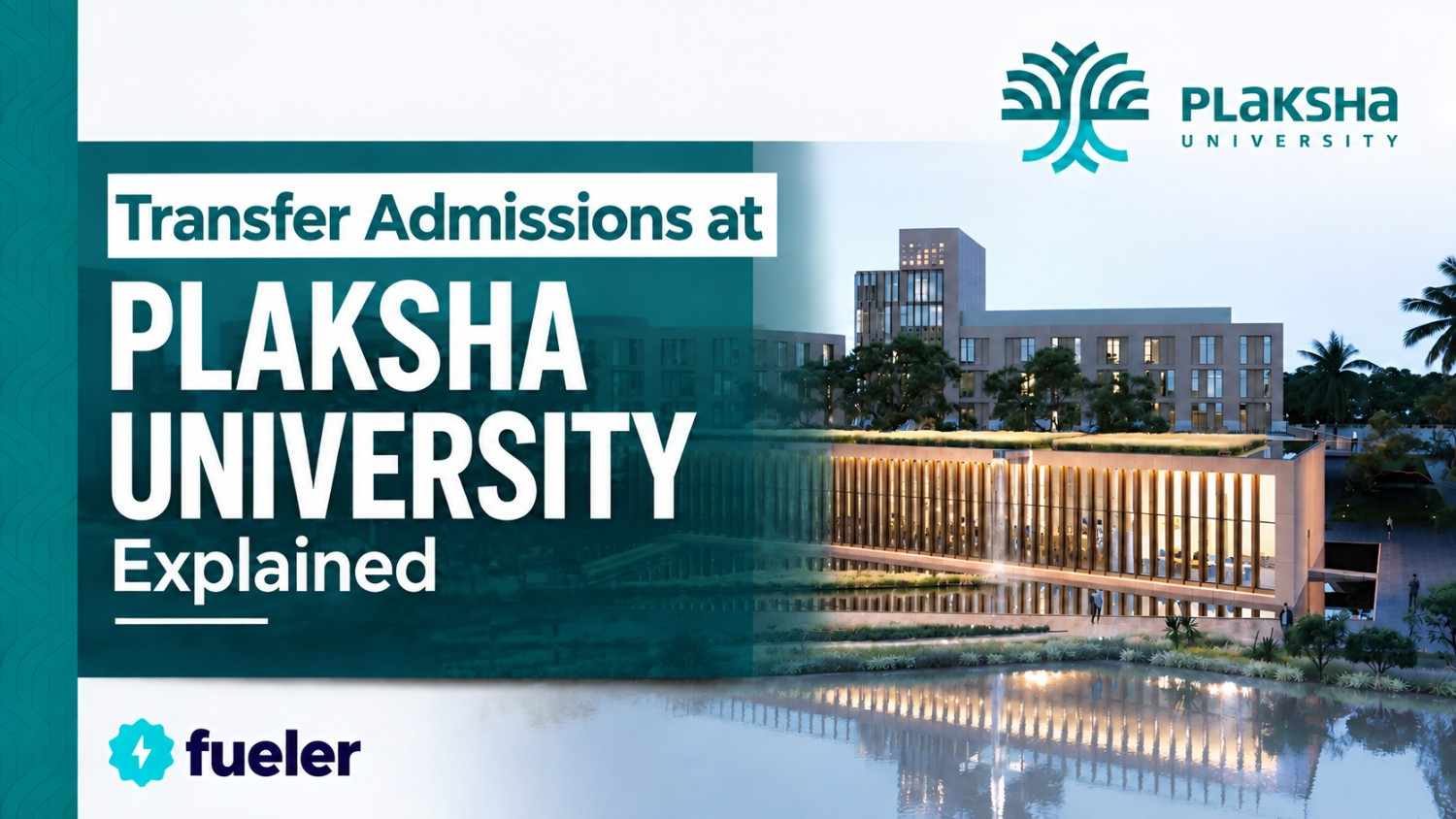
Transfer Admissions at Plaksha University Explained

Riten Debnath
31 Aug, 2026
Last updated: August 2026
Every single week, I speak with young builders, engineers, and ambitious students who feel completely trapped inside traditional college systems. They picked an engineering branch at age 17 based on a single entrance test score, only to realize two semesters later that their curriculum is entirely out of touch with modern technology, artificial intelligence, and real startup building. When these students realize they want a fast-paced, hands-on, interdisciplinary environment, they often assume it is too late and that they must either drop out or suffer through four years of outdated theory.
I’m Riten, founder of Fueler, a skills-first portfolio platform building the career infrastructure for 100 million creative professionals. Fueler connects talented individuals with companies through assignments, portfolios, and projects, not just resumes or CVs. Think of it as Dribbble/Behance for work samples combined with AngelList for hiring infrastructure.
In my work with founders, hiring managers, and ambitious candidates, I see the exact same pattern over and over again: traditional engineering education rewards test-taking, whereas the modern tech ecosystem rewards proof of work. That is why transfer admissions at Plaksha University caught my attention. Plaksha has created a structured lateral entry pathway for undergraduate students who started their engineering degree at another university but want to switch without throwing away their academic progress.
In this guide, we will break down how transfer admissions at Plaksha University work, who qualifies, how credit mapping functions, and how you can position your application to land a spot.

Quick Answer Summary
- What it is: A lateral entry pathway that allows undergraduate engineering and science students from recognized universities to join Plaksha University in their second year without restarting their four-year BTech degree.
- Who it is for: Students currently enrolled in a UGC-recognized or foreign university who have completed at least 35 academic credits in quantitative or foundational science subjects.
- Available Majors: BTech in Data Science, Economics and Business (DSEB), BTech in Robotics & Autonomous Systems (RAS), and BTech in Biological Systems Engineering (BSE).
- Graduation Requirement: Students must complete a total of 160 credits, with at least 80 credits earned directly on campus at Plaksha University.
- Key Selection Process: Submission of college transcripts and syllabus, profile screening, technical interview, and credit equivalence review by the Credit Equivalence Committee (CEC).
- Best Suited For: Ambitious coders, hardware builders, and interdisciplinary thinkers stuck in rigid theoretical colleges who want project-first learning, modern industry access, and strong career outcomes.
What is Transfer Admissions at Plaksha University?
Transfer admissions at Plaksha University is a dedicated lateral entry mechanism for undergraduate students who are already enrolled in a regular degree program at another recognized university. Instead of forcing you to drop out, lose a year, and take freshman entrance exams all over again, Plaksha allows you to transfer the academic credits you have already earned directly into their four-year BTech program.
Historically, higher education in India has been rigid. Once you pick a branch at an engineering institution, changing your university or major without starting from scratch is nearly impossible. Plaksha breaks this barrier by accepting transfer candidates into three specific interdisciplinary majors: Data Science, Economics and Business (DSEB), Robotics & Autonomous Systems (RAS), and Biological Systems Engineering (BSE).
This pathway matters because smart, ambitious students often make college choices before they truly understand what modern tech companies need. At Fueler, we see talented engineers build real software projects in their free time while struggling to care about outdated college lectures. Plaksha’s transfer pathway gives these builders a clean second chance to align their daily education with modern industry demands. Instead of judging you solely on a high school test, Plaksha looks at your actual academic coursework, technical problem-solving ability, and documented proof of work.
Key Facts Table
Detailed Explanation: Transfer Admissions at Plaksha University Explained
Transfer admissions at Plaksha University is an academic evaluation process where your previous college work is matched against Plaksha’s curriculum to grant you credit standing. Let us break down every core piece of how this system operates in practice.
Definition and Core Mechanics
Under standard higher education policies, a college credit represents a specific number of classroom and laboratory learning hours. Plaksha requires a total of 160 credits to award a BTech degree. To qualify as a transfer applicant, you must have already completed at least 35 credits at a recognized university.
When you apply, you do not just send your marksheet; you submit the complete syllabus of every course you completed. Plaksha’s Credit Equivalence Committee (CEC) inspects the topics, assignments, and learning outcomes of your previous courses. If your prior Calculus, Computer Programming, or Physics course covers the necessary depth, the CEC approves those credits. Those approved credits count toward your 160-credit graduation requirement, allowing you to enter directly into the second year.
Context and Educational Philosophy
Plaksha University was founded by a collective of tech leaders, venture capitalists, and academic advisors from global institutions like UC Berkeley, Purdue, and UPenn. The campus was built to fix the gaps of traditional engineering colleges, which often isolate disciplines into strict silos like Mechanical, Electrical, or Civil.
Plaksha’s first three semesters focus on foundational subjects across computing, design, data, and hardware. Because traditional colleges rarely teach in this interdisciplinary way, Plaksha provides bridging modules for incoming transfer students. These bridging modules act as specialized catch-up courses so you can transition into advanced major subjects smoothly without feeling lost.
Why Transfer Admissions Matter for Ambitious Students
In the startup ecosystem, execution speed is everything. If you spend four years memorizing old lecture slides, you graduate with no relevant skills. By transferring to an interdisciplinary, project-first institution, your daily work shifts from memorizing textbooks to building real systems.
When candidates apply for top startup roles in product management, growth, or engineering, companies do not hire based on textbook knowledge. They hire based on proof of workthe actual projects, code repositories, and assignments you have built. Transferring to a university that prioritizes hands-on building helps you assemble a deep portfolio of real projects while earning your BTech.
How Transfer Admissions Differ from Standard Freshman Admissions
Standard freshman admissions at Plaksha evaluate high school performance, JEE Main or SAT scores, personal essays, and interviews. In contrast, transfer admissions evaluate your university-level performance, foundational science or engineering background, course syllabi, and technical readiness. It is an ideal path if your high school entrance ranks did not reflect your actual capability, but you have since built strong foundational skills during your first year of college.
How It Works
The transfer admission process follows a step-by-step roadmap from your initial application to stepping onto campus.
Step 1: Online Application and Document Upload
You begin by completing the online application on the Plaksha admissions portal. During this stage, you must submit:
- Class 10 and Class 12 marksheets
- Official government identification (Aadhaar, Passport, or APAAR ID)
- Official university transcripts showing at least 35 completed credits
- Detailed syllabus copies for every subject you completed at your previous college
- An academic resume highlighting any extra-curricular or co-curricular achievements
Step 2: Profile Screening
Plaksha’s admissions team reviews your entire profile. Evaluators examine your high school grades, undergraduate performance, and evidence of self-driven learning, such as projects, coding achievements, or competition participation.
Step 3: Technical Interview
If you pass the initial screening, you are invited to a technical interview. This is not a high-pressure exam designed to eliminate you. Instead, faculty members evaluate your core problem-solving approach, your understanding of basic mathematics and programming concepts, and your genuine interest in your chosen major.
Step 4: Credit Equivalence Mapping
The Credit Equivalence Committee (CEC) reviews your submitted syllabi line by line. They determine exactly how many of your completed credits map directly to Plaksha’s core and elective requirements.
Step 5: Admission Decision and Offer Letter
Selected applicants receive a formal offer letter. This letter explicitly states the credits accepted for transfer, any required bridging modules, and your expected timeline for completing your BTech degree.
Step 6: Onboarding and Integration
Once you accept the offer and complete the fee formalities, Plaksha’s Program Chair assigns you a personal academic advisor. Your advisor guides you through course selection and helps you integrate smoothly into academic and social life on campus.
Benefits
Transferring to Plaksha University offers practical advantages that go far beyond standard academic credentials:
- No Lost Time or Wasted Credits: You do not have to restart as a first-year student. Your 35+ completed credits count directly toward your graduation requirements, keeping your career timeline intact.
- Interdisciplinary Majors: You gain access to modern majors like Data Science, Economics and Business (DSEB), Robotics & Autonomous Systems (RAS), and Biological Systems Engineering (BSE) that traditional universities rarely offer.
- Project-First Learning: Instead of spending semesters sitting through purely theoretical lectures, you work on real projects, build physical prototypes, and write production-grade code.
- Building Real Proof of Work: The curriculum gives you continuous opportunities to solve open-ended problems. Publishing these projects on platforms like Fueler creates a live, verified portfolio that hiring managers can review directly.
- Direct Access to Startup Founders: Plaksha’s ecosystem is backed by top business leaders, venture capitalists, and founders. You study in an environment connected directly to high-growth tech companies and startup incubators.
- Customized Academic Mentorship: Small class sizes and dedicated academic advisors ensure you receive individual guidance tailored to your specific career goals.
Challenges and Limitations
Transferring universities requires effort and adaptation. It is important to look at the challenges clearly before deciding to apply:
- Not All Credits May Transfer: The CEC approves credits based on strict content match. If your previous college taught outdated material, some of your past credits might not map over, requiring extra coursework.
- Strict Major Availability: Transfer admissions are limited to DSEB, RAS, and BSE. If you strictly want a standalone Computer Science degree without interdisciplinary elements, this pathway is not for you.
- High Academic Rigor: Plaksha expects active participation, collaborative projects, and original thinking. If you are used to passive learning and cramming before final exams, adjusting to this pace requires real effort.
- Bridging Workload: If you have credit gaps in specific foundational topics, you will take bridging modules alongside your standard second-year courses. This can create a heavy workload during your first semester after transferring.
Comparison Table
Fees and Cost
Understanding the financial commitment is essential for planning your education. Below is the standard BTech fee structure at Plaksha University for the academic year:
Need-Based Financial Aid
To ensure talented students are not turned away by financial constraints, Plaksha offers a need-based financial aid program:
- Family Income under ₹18 Lakhs: Up to 100% tuition fee waiver
- Family Income between ₹18 Lakhs – ₹28 Lakhs: Up to 75% tuition fee waiver
- Family Income between ₹28 Lakhs – ₹38 Lakhs: Up to 50% tuition fee waiver
- Family Income between ₹38 Lakhs – ₹50 Lakhs: Up to 25% tuition fee waiver
Return on Investment (ROI)
While the fee is higher than traditional state colleges, the ROI is driven by practical career outcomes. Students who work on industry projects, build autonomous hardware, or analyze business data graduate ready for high-value roles in product management, data science, and technology leadership.
When candidates show verified proof of work instead of just listing courses on a PDF resume, they bypass entry-level competition and secure better roles in fast-growing startups and tech firms.
Career Opportunities
Graduating with an interdisciplinary BTech degree opens up high-demand career paths across the technology and business sectors:
- Founder's Office & Chief of Staff Roles: Startups look for individuals who understand both technical architecture and business strategy. DSEB graduates are well-positioned for these roles.
- Associate Product Manager (APM): APM roles require a mix of data analytics, user research, and technical understanding all core components of Plaksha's curriculum.
- Robotics & Embedded Systems Engineer: RAS graduates build autonomous systems, drone software, hardware-software integration, and smart industrial automation solutions.
- Computational Biologist & Biotech Product Analyst: BSE graduates work at the intersection of life sciences, data analytics, and bio-manufacturing, addressing healthcare and environmental challenges.
- Data Scientist & AI Analyst: High-growth tech firms hire graduates to build predictive models, optimize supply chains, and deploy machine learning pipelines.
Salary ranges for these interdisciplinary technical roles typically start between ₹10 LPA to ₹22+ LPA, depending heavily on your technical skills, problem-solving ability, and portfolio of completed projects.
Who Should Choose This?
- Enrolled Engineering Students: You have completed at least 1 year (35+ credits) of college but feel uninspired by your current institution.
- Practical Builders: You spend your free time writing code, designing products, or tinkering with hardware, and want a college that grades you on actual projects.
- Interdisciplinary Thinkers: You want to combine computer science with economics, robotics with control systems, or biology with data analytics.
- Students Seeking Strong Career Outcomes: You want direct exposure to top founders, corporate partners, and modern hiring pathways.
Who Should Avoid This?
- Rote Learners: If you prefer memorizing lecture notes and taking standard written exams without doing project work, this rigorous environment will be challenging.
- Pure CS Traditionalists: If you strictly want a traditional Computer Science degree without interdisciplinary business, robotics, or biology courses, this program may not fit your preferences.
- Unprepared Applicants: If you have completed fewer than 35 credits at your current university, you do not meet the baseline transfer eligibility criteria.
Final Thoughts
Education should never be a one-way street where a choice made at 17 dictates your entire career. If you are stuck in an environment that limits your growth, taking control of your learning path is the best decision you can make.
Transfer admissions at Plaksha University offer a clear, practical solution. It allows you to move into a modern, project-centric education without throwing away the academic credits you have already earned.
As you prepare your transfer application, remember that grades and syllabi are only part of the equation. What sets top applicants apart is demonstrated initiative. Document your personal projects, open-source work, and assignments clearly. Having a structured portfolio of proof of work on platforms like Fueler gives you a distinct advantage during your technical interview and profile review. If you are ready for hands-on learning, this pathway could be the exact turning point your engineering education needs.
Key Takeaways
- Lateral Entry: Plaksha allows current university students to transfer directly into the second year of BTech.
- Credit Eligibility: You must have completed at least 35 credits in quantitative or foundational science subjects at a recognized institution.
- Available Majors: Admissions are open for BTech programs in DSEB, RAS, and BSE.
- Rigorous Review: Transfers are evaluated based on course syllabus equivalence, academic records, and a technical interview.
- No Lost Progress: You must earn at least 80 credits at Plaksha out of the 160 total required for graduation.
- Bridging Support: Plaksha provides targeted bridging modules to help transfer students catch up on foundational concepts.
- Financial Aid: Need-based aid is available, offering up to 100% tuition waivers based on family income tier.
- Portfolio Advantage: Showcasing documented proof of work significantly strengthens your admission profile.

FAQs
What is the minimum credit requirement for transfer admissions at Plaksha University?
Applicants must have successfully completed a minimum of 35 academic credits in quantitative, science, or engineering subjects from a UGC-recognized or equivalent foreign university before starting at Plaksha.
Which BTech majors accept transfer students at Plaksha University?
Transfer students can apply for three interdisciplinary BTech majors: Data Science, Economics and Business (DSEB), Robotics & Autonomous Systems (RAS), and Biological Systems Engineering (BSE).
Do I have to restart my BTech degree from the first year?
No. Approved academic credits from your previous university count toward your degree, allowing you to join Plaksha in the second year without losing your prior academic progress.
How does Plaksha determine which of my previous college credits will transfer?
Plaksha's Credit Equivalence Committee (CEC) conducts a detailed course-mapping evaluation by comparing your previous college course syllabi with Plaksha's curriculum standards.
Is financial aid available for BTech transfer students at Plaksha University?
Yes. Plaksha provides need-based financial aid, offering up to 100% tuition waivers depending on your family's annual income tier.
Why 100,000+ professionals use Fueler
Fueler helps professionals showcase proof of work through projects, assignments, case studies, and achievements.
- Thousands of professionals use Fueler to create their digital portfolio
- Thousands of projects are published on Fueler. Check here
- Startups and Companies hire through proof of work on Fueler
- Used by freelancers, creators, marketers, video editors, writers, designers, and product managers
Our mission is to help the next 100 million professionals build a verified professional identity through proof of work
What should you do next?
You've read the article. Now turn your skills into proof of work and unlock more opportunities.
Build your proof of work portfolio
Create a clean portfolio with projects, assignments, resumes, and AI stack details that companies actually want to see.
Create your Fueler portfolio →Apply through assignments, not resumes
Stand out by solving real tasks from companies hiring on Fueler.
Explore assignments →Get discovered by companies
Make your work public and let recruiters discover your skills through actual projects instead of keywords.
Get discovered →