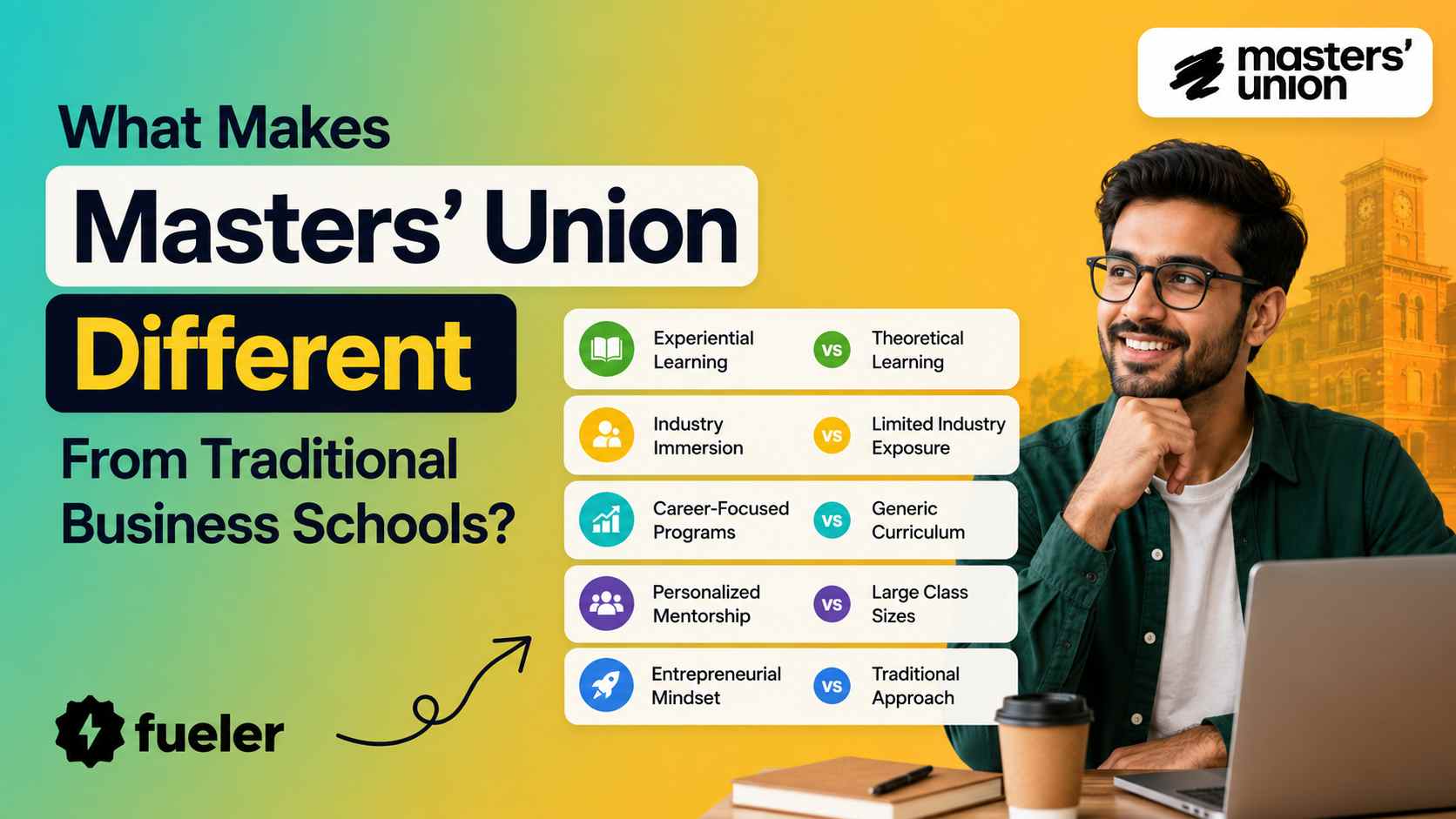
What Makes Masters' Union Different From Traditional Business Schools?

Riten Debnath
16 Aug, 2026
Last updated: August 2026
When an alternative business program steps into the higher education arena charging prices on par with premier legacy institutions, ambitious professionals are forced to ask a tough question: What actually makes this model different, and is it built to deliver real long-term value?
Traditional business education has relied on the same playbook for nearly a century: academic lectures, theoretical case studies, and written exams that reward memorization over execution. But the modern business landscape moves far too fast for two-year-old case studies. Building a venture or leading growth today requires immediate, hands-on execution.
I’m Riten, founder of Fueler, a skills-first portfolio platform building the career infrastructure for 100 million creative professionals. Fueler connects talented individuals with companies through assignments, portfolios, and projects, not just resumes or CVs. Think of it as Dribbble/Behance for work samples combined with AngelList for hiring infrastructure.
In my journey building Fueler, I see every single day how top-tier founders, growth leads, and venture capital partners evaluate prospective hires. They rarely care about a framed degree hanging on a wall or a 4.0 academic GPA. They look for proof of work. They want to see live products shipped, real performance ad spend managed, user acquisition campaigns run, and clear proof of execution.
This fundamental shift in how talent is hired is exactly why Masters' Union sparks so much discussion across the startup ecosystem. Located in DLF Cyber Park, Gurgaon, Masters' Union operates less like a traditional university campus and more like an intensive, 16-month business accelerator. In this breakdown, we will unpack how Masters' Union differs from traditional business schools across faculty composition, hands-on learning models, proof-of-work culture, curriculum architecture, placement outcomes, and overall return on investment.
Quick Answer Summary
- Practitioner-Led Faculty: Courses are taught directly by active startup founders, corporate CXOs, managing directors, and venture capitalists rather than tenured academic professors.
- Real Capital Practicums: Students run live e-commerce businesses, manage a ₹5 Crore student-led venture fund, and execute hands-on growth campaigns.
- Portfolio Over Textbooks: Academic evaluation focuses on live project outputs, revenue generation, product teardowns, and verified work samples.
- Integrated Technology Stack: Python, SQL, data analytics, AI tools, and product management are built directly into core business courses rather than kept as secondary electives.
- High-Ownership Career Tracks: Prepares graduates for generalist, execution-heavy roles such as Chief of Staff, Founder’s Office, Product Manager, and Venture Capital Associate.

What is the Masters' Union Cohort?
Masters' Union is an autonomous private business school based in Gurgaon, India's primary corporate tech hub. Its primary program, the Post Graduate Programme in Technology and Business Management (PGP-TBM), runs for 16 months and focuses on bridging the gap between business strategy and digital technology.
Unlike legacy MBA colleges that rely heavily on tenured academics who spend their years publishing research papers, Masters' Union operates on a practitioner-led framework. The core philosophy is that business cannot be mastered through passive observation. You learn performance marketing by burning real ad budgets to convert real users. You learn supply chain mechanics by finding suppliers and shipping physical products. You learn corporate finance by evaluating real startups and deploying capital.
This model mirrors how hiring works on platforms like Fueler. When job seekers present verified proof of work such as actual campaigns run or software products launched, recruiters make hiring decisions much faster. Masters' Union builds that exact portfolio creation process directly into its 16-month curriculum.
Key Facts Table
Detailed Explanation: Key Differences
To understand what truly sets Masters' Union apart from traditional business schools, you need to break down the program across four distinct pillars: faculty structure, experiential learning, evaluation methodology, and industry integration.
1. Faculty: Active Operators vs. Academic Scholars
In a traditional MBA environment, professors spend most of their time writing academic research papers for scholarly journals. While this research holds academic value, it often lacks immediate practical utility in fast-moving industries like consumer tech, fintech, or performance marketing.
Masters' Union replaces traditional tenured faculty with "Professors of Practice".
- Active Founders and Executive Leaders: Classes are led by managing directors from global consulting firms, founders of venture-backed startups, and product heads from top consumer platforms.
- Real-Time Market Context: When an active Chief Marketing Officer teaches performance marketing, they explain tactics that worked earlier that week, not theoretical case studies written decades ago.
- Direct Professional Networking: Learning from active operators creates natural mentorship channels. Outstanding students build direct relationships with hiring leaders inside the classroom.
2. Learning Pedagogy: Live Capital vs. Harvard Case Studies
The classic case study method asks students to read a 20-page document about a past business decision and debate what the CEO should have done. Masters' Union replaces these passive debates with active execution using real capital.
- The Dropshipping Challenge: Student teams receive capital to launch an e-commerce store. They must source inventory, build a digital storefront, run paid ad campaigns, optimize conversion rates, manage customer support, and track real profit and loss.
- The ₹5 Crore Student-Led Fund: Rather than tracking paper stocks in a simulation, students evaluate real early-stage companies, conduct due diligence, write investment memos, and deploy capital from an actual student-managed fund.
- The Content Creator Challenge: Understanding personal distribution is critical for modern leaders. Students are challenged to build organic audiences on public platforms, gaining hands-on experience with content strategy, audience retention, and channel analytics.
3. Student Evaluation: Proof of Work vs. Written Exams
Traditional business schools evaluate students through closed-book written exams, multiple-choice quizzes, and academic essays graded on a curve. Masters' Union evaluates students based on tangible outputs.
TRADITIONAL EVALUATION
Textbook Study ──► Written Exam ──► Letter Grade ──► Static Resume
MASTERS' UNION EVALUATION
Live Business Build ──► Market Feedback & Revenue ──► Public Portfolio ──► Direct Hiring
- Tangible Project Output: Students graduate with concrete assets: live e-commerce businesses, audited ad spend reports, comprehensive product teardowns, and published research memos.
- Verified Skills: Just as creative and tech professionals use Fueler to demonstrate their capabilities through project samples rather than flat resumes, Masters' Union students present their real project res ults directly to prospective employers during recruitment drives.
- Market-Driven Grading: Projects are judged by external industry leaders, venture capitalists, and real customers rather than academic grading boards.
4. Curriculum Focus: Integrated Tech Stack vs. Pure Management
At traditional business schools, technology is often relegated to elective courses. Masters' Union integrates modern tech tools directly into every core management discipline.
- Data-Driven Decision Making: Students learn SQL, Python, and data visualization tools alongside standard financial accounting and corporate strategy.
- AI Tooling Integration: Modules explicitly teach students how to use modern AI workflows for market research, financial modeling, automation, and rapid prototyping.
- Product-Led Growth: Courses cover user experience design, wireframing, sprint management, and product analytics alongside traditional brand management.
Step-by-Step Breakdown: The 16-Month Curriculum Journey
The program moves through five intensive phases designed to build execution capability step-by-step.
- Phase 1: Foundation & Core Tooling (Terms 1–2)
- Deep dive into business statistics, accounting, managerial economics, and corporate finance.
- Hands-on training in Python, SQL, data analytics, and design thinking fundamentals.
- Phase 2: Live Execution & E-Commerce Sprint (Terms 3–4)
- Launching live dropshipping businesses and running real performance campaigns.
- Managing customer acquisition cost (CAC), return on ad spend (ROAS), supply chain logistics, and customer retention.
- Phase 3: Venture Creation & Capital Deployment (Terms 5–6)
- Evaluating early-stage startups and deploying capital through the ₹5 Crore student-led fund.
- Building new venture prototypes, validating target markets, and pitching to angel investor networks.
- Phase 4: CXO Residencies & Industry Immersion (Term 7)
- Shadowing startup founders, venture capitalists, and corporate executives in Gurgaon and Bangalore.
- Working directly on live consulting challenges submitted by partner organizations.
- Phase 5: Placement Drives & Demo Days (Term 8)
- Presenting ventures to seed funds during campus Demo Days.
- Interviewing for high-ownership corporate roles through portfolio-first hiring drives.
Real ROI and Career Outcomes
Evaluating any higher education program requires looking beyond marketing claims at real placement performance and payback periods.
Salary Statistics
- Overall Average Package: The reported average CTC for the flagship PGP cohort stands at ₹33.39 LPA.
- Median Compensation: Sits at ₹27.78 LPA, showing consistent compensation across the broader student body rather than figures inflated by a few outliers.
- Top Quarter Performance: The top 25% of the cohort averages ₹54.80 LPA, largely driven by product management, strategy, and international roles.
- Highest Domestic Package: Reached ₹1.28 Crore per annum.
Payback Period Breakdown
When you factor in total tuition fees, statutory taxes, hostel accommodations, and personal living expenses in Gurgaon, the complete financial investment reaches roughly ₹38 Lakhs to ₹42 Lakhs.
With an average starting package of ₹33.39 LPA (yielding a net monthly take-home salary of approximately ₹1.8 Lakhs to ₹2.1 Lakhs after taxes and deductions), the net financial payback period ranges between 22 and 28 months. This recovery timeline compares favorably with ISB and is significantly faster than most traditional tier-2 business schools.
Primary Career Roles
Graduates are primarily recruited for generalist, high-ownership roles in fast-growing sectors:
- Chief of Staff / Founder's Office: Working directly alongside tech CEOs on strategic initiatives, investor decks, and operational scaling.
- Product Manager (PM): Defining product roadmaps, user acquisition loops, and feature prioritization for consumer platforms.
- Growth Marketing Lead: Managing performance channels, customer acquisition, retention funnels, and brand campaigns.
- Venture Capital Analyst: Sourcing early-stage startups, analyzing unit economics, and assisting portfolio companies.
Detailed Comparison: Masters' Union vs Competitors
Real Challenges and Trade-offs
A complete analysis requires examining the limitations of this model alongside its advantages.
1. Non-Degree Status
Masters' Union is an autonomous private institution and does not award a UGC-recognized Master's degree or AICTE-approved diploma. If your long-term plans include pursuing a PhD, applying for government civil service exams, or qualifying for immigration point systems that strictly mandate an accredited Master's degree, this non-degree status can present obstacles.
2. High Pace and Intensity
Compressing business fundamentals, coding tools, dropshipping challenges, VC fund management, and recruitment prep into 16 months creates a high-pressure environment. Students who thrive in structured, slow-paced academic environments can find this pace overwhelming.
3. Startup Market Dependency
Placement outcomes are closely tied to the broader tech, venture capital, and startup ecosystem. Extended macroeconomic downturns or funding slowdowns in consumer tech can directly impact hiring volumes and compensation packages.

Who Should Choose This Model?
- Action-Oriented Builders: Professionals who learn best by building live projects, experimenting, and getting real market feedback.
- Future Product & Growth Leaders: Candidates seeking roles in product management, growth marketing, or business operations within fast-moving tech companies.
- Aspiring Startup Founders: Individuals who want to test business concepts, pitch to real investors, and launch a venture during their studies.
- Portfolio Believers: Professionals who realize that displaying verified work samples on platforms like Fueler creates far more job opportunities than sending out flat resumes.
Who Should Avoid This Model?
- Public Sector / PSU Aspirants: Anyone who requires an AICTE or UGC-approved degree to meet regulatory hiring criteria for government positions.
- Pure Academic Researchers: Students who prefer traditional theoretical research, academic paper publishing, or pursuing a university doctorate.
- Risk-Averse Learners: Candidates who feel uncomfortable working in fast-changing environments without rigid institutional guidelines.
Final Thoughts
Comparing Masters' Union to traditional business schools isn't about deciding which model is universally superior. It comes down to identifying which learning style fits your career goals.
If you value academic tradition, long-established institutional alumni networks, and formal university degrees, traditional IIMs offer a proven, highly respected path.
However, if you view business as an active trade, one best learned by managing budgets, launching products, analyzing live metrics, and building a public portfolio of work, then a practitioner-led, hands-on model offers a compelling alternative. In today's hiring landscape, execution speaks far louder than credentials. The institutions that teach students how to execute before they enter the job market are setting a new benchmark for business education.
Key Takeaways
- Practitioner Faculty: Classes are led by active founders, CXOs, and venture capitalists rather than traditional academics.
- Real Capital Projects: Students run live dropshipping stores and manage a ₹5 Crore investment fund.
- Proof-of-Work Focus: Evaluation prioritizes tangible project portfolios over written textbook exams.
- Tech Integration: Python, SQL, data analytics, and AI tools are built directly into the core management courses.
- Strong Career Outcomes: Achieved an overall average CTC of ₹33.39 LPA with a median of ₹27.78 LPA.
- Non-Degree Certificate: Grants an autonomous program certificate rather than a UGC-recognized university degree.
Frequently Asked Questions (FAQs)
How does the faculty at Masters' Union differ from traditional MBA colleges?
Instead of tenured academic professors, classes are taught directly by active startup founders, corporate CXOs, managing directors, and venture capitalists who bring current real-world business contexts into the classroom.
Is Masters' Union recognized as a formal university degree in India?
No, Masters' Union is an autonomous private institute and does not grant a UGC-recognized degree or AICTE-approved diploma. It awards an independent post-graduate program certificate focused on practical industry skills.
What is the ₹5 Crore student-led fund at Masters' Union?
It is a real investment fund where students evaluate early-stage startups, conduct financial due diligence, draft investment memos, and deploy actual capital, gaining direct venture capital experience.
What is the average salary package for Masters' Union PGP-TBM graduates?
The reported average CTC stands at ₹33.39 LPA, with a median compensation of ₹27.78 LPA. Top roles are concentrated in product management, strategy, and business operations.
How do recruiters evaluate Masters' Union students without traditional grades?
Recruiters evaluate candidates through their public proof of work, including live e-commerce builds, audited campaign metrics, product teardowns, and verified project portfolios created throughout the 16-month program.
Why 100,000+ professionals use Fueler
Fueler helps professionals showcase proof of work through projects, assignments, case studies, and achievements.
- Thousands of professionals use Fueler to create their digital portfolio
- Thousands of projects are published on Fueler. Check here
- Startups and Companies hire through proof of work on Fueler
- Used by freelancers, creators, marketers, video editors, writers, designers, and product managers
Our mission is to help the next 100 million professionals build a verified professional identity through proof of work

What should you do next?
You've read the article. Now turn your skills into proof of work and unlock more opportunities.
Build your proof of work portfolio
Create a clean portfolio with projects, assignments, resumes, and AI stack details that companies actually want to see.
Create your Fueler portfolio →Apply through assignments, not resumes
Stand out by solving real tasks from companies hiring on Fueler.
Explore assignments →Get discovered by companies
Make your work public and let recruiters discover your skills through actual projects instead of keywords.
Get discovered →