What Skills Will You Learn in Masters' Union's UG Programs?

Riten Debnath
17 Aug, 2026
Last updated: August 2026
If you talk to any founder, product lead, or growth marketer currently hiring, they will tell you the exact same thing: traditional resumes are dead. A three-page CV listing relevant coursework, exam percentages, and passive campus club memberships tells an employer almost nothing about what you can execute on a random Tuesday morning when a marketing funnel breaks or a product launch stalls.
I’m Riten, founder of Fueler, a skills-first portfolio platform building the career infrastructure for 100 million creative professionals. Fueler connects talented individuals with companies through assignments, portfolios, and projects, not just resumes or CVs. Think of it as Dribbble/Behance for work samples combined with AngelList for hiring infrastructure.
Having processed thousands of real-world assignments, project showcases, and proof-of-work profiles on Fueler, I pay close attention to how higher education is adapting. That is why the undergraduate programs at Masters' Union stand out. Instead of lecturing students on business theory out of outdated textbooks, the curriculum forces students to build real products, execute live growth campaigns, write code, deploy AI agents, and manage real capital.

Quick Answer Summary
- Who It Is For: High school graduates, aspiring entrepreneurs, growth marketers, product builders, and data enthusiasts.
- Cost: Approximately ₹9.25 Lakhs per year in base tuition, totaling around ₹38 Lakhs to ₹43 Lakhs across four years (excluding living expenses).
- Key Takeaway: Students build a verified public portfolio of work including live e-commerce stores, AI apps, performance campaigns, and financial models.
- Best Suited For: Self-starters who want to learn by doing and build a tangible track record before entering the job market.
What is the Masters' Union Undergraduate Program?
The Masters' Union Undergraduate Program is a four-year degree in Technology and Business Management (with pathways spanning Data Science & AI, Psychology & Marketing, and Core Business). It is structured like a startup incubator crossed with an applied technology institute.
Traditional colleges rely on written midterms and finals to check whether students memorized definitions. Masters' Union shifts the focus entirely to execution. Students spend their academic terms completing practical "drops" and industry challenges.
Why does this matter? Because modern employers look for candidates who can take immediate operational ownership. When you apply for a high-leverage role in a fast-moving tech startup, nobody asks about your exam scores. They want to see what you have actually built, launched, managed, or scaled.
This model aligns directly with our philosophy at Fueler: verified proof of work beats theoretical credentials every single time.
Key Facts Table
Detailed Explanation
The skills you learn at Masters' Union are divided into practical functional pillars. Rather than studying these domains in isolation, students combine tech, business, and distribution skills across their four years.
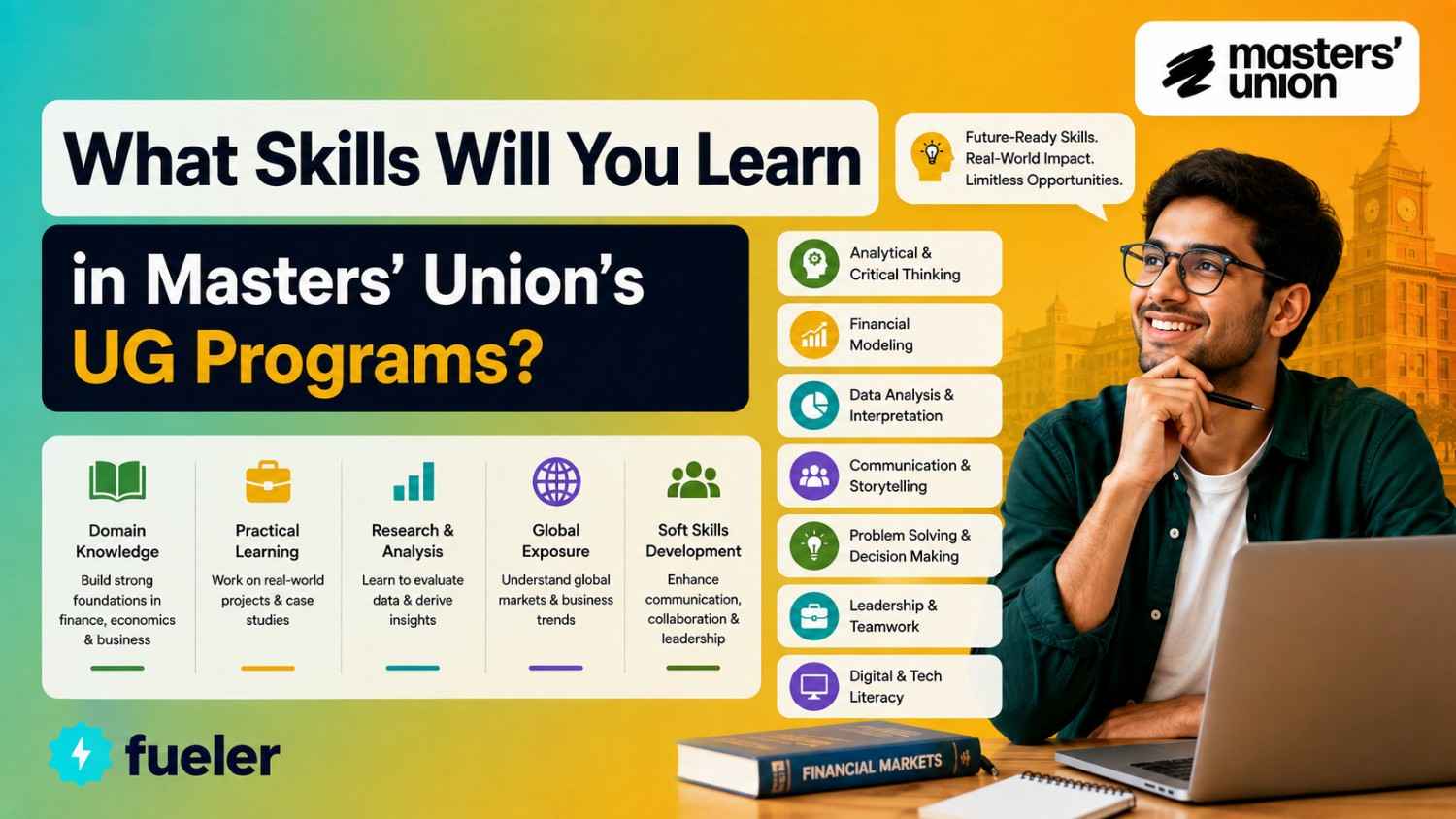
What Skills Will You Learn in Masters' Union's UG Programs?
You learn a balance of technical execution, business strategy, growth marketing, product design, and leadership. Instead of learning how tools work in theory, students use these platforms to run real experiments, deploy live software, and manage actual budgets.
Here is an in-depth look at the exact skill sets built across the four-year undergraduate timeline:
1. Performance Marketing, E-Commerce, and Unit Economics
In your first year, you do not just study marketing channels, you build a business from scratch during the Drop-shipping Challenge.
- What You Learn: Customer Acquisition Cost (CAC) optimization, Return on Ad Spend (ROAS) tracking, media buying on Meta and Google, copywriting, and supply chain coordination.
- Why It Matters: Most college graduates understand marketing definitions, but very few know how to write converting ad copy or optimize an ad spend budget.
- How It Is Taught: Teams receive capital, set up an e-commerce storefront using no-code platforms like Shopify, launch ad campaigns, and track real profit and loss (P&L) statements.
- Real-World Application: You learn to read performance analytics, diagnose why a sales funnel drops off, and adjust target audiences in real time.
2. Applied AI, Machine Learning, and No-Code Engineering
In the technology and data tracks, learning code goes beyond theoretical algorithms. You learn to deploy modern artificial intelligence tools to build functional apps.
- What You Learn: Prompt engineering, deploying autonomous AI agents, fine-tuning LLMs, API integrations, database management (SQL), and web scraping.
- Why It Matters: Modern companies expect non-engineers to build tools, automate workflows, and use AI to increase operational speed.
- How It Is Taught: During the Applied AI Challenge and Agentic AI Accelerator, students build working chatbots, automated HR tools, customer service agents, and predictive forecasting models.
- Real-World Application: Students construct cloud-based AI tools that serve real users, giving them direct experience in building software products from scratch.
3. Product Management, UX Design, and Product Analytics
Product management sits at the intersection of business, design, and technology. You learn how to turn an unstructured user problem into a functional, scalable digital product.
- What You Learn: Writing Product Requirement Documents (PRDs), wireframing and prototyping in Figma, running user research interviews, and tracking key metrics like churn, retention, and monthly active users.
- Why It Matters: Associate Product Manager (APM) roles are highly competitive, and recruiters look for candidates who have managed real product development cycles.
- How It Is Taught: Students design, test, and iterate on user interface prototypes, run usability tests, and use data analytics to optimize user journeys.
- Real-World Application: You build interactive product prototypes and document the entire feature roadmap inside your public portfolio on platforms like Fueler.
4. Financial Modeling, Valuation, and Venture Investing
Finance is taught through active management rather than static chalkboards. Students learn how money moves through companies, from early-stage venture rounds to global equity markets.
- What You Learn: Building discounted cash flow (DCF) models, cap table management, unit economics analysis, venture capital deal structuring, and corporate financial health analysis.
- Why It Matters: Understanding how capital is allocated helps you evaluate business models, whether you plan to launch a company or join an investment firm.
- How It Is Taught: Students manage and invest capital from a student-led investment fund, evaluating early-stage pitch decks and making real investment decisions.
- Real-World Application: You gain hands-on experience in evaluating startup pitch decks, analyzing financial health, and conducting investment due diligence.
5. Content Distribution, Storytelling, and Organic Growth
Having a great product is useless if nobody knows it exists. Students learn distribution through the Creator Challenge.
- What You Learn: Short-form and long-form video production, audio editing, content strategy, algorithmic audience growth, and community management.
- Why It Matters: Companies hire operators who understand how to build organic distribution engines without relying entirely on paid ad budgets.
- How It Is Taught: Students launch media channels on YouTube, LinkedIn, or podcasts and are evaluated on organic reach, subscriber growth, and audience engagement.
- Real-World Application: Building a public audience establishes early industry credibility and creates networking opportunities with leaders who come on as podcast guests.
How It Works
The curriculum moves sequentially over four years, building your skill set from basic execution to complete strategic ownership.
- Foundational Execution (Year 1): You learn core business fundamentals, basic data analysis, and digital marketing by running micro-businesses like drop-shipping stores.
- Applied Tech and Building (Year 2): You move into building software prototypes, deploying AI tools, writing code, and mastering data analytics tools like SQL.
- Venture Acceleration (Year 3): You form teams to launch real tech startups through the Venture Initiation Program, pitching to angel investors and venture capital firms.
- Industry Immersion (Year 4): You spend extended periods interning inside fast-growing startups or corporate strategy teams while completing advanced electives.
- Portfolio Defense: To graduate, you present a public portfolio containing live software builds, revenue numbers, campaign case studies, and user metrics.
Benefits
A practical skill set translates into distinct advantages when entering the job market.
- Immediate Workplace Readiness: You skip entry-level training because you have already used industry-standard software tools during college.
- Verified Proof of Work: You graduate with a digital portfolio of projects hosted on platforms like Fueler, giving hiring managers clear visibility into your skills.
- Direct Access to Industry Operators: Learning directly from CEOs, CTOs, and VCs keeps your skill set aligned with current market needs.
- Cross-Functional Versatility: You learn to bridge the gap between engineering, design, marketing, and finance, making you an asset to early-stage teams.
- Strong Operational Resilience: Managing real ad budgets and launching live products teaches you how to handle operational friction and business pivots calmly.
Challenges and Limitations
It is equally important to examine potential friction points to evaluate if this learning style matches your personality.
- Requires High Self-Direction: There are no straightforward textbook answers to memorize; you must figure out solutions to open-ended problems independently.
- Fast Pace and Constant Context-Switching: Moving between ad campaigns, coding projects, and financial modeling requires strong time management skills.
- Comfort with Public Failure: When you launch a public product or marketing campaign, failure is visible in real time, requiring emotional maturity and adaptability.
- Higher Financial Investment: Tuition fees are higher than traditional public university degrees, meaning families should evaluate the expected return on investment carefully.
Comparison Table
Fees and Costs
Here is a breakdown of the overall investment involved for the undergraduate track:
- Tuition Fees: Base tuition starts at approximately ₹9,25,500 for the first year, with total tuition fees across four years amounting to roughly ₹38 Lakhs to ₹43 Lakhs (plus applicable taxes).
- Living & Accommodation: Student housing, meals, and local transit in Gurgaon cost roughly ₹1.5 Lakhs to ₹2.5 Lakhs per year.
- Scholarships: Merit-based and need-based financial aid is available for exceptional applicants, including promising young founders and high achievers.
- Return on Investment: While the upfront cost is significant, acquiring high-demand skills in AI, growth marketing, and product management helps graduates access competitive, high-growth career tracks.
Career Opportunities
Acquiring execution-focused skills opens up direct entry pathways into modern, high-growth job categories:
- Associate Product Manager (APM): Using product design, user analytics, and roadmapping skills to manage software features.
- Growth Marketing Lead: Running performance marketing campaigns, optimizing conversion funnels, and managing acquisition channels.
- Founder’s Office / Chief of Staff Associate: Working alongside startup CEOs to handle operational bottlenecks, market research, and strategic expansion.
- AI Solutions Associate: Deploying AI agents and automated workflows inside corporate teams to improve operational efficiency.
- Venture Capital Analyst: Evaluating startup pitch decks, analyzing business metrics, and supporting investment decisions.
Who Should Choose This?
- Students who want to acquire practical skills in coding, AI, growth marketing, and financial modeling.
- Aspiring entrepreneurs who want to build real companies during college.
- Individuals who prefer project-based learning over memorizing textbooks for written exams.
- Students who want to document their proof of work on digital platforms like Fueler to stand out during job searches.
Who Should Avoid This?
- Students looking for a traditional, lecture-based academic schedule.
- Candidates focused purely on theoretical research or academic publishing.
- Anyone who struggles with fast-paced group environments and unstructured, open-ended assignments.
Final Thoughts
The skill sets that companies value have changed dramatically over the last few years. Knowing business definitions is no longer enough. The market rewards candidates who can write ad copy that converts, build an AI tool that saves hours of manual work, analyze a financial statement, and ship a functional software product.
At Fueler, we see this truth verified every single day. The candidates who secure high-impact roles are those who show up with a dynamic portfolio of completed assignments, live campaign metrics, and published work. Masters' Union has designed its undergraduate curriculum to build those exact practical capabilities.
While the high pace and financial investment mean it is not for everyone, its focus on practical skills offers a clear blueprint for modern business education. If you want to spend your college years building a real skill set and a verified track record, this model offers a compelling pathway.
Key Takeaways
- The program focuses on high-demand practical skills like growth marketing, AI deployment, product analytics, and venture finance.
- Students learn by running live e-commerce stores, building AI tools, and managing real marketing budgets.
- Classes are taught by active industry operators, startup founders, and venture capitalists.
- Evaluation relies on live project performance, campaign metrics, and portfolio showcases rather than standard written exams.
- Students graduate with a verified public portfolio of work, giving them a clear advantage when applying for competitive tech roles.

FAQs
What technical skills do you learn in the Masters' Union UG program?
You learn no-code tool building, SQL database management, prompt engineering, deploying autonomous AI agents, basic coding, and product wireframing using Figma.
Do you learn real-world marketing or just textbook theories?
You learn performance marketing by managing real ad budgets on Meta and Google, setting up e-commerce stores, optimizing landing pages, and tracking customer acquisition costs.
How does the program teach financial modeling and valuation?
Students build financial models, analyze unit economics, evaluate cap tables, and participate in managing capital through a student-led investment fund.
What is the primary method used to evaluate student skills?
Evaluation relies on live project outcomes, P&L statements from micro-businesses, user growth metrics, software builds, and portfolio presentations evaluated by visiting industry leaders.
Do students learn how to build AI products during the undergraduate course?
Yes, students build functional AI chatbots, automated operational agents, and predictive forecasting models serving real users during specialized tech and data drops.
Why 100,000+ professionals use Fueler
Fueler helps professionals showcase proof of work through projects, assignments, case studies, and achievements.
- Thousands of professionals use Fueler to create their digital portfolio
- Thousands of projects are published on Fueler. Check here
- Startups and Companies hire through proof of work on Fueler
- Used by freelancers, creators, marketers, video editors, writers, designers, and product managers
Our mission is to help the next 100 million professionals build a verified professional identity through proof of work
What should you do next?
You've read the article. Now turn your skills into proof of work and unlock more opportunities.
Build your proof of work portfolio
Create a clean portfolio with projects, assignments, resumes, and AI stack details that companies actually want to see.
Create your Fueler portfolio →Apply through assignments, not resumes
Stand out by solving real tasks from companies hiring on Fueler.
Explore assignments →Get discovered by companies
Make your work public and let recruiters discover your skills through actual projects instead of keywords.
Get discovered →