What to Put on Your Resume When AI Does Half the Work

Riten Debnath
10 Sep, 2026
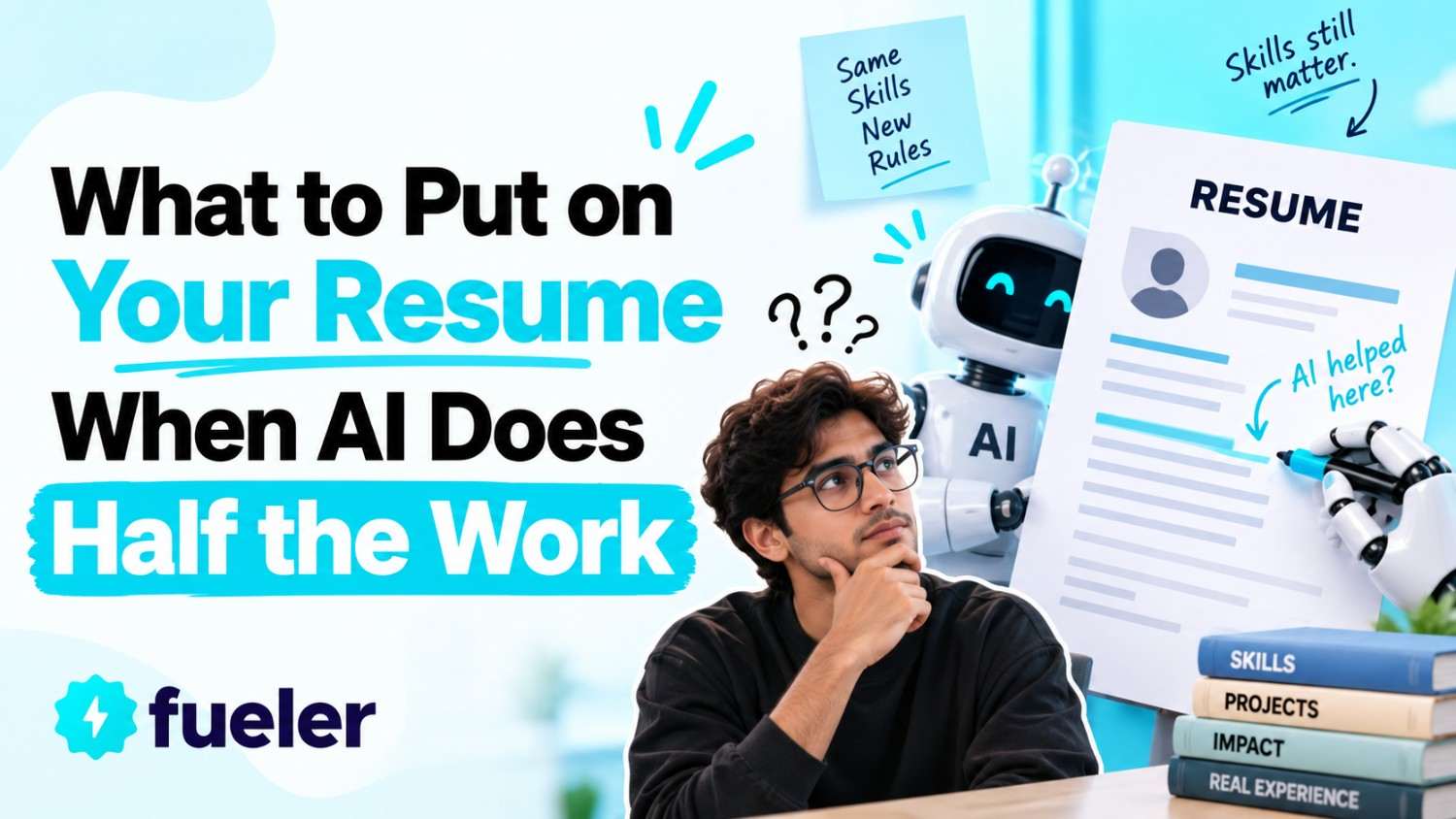
Anthropic's Economics team published a forecast this year with a line that should change how everybody writes their resume. In their middle scenario, AI is capable of doing half of all knowledge work by 2030, the majority of it autonomously.
Now look at your resume. It says something like "Content Writer, 2023 to 2026." What does that line tell a hiring manager about which half is still yours?
Nothing. It tells them nothing at all.
I am Riten, founder of Fueler, a platform where people get hired through their work. I read a lot of resumes and a lot of portfolios, and the gap between the two has never been wider than it is right now. This piece is about what to actually put down when the old format has stopped working.
Why the Old Resume Format Stopped Working
Anthropic's model, published as Economic Scenarios for Transformative AI (Korinek et al., 2026), does not treat a job as one thing. It treats every job as a bundle of tasks, drawn from the US Department of Labor's O*NET taxonomy.
Each task in the bundle can go four ways. AI leaves it alone. AI helps you do it faster, which they call augmentation. AI takes it over entirely. Or a new task appears that did not exist before.
Their example is a nurse. She does rounds, draws blood, triages patients, charts vitals and orders supplies. AI cannot bathe a patient, so that stays. AI helps her draft discharge instructions and monitor patients remotely. It may fully take over charting vitals and ordering supplies. And it creates new work, like reviewing an AI proposed care plan.
Her title is unchanged. Her bundle is completely different.
The resume was built to communicate the title. It was a workable shortcut when the bundle behind a title stayed roughly stable for a decade. It is a bad shortcut now, because two people with identical resume lines can be doing almost entirely different work.
A resume tells an employer that you held a position. In 2026, the employer needs to know what you did inside it.
Five Things to Put on Your Resume Instead of Job Titles
Here is what I would actually write, and why.
- Your task list, not your designation. Under each role, list the specific tasks you performed. "Wrote and edited long form articles, ran keyword research, managed a freelance writer pool of six, owned the publishing calendar." That is information. "Content Writer" is not. This single change improves most resumes more than any formatting or font choice.
- What you decided, not just what you delivered. Output is increasingly cheap to produce and therefore increasingly weak as evidence. Decisions are not. "Cut the blog from four posts a week to one and grew traffic" tells a hiring manager something about your judgment that a portfolio of four hundred posts does not.
- Your AI workflow, in specifics. Name the tools, name the stage you use them at, and name what you still do yourself. "Used AI for first draft research and outline variations, wrote and edited final copy myself, built a prompt library the team now uses." This is the single most differentiating thing you can add in 2026, because Anthropic's own model shows adoption trailing far behind capability. Most people have not caught up.
- New tasks you have picked up. If you now review AI output, quality check AI generated work, or manage a workflow that includes AI, write it down. The report notes that historically new technology creates new tasks for workers. These roles are appearing faster than job titles exist for them, so nobody will recognise them unless you name them.
- A link to actual work. One line at the top, pointing to a portfolio where every claim above can be verified. This is the part that turns your resume from assertion into evidence, and it is the part most people skip.
Why It Matters
The stakes here are not abstract, and Anthropic's wage findings show why.
The model finds that average wages rise in all three of its scenarios, but that the increase concentrates in occupations outside knowledge work. In the substantial scenario, wages for knowledge workers are essentially flat. In the extreme scenario, they fall by more than 10% by 2030.
When the price of knowledge output falls, the burden of proof shifts onto the individual. You are no longer competing only against other candidates. You are competing against an assumption in the hiring manager's head about how much of your work a machine could do.
A resume built on titles loses that argument by default, because it offers no evidence either way. A resume built on tasks, decisions and links wins it, because it shows exactly where the human contribution sits.
It is worth noting what the model does and does not claim. Anthropic states clearly that it excludes policy responses, business cycles, financial market disruptions and hyper capable robots. It does not track individual workers. Reviewers disagreed with the authors in both directions. And in the modest and substantial scenarios, unemployment stays within ranges history has already seen.
So this is not advice for surviving an apocalypse. It is advice for being legible in a market where the old signals have gone quiet.
What This Means for Your Portfolio and How You Get Hired
The truth is that a resume can only carry so much. It is one page, it is text, and it is unverifiable. Everything I listed above works better when there is something behind it.
That is what a portfolio does, and it is the reason I built Fueler.
Make each project a case, not a thumbnail. Title, then a detailed description of your process. What the problem was, how you approached it, what you tried, what you rejected, what tools you used, what you learned. This is exactly the structure that makes a proof of work portfolio work step by step, and it is what companies actually read.
Document your AI process properly. Do not just say "used AI." Show the workflow. On Fueler you can add your AI stack to a project and lay out exactly where AI entered and what you did with the output. I would hire the person who shows this over the person who hides it, every single time.
Use a structure so you actually finish. Most people never build a portfolio because they do not know where to start and the blank page wins. The 6 step portfolio formula exists to solve that. Follow it and you will have something publishable in a weekend.
Start before you have a job. If you are a student or a fresher, you can build proof from self initiated projects, and it works. The student guide to building a first portfolio walks through how, without needing a client or an internship first.
For designers, lead with reasoning. The strongest design portfolios I see are not the prettiest ones. They are the ones that explain choices. There is a clear pattern in how designers build their portfolio when they do it well.
Final Thoughts
I want to leave you with the exercise that I think is worth more than everything else in this article.
Take a blank sheet of paper. Write down every task your job actually contains. Most people find between eight and fifteen. Then go through the list and mark each one: still mine, done faster with AI, mostly done by AI now, or new since AI arrived.
That sheet is your real resume. It is honest, it is specific, and it is the version of yourself a hiring manager actually needs to see.
Then go build the document that shows it. Not a list of titles and dates, but a record of what you can do and how you think.
Anthropic's model says half of knowledge work may be automatable by 2030. That is not the frightening part. The frightening part is being unable to say which half was yours.
Go build a career portfolio that actually gets jobs, and make sure nobody has to guess.
Frequently Asked Questions
What should I put on my resume in the AI era?
List your specific tasks rather than only your job title, describe the decisions you made rather than just the work you delivered, name your AI workflow in detail, include any new tasks you have picked up such as reviewing AI output, and link to a portfolio where the claims can be verified.
Should I mention AI tools on my resume?
Yes, and be specific. Name the tools, the stage you use them at, and what you still do yourself. Anthropic's model shows AI adoption lagging well behind its capability, so demonstrating a real working process puts you ahead of most candidates rather than behind them.
Is the resume dead because of AI?
Not dead, but much weaker as a signal. A resume records job titles and dates, while AI is rapidly changing the tasks inside those titles. Two candidates with identical resume lines can now have very different actual capabilities, which is why supporting evidence matters more than it used to.
How do I show my skills if AI helped with my work?
Show the parts you owned. Explain the brief, the direction you chose, what you rejected, how you evaluated the output and what you changed. Judgment and quality control are real skills and they are exactly what employers are trying to identify.
Do I need a portfolio if I already have a resume?
A resume asserts and a portfolio proves. As the tasks inside job titles shift, employers increasingly need evidence rather than claims, and a portfolio is the only format that provides it in a way a hiring manager can inspect directly.
Why 100,000+ professionals use Fueler
Fueler helps professionals showcase proof of work through projects, assignments, case studies, and achievements.
- Thousands of professionals use Fueler to create their digital portfolio
- Thousands of projects are published on Fueler. Check here
- Startups and Companies hire through proof of work on Fueler
- Used by freelancers, creators, marketers, video editors, writers, designers, and product managers
Our mission is to help the next 100 million professionals build a verified professional identity through proof of work

What should you do next?
You've read the article. Now turn your skills into proof of work and unlock more opportunities.
Build your proof of work portfolio
Create a clean portfolio with projects, assignments, resumes, and AI stack details that companies actually want to see.
Create your Fueler portfolio →Apply through assignments, not resumes
Stand out by solving real tasks from companies hiring on Fueler.
Explore assignments →Get discovered by companies
Make your work public and let recruiters discover your skills through actual projects instead of keywords.
Get discovered →