Why Exactly Was Bhopal Chosen by Anthropic for the Fable 5.1 Buildathon?

Riten Debnath
12 Sep, 2026
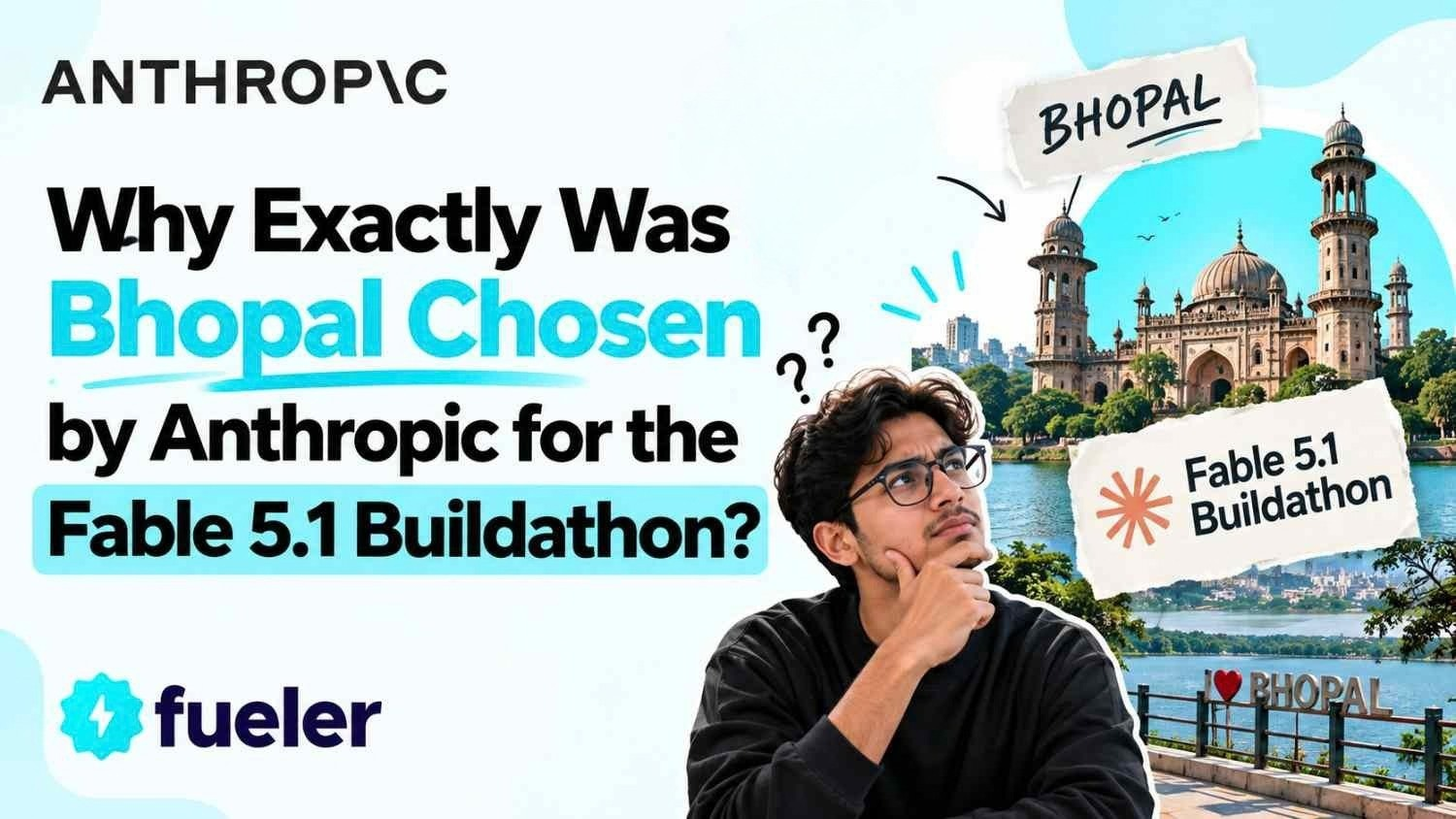
When I first came across the announcement that Bhopal was going to host Anthropic's Fable 5.1 Build Day, I found the choice interesting because Bhopal is not usually the first city that comes to mind when we talk about India's technology ecosystem. Bengaluru, Delhi, Mumbai, Hyderabad and Pune have traditionally dominated conversations around startups, developers, artificial intelligence and technology communities. These cities have large numbers of technology companies, engineering colleges, founders, developers and investors, so seeing Bhopal on Anthropic's global Build Day list naturally raised a question for many people: why Bhopal?
The question becomes even more interesting when you look at the other cities participating in Anthropic's global Fable 5.1 Build Day initiative. Bhopal appears alongside cities such as Osaka, Miami and Taipei. At first glance, it is easy to assume that Anthropic must have studied India's technology ecosystem, compared different cities and deliberately selected Bhopal over Bengaluru, Mumbai or Delhi. However, the public information available around the event does not support that conclusion. There is no evidence that Anthropic conducted a city-by-city competition in India and decided that Bhopal had a better technology ecosystem than these larger cities.
Instead, the available information points towards something much more interesting: Anthropic's community strategy and the strength of the local people building the Claude community in Bhopal.
What exactly is the Fable 5.1 Build Day?
Anthropic's Fable 5.1 Build Day is not simply a traditional product launch where people attend a presentation and listen to a company talk about a new AI model. The format is much more focused on getting people to use the technology themselves. The Bhopal event is designed for developers, students, creators, founders and AI enthusiasts who want to experiment with Fable 5.1 and build something during the event.
According to the public event listing, participants can work individually or in small teams and build projects around different themes, including Delight, Breakthrough and Everyday. The event also encourages participants to demonstrate their projects and submit their work for potential inclusion in the broader Fable 5.1 Build Day showcase. This makes the event less about watching what Anthropic is building and more about getting people to build with Anthropic's technology. (luma.com)
That distinction is important because it tells us something about the kind of community Anthropic wants to create. AI products become much more valuable when people do not just sign up for them but actually learn how to use them, build projects with them, share those projects with other people and eventually teach others to use the same tools. A buildathon is a very effective way to create that behaviour because participants leave the event with something they have actually built rather than simply another product demo they watched.
The biggest clue is Anthropic's Community Ambassador program
To understand why Bhopal became part of this global initiative, it is useful to look at Anthropic's Claude Community Ambassador program. Anthropic has created a global network of community members who help build and lead Claude communities in their cities. Ambassadors can organise meetups, workshops, hackathons and other activities, while Anthropic provides resources such as event support, content, swag and API credits. Anthropic also says that it actively prioritises geographic diversity as part of this community program.
The Bhopal Fable 5.1 event is hosted by Aniket Sahu, who is listed as a Claude Community Ambassador. This detail is probably much more important than the name of the city itself because it gives us a possible explanation for how Bhopal became part of the global event.
The most useful question, therefore, is not necessarily why Anthropic selected Bhopal. It is why there was already a person in Bhopal who was actively building a Claude community and organising events around the product.
Bhopal had an active Claude community before the buildathon
The Fable 5.1 Build Day was not the first Claude-related activity to happen in Bhopal. Public information about the community shows that several Claude events had already taken place in the city before the September buildathon.
Aniket Sahu publicly shared details about the launch of the Claude Community in Bhopal. According to his post, the launch received more than 300 registrations and more than 100 people attended the event in person. The community continued with additional events focused on Claude, AI development and practical building. (linkedin.com)
A public community tracker also lists several Bhopal events, including Claude meetups, a Claude Code workshop, Claude for College Builders, Claude Conversation and Claude Impact Lab. This is useful because it shows that the Bhopal community was not created specifically for the Fable 5.1 announcement. There was already a pattern of people organising and attending events around Claude before the buildathon was announced.
That continuity may be one of the strongest explanations for Bhopal's inclusion. A technology company can provide funding, products and branding, but it cannot easily manufacture a local community from scratch. Someone has to do the work of finding people, organising venues, communicating with attendees, running workshops and making sure that people come back for the next event.
Bhopal already appeared to have that structure.
Why Bhopal can be valuable even though Bengaluru is much bigger
It would be incorrect to argue that Bhopal has a larger technology ecosystem than Bengaluru or that it has more AI talent than Mumbai or Delhi. There is no evidence to support such a claim. The more useful comparison is between the size of a city's technology ecosystem and the strength of a particular local community.
Bengaluru has an enormous number of developers, founders and technology companies, but that does not automatically mean that every technology community operating there will be highly active. There are already hundreds of meetups, startup groups, conferences and developer communities competing for people's attention. A company like Anthropic can certainly benefit from being present in Bengaluru, but it also has an opportunity to reach people who are outside the traditional technology hubs.
This is where geographic diversity becomes important. Anthropic's Community Ambassador program is explicitly global and the company says it wants to build communities across different locations. From that perspective, a strong community in Bhopal can provide something different from another community in Bengaluru. It allows Anthropic to reach students, developers and early builders who may not be part of the existing startup ecosystem in India's largest technology cities.
The strategic value is therefore not necessarily the number of technology companies in a city. It is the ability to create an active network of people who use and promote the product locally.
Did Anthropic actually reject Bengaluru, Mumbai or Delhi?
This is an important point because the headline can easily create the wrong impression. Based on the public information available, we should not say that Anthropic evaluated Bengaluru, Mumbai, Delhi and Bhopal and decided that Bhopal was the winner.
There is no public evidence of such a selection process.
In fact, Claude community activity is taking place in other major Indian cities as well. Delhi has had Claude-related community events, and there are efforts to expand Claude communities into several other Indian cities. This suggests that Anthropic's approach is not about selecting one Indian city and ignoring the others. It is much closer to building a distributed network of local communities.
The Bhopal Build Day is therefore better understood as one node in that larger network. Bhopal happened to have an active organiser and a community that had already demonstrated interest in Claude, making it possible to host a large community-led event around Fable 5.1.
That is a much more interesting story than simply saying that Anthropic picked Bhopal over Bengaluru.
The role of students could be particularly important
Another detail that deserves attention is the focus on college builders in the Bhopal Claude community. One of the community events was specifically designed for students who were working on college projects, learning to code, building products or exploring AI.
From my experience building Fueler, I find this particularly interesting because students are becoming an important part of the new technology ecosystem. They may not have years of professional experience, but they can learn new tools quickly and experiment with technologies that established professionals may take longer to adopt.
AI makes this even more significant because the barrier to creating software, content and prototypes is falling rapidly. A student who could not previously build a product independently may now be able to create a working prototype with the help of AI tools. If that student joins a community where other people are doing the same thing, the learning process becomes much faster.
This is also why I believe proof of work is becoming increasingly important. At Fueler, we have built our platform around the idea that people should be able to demonstrate their ability through actual work instead of relying entirely on resumes and credentials. A student who builds something useful and can explain how they built it has created a stronger signal than simply saying they are interested in AI. You can read more about this approach in our guide to proof of work portfolios.
What Anthropic is really building through these communities
The bigger business strategy here is what I find most interesting. Anthropic is not only distributing an AI product. It is also building a network of people who can help others understand and adopt that product.
An active community member can organise a workshop where ten people learn about Claude. Some of those people might then start using Claude regularly. A few might build projects with it and share those projects online. Those projects can attract another group of people who want to learn. Some of them may eventually organise events themselves. Over time, the community grows without every new member having to be acquired directly through traditional advertising.
This creates a very different distribution model for a technology company. The product is still at the centre, but the community becomes the layer that helps the product spread.
I think this is particularly important for AI products because many of their use cases are not obvious until people see them in action. A person may understand what an AI coding tool is after reading a website, but seeing another developer build a real application with it can make the value much clearer. The same applies to students, creators, marketers and founders.
A good community turns a product from something people hear about into something people experience.
What Bhopal's story means for smaller cities in India
The Bhopal example also tells us something about the future of India's technology ecosystem. For many years, ambitious students and founders in smaller cities felt that they had to move to Bengaluru, Mumbai or Delhi to access technology communities and opportunities. That is still true for many jobs and companies, but the internet and AI are changing part of this equation.
The technology itself is now available almost everywhere. A student in Bhopal can access the same AI models as someone in Bengaluru. A founder in Jaipur can build a prototype using the same tools as a founder in Mumbai. What is still difficult to create is the local network of people who can learn together, share knowledge and create opportunities for one another.
That is where communities can make a difference.
If one person starts organising useful events, brings together a few active builders and continues doing it consistently, that community can eventually become valuable enough for a global company to support it. The important point is that the community does not need to begin at a massive scale. It needs people who are willing to keep showing up.
The bigger lesson for founders and community builders
As a founder, I think there is a useful lesson here that goes beyond Anthropic and Bhopal. When building a product, we often focus on the biggest markets because they appear to offer the highest number of potential customers. But the strongest early communities are not always found in the biggest markets. They are often built around a small group of people who care deeply about a particular problem and are willing to spend time helping other people.
For a startup, this can become a powerful distribution channel. For a community builder, it can become a way to create opportunities in a city that does not yet have a large technology ecosystem. For students, it can provide access to people and knowledge that would otherwise be difficult to find.
At Fueler, we see a similar pattern in the way people build careers. Someone does not necessarily need to wait for a company to give them their first opportunity before they can demonstrate their ability. They can create projects, complete assignments and publish their work. That is the thinking behind assignment-based hiring and building a portfolio without work experience.
The same idea applies to communities. You do not necessarily need a famous technology ecosystem before you can start creating one. You can begin with a small group, create useful events and keep building from there.
So, why Bhopal?
After looking at the available public information, my conclusion is that we should be careful about saying Anthropic "chose Bhopal over Bengaluru, Mumbai or Delhi." There is no evidence that such a city-versus-city selection process took place.
What we can say with much more confidence is that Bhopal had an active Claude community, a local Community Ambassador and a history of organising events before the Fable 5.1 Build Day. Anthropic's community strategy also explicitly values geographic diversity, which makes it reasonable to see smaller cities as important parts of its global community network.
For me, that is the most interesting part of this entire story.
Bhopal did not need to become India's biggest technology city to get onto a global AI company's map. A local community was already doing the work of bringing people together, helping them learn and creating a space where people could build.
That is a useful lesson for India's smaller cities. The next generation of technology communities may not come only from Bengaluru, Mumbai and Delhi. They could emerge from Bhopal, Jaipur, Indore, Guwahati, Lucknow, Bhubaneswar and dozens of other cities where a small number of motivated people decide to start building something together.
The technology is becoming more accessible. The real advantage may increasingly come from the people who know how to bring other people together and turn that access into action.
And that, more than the city itself, is probably the real story behind Bhopal and Anthropic's Fable 5.1 Build Day.
Frequently Asked Questions
Why did Anthropic choose Bhopal for the Fable 5.1 Build Day?
There is no public evidence that Anthropic conducted a competition between Bhopal, Bengaluru, Mumbai and Delhi and selected Bhopal as the winner. The available information suggests that the Bhopal Fable 5.1 Build Day is part of Anthropic's community-led event strategy and is hosted by Aniket Sahu, a Claude Community Ambassador. Bhopal already had an active Claude community with multiple events and workshops before the Fable 5.1 Build Day was announced.
Is Bhopal becoming an AI hub in India?
It is too early to call Bhopal one of India's major AI hubs, especially when cities such as Bengaluru, Hyderabad, Delhi and Mumbai have much larger technology ecosystems. However, Bhopal has developed an active local Claude community, with events focused on AI, Claude Code, students and builders. Its inclusion in the Fable 5.1 Build Day shows that smaller Indian cities can also become important parts of the growing AI community.
Why did Anthropic choose Bhopal instead of Bengaluru?
There is no evidence that Anthropic chose Bhopal instead of Bengaluru through a formal city selection process. Bengaluru continues to have a much larger technology and startup ecosystem. The more likely explanation is that Anthropic's Community Ambassador program allows active local organisers to create Claude communities in different cities, and Bhopal already had an active organiser and an established community that could host the event.
What is Anthropic Fable 5.1 Build Day?
Anthropic's Fable 5.1 Build Day is a community-focused building event where developers, students, creators and AI enthusiasts can experiment with Fable 5.1 and create projects. The Bhopal event allows participants to work individually or in small teams and build projects around themes such as Delight, Breakthrough and Everyday. The format focuses on practical building rather than simply attending a product presentation.
How can students benefit from AI communities and buildathons?
AI communities and buildathons can give students a practical way to learn new tools, meet other builders and create projects that demonstrate their skills. This is becoming increasingly valuable because employers can look at what someone has actually built instead of relying only on academic qualifications or a resume. Students can document these projects as proof of work through a career portfolio, which can help them demonstrate their skills when applying for internships, freelance projects and full-time jobs.
Why 100,000+ professionals use Fueler
Fueler helps professionals showcase proof of work through projects, assignments, case studies, and achievements.
- Thousands of professionals use Fueler to create their digital portfolio
- Thousands of projects are published on Fueler. Check here
- Startups and Companies hire through proof of work on Fueler
- Used by freelancers, creators, marketers, video editors, writers, designers, and product managers
Our mission is to help the next 100 million professionals build a verified professional identity through proof of work

What should you do next?
You've read the article. Now turn your skills into proof of work and unlock more opportunities.
Build your proof of work portfolio
Create a clean portfolio with projects, assignments, resumes, and AI stack details that companies actually want to see.
Create your Fueler portfolio →Apply through assignments, not resumes
Stand out by solving real tasks from companies hiring on Fueler.
Explore assignments →Get discovered by companies
Make your work public and let recruiters discover your skills through actual projects instead of keywords.
Get discovered →