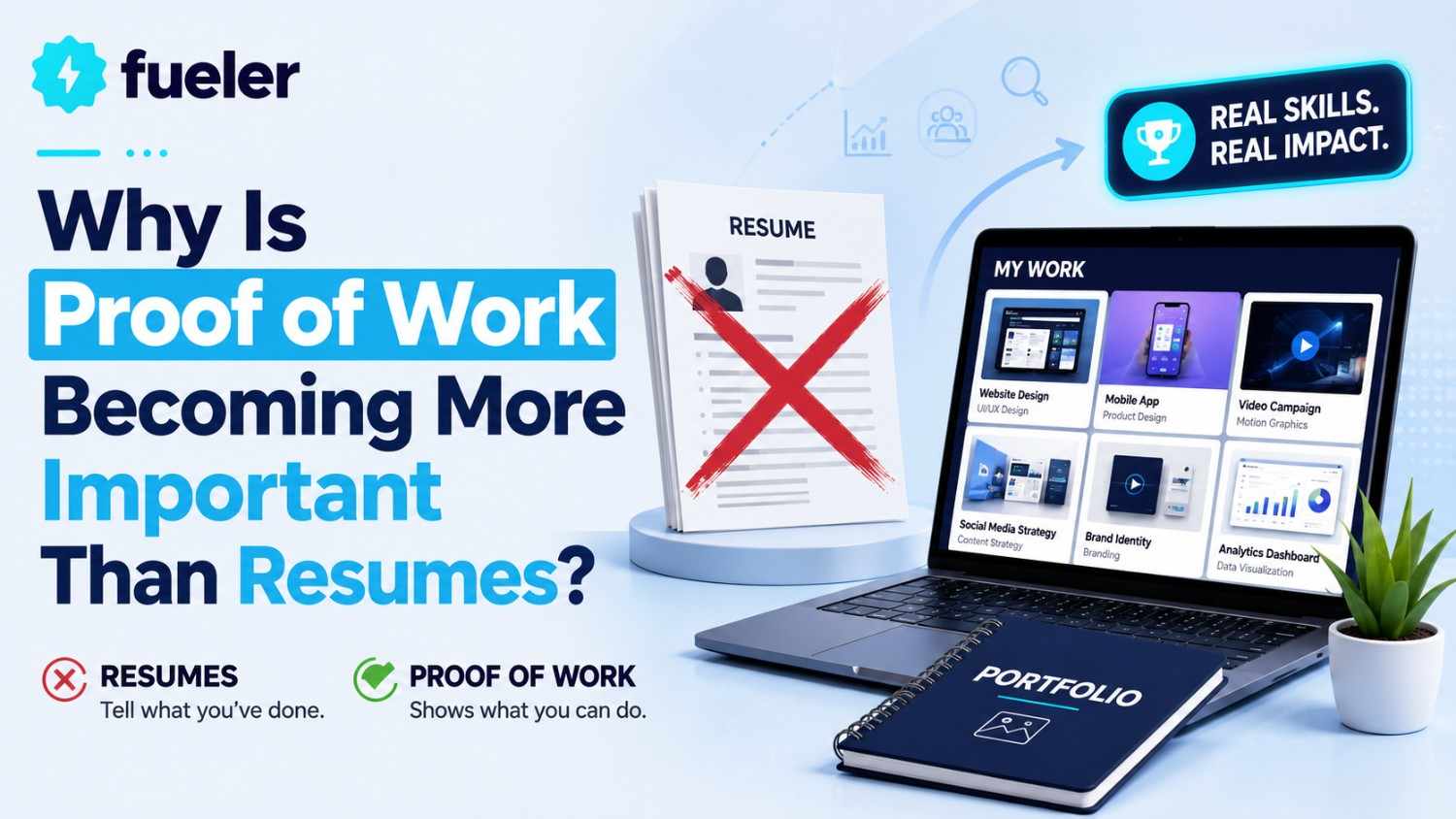
Why Is Proof of Work Becoming More Important Than Resumes?

Riten Debnath
29 Jul, 2026
Last updated: July 2026
Resumes were created for an era when checking paper credentials was the only way to measure human capability. In 2026, hiring managers open job posts only to be drowned in thousands of polished, AI-generated applications within hours. When every candidate presents a perfect resume full of buzzwords, recruiters lose the ability to spot real execution talent.
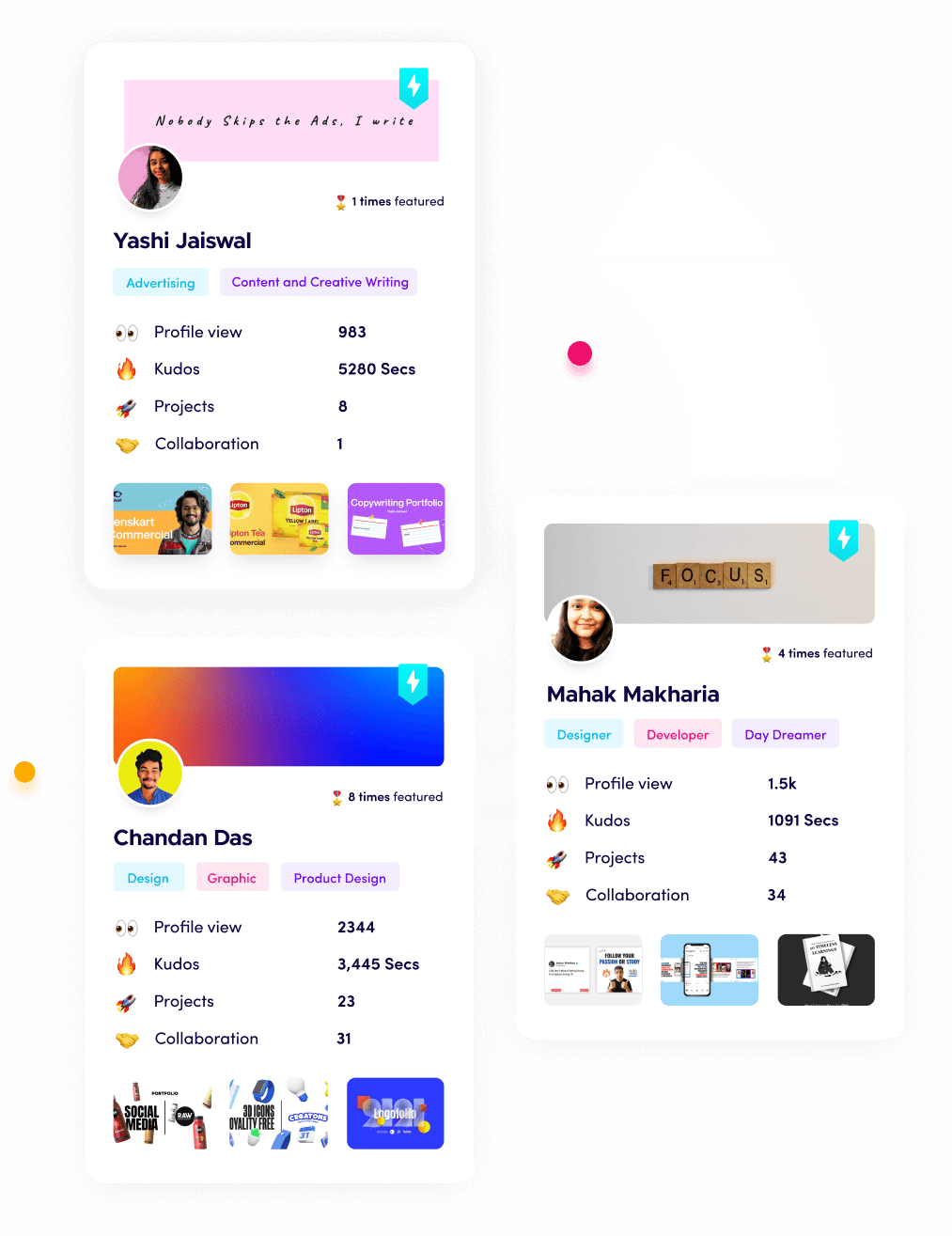
I’m Riten, founder of Fueler, a skills-first portfolio platform building the career infrastructure for 100 million creative professionals. Fueler connects talented individuals with companies through assignments, portfolios, and projects, not just resumes or CVs. Think of it as Dribbble/Behance for work samples combined with AngelList for hiring infrastructure.
In this deep breakdown, you will learn the 8 core reasons why tangible proof of work is replacing traditional resumes across modern companies. We will explore how skill verification works, why execution visibility wins interviews, and how building real project assets accelerates your long-term career growth.

AI-Generated Resumes Are Flooding Hiring Databases
Artificial intelligence tools allow job applicants to generate hundreds of tailored resumes in seconds. This mass automation has overwhelmed hiring systems, making traditional application screening almost impossible for recruiters.
When every job applicant uses automated software to write flawless cover letters and mirror job description keywords, resumes lose their ability to signal true competence. Hiring teams can no longer distinguish between a candidate who possesses genuine expertise and one who simply mastered prompt writing.
Because keyword-stuffed resumes no longer predict actual job performance, recruiters are forced to look beyond static documents. Companies now prioritize tangible project samples, public code repositories, and written case studies to verify whether a candidate can deliver practical results.
- Eradication of Keyword Filtering: Automated screening software cannot distinguish genuine technical skills from AI-generated buzzwords. Recruiters now ignore polished resume text and request verifiable work samples to confirm actual candidate capabilities before scheduling initial interviews.
- Reduction in Screening Noise: Hiring managers waste hundreds of hours reviewing identical automated applications. Requesting practical project assignments early in the hiring pipeline filters out spam applications and leaves only serious, capable candidates.
- Authentic Writing Style Assessment: AI tools produce repetitive, overly polished text that conceals authentic communication skills. Evaluating original project breakdowns reveals how candidates actually think, structure ideas, and solve problems under real working conditions.
- Direct Verification of Expertise: Applicants can easily claim management of large budgets on a static document. Reviewing live dashboards, campaign teardowns, or code commits provides indisputable proof of direct individual contributions.
- Faster Shortlisting Decisions: Reviewing a well-documented project sample takes seconds compared to deciphering vague job titles on a resume. Visual evidence allows hiring teams to make confident interview decisions without endless initial screening calls.
Why It Matters
Automated applications have effectively broken traditional resume screening. Companies hire candidates who present verified proof of work because direct evidence eliminates hiring noise, saves recruiter time, and guarantees that candidates possess the practical skills required to perform the job from day one.
Skills-Based Hiring Replaces Degree Requirements
Major enterprises and fast-growing startups are removing formal university degree requirements from job descriptions. Employers are shifting focus toward what candidates can build today rather than where they studied years ago.
Technology tools and industry practices evolve far faster than traditional academic curricula can adapt. A four-year degree often teaches theoretical concepts that become obsolete by graduation, leaving students unprepared for immediate operational tasks.
Skills-based hiring evaluates applicants on demonstrated capabilities rather than institutional prestige. By testing candidate output through real-world exercises, organizations unlock access to non-traditional talent pools while dramatically improving the quality of their permanent hires.
- Focus on Practical Capability: Employers prioritize immediate operational output over institutional prestige. Demonstrating mastery of modern software tools through completed assignments proves job readiness far better than carrying a diploma from a top-tier university.
- Democratization of Career Access: Removing strict degree filters creates equal hiring opportunities for self-taught professionals. Candidates with non-traditional backgrounds win high-paying roles simply by presenting superior portfolios that clearly outperform credentialed applicants.
- Alignment With Rapid Tool Changes: Academic programs struggle to update lesson plans alongside fast-moving industry tools. Showing recent project work proves you understand current workflows, platforms, and execution standards used by active engineering teams.
- Objective Talent Assessment: Evaluating completed assignments eliminates institutional bias during early recruiting stages. Hiring managers judge candidates strictly on problem-solving logic and work quality rather than university names listed on paper resumes.
- Higher Employee Onboarding Speed: Candidates who possess documented proof of work require minimal foundational training after signing employment contracts. Their existing project assets demonstrate they already handle real tasks efficiently without constant supervision.
Why It Matters
The modern economy demands immediate execution, not theoretical credentials. Companies that adopt skills-based hiring build stronger teams faster by evaluating actual capability. Presenting verified work assets allows ambitious professionals to bypass traditional educational gatekeepers and secure top-tier opportunities.
Verification of Real Practical Execution and Problem Solving
Resumes allow candidates to make bold claims about past achievements without providing supporting context. Proof of work forces applicants to reveal their exact problem-solving thought process, execution methods, and final outcomes.
A bullet point claiming a candidate increased customer conversion rates by fifty percent sounds impressive on paper. However, without seeing the initial problem, the tested hypotheses, and the final implementation, hiring managers cannot evaluate true individual contribution.
Detailed case studies break down the messy reality of project execution. By sharing initial constraints, key mistakes made, and specific solutions implemented, candidates demonstrate real analytical depth that a simple bullet point on a resume can never convey.
- Transparency in Execution Logic: Detailed project breakdowns show how you approach complex challenges step by step. Evaluators see your research methods, strategic decisions, and logical reasoning rather than trusting unverified claims written on a static resume.
- Exposure of Individual Contribution: Resumes often obscure team efforts by taking credit for group accomplishments. Presenting specific project deliverables proves exactly what parts of the execution pipeline you owned, designed, and delivered independently.
- Validation of Technical Mastery: Anyone can list software names on a skills summary section. Sharing actual code repositories, design files, or data models proves you possess hands-on technical proficiency with modern industry software.
- Demonstration of Critical Thinking: Highlighting project obstacles and explaining how you overcame them shows resilience. Employers value candidates who admit mistakes, analyze failure points, and refine their execution strategies based on clear feedback.
- Clear Context Around Metrics: Metrics mean nothing without understanding baseline starting numbers and operating constraints. Detailed case studies explain the full story behind revenue growth, user engagement increases, or system performance gains.
Why It Matters
Claims without evidence create hiring uncertainty for business leaders. Proof of work bridges the trust gap by revealing how candidates think, adapt, and execute under constraints. Documenting your problem-solving process proves you can deliver repeatable results in high-stakes environments.
Remote Work Requires Asynchronous Execution Visibility
Distributed teams operate across multiple time zones, relying on clear documentation and independent problem-solving. Proof of work demonstrates that a professional can manage tasks autonomously without needing constant managerial oversight.
In a remote work environment, managers cannot monitor daily physical presence or supervise every step of an assignment. Team success depends entirely on clear written communication, self-direction, and consistent public documentation of completed work.
A candidate who maintains a well-organized portfolio demonstrates inherent capability for remote collaboration. Showing public project logs, clear documentation, and structured task updates proves you can thrive in decentralized corporate environments from day one.
- Proof of Self-Motivation: Maintaining an active portfolio requires consistent personal initiative and discipline. Remote employers prefer candidates who independently build, document, and publish project assets without needing external deadlines or constant managerial pushing.
- Asynchronous Communication Mastery: Highlighting written case studies demonstrates your ability to explain complex concepts clearly across time zones. Clear documentation reduces meeting overload and keeps distributed engineering teams aligned on key objectives.
- Independent Problem Solving: Remote roles demand professionals who solve unexpected roadblocks without waiting for hand-holding. Public project logs prove you research solutions independently, test hypotheses, and complete deliverables despite vague initial guidelines.
- Transparent Task Management: Documenting project milestones shows you structure complex tasks efficiently. Remote managers trust workers who break large goals into measurable sub-tasks and maintain clear progress tracking across shared platforms.
- Reduced Need for Supervision: Candidates with proven execution records require significantly less managerial oversight after onboarding. Their public track record proves they take ownership of outcomes, handle feedback professionally, and consistently hit deadlines.
Why It Matters
Remote work thrives on trust, clarity, and autonomous execution. Resumes say nothing about how well you work when nobody is watching. Showing organized proof of work proves to remote leaders that you possess the self-discipline and documentation habits needed to excel in distributed teams.
Lowering Expensive Hiring Risks for Startup Founders
Making a bad hire can cost an early-stage startup tens of thousands of dollars in wasted salaries, lost productivity, and team disruption. Founders increasingly insist on proof of work to eliminate hiring guesswork entirely.
Early-stage companies operate with limited capital and tight timelines where every team member must produce immediate value. Hiring a candidate who interviews well but struggles with execution can derail product launches and drain valuable financial reserves.
Evaluating candidates through practical assignments and past work portfolios drastically reduces mis-hires. Founders can verify work quality, execution speed, and cultural alignment before extending expensive full-time employment offers to prospective applicants.
- Elimination of Interview Bluffing: Polished talkers often perform exceptionally during verbal interviews while failing at actual execution. Reviewing tangible work assets ensures candidates possess practical skills rather than just persuasive talking points.
- Protection of Startup Runway: Mis-hires burn limited seed capital and delay critical product milestones. Grounding recruitment decisions in verified proof of work protects startup runway by guaranteeing new hires generate immediate business returns.
- Validation of Execution Speed: Early-stage startups require team members who build and iterate rapidly. Examining past project timelines reveals how quickly a candidate turns abstract concepts into functional products without sacrificing output quality.
- Cultural Fit Through Work Style: Reviewing how candidates complete paid trial assignments reveals their collaboration habits, responsiveness, and attention to detail. Practical exercises reveal real-world team compatibility better than artificial behavioral interview questions.
- Higher Retention of Proven Talent: Candidates hired based on demonstrated skill alignment show higher long-term job satisfaction. When roles match real capabilities, employees experience less workplace frustration and stay committed to company growth goals longer.
Why It Matters
Founders cannot afford to gamble financial resources on resume promises. Proof of work provides undeniable evidence of candidate execution, speed, and reliability. Prioritizing work samples protects company runway while building high-performing operational teams.
Faster Candidate Evaluation Through Trial Projects
Traditional hiring processes involving six rounds of interviews waste weeks for both companies and applicants. Evaluating candidates through short trial projects streamlines recruitment and leads to faster hiring decisions.
Multiple interview rounds rarely produce better hiring accuracy; they mostly create decision fatigue and cause top talent to lose interest. Replacing repetitive interviews with focused practical assignments gives both parties clarity on capability within days.
Paid trial projects allow companies to test real-world working dynamics in a controlled environment. Applicants showcase their problem-solving speed, while hiring managers assess deliverables against clear internal quality benchmarks before finalizing job offers.
- Streamlined Recruitment Timelines: Replacing endless interview loops with paid trial tasks reduces total time-to-hire by weeks. Companies evaluate real deliverables quickly, enabling them to extend offers to top talent before competitors respond.
- Objective Performance Benchmarks: Standardized project assignments give hiring teams clear metrics for comparing candidate performance. Evaluating identical tasks under equal conditions removes subjective interviewer bias and highlights the strongest operator.
- Mutual Trial Opportunities: Paid trial tasks allow candidates to experience real team workflows, communication tools, and management styles. This two-way evaluation ensures applicants genuinely enjoy the work environment before accepting formal contracts.
- Clear Evaluation Criteria: Trial projects focus strictly on tasks directly relevant to daily job duties. Candidates know exactly what criteria determine success, eliminating guesswork and allowing them to showcase their strongest technical skills.
- Immediate ROI Verification: Reviewing trial project output gives hiring leaders instant confidence in candidate return on investment. Seeing completed deliverables eliminates anxiety about post-hire performance and smooths internal approval processes.
Why It Matters
Long, drawn-out recruitment processes frustrate candidates and slow company growth. Short trial projects anchored in real work samples create a fast, fair, and objective hiring pipeline that saves time for everyone while securing top talent efficiently.
Demonstration of Adaptability to Modern AI Workflows
Modern workplaces require professionals who actively integrate artificial intelligence tools into their daily execution pipelines. Resumes cannot demonstrate how effectively an applicant uses AI to accelerate output quality.
Listing software proficiency on a document does not tell an employer how you actually leverage technology to solve problems. Modern operators combine human strategic judgment with automated tools to produce work far faster than traditional workers.
Proof of work showcases how you prompt, refine, and deploy AI systems across real projects. Showing finished case studies built with automated assistance proves you stay ahead of technological shifts and deliver high-volume, high-quality results.
- Proof of Modern Tool Fluency: Displaying projects created using contemporary AI tools proves you stay ahead of tech trends. Employers prefer candidates who continuously upgrade their operational workflows to produce higher quality output faster.
- Higher Operational Efficiency: Showing how you combine human creativity with automated software highlights superior productivity. Highlighting fast project completion times demonstrates you generate substantial leverage for marketing, engineering, or design teams.
- Quality Control and Refinement: Anyone can run simple AI prompts, but output quality depends on skilled human editing. Case studies show how you critically evaluate, fix, and refine automated drafts into polished business assets.
- Innovation in System Building: Highlighting custom AI automation pipelines demonstrates advanced problem-solving initiative. Sharing workflows that automate routine tasks proves you create lasting operational efficiency for your entire department.
- Adaptability to Industry Shifts: Technology changes quickly, rendering static skills outdated within years. Maintaining a dynamic portfolio showcasing recent tech integrations proves you possess the adaptability needed to thrive amid continuous industry shifts.
Why It Matters
Tool fluency changes rapidly, and companies need operators who adapt continuously. Showing how you integrate modern AI tools into real project workflows proves you deliver superior efficiency and keep your organization competitive.
Equalizing Opportunity Beyond Geographic and Institutional Bias
Resume screening historically favored candidates from wealthy regions or famous universities, ignoring talent elsewhere. Proof of work creates a global meritocracy where individual skill determines career success regardless of background.
For decades, living outside major tech hubs or lacking elite university connections limited access to high-paying international careers. Traditional recruiters defaulted to familiar school names and corporate brands when filtering large applicant pools.
Public portfolios break down these geographic and social barriers completely. When candidates present undeniable project execution online, employers evaluate them based on deliverable quality rather than postal code or academic background.
- Global Career Opportunities: Public portfolios enable talented professionals worldwide to compete directly for international roles. Showcasing verified work samples allows skilled individuals to land remote positions based purely on deliverable quality.
- Reduction of Unconscious Bias: Evaluating anonymized project samples forces hiring managers to focus exclusively on technical craftsmanship. Grounding decisions in work quality reduces demographic, institutional, and regional biases during recruitment.
- Empowerment of Self Taught Talent: Passionate individuals who learn through online courses or independent practice can outcompete traditional graduates. Displaying high-impact side projects proves capability far better than accumulating expensive academic credentials.
- Validation of Career Changers: Professionals switching industries often struggle to present relevant experience on traditional resumes. Building targeted portfolio assets allows career changers to prove practical competency in a new field immediately.
- Creation of Public Reputation: Publishing projects publicly builds an enduring personal brand that attracts incoming inbound opportunities. A strong portfolio turns career growth into an active magnet rather than a passive job application process.
Why It Matters
Proof of work levels the global playing field by prioritizing raw capability over privilege. By focusing on verified project output, companies gain access to extraordinary international talent while ambitious professionals build thriving global careers on their own merit.
How Does This Connect to Building a Strong Career or Portfolio?
Building a durable career in 2026 requires continuous visibility into your execution ability. Relying solely on text resumes leaves your actual talents hidden behind unverified claims. Documenting your real-world assignments, project breakdowns, and problem-solving workflows creates an undeniable track record that earns instant trust from hiring managers. Platforms like Fueler allow professionals to curate their proof of work into an organized public portfolio that showcases real project outcomes instead of static credentials. Taking ownership of your work artifacts opens doors to higher-paying opportunities and ensures your skills speak for themselves.
Final Thoughts
The transition from resume-based hiring to proof of work is not a temporary trend; it is a permanent structural shift in how talent is recognized and hired globally. As artificial intelligence continues to make static applications meaningless, your actual execution history becomes your most valuable professional asset. Instead of spending hours polishing bullet points on a PDF document, invest that energy into building, documenting, and sharing real projects online. Focus on solving tangible problems and publishing your work transparently. In a world full of resume claims, showing what you can actually build will always set you apart.

Frequently Asked Questions
What is proof of work in the context of hiring?
Proof of work refers to publicly verifiable evidence of your skills, such as live projects, code repositories, design files, content campaigns, and case studies that demonstrate your ability to execute tasks effectively.
Can proof of work completely replace a traditional resume?
While resumes still provide a quick chronological overview of your work history, proof of work validates your claims with actual evidence. Employers rely on portfolios to make final hiring and interview decisions.
How can beginners create proof of work without prior client experience?
Beginners can build proof of work by completing sample assignments, redesigning existing products, analyzing real company data, or building open-source projects. Documenting your process proves your practical capability regardless of client history.
What types of projects should I include in my proof of work portfolio?
Select three to five high-quality projects that directly align with the specific role you want. Include details about the initial problem, your specific execution process, tools used, and final measurable outcomes.
Why do startup founders prefer proof of work over university degrees?
Startup founders operate under tight deadlines and limited budgets. Proof of work demonstrates immediate execution capability and problem-solving speed, reducing the risk of expensive mis-hires compared to relying on theoretical degrees.
What should you do next?
You've read the article. Now turn your skills into proof of work and unlock more opportunities.
Build your proof of work portfolio
Create a clean portfolio with projects, assignments, resumes, and AI stack details that companies actually want to see.
Create your Fueler portfolio →Apply through assignments, not resumes
Stand out by solving real tasks from companies hiring on Fueler.
Explore assignments →Get discovered by companies
Make your work public and let recruiters discover your skills through actual projects instead of keywords.
Get discovered →