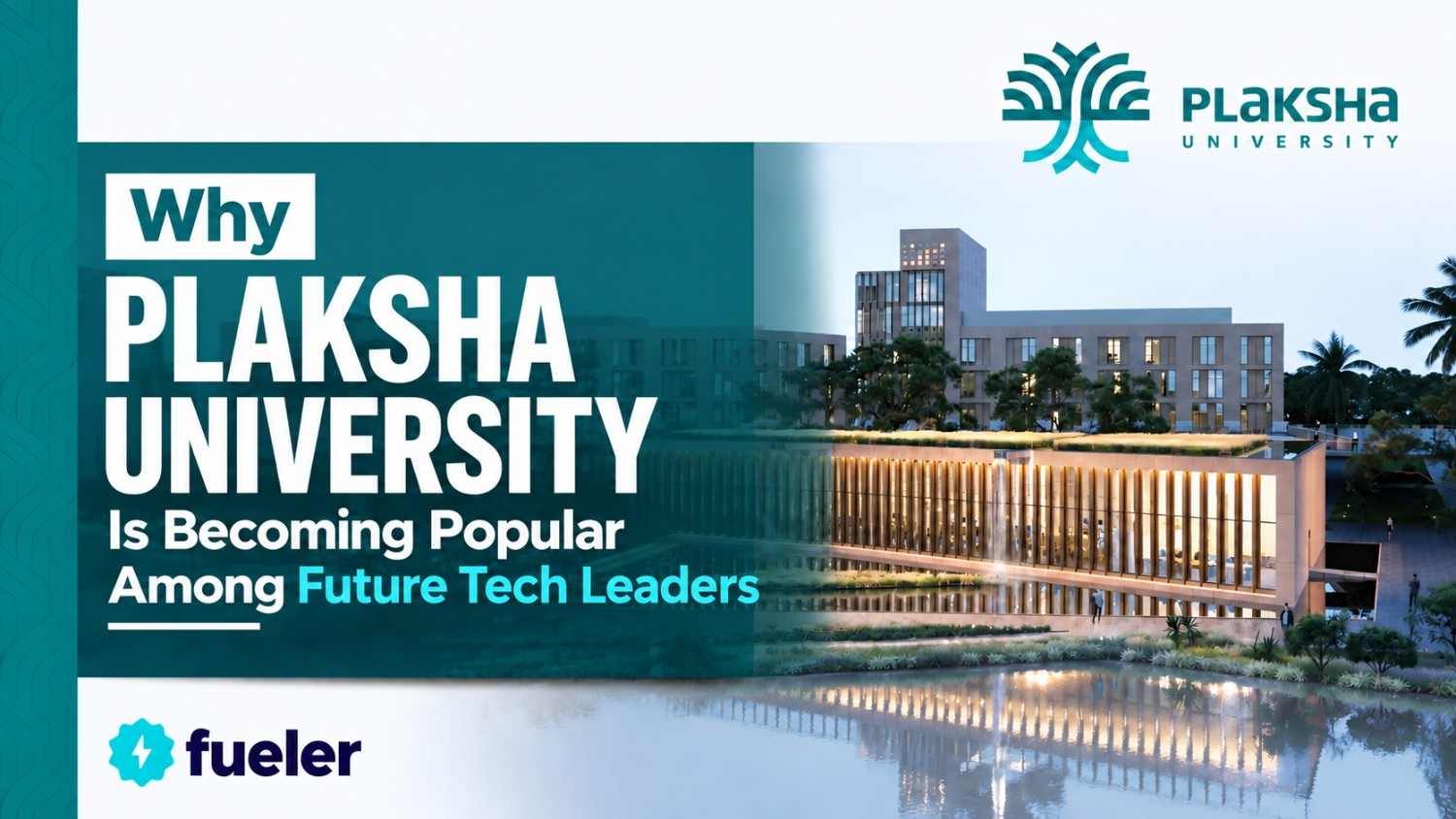
Why Plaksha University Is Becoming Popular Among Future Tech Leaders

Riten Debnath
31 Aug, 2026
Last updated: August 2026
Engineering education in India is hitting a visible wall. For decades, the path to a tech career meant clearing high-pressure entrance exams, sitting through lecture halls, and memorizing 20-year-old syllabus books, only to land a job where you re-learn everything on the fly.
I’m Riten, founder of Fueler, a skills-first portfolio platform building the career infrastructure for 100 million creative professionals. Fueler connects talented individuals with companies through assignments, portfolios, and projects, not just resumes or CVs. Think of it as Dribbble/Behance for work samples combined with AngelList for hiring infrastructure.
Through our work at Fueler, we see thousands of young tech graduates struggle to get hired because companies no longer care about degrees or marks. Founders and engineering managers look for actual proof of work: live projects, GitHub commits, design prototypes, and working products.
This exact shift is why Plaksha University is getting so much attention from young builders and future tech leaders. Located in Mohali, Punjab, Plaksha is not another traditional engineering college. Built from scratch by over 60 tech founders, corporate leaders, and venture capitalists, it replaces old exam-heavy patterns with hands-on building, practical projects, and interdisciplinary learning.

Quick Answer Summary
- What it is: A contemporary tech and research university in Mohali redesigning higher engineering education.
- Who it is for: Students, tech aspirants, and future founders seeking a hands-on alternative to traditional B.Tech degrees.
- Cost: Annual tuition ranges from ₹7.8 Lakhs to ₹9.36 Lakhs, with residential fees around ₹2.1 Lakhs per year.
- Key Takeaway: Focuses on interdisciplinary majors, continuous project building, global university tie-ups, and founder mentorship.
- Best Suited For: Self-driven builders who want to launch startups or join fast-scaling product teams right after college.
What is Plaksha University?
Plaksha University is an independent, non-profit tech university located in Mohali, Punjab. It was established under the Punjab State Private Universities Act to fix the core issues of traditional higher education.
Instead of traditional engineering branches like generic Civil or Mechanical Engineering, Plaksha offers four interdisciplinary majors:
- Computer Science & Artificial Intelligence (CS & AI)
- Robotics & Autonomous Systems (RAS)
- Data Science, Economics & Business (DSEB)
- Biological Systems Engineering (BSE)
At its core, Plaksha treats technology as an applied tool rather than pure theory. From their very first semester, students do not just study theory; they work in maker spaces, run code on real hardware, and solve actual problems.
It differs from traditional engineering colleges because grades are based on continuous project evaluation rather than end-of-semester written exams. You build real systems, document your work, and show your output to industry experts.
Key Facts Table
Detailed Explanation
Why is Plaksha University rapidly gaining mindshare among students, parents, and startup operators? The reasons are straightforward, structural, and verified by real academic design.
Built and Backed by Founders, Not Bureaucrats
Plaksha was created through collective philanthropy. Over 60 business leaders, tech founders, and venture capitalists pooled their own capital and expertise to launch it.
Because the campus is governed by active business operators, the curriculum updates constantly. When generative AI or new robotics frameworks emerge in industry, they get integrated into coursework immediately, avoiding the multi-year approval delays common in traditional state universities.
Interdisciplinary Majors That Match Modern Careers
In most colleges, engineering branches operate in isolation. Computer science students never learn business models, and business students never learn how to build software.
Plaksha breaks these walls. Their Data Science, Economics & Business major mixes quantitative data analysis with economic strategy. Their Biological Systems Engineering degree combines computation with life sciences. This design matches real product development, where software engineers, data leads, and business operators work together daily.
Global Academic Partnerships
Plaksha partners directly with top global engineering schools, including UC Berkeley, the University of Pennsylvania, and Purdue University.
These tie-ups go beyond logos on a website. Professors from partner institutions help design course modules, lead guest sessions, and run collaborative research programs. Students get exposed to global academic standards right from Mohali.
Culture of Building Public Proof of Work
At Fueler, we always emphasize that showing what you have built matters far more than claiming what you know. Plaksha aligns directly with this belief.
Students do not write basic theoretical assignments that get thrown away. They work on capstone projects, build real applications, write open-source code, and assemble functional hardware. When these students showcase their projects on a platform like Fueler, recruiters see verified proof of capability instead of a generic one-page resume.
How It Works
Broad Foundational Core (Year 1)
All incoming B.Tech students take foundational courses across computational thinking, mathematics, physics, design, and humanities. This ensures every student develops strong fundamentals before specializing.
Major Selection & Core Labs (Year 2)
Students select their major (CS & AI, RAS, DSEB, or BSE) and move into specialized laboratory environments. Learning takes place through maker spaces rather than passive lecture halls.
Industry Immersion & Challenge Labs (Year 3)
Students work on real-world industry problems guided by corporate partners and startup founders. They intern with high-growth companies, build functional tools, and document their development journey.
Grand Challenge Capstone (Year 4)
In their final year, students execute a major capstone project. They build advanced technology systems, launch early-stage ventures through the Center for Entrepreneurship, or publish original research.
Practical Benefits
- Practical Capability Over Rote Learning: Graduates leave with working systems experience. They understand how to build software, test hardware, and debug live production environments.
- Direct Access to Startup Networks: Being backed by top founders means regular campus visits, guest sessions, and direct hiring lines to fast-growing ventures.
- Strong Career Positioning: Publishing assignments and projects on Fueler gives Plaksha students a clear advantage over candidates from traditional colleges who only submit standard resumes.
- Founder Mindset: Through campus incubation support, students with viable product ideas receive seed support, workspace, and founder guidance to launch real startups.
Limitations
Plaksha offers a modern education model, but it is important to evaluate its potential drawbacks honestly:
- Significant Cost: Total tuition and residential fees can exceed ₹10 Lakhs per year without financial aid.
- Young Alumni Base: Founded recently, Plaksha does not yet have the massive, decades-old alumni networks of older IITs or NITs.
- High Project Workload: The continuous evaluation model demands steady effort. Students who prefer cramming right before exams will struggle.
- Recruiter Awareness in Traditional Sectors: Modern tech startups, product firms, and VC funds actively hire from Plaksha. However, conservative public sector companies still stick to legacy government engineering colleges.
Comparison Table
Fees and Costs
Here is a clear view of the undergraduate fee structure:
- Tuition Fee: ₹7,80,000 per year (Category A) or ₹9,36,000 per year (Category B).
- Living & Food Costs: ₹1,44,000 for hostel accommodation and ₹66,000 for meal plans per year.
- One-Time Deposits: ₹50,000 non-refundable admission fee and ₹50,000 refundable security deposit.
- Need-Based Financial Aid: Plaksha runs a transparent financial aid program for families with annual incomes under ₹50 Lakhs:
- Income < ₹18 Lakhs: Up to 100% Tuition Fee Waiver
- Income ₹18 L – ₹28 Lakhs: Up to 75% Waiver
- Income ₹28 L – ₹38 Lakhs: Up to 50% Waiver
- Income ₹38 L – ₹50 Lakhs: Up to 25% Waiver
Career Opportunities
Plaksha graduates are built specifically for modern technology roles.
- Software & AI Engineering: Building core AI models, scalable infrastructure, and modern software applications. Salary range: ₹14 LPA to ₹30+ LPA.
- Product & Growth Analytics: Analyzing user metrics, designing features, and managing tech products. Salary range: ₹12 LPA to ₹22 LPA.
- Robotics & Autonomous Systems: Engineering smart hardware, drones, and automated industrial devices. Salary range: ₹10 LPA to ₹25 LPA.
- Founder's Office & Venture Operations: Working directly alongside startup founders on business growth and operations. Salary range: ₹12 LPA to ₹20 LPA.
Who Should Choose This?
- Students who enjoy building real software and hardware over memorizing textbooks.
- Aspirants who want early exposure to modern AI, robotics, and quantitative business.
- Future founders looking for seed support, mentorship, and co-founders in college.
- Candidates committed to publishing real proof of work on platforms like Fueler to stand out.
- Families looking for a modern alternative to traditional engineering degrees.
Who Should Avoid This?
- Students who prefer traditional lecture formats and final written exams.
- Candidates strictly seeking low-cost public government colleges.
- Learners who struggle with fast-paced continuous project work.
- Anyone seeking classic mass-recruiter placements in traditional consulting or public sector firms.
Final Thoughts
Education works best when it keeps pace with real industry demands. At Fueler, we see every day how proof of work transforms careers for young builders. The students who win in today's tech market are not those with perfect theoretical marks, but those who can point to a live product, a working neural network, or a clean codebase and say, "I built this."
Plaksha University is structured around this exact operational truth. By combining founder mentorship, global academic standards, and project-based learning, it gives students a genuine head start in tech and business. If you have the drive to build rather than just study, it is easily one of the most promising tech destinations in the country today.
Key Takeaways
- Plaksha University is a founder-backed higher education institution located in Mohali.
- Replaces outdated syllabus models with hands-on projects and interdisciplinary majors.
- Partners directly with UC Berkeley, UPenn, and Purdue University.
- Evaluates students on continuous output, maker projects, and capstone work.
- Provides need-based financial aid up to 100% for eligible income brackets.
- Prepares graduates for high-growth roles in AI, robotics, product management, and founder teams.

FAQs
What degrees does Plaksha University offer?
Plaksha offers 4-year B.Tech degrees in Computer Science & Artificial Intelligence, Robotics & Autonomous Systems, Data Science, Economics & Business, and Biological Systems Engineering, alongside postgraduate programs.
Is Plaksha University UGC recognized?
Yes, Plaksha University is established under the Punjab State Private Universities Act and is fully UGC-recognized to award degrees.
What is the fee structure for B.Tech at Plaksha?
Annual B.Tech tuition ranges from ₹7.8 Lakhs to ₹9.36 Lakhs, with hostel and meal fees totaling around ₹2.1 Lakhs per year.
Does Plaksha offer scholarships or financial aid?
Yes, Plaksha offers need-based financial aid covering 25% to 100% of tuition for families earning under ₹50 Lakhs annually.
How are placements at Plaksha University?
Plaksha graduates secure roles in AI, software engineering, and product management, with average placement packages ranging between ₹16 LPA and ₹19.45 LPA.
Why 100,000+ professionals use Fueler
Fueler helps professionals showcase proof of work through projects, assignments, case studies, and achievements.
- Thousands of professionals use Fueler to create their digital portfolio
- Thousands of projects are published on Fueler. Check here
- Startups and Companies hire through proof of work on Fueler
- Used by freelancers, creators, marketers, video editors, writers, designers, and product managers
Our mission is to help the next 100 million professionals build a verified professional identity through proof of work

What should you do next?
You've read the article. Now turn your skills into proof of work and unlock more opportunities.
Build your proof of work portfolio
Create a clean portfolio with projects, assignments, resumes, and AI stack details that companies actually want to see.
Create your Fueler portfolio →Apply through assignments, not resumes
Stand out by solving real tasks from companies hiring on Fueler.
Explore assignments →Get discovered by companies
Make your work public and let recruiters discover your skills through actual projects instead of keywords.
Get discovered →