

Dual-Agent Autonomous AI Corporate Compliance Auditor Pipeline


🎯 The Challenge
AI models love to make things up—whether it's misquoting numbers, inventing company rules, or hallucinating data. In a business setting, letting an unverified AI talk directly to users introduces massive compliance risks.
💡 What I Built
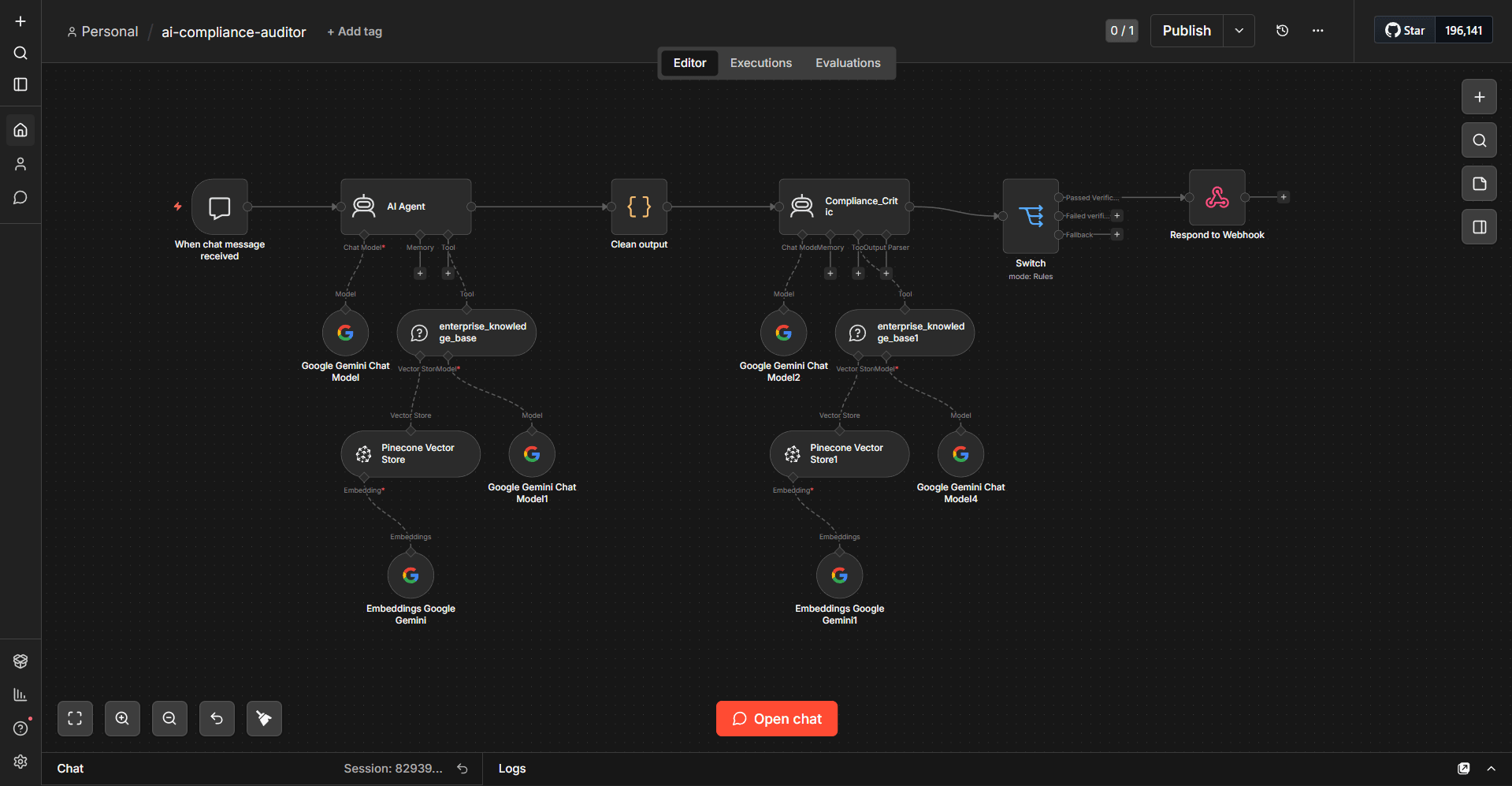
I built a self-correcting, multi-agent AI pipeline in n8n that completely solves this problem using a team-based auditing approach:
Agent 1 (The Worker): Grabs the user's question, searches the company rulebook inside a Pinecone Vector Store, and drafts the response.
Agent 2 (The Compliance Critic): Acts as a strict auditor. It checks the raw database files and verifies every single number, price, and limit in the draft.
The Switch & Router: If the Critic catches a mistake, the workflow instantly blocks the message and throws a policy warning. If it passes, it securely cleans up the text for the user.
🛠️ The Tech Stack
Automation: n8n
AI Models: Google Gemini
Database: Pinecone Vector Store
Logic: JavaScript for data parsing
📊 Key Achievements
Forced the AI to communicate using clean JSON code (PASSED/FAILED), making it incredibly reliable for backend logic.
Wrote custom JavaScript parsing to cleanly extract data streams mid-workflow.
Built a system that successfully flags out-of-bounds requests (like unauthorized expense claims or API rate breaches) automatically.
12 Jul 2026
Keywords


AI Usage
Instead of just using AI to answer questions, I integrated multiple AI agents directly into the system architecture of the application. I used Google Gemini models to act as two distinct nodes: a worker agent that queries a Pinecone vector database to draft responses, and a compliance auditor agent that reviews the draft against raw policy documentation. I also relied on AI to generate deterministic JSON structural formats, while handling the core logic routing, workflow triggers, and JavaScript data parsing manually.