

My Device Configuration


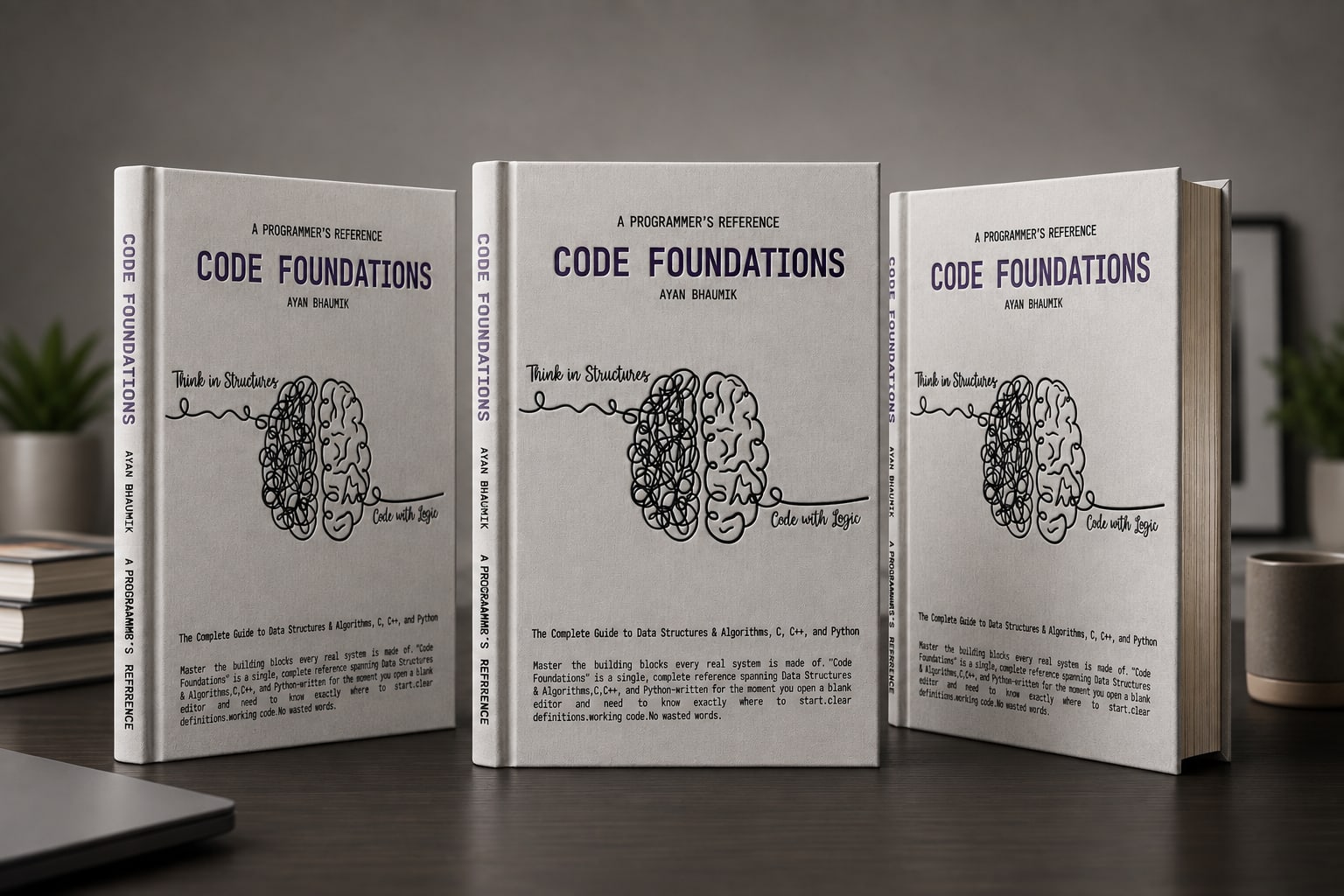
Code Foundations: The Complete Guide to Data Structures & Algorithms, C, C++, and Python


Code Foundations is a self-contained educational reference designed for students, self-learners, and anyone who has ever stared at a blank editor unsure of where to begin. Published in 2026, the book bridges the gap between theoretical computer science and practical software development by covering four foundational subject areas: Data Structures & Algorithms, C, C++, and Python.
Book Structure and Methodology
The book uniquely organizes its content into nine distinct parts, pairing deep-dive explanations with highly scannable cheat sheets for each language:
Core Subjects CoveredKey Features
Grounded in the author's hands-on experience building real-world platforms, Code Foundations is built on the philosophy that the fastest way to master a language or data structure is to see it plainly defined, simply explained, and executed in working code.
Real-World Context: Concepts are grounded in practical applications, comparing abstract ideas to real-world systems like browser histories, OS scheduling, and emergency room triage queues.
Interview Preparation: Includes a dedicated index of common technical interview questions categorized by topic (e.g., arrays, linked lists, dynamic programming) and Big-O complexity charts.
Study Guide & Learning Path (Part 9): The final section provides a recommended five-phase study order, time estimates, and mastery checklists to guide the reader's learning journey.
Python Programming (Parts 7 & 8): Introduces high-level dynamic programming, focusing on data collections, comprehensions, object-oriented principles, and introductory data science libraries like NumPy and Pandas.
C++ Programming (Parts 5 & 6): Transitions into object-oriented and generic programming, detailing classes, inheritance, polymorphism, templates, exception handling, and the Standard Template Library (STL).
C Programming (Parts 3 & 4): Builds a strong low-level computing foundation, teaching variables, control flow, pointers, manual memory management, and file handling.
Data Structures & Algorithms (Parts 1 & 2): Covers fundamental linear structures (arrays, linked lists, stacks, queues), complex non-linear structures (trees, heaps, graphs), and essential sorting, searching, and hashing algorithms.
Quick References: Following each comprehensive section, these chapters act as rapid lookup guides featuring syntax cheat sheets, complexity tables, and common-mistake fixes designed to be scanned in seconds while actively coding.
Comprehensive Notes: These sections explain concepts from first principles, providing clear definitions, real-world analogies, and worked code examples.
15 Aug 2026
Keywords