AI and IT Jobs in India: What Anthropic's Economic Model Means for BPO Workers

Riten Debnath
10 Sep, 2026
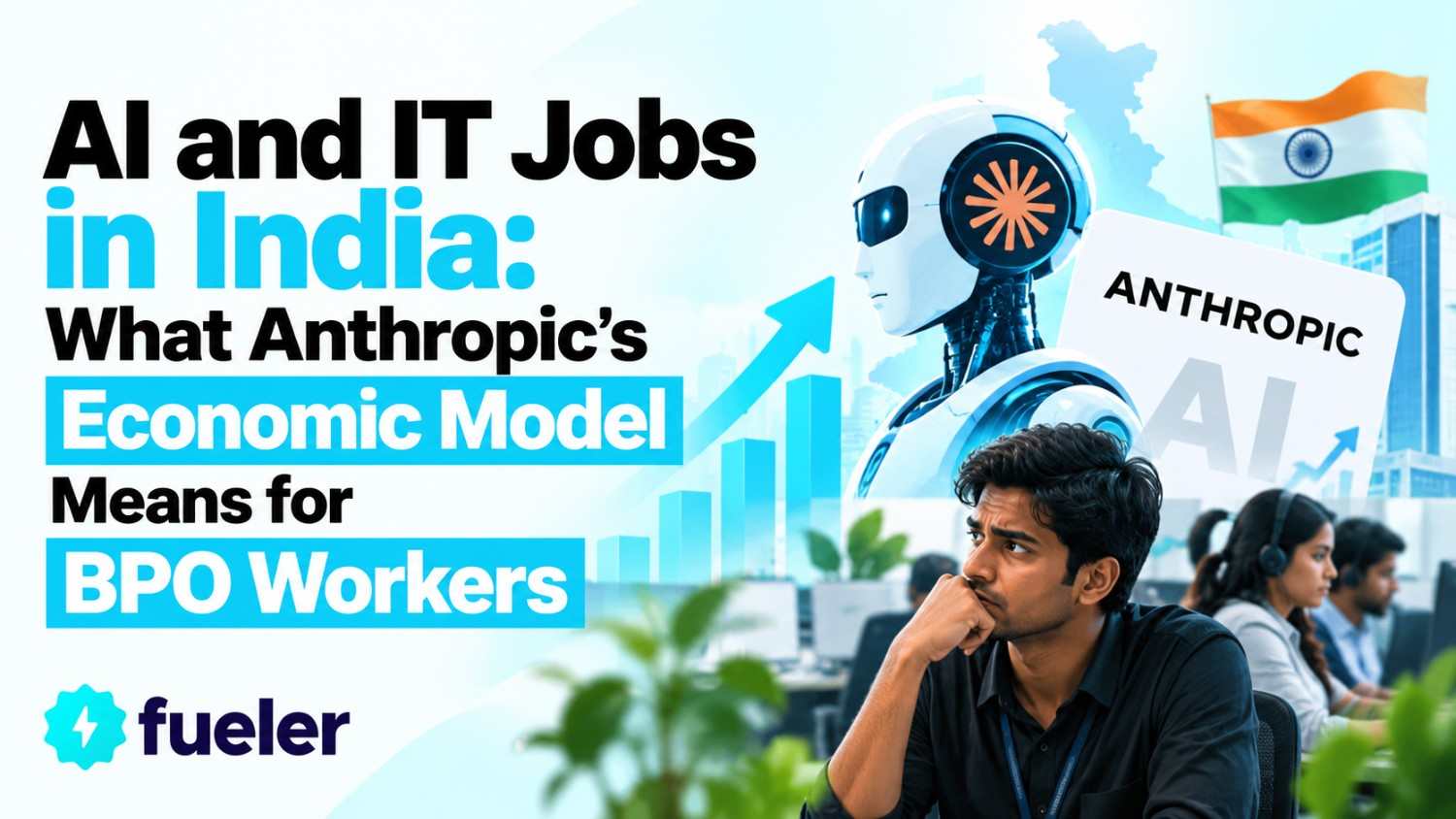
Anthropic's Economics team has published a model of how AI could reshape the economy by 2030, and in the section on job displacement it names two occupations directly. Coders and call service centre agents. The report suggests these workers may have to switch to jobs like electrician and nurse, which are less exposed to AI.
The model is about the United States. India is where a very large share of the world's coding and call centre work is actually performed.
I am Riten, founder of Fueler, a platform where people get hired through proof of work. I want to be honest about what follows. Anthropic's report, Economic Scenarios for Transformative AI (Korinek et al., 2026), contains no India specific data. Every number in it is American. What I am doing here is reading their findings and thinking through what they could mean for people I talk to every week in Indian IT and support roles. Where I am interpreting rather than reporting, I will say so.
What Anthropic's Model Actually Found
The model treats every job as a bundle of tasks drawn from the US Department of Labor's O*NET taxonomy. AI can leave a task alone, help a human do it faster, take it over completely, or create a new task that did not exist before.
From there the report builds three scenarios.
Modest. AI has roughly the impact the internet did. GDP ends up 1.6% higher, at $34.1 trillion.
Substantial. AI is capable of doing half of all knowledge work by 2030, the majority of it autonomously, though most knowledge work is still done without AI because adoption lags. The economy grows at twice its normal rate. GDP is 8.3% higher, at $36.3 trillion.
Extreme. AI is more productive than humans at the vast majority of knowledge work tasks and creates essentially no new knowledge tasks for people. GDP growth hits 15% a year. Unemployment rises beyond typical recessionary levels.
On wages, the model finds average pay rises in all three scenarios, but the gains concentrate outside knowledge work. Knowledge worker wages are essentially flat in the substantial scenario and fall by more than 10% by 2030 in the extreme one.
And on displacement, it finds that in most scenarios job reallocation and unemployment stay within ranges history has already seen. Only the extreme scenario breaks that pattern.
Five Things Indian IT and BPO Workers Should Take From This
This section is my reading, not Anthropic's findings. The model does not study India.
- The named roles are roles India specialises in. The report picks out coders and call service centre agents as examples of displaced workers. That is not a random pair. It describes a very large part of India's services export economy. If the model's task logic holds anywhere, it holds here.
- The suggested destination jobs may not translate. Anthropic suggests displaced workers move toward occupations like electrician and nurse. Whether that path makes sense in an Indian labour market with different wage structures and different demand is an open question the model does not answer. I would not assume it transfers.
- The adoption gap is probably wider here, and that is time. In the substantial scenario, AI can do half of knowledge work and most of it still happens without AI. Enterprise adoption depends on budgets, client contracts, compliance and trust. Indian services firms work inside client contracts that take years to renegotiate. My read is that this buys people more time than the headlines suggest.
- Flat pay is the more likely experience than job loss. In the middle scenario, knowledge worker wages do not rise while other workers gain. For a support or delivery professional, that looks like appraisals that keep coming in lower than expected, not a termination letter. It is quieter and easier to ignore, which is exactly what makes it dangerous.
- The value moves toward whoever can prove judgment. When output gets cheap to produce, the differentiator is the person who decides what should be produced and checks whether it is right. The report itself notes new tasks appearing, like reviewing an AI proposed plan or checking how well an AI performed. Those are real roles and they are being filled right now by people who can demonstrate they can do them.
Why It Matters
India's services sector employs millions of people whose work sits squarely in the categories this model describes. Even if you disagree with Anthropic's specific numbers, the structure of the argument is hard to dismiss, and it was reviewed by economists including Daron Acemoglu and David Autor, who have spent careers studying exactly this question.
But there is a reason for measured optimism rather than panic, and it comes from the report itself.
In the modest and substantial scenarios, unemployment stays inside historical ranges. The economy gets bigger in every scenario. And the report is explicit that automation upstream can create demand downstream. Its own example is that faster design and permitting work leads to more construction projects, which raises demand for construction workers.
Applied to India, and this is my interpretation, that suggests something worth considering. If software becomes dramatically cheaper to build, more organisations build software. More products launch. More things need designing, marketing, editing, supporting and fixing. Cheaper production has historically expanded markets rather than shrinking them.
I should also be clear about what the model excludes, because it matters for this reading. It leaves out policy responses, business cycles, aggregate demand effects, financial market disruptions and hyper capable robots. It does not follow individual workers. And several reviewers disagreed with the authors, some saying the extreme scenario reads better as a thought experiment, others saying the modest one understates what is already visible.
Nobody has a confident answer. Anyone telling you they do is selling something.
What This Means for Your Portfolio and How You Get Hired
Here is what I would actually do if I worked in Indian IT services or a BPO right now.
Write down your task list this week. Not your designation. Your tasks. Most people find between eight and fifteen. Mark which ones AI already touches. This takes twenty minutes and it is more useful than any prediction, because it is about your actual bundle rather than an average one.
Build proof outside your company output. Most people in services work cannot show client work publicly. That is a real problem, and the answer is to build parallel evidence. Small projects, personal builds, documented properly. When you build a proof of work portfolio step by step, you create something that belongs to you rather than to a client contract.
Show your AI workflow explicitly. This is the biggest opportunity I see and almost nobody is taking it. Companies are desperately trying to identify people who genuinely know how to work with these tools. If you can add your AI stack to a project and explain your process, you are demonstrating exactly the capability the adoption gap has created demand for.
Start early if you are a student. If you are studying now and heading into this market, the advantage of building proof from year one is enormous. The student guide to building a first portfolio walks through how to do it with no work experience at all.
Follow a structure rather than improvising. People stall because they do not know where to begin. The 6 step portfolio formula is the shortest route from an empty page to something a recruiter can evaluate.
Final Thoughts
I am not going to tell you Indian IT jobs are doomed, because the report does not say that, and I do not believe it.
What I will say is this. The model names your roles specifically. It expects wages in knowledge work to stay flat or fall. And it says that when people do need to move, moving is slow and hard, mostly because getting hired in a new area is difficult even when you have the ability.
That last part is the one you can do something about, starting today.
I built Fueler because I believe the biggest waste in the Indian job market is capable people who cannot prove what they can do. Millions of people carry real skill inside a resume that shows only a designation and a company name. When the ground shifts, that resume protects nobody.
Your work can. Go build a career portfolio that actually gets jobs, and make sure that whatever the next five years look like, the person reading about you can see exactly what you are capable of.
Frequently Asked Questions
Will AI replace IT jobs in India?
Anthropic's model does not study India and contains no India specific data. It does name coders and call service centre agents as occupations that may face displacement in its more transformative scenarios. Since India performs a large share of this work globally, the findings are worth taking seriously, but they should be read as a US model rather than an Indian forecast.
Are BPO and call centre jobs at risk from AI?
The report lists call service centre agents among the roles that may need to switch occupations in its substantial and extreme scenarios. However, it also finds that in most scenarios job reallocation and unemployment stay within historically normal ranges, and that adoption of AI trails its capability by a wide margin.
Which jobs are less exposed to AI according to Anthropic?
The report points to occupations like electrician and nurse as less exposed, because their task bundles include physical and in person work that AI cannot perform. The model deliberately excludes scenarios involving hyper capable robots.
Will AI lower salaries in Indian IT?
The report makes no claims about Indian salaries. For the US, it finds knowledge worker wages essentially flat in the substantial scenario and falling more than 10% by 2030 in the extreme scenario, while average wages across the economy rise in all three.
How can Indian tech workers stay employable as AI grows?
Build visible evidence of your work outside client deliverables, document your decision making rather than just your output, and show how you use AI inside your workflow. Anthropic's model shows adoption lagging capability, which means people who can demonstrate real AI workflows are ahead of the market rather than behind it.
Why 100,000+ professionals use Fueler
Fueler helps professionals showcase proof of work through projects, assignments, case studies, and achievements.
- Thousands of professionals use Fueler to create their digital portfolio
- Thousands of projects are published on Fueler. Check here
- Startups and Companies hire through proof of work on Fueler
- Used by freelancers, creators, marketers, video editors, writers, designers, and product managers
Our mission is to help the next 100 million professionals build a verified professional identity through proof of work

What should you do next?
You've read the article. Now turn your skills into proof of work and unlock more opportunities.
Build your proof of work portfolio
Create a clean portfolio with projects, assignments, resumes, and AI stack details that companies actually want to see.
Create your Fueler portfolio →Apply through assignments, not resumes
Stand out by solving real tasks from companies hiring on Fueler.
Explore assignments →Get discovered by companies
Make your work public and let recruiters discover your skills through actual projects instead of keywords.
Get discovered →