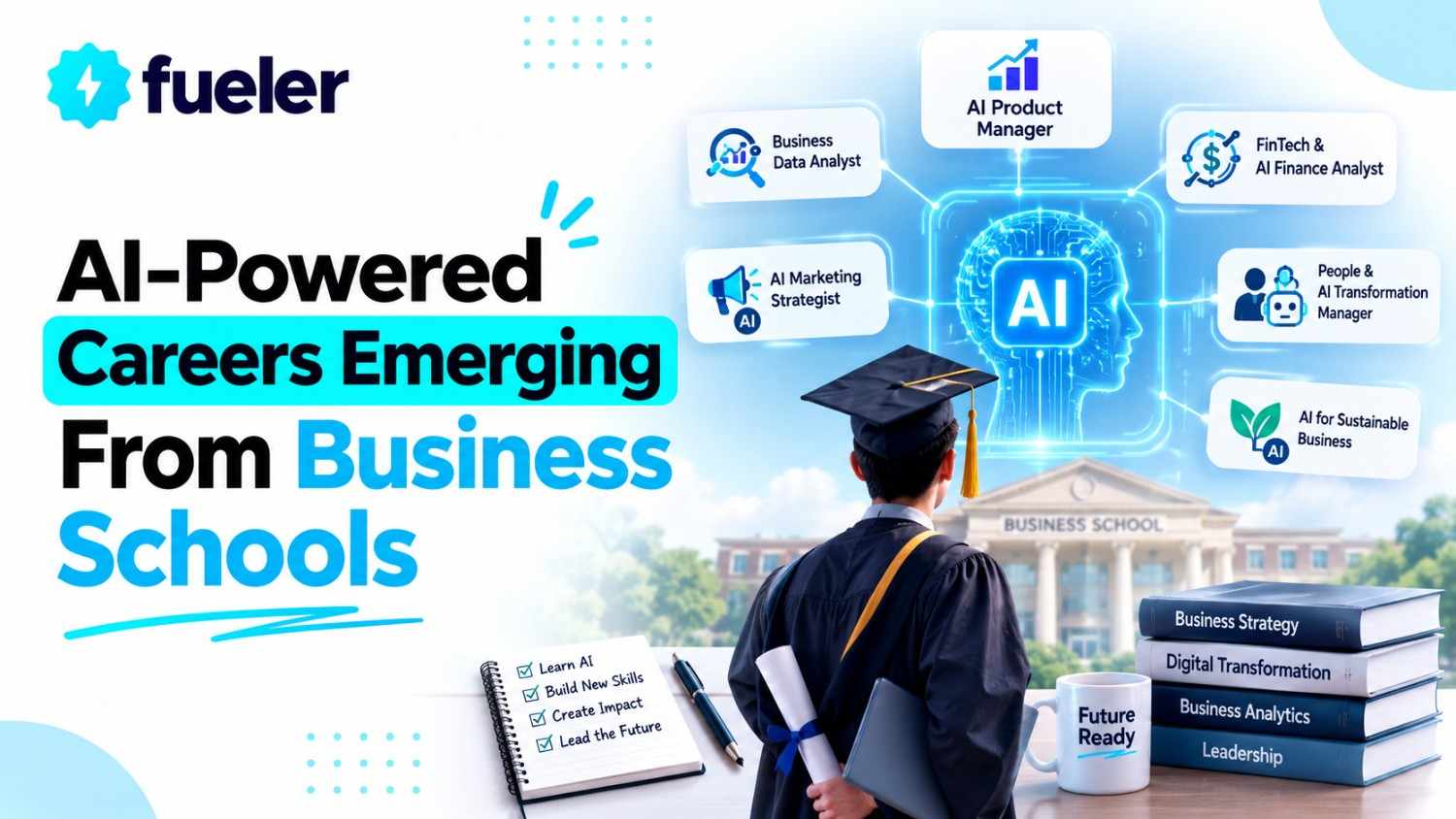
AI-Powered Careers Emerging From Business Schools

Riten Debnath
19 Jul, 2026
Last updated: July 2026
The classic business school path used to follow a highly predictable trajectory: two years analyzing historical case studies, followed by a campus placement into general management, traditional investment banking, or corporate consulting. But as corporate operations shift completely toward automated workflows and algorithmic decision-making, that playbook has officially broken down.
I’m Riten, founder of Fueler, a skills-first portfolio platform building the career infrastructure for 100 million creative professionals. Fueler connects talented individuals with companies through assignments, portfolios, and projects, not just resumes or CVs. Think of it as Dribbble/Behance for work samples combined with AngelList for hiring infrastructure.
Corporate teams are no longer looking for generalists who can merely build static spreadsheets or talk about high-level corporate strategies. They are aggressively hiring business leaders who understand how to deploy automated models, orchestrate autonomous software workflows, and govern technical risk.
Here are the eight essential AI-powered corporate careers emerging directly from top-tier business schools this year, and the exact skills required to claim them.
1. AI Product Manager
The gap between technical engineering squads and core commercial strategy is one of the most expensive bottlenecks in modern business. Companies regularly waste millions building complex internal machine learning models that completely fail to align with actual user needs or market demands.
An AI Product Manager acts as the translation layer between technical data departments and the business executives funding the projects. Instead of writing raw source code, you are responsible for defining the product vision, mapping user journeys, and setting performance metrics. You ensure that every technical system built by the engineering squad drives direct financial margins or improves customer retention.
- Cross-functional roadmapping aligns the technical development sprints of software teams with the overarching commercial deadlines of marketing and sales departments.
- Data-driven user tracking monitors ongoing client interactions within software tools to quickly isolate friction points or feature drop-off locations.
- API infrastructure evaluation assesses the cost and reliability of third-party cloud data services before integrating them into consumer-facing applications.
- Core value proposition scoping ensures that new product features directly solve customer pain points rather than serving as temporary technology gimmicks.
- Return on investment monitoring calculates the exact operational savings or revenue lifts created by deployed models to justify ongoing corporate funding.
Why It Matters
Modern corporate teams require leaders who can ship functional software assets without getting bogged down in purely technical silos. Landing this role proves you can direct complex engineering projects to hit strict commercial goals, making it one of the highest-value tracks for business graduates. It repositions you from a traditional manager into a core technical orchestrator.
2. Business Intelligence and AI Analyst
Relying entirely on manual end-of-month data entry to review corporate performance leaves companies completely exposed to sudden market shifts. Modern management requires immediate tracking systems that identify macro revenue trends and supply chain variations as they happen.
The AI Analyst works directly within corporate operations to convert raw, unstructured data lakes into clean, conversational executive dashboards. By deploying localized language processing systems, these professionals query massive company databases using everyday language instead of writing tedious SQL queries. This allows teams to instantly extract localized regional sales metrics and pinpoint supply chain anomalies.
- Conversational data querying replaces complex structural programming language scripts, allowing non-technical managers to extract instant performance information.
- Predictive operational forecasting utilizes past sales records to model future inventory requirements, mitigating the risk of warehouse stockouts.
- Automated anomaly alerts flag sudden dips in operational margins or unusual spending spikes across international departmental balance sheets.
- Customer cohort mapping groups active accounts by transaction behavior to identify shifting churn risks across distinct pricing tiers.
- Executive summary drafting translates heavy data tables into concise text highlights that can be dropped straight into weekly corporate briefings.
Why It Matters
Organizational execution hinges entirely on how rapidly a corporate unit can diagnose internal inefficiencies and respond to market realities. Mastering predictive analytics workflows guarantees that your strategic recommendations are backed by hard, real-time data trends rather than loose intuition. It makes you an indispensable asset to corporate leadership teams looking for immediate operational clarity.
3. AgentOps Optimization Engineer
Enterprise technology has rapidly moved past basic chat interfaces and simple command automations. Modern operations rely heavily on autonomous software networks that can independently process invoices, update inventory ledgers, and handle initial client support loops without human oversight.
An AgentOps Engineer specializes in managing, monitoring, and auditing these networks of autonomous corporate agents. Because these software agents act independently across company databases, they require continuous tuning to ensure they do not stall, loop endlessly, or corrupt internal records. This career tracks your ability to maximize system reliability across the entire organization.
- System latency auditing tracks the exact response speeds and processing costs of automated networks to eliminate systemic operational lag.
- Workflow error isolation instantly detects when an automated data pipeline misinterprets an inbound corporate document or drops a customer file.
- Behavior constraint enforcement sets strict operational boundaries to prevent autonomous software from making unauthorized financial changes.
- Multi-agent communication sync structures the digital handoffs between different automated loops, such as moving a lead from marketing to sales.
- Resource consumption profiling calculates the processing costs of active digital workflows to keep operational overhead highly predictable.
Why It Matters
When software systems begin executing real corporate tasks independently, system failures carry direct financial consequences. Understanding the frameworks used to monitor and secure these automated operations places you at the very front of corporate scalability. It proves you can build and maintain the digital infrastructure required to run a lean, modern enterprise.
4. Corporate AI Enablement Lead
Introducing advanced software tools into a legacy enterprise frequently triggers intense cultural pushback and operational confusion. Simply buying software licenses for a workforce does nothing if the employees do not know how to reform their daily workflows around the new systems.
The AI Enablement Lead focuses entirely on scaling systems literacy and managing cultural transition across non-technical departments. They audit existing legacy workflows in departments like Human Resources, Legal, and Finance, and then design structured training frameworks to upskill the staff. This role ensures the entire company builds collective muscle memory around modern tools.
- Legacy workflow auditing uncovers time-wasting administrative processes within traditional departments that can be optimized via modern platforms.
- System literacy training designs clear, jargon-free educational playbooks to help non-technical employees confidently use cloud analytics systems.
- Internal prompt library building creates verified, company-specific operational templates to ensure consistent output quality across teams.
- Change management scaling handles employee concerns regarding automation, repositioning digital systems as helpful work accelerators rather than threats.
- Cross-functional tool sync ensures that independent departments utilize standardized software networks to prevent internal data fragmentation.
Why It Matters
The true value of modern enterprise technology is only realized when it is adopted by the entire workforce, not just the engineering team. Serving as an enablement leader proves you possess the rare combination of high technical empathy and strong corporate training skills. It marks you as a highly strategic change agent capable of transforming legacy company cultures.
5. Algorithmic Supply Chain Strategist
Global shipping networks, warehouse inventory allocations, and demand projections are far too volatile to manage on static desktop spreadsheets. Modern logistics networks require continuous, algorithmic balancing to protect operating margins against material shortages and transport delays.
An Algorithmic Supply Chain Strategist integrates advanced mathematical optimization systems into standard shipping and warehousing logistics. By evaluating real-time weather datasets, customs timelines, and regional consumer trends, these strategists build self-adjusting distribution models. This prevents companies from locking up capital in dead warehouse inventory while keeping fulfillment times remarkably short.
- Dynamic inventory optimization rebalances warehouse stock levels automatically based on real-time local demand swings and manufacturing timelines.
- Logistics route re-routing utilizes predictive transport analytics to bypass congested shipping ports and highly volatile transit corridors.
- Supplier risk benchmarking tracks performance consistency metrics across global material vendors to flag hidden downstream failure points.
- Material price forecasting analyzes global commodity market trends to advise procurement teams on the optimal moments to lock in purchase contracts.
- Fulfillment center load balancing distributes order processing stress evenly across regional warehouses to keep delivery speeds perfectly uniform.
Why It Matters
Supply chain efficiency directly dictates whether a physical product brand can survive intense margin competition. Knowing how to orchestrate automated logistics software changes your profile from a basic shipping coordinator into a highly advanced supply systems architect. It prepares you for critical leadership paths within global e-commerce, manufacturing, and international retail operations.
6. AI Risk and Governance Specialist
As corporate teams deploy automated systems to handle sensitive customer data, evaluate credit scores, or screen job candidates, the risk of legal liability skyrockets. A single biased model or unmapped data leak can expose a corporation to massive regulatory fines and devastating reputational damage.
The AI Governance Specialist sits at the intersection of corporate compliance, digital ethics, and data privacy law. Your primary responsibility is to construct strict operational guardrails that protect the company against algorithmic errors and regulatory non-compliance. You thoroughly audit data inputs to ensure the systems respect international privacy laws and avoid reproducing historical biases.
- Model bias auditing stress-tests internal automated evaluation systems to ensure they remain completely fair across diverse user demographics.
- Data privacy validation checks that all data collection pipelines perfectly comply with strict regional regulatory frameworks.
- Algorithmic transparency mapping documents exactly how complex models reach specific commercial conclusions to satisfy regulatory oversight.
- System vulnerability patching coordinates with internal cybersecurity teams to protect active data pipelines from outside manipulation.
- Ethical compliance boundary setup designs the company's official rulebook governing the responsible use of generative customer technologies.
Why It Matters
Sustainable enterprise scaling requires absolute legal safety, meaning risk professionals are being brought into project planning at the very earliest stages. Developing expertise in digital governance guarantees you can protect corporate assets in an increasingly complex global legal landscape. It provides a highly stable, high-authority career path within heavily regulated spaces like healthcare, banking, and insurance.
7. FinTech Algorithmic Product Specialist
The financial services sector has completely transitioned away from slow, manual portfolio tracking toward hyper-fast, programmatic asset management. Modern investment firms and banking applications rely on automated risk models to execute complex trades and issue immediate lending decisions.
A FinTech Algorithmic Product Specialist designs and manages the user-facing financial tools that run on these automated engines. You don’t need to write the underlying algorithmic trading scripts, but you must deeply understand how those models react to macroeconomic data shifts. This allows you to build reliable, intuitive consumer banking platforms, micro-lending tools, and automated wealth advisors.
- Lending risk parameter configuration sets the specific automated boundary lines that determine credit approval rates for digital applicants.
- Automated wealth advisory scaling designs user interfaces that dynamically adjust investment portfolios based on individual risk scores.
- Real-time transaction fraud tracking monitors programmatic payment streams to instantly isolate and freeze suspicious banking profiles.
- Macroeconomic trend integration connects external market indicators directly into internal risk assessment software engines.
- Financial regulatory compliance tracking ensures that automated trading and lending features match changing international banking rules.
Why It Matters
FinTech scaling demands business professionals who can take highly abstract quantitative data models and package them into intuitive retail financial products. This specialty places you directly inside the most profitable segment of the modern financial ecosystem. It bridges the gap between deep quantitative finance and modern digital product design.
8. AI Growth Marketing Strategist
Traditional marketing campaigns built on static audience categories and rigid seasonal calendars are incredibly inefficient. Modern digital customer acquisition requires continuous, automated personalization that reacts instantly to live user engagement data.
An AI Growth Marketing Strategist orchestrates automated programmatic ad bidding, dynamic landing page generation, and behavioral messaging setups. Instead of manually reviewing campaign performance at the end of the week, you configure self-optimizing marketing funnels. These funnels automatically adjust ad creative variations and budget allocations to secure the lowest possible customer acquisition cost.
- Dynamic ad variation testing coordinates automated systems that test thousands of copy and layout mutations simultaneously to maximize click rates.
- Behavioral conversion mapping configures automated messaging triggers that respond instantly when a user exhibits high purchase intent.
- Programmatic bidding optimization sets strict margin boundaries for automated auction platforms to prevent waste on low-value traffic channels.
- Predictive customer lifetime modeling evaluates early user interactions to instantly identify the highest-value long-term account prospects.
- Hyper-personalized content routing delivers highly targeted product recommendations to distinct website visitors based on past browsing paths.
Why It Matters
Corporate growth is directly tied to the speed and efficiency of customer acquisition pipelines. Demonstrating that you can design self-improving marketing loops makes you an incredibly valuable asset to venture-backed startups and major consumer brands alike. It shifts your professional status from a creative advertiser into a highly quantitative growth engine.
How This Connects to Building a Strong Career or Portfolio
Modern hiring has completely outgrown the traditional paper resume. Top-tier corporate employers no longer care about general course listings or vague descriptions of past internships; they demand to see clear, verifiable evidence of what you have actually built, tested, and shipped. When you build automated operations, configure dashboard systems, or document risk audit procedures, you are creating highly valuable digital assets.
By organizing these structural case studies on Fueler, you show corporate recruiters your exact workflow, systems thinking, and technical implementation. Displaying your actual operational output builds undeniable professional credibility and secures elite corporate roles based on genuine proof of work.
Final Thoughts
The business landscape is aggressively filtering out generalists who can only discuss strategy conceptually, replacing them with operators who can execute systems practically. Graduating from business school with a solid grasp of modern operational tools, data pipelines, and automation structures gives you an immediate competitive advantage. Do not wait for standard academic structures to catch up to industry realities. Focus on building a deep, proof-of-work portfolio that proves you can architect efficient, self-sustaining corporate systems from day one.
Frequently Asked Questions
What are the fastest-growing AI careers for business graduates?
The fastest-growing career roles include AI Product Managers, AgentOps Optimization Engineers, and AI Risk Governance Specialists. These positions are expanding rapidly as global companies transition from basic software experimentation to full-scale enterprise automation.
Do AI business careers require a deep computer science degree?
No, these roles prioritize high applied systems literacy, data interpretation, and cross-functional workflow design over raw software coding. The primary skill is knowing how to strategically orchestrate technical assets to drive measurable commercial results.
How do modern corporations use AgentOps frameworks?
Companies use specialized AgentOps practices to monitor, secure, and continuously audit autonomous software agents operating inside their workflows. This ensures that automated loops run efficiently without throwing data errors or breaking core database architectures.
Why is a traditional paper resume failing in modern corporate hiring?
A traditional resume only states past titles and high-level responsibilities, which provides zero proof of actual software execution. Modern hiring managers look for verifiable digital projects that clearly display your strategic thinking, analytical skills, and tool implementation.
How can business students learn automated operational workflows?
Students can build high-value operational skills by using visual automation platforms like Zapier to connect separate application databases. Constructing self-running lead routers or automated data trackers creates direct, real-world examples of enterprise systems engineering.
Why 100,000+ professionals use Fueler
Fueler helps professionals showcase proof of work through projects, assignments, case studies, and achievements.
- Thousands of professionals use Fueler to create their digital portfolio
- Thousands of projects are published on Fueler. Check here
- Startups and Companies hire through proof of work on Fueler
- Used by freelancers, creators, marketers, video editors, writers, designers, and product managers
Our mission is to help the next 100 million professionals build a verified professional identity through proof of work

What should you do next?
You've read the article. Now turn your skills into proof of work and unlock more opportunities.
Build your proof of work portfolio
Create a clean portfolio with projects, assignments, resumes, and AI stack details that companies actually want to see.
Create your Fueler portfolio →Apply through assignments, not resumes
Stand out by solving real tasks from companies hiring on Fueler.
Explore assignments →Get discovered by companies
Make your work public and let recruiters discover your skills through actual projects instead of keywords.
Get discovered →