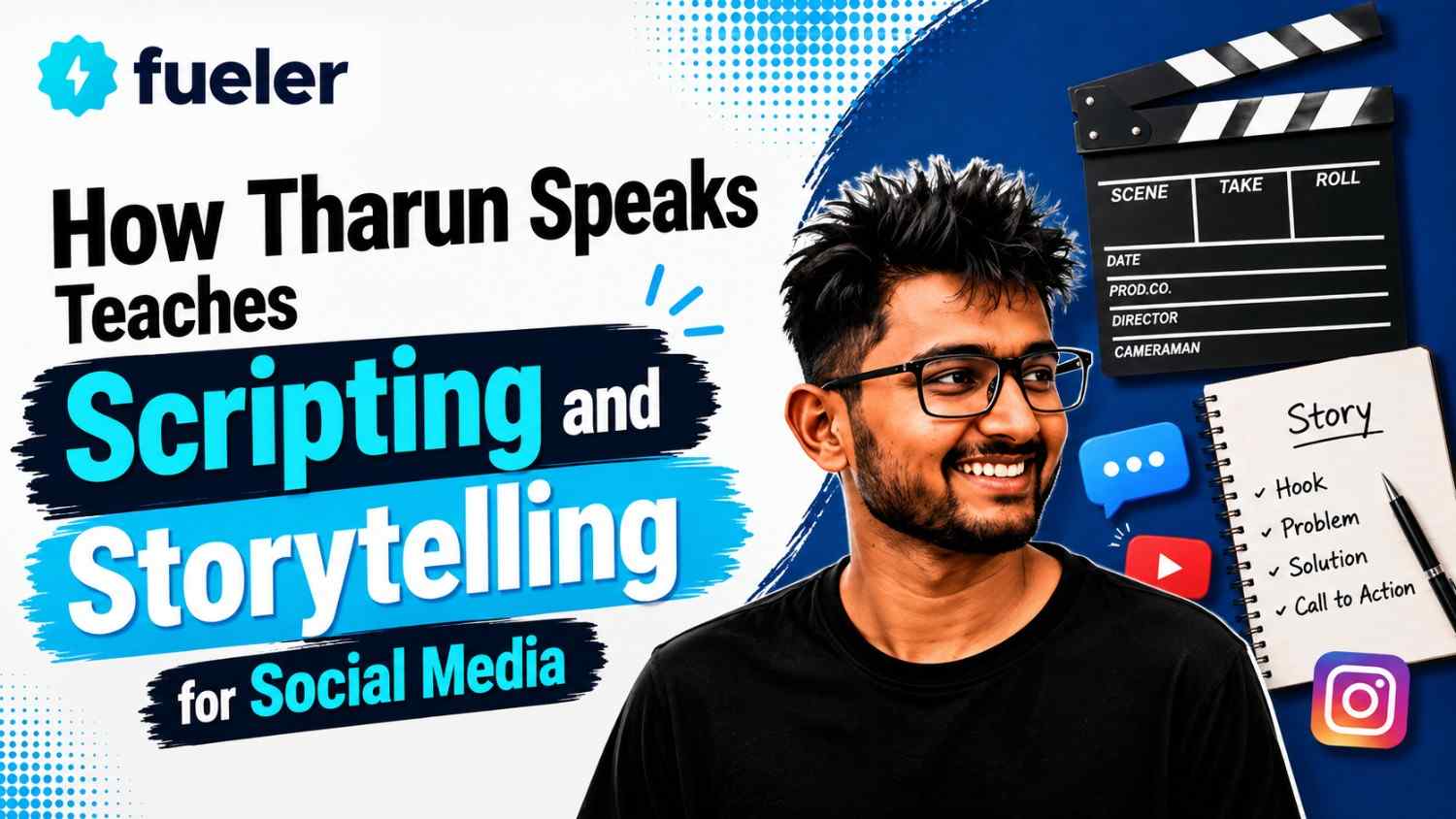
How Tharun Speaks Teaches Scripting and Storytelling for Social Media

Riten Debnath
11 Aug, 2026
Last updated: August 2026
Imagine spending three days meticulously editing a video, carefully color-grading every clip, syncing cuts perfectly to the beat of an expensive lo-fi track, and adding slick 3D text animations only to watch your view counter stubbornly freeze at 42 views. And let’s be honest, 40 of those hits were probably you aggressively refreshing the page on different family members' phones.
I’m Riten, founder of Fueler, a skills-first portfolio platform building the career infrastructure for 100 million creative professionals. Fueler connects talented individuals with companies through assignments, portfolios, and projects, not just resumes or CVs. Think of it as Dribbble/Behance for work samples combined with AngelList for hiring infrastructure.
Most social media tutorials make storytelling sound like an abstract, poetic ritual reserved for film school professors or Hollywood directors. In reality, modern video distribution is closer to engineering than creative writing. When young creators ask me why their videos get swiped away, I point them toward structured retention systems like those taught in the Tharun Speaks Cohort. Creator Tharun Naik treats video scripting not as a creative dump, but as a deliberate science of holding human attention across Instagram Reels, YouTube Shorts, and long-form video essays.
Quick Answer Summary
- Definition: A practical framework taught by creator Tharun Naik that combines narrative pacing, visual hooks, psychological retention loops, and sound design to help creators produce engaging videos.
- Who It Is For: Aspiring YouTubers, video editors, social media managers, growth marketers, and digital storytellers wanting higher audience retention and better client portfolios.
- Cost: Available via cohort tiers starting at ₹4,999 (Essential), ₹6,999 (Elite), and ₹14,999 (Ultimate).
- Key Takeaway: Shifts scripting away from rigid text essays toward visual-first storyboards, retention psychology, open loops, and narrative pacing.
- Best Suited For: Creators who know basic camera work or editing software but struggle to keep viewers watching past the first few seconds of their videos.
What is Scripting and Storytelling in the Tharun Speaks Cohort?
Scripting and storytelling in the Tharun Speaks Cohort is a structured method of designing video content so that it captures immediate viewer focus, maintains continuous curiosity, and delivers an emotional or educational payoff. Instead of writing scripts like academic term papers or blog posts, the cohort treats every script as a visual blueprint that coordinates spoken words, visual cutaways, graphics, and layered sound cues.
At its core, this approach dismantles the myth that viral videos are happy accidents. When you look at how content moves through social media algorithms, platforms don't evaluate how much sweat you poured into your timeline. They measure audience retention graphs and watch time. If thirty percent of your viewers swipe away in the first three seconds, your video is dead on arrival.
This matters because knowing how to write for visual retention is the ultimate leverage in the modern creator economy. Whether you are a solo YouTuber trying to gain your first 10,000 subscribers, an editor trying to charge $500 per edit, or a startup founder running a growth experiment, knowing how to structure a script determines your organic reach.
Unlike traditional marketing courses that teach outdated branding formulas, this framework breaks down human attention into predictable patterns. At Fueler, we notice that editors and writers who understand retention mechanics build far stronger proof-of-work portfolios. They don't just showcase flashy transitions; they demonstrate how their scripts actually held audience focus.
Key Facts Table
Detailed Explanation
1. Hook Psychology and Earning the First Ten Seconds
The opening statement, visual, or sound sequence that occurs in the first three to ten seconds of a video determines its overall performance. Tharun teaches that a hook must answer one implicit question in the viewer's mind: "Why should I care about this right now?"
YouTube and short-form algorithms track the steepest drop-off in video watch time right at the start. If you lose thirty to forty percent of your audience in the first ten seconds, the platform stops pushing your content to broader feeds. Instead of starting with channel intros, animated logos, or casual greetings like "Hey guys, welcome back to my channel," the cohort teaches creators to jump straight into the core tension or promise.
For example, an amateur scripting a productivity video opens with: "Hi everyone, today we are going to talk about five time management tips." A retention-focused script taught in the cohort opens with: "I spent 30 days following Elon Musk's extreme daily schedule, and by day four, my body completely crashed. Here is what actually happened."
This simple shift creates immediate intrigue. It pairs a bold verbal statement with a dramatic visual cue, forcing the viewer's brain to stop scrolling.
2. The Open Loop Technique for Managing Curiosity
An open loop is a storytelling device where a script introduces a question, a mystery, or a high-stakes challenge early in the video but deliberately delays the resolution until later in the timeline.
Human brains naturally seek closure. When a narrative loop opens, viewers experience a subtle psychological itch that keeps them watching until the loop resolves. Tharun shows creators how to layer multiple open loops throughout a video script. As soon as one question gets answered, a new micro-question gets introduced.
In a tech review script, instead of just reading off spec sheets, a creator opens a loop: "This $500 camera claims to beat a $3,000 cinema camera, but when we took it out into low-light night scenes, we ran into a massive problem that almost ruined our shoot."
The creator then explains basic features while keeping the audience hanging to see the night footage result. This prevents the video from feeling like a boring list of specs and turns it into an unfolding story.
3. Audio-Visual Dual Scripting Framework
Most beginner creators write scripts like school essays just blocks of text meant to be read aloud. The cohort breaks this habit by teaching a two-column scripting method: the Audio Column and the Visual Column.
Every spoken line in the audio column is paired with a specific visual direction in the visual column. If the spoken script says, "Inflation is eroding your savings," the visual column mandates a kinetic graphic showing a bank account balance dropping, accompanied by a subtle cash register sound effect.
This prevents "talking head fatigue," where a viewer stares at a static speaker for minutes on end. By mapping out B-roll cutaways, sound effects, text overlays, and screen zooms during the script phase, you ensure that the video remains visually dynamic long before you open your editing software.
4. The A-B Story Structure
Educational content alone easily gets commoditized. If your script only shares facts, viewers can get those same facts anywhere else. People subscribe to specific creators because they build a personal connection with the individual behind the information.
The cohort teaches the A-B story structure, which balances the primary educational topic (Story A) with a secondary personal narrative, struggle, or behind-the-scenes perspective (Story B).
For example, while explaining how to learn coding in 2026 (Story A), the creator weaves in their own real-time frustration with a failed job interview or a project deadline crash (Story B). This grounds abstract information in human emotion, making the script relatable rather than robotic.
5. Pacing and Information Density Control
Pacing is the rhythm at which a script delivers new information, visual changes, and emotional beats. Delivering information too slowly causes boredom; delivering it too quickly without pause causes cognitive fatigue.
Tharun teaches creators how to modulate information density. High-energy setup moments use short, punchy sentences and rapid visual changes, while complex concepts use slightly slower explanations paired with clear diagrams.
Creators learn to edit down their written scripts ruthlessly. Unnecessary filler words, repetitive explanations, and slow transitions are cut out. Every sentence in the final script must serve one of two purposes: advance the core story or build curiosity.
6. Payoff and The Action-Driven Outro
A great script with a weak ending leaves viewers feeling cheated, while a boring ending causes your audience to drop off before taking any action. The cohort teaches how to land a strong narrative payoff that delivers on the promise made in the hook.
Once the core promise is fulfilled, the script immediately transitions into a sleek call-to-action (CTA). Instead of using slow, clunky endings like "Thanks for watching, don't forget to like, share, and subscribe," the script uses a seamless bridge.
For instance, the video links its concluding thought directly to the next logical step: "Now that you know how to script your video, click here to see how we edit those exact scripts in Adobe Premiere." This keeps viewers binge-watching inside your content ecosystem.
How It Works
- Deconstructing Viral Scripts: Students analyze top-performing YouTube videos and Reels, mapping out their retention graphs to identify hooks, open loops, and visual transitions.
- Topic Selection and Core Tension: You identify a clear target audience problem and draft a primary thesis that sets up high stakes or curiosity.
- Drafting the Dual-Column Script: You write the spoken dialogue in the Audio Column while simultaneously mapping visual cues, lower-thirds, and sound effects in the Visual Column.
- Hook Refinement: You write 5 to 10 different variations of the opening 10 seconds, testing different verbal angles, visual setups, and curiosity triggers.
- Peer and Mentor Script Reviews: You submit your draft script to cohort mentors for direct feedback on pacing, narrative flow, and cuttable filler text.
- Production and Timeline Assembly: You shoot and edit the video following the exact audio-visual cues established in your approved storyboard.
- Publishing and Portfolio Documentation: You publish the finished video asset and archive the completed script, retention metrics, and storyboard into your public proof-of-work portfolio.
Benefits
- Higher Audience Retention: Mastering hook psychology and open loops helps keep viewers watching your videos longer, signaling algorithms to expand your organic reach.
- Faster Scripting Workflows: Using structured two-column storyboards eliminates writer's block and cuts production preparation time in half.
- Stronger Client Value Proposition: Freelancers can pitch clients a complete video strategy, including retention scripting rather than just executing raw cuts.
- Versatile Across Platforms: The core narrative principles apply equally to 60-second vertical Reels, 15-minute YouTube essays, and corporate brand stories.
- Elimination of Filler Content: You learn how to cut fluff out of your content, leading to punchier, more professional videos.
- Improved On-Camera Confidence: Speaking from a well-structured visual script prevents rambling and helps you deliver clear, authoritative talking points.
Challenges / Limitations
- Requires Script Writing Discipline: Writing visual storyboards and multiple hook variations takes effort. Creators looking for effortless "record-and-upload" tricks will find the process demanding.
- Initial Pacing Adjustments: Beginners often struggle to balance fast pacing with clarity, occasionally making early scripts sound overly rushed.
- Platform-Specific Nuances: While narrative fundamentals stay the same, short-form Reels demand much tighter visual cuts than long-form YouTube documentaries.
- Tier-Gated Mentor Feedback: Individualized, line-by-line script reviews from senior mentors are restricted to higher cohort tiers like Elite and Ultimate.
Comparison Table
Fees / Cost
Accessing the scripting and storytelling modules depends on the selected tier within the Tharun Speaks Cohort system.
- Essential Tier (₹4,999): Provides access to all recorded studio modules on scripting, visual storyboarding, and retention psychology, along with attendance at weekly live sessions.
- Elite Tier (₹6,999): Includes all studio modules plus direct mentor feedback on script assignments, access to storyboarding challenges, and community masterclasses.
- Ultimate Tier (₹14,999): Adds a Personal Learning Manager, private group access, advanced asset packs, and direct job placement support for scripting and video roles paying up to ₹30,000 per month.
When evaluating return on investment, landing a single client retainer to write and edit retention-focused scripts easily covers the enrollment cost in your first month of active freelancing.
Career Opportunities
Understanding narrative scripting and video storytelling unlocks several specialized roles across the digital economy.
- YouTube Scriptwriter / Content Researcher: Crafting long-form video essays, documentaries, and educational scripts for top YouTubers and media brands. Pay ranges from ₹35,000 to ₹75,000 per month.
- Short-Form Content Strategist: Writing high-retention script hooks and visual storyboards for Instagram Reels, Shorts, and brand campaigns. Roles pay between ₹40,000 and ₹80,000 per month.
- Creative Director / Growth Lead: Overseeing the end-to-end scripting, shooting, and editing pipeline for startups and agencies. Salaries range from ₹6 LPA to ₹12 LPA+.
- Freelance Video Storyteller: Offering bundled scripting, editing, and distribution strategy packages to global clients, earning ₹60,000 to ₹2,000,000+ annually based on retainer volume.
Demand for creators and strategists who can write for visual media continues to grow as brands shift marketing budgets away from traditional ads toward organic video distribution.
Who Should Choose This?
- Video editors who want to step up to strategic roles that command higher rates by writing retention scripts.
- YouTubers and content creators struggling with low average view duration or steep audience drop-offs.
- Startup growth operators and marketers building organic social media channels.
- Copywriters looking to adapt their text writing skills into visual video storyboarding.
- Students and freshers building a public content creation portfolio to land remote creative roles.
Who Should Avoid This?
- Creators who prefer unscripted, completely spontaneous vlogs without structured narrative planning.
- Individuals who are unwilling to spend time writing, editing, and revising script drafts before filming.
- People looking purely for software-button tutorials without learning narrative strategy.
- Experienced copywriters who already have a proven system for writing high-retention video content.
Final Thoughts
The biggest mistake I see young creators make is assuming that great video editing can save a terrible script. You can throw in all the 3D graphics, sound effects, and color grades you want, but if your core story is boring, viewers will swipe away.
Tharun Speaks teaches scripting as a practical, repeatable engineering process. It forces you to respect human attention, design curiosity hooks, and build clear visual blueprints before hitting record.
At Fueler, we see every day how strong proof of work opens doors. When you can present a portfolio containing well-written scripts alongside completed videos and retention metrics, you immediately set yourself apart from thousands of generic applicants. If you are serious about building a career in the creative economy, learning how to write for visual retention is one of the best investments you can make.
Key Takeaways
- Video scripting in the cohort is treated as a visual blueprint rather than a basic text essay.
- The first ten seconds of a script must combine a verbal hook, visual cue, and audio trigger to prevent drop-off.
- Open loops keep audience interest stable by introducing continuous curiosity gaps.
- The dual-column scripting format maps spoken words directly to specific B-roll, lower-thirds, and sound cues.
- Scripting modules are available across Essential (₹4,999), Elite (₹6,999), and Ultimate (₹14,999) cohort tiers.
- Documenting your finished scripts and video assets in a public portfolio helps land client retainers and full-time creative roles.
FAQs
How does Tharun Speaks teach video scripting for beginners?
Tharun teaches scripting using a dual-column blueprint method. Beginners learn to pair spoken dialogue with visual cues, sound effects, open loops, and narrative hooks to maximize viewer retention.
What is an open loop in video storytelling?
An open loop is a storytelling technique that introduces a mystery or question early in a video but delays the answer until later, keeping viewers engaged.
Do I need to be a good writer to learn scripting?
No prior creative writing experience is needed. The cohort teaches structured frameworks, visual storyboarding templates, and clear formulas that any beginner can follow.
How does scripting improve video editing speed?
A clear visual script maps out all B-roll, sound effects, and text cuts beforehand. Editors waste far less time searching for footage or guessing what comes next.
Can I get a job as a video scriptwriter after this?
Yes, mastering retention scripting prepares you for roles like YouTube scriptwriter, short-form content strategist, or creative director at media agencies and startups.
Why 100,000+ professionals use Fueler
Fueler helps professionals showcase proof of work through projects, assignments, case studies, and achievements.
- Thousands of professionals use Fueler to create their digital portfolio
- Thousands of projects are published on Fueler. Check here
- Startups and Companies hire through proof of work on Fueler
- Used by freelancers, creators, marketers, video editors, writers, designers, and product managers
Our mission is to help the next 100 million professionals build a verified professional identity through proof of work

What should you do next?
You've read the article. Now turn your skills into proof of work and unlock more opportunities.
Build your proof of work portfolio
Create a clean portfolio with projects, assignments, resumes, and AI stack details that companies actually want to see.
Create your Fueler portfolio →Apply through assignments, not resumes
Stand out by solving real tasks from companies hiring on Fueler.
Explore assignments →Get discovered by companies
Make your work public and let recruiters discover your skills through actual projects instead of keywords.
Get discovered →