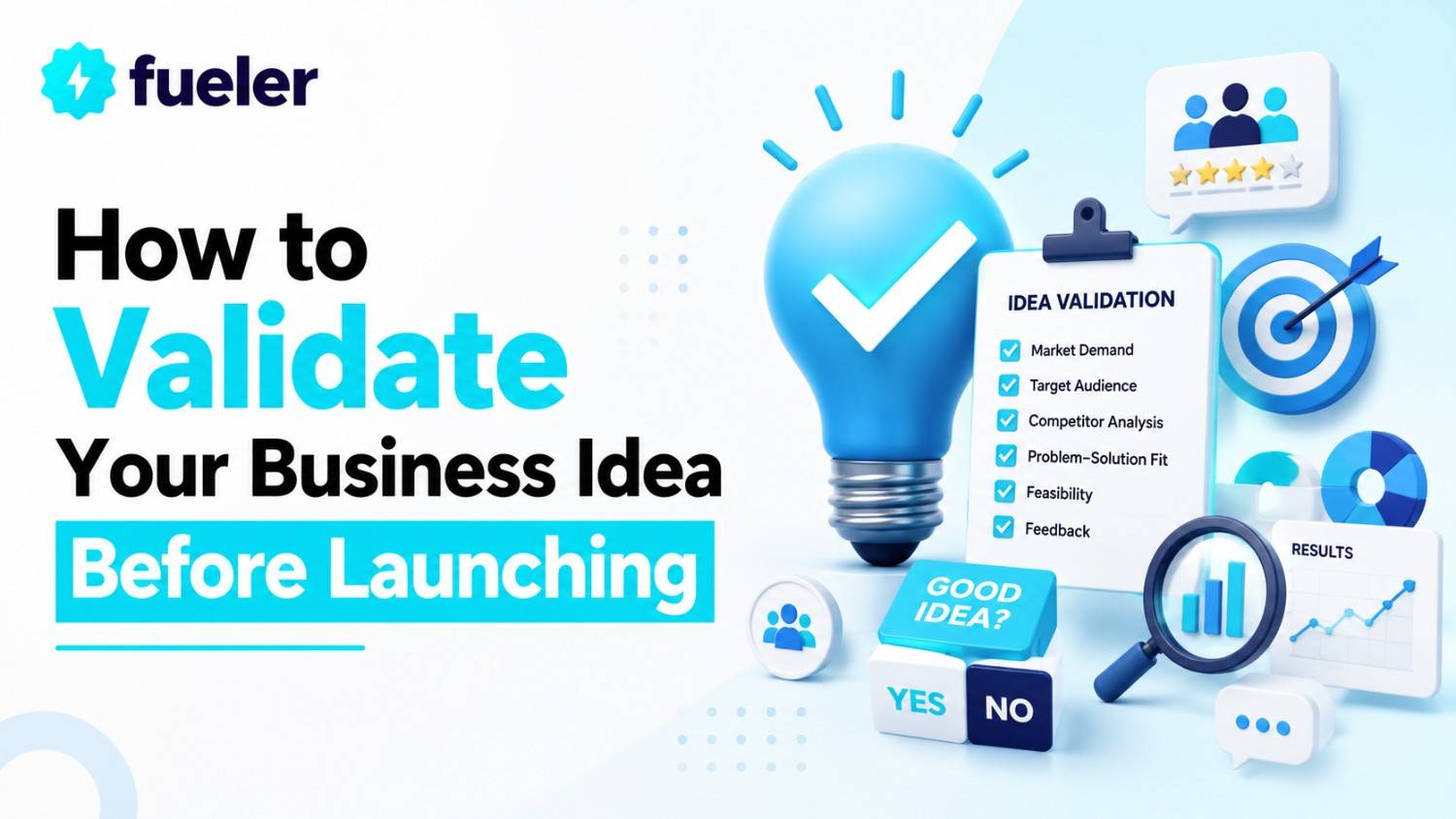
How to Validate Your Business Idea Before Launching

Riten Debnath
14 May, 2025
Last updated: July 2026
You don’t need to build the full product to know if your idea will work. In fact, waiting too long to validate can cost you money, time, and motivation. The best founders test early, fail fast, and learn quickly. Because the truth is: having an idea is easy. Proving it works? That’s the real challenge.
I’m Riten, founder of Fueler, a skills-first portfolio platform building the career infrastructure for 100 million creative professionals. Fueler connects talented individuals with companies through assignments, portfolios, and projects, not just resumes or CVs. Think of it as Dribbble/Behance for work samples combined with AngelList for hiring infrastructure.
Let’s dive into the exact steps I’ve used (and seen many founders use) to validate business ideas before spending months building.
Step 1: Talk to Your Potential Users
Before you touch a line of code or design a logo, talk to at least 15-20 people who could be your potential users. Ask them:
- What problems do they face?
- How are they solving them right now?
- What do they think of your idea?
Avoid yes or no questions. Dive deep. Listen more than you speak.
This process is called Customer Discovery, and it's the foundation of any successful startup.
Pro tip: When I started Fueler, I interviewed freelancers, hiring managers, and founders. The insights shaped everything from our core features to our landing page copy.
Step 2: Do a Quick Competitor Research
Chances are, someone else is already working on something similar. That’s not a bad thing. In fact, it means there’s demand.
Study how your competitors:
- Position themselves
- Price their product
- Market to users
Your job? Spot the gaps. Can you solve the same problem better, faster, or cheaper?
Step 3: Build a Landing Page
You don’t need a full app to start attracting users. Just build a simple landing page that explains:
- What your product does
- Who it’s for
- Why it matters
Include a clear CTA (Call to Action):
- Join the waitlist
- Sign up for early access
- Take a quick survey
Tools to Build a Landing Page:
Carrd
Carrd is a simple, one-page site builder. You can set up a clean and mobile-friendly page in under an hour. It's perfect if you're not from a tech background.
Description: Carrd makes it easy for non-tech founders to create beautiful landing pages. With drag-and-drop tools, mobile responsiveness, and customizable templates, Carrd is ideal for validating your idea without overthinking design or code. You can collect emails, link forms, or even embed payment options for pre-orders.
Step 4: Share and Promote Smartly
Now that you have a page, it’s time to bring eyeballs to it.
- Share in relevant communities (Reddit, IndieHackers, Twitter, LinkedIn)
- Send it to people you interviewed earlier
- Run a small ad campaign (if budget allows)
Track how many people visit, sign up, or show interest. These early numbers are more valuable than opinions.
Step 5: Create a Prototype (Not the Full Product)
Instead of building the whole thing, build a Minimum Viable Product (MVP) or prototype. Think of it as a mockup or clickable demo.
Tools to Build MVPs:
Figma
Figma is a free design tool that lets you create UI mockups, clickable prototypes, and shareable demos.
Description: Figma is a collaborative design tool used by top startups and designers to build interfaces and clickable prototypes without writing code. For validating ideas, Figma is gold. You can visually explain how your product will work, simulate interactions, and test user responses. Plus, it’s cloud-based, so teams can collaborate in real time. At Fueler, we used Figma to test dashboard layouts with our early users before writing a single line of code. Feedback came quickly, and we could adapt fast. If you want to present a polished idea without building the tech, start with Figma.
Step 6: Ask People to Pay
Yes, even before the product is live. This is the real validation.
- Offer a pre-order
- Charge for early access
- Set up a waitlist with premium features
If people are willing to pay for something that doesn’t fully exist yet, that’s strong validation.
At Fueler, we offered lifetime deals to early supporters who believed in the mission. That not only validated demand, but funded our first few months of development.
Step 7: Use No-Code Tools to Launch Fast
You don’t need to hire a team of engineers. With no-code tools, you can get version 1 out in days.
Tools to Launch Without Code:
Bubble
Bubble lets you build web apps without writing any code. You can create real functionality: logins, dashboards, payments, and more.
Description : Bubble is a powerful no-code builder that allows you to launch fully functional web apps without traditional coding. It supports complex logic, user authentication, databases, and integrations. Whether you're building a SaaS platform or a marketplace, Bubble gets you to market faster. When validating your business idea, speed matters. Bubble enables you to test, learn, and iterate in real time. I’ve seen founders launch working versions of their startup within a weekend using Bubble. That’s a game changer, especially when resources are limited.
Bonus Step: Build in Public
Share your journey online. Talk about what you’re building, the challenges you’re facing, and lessons you’re learning.
This does 3 things:
- Builds trust
- Attracts early users
- Creates a support system
At Fueler, we build in public. It helps us stay accountable and connected with our users. Many of our best ideas have come from public feedback.
Fueler Can Help You Validate Faster
On Fueler, you can create a live portfolio of your idea validation process. Share your research, mockups, landing pages, and learnings. This isn’t just for freelancers; it’s for makers, solopreneurs, and founders who want to prove their work, not just talk about it.
Your portfolio becomes a live case study. And it attracts collaborators, supporters, and even investors.
Final Thoughts
Validating your business idea isn’t about perfection. It’s about momentum.
Talk to users, build lean, test fast, and stay close to feedback. If you’re waiting for the "perfect" time, you might miss your window. Start with what you have.
The earlier you validate, the better your chances of building something that actually matters.
FAQs About Validating Business Ideas
1. What is the fastest way to validate a startup idea?
Build a landing page, share it with your target audience, and track their interest or sign-ups.
2. How can I validate a business idea without spending money?
Talk to users, use free tools like Carrd and Figma, and promote on free platforms like Twitter and LinkedIn.
3. What are the best tools to validate business ideas in 2026?
Carrd, Figma, Bubble, Typeform, and Fueler for portfolio and case study building.
4. How do I know if people will pay for my product?
Ask for pre-orders or charge for early access. Real payments = real interest.
5. Is building a portfolio important before launching a startup?
Yes. Platforms like Fueler help you showcase your validation journey and attract users, team members, and investors.
Why 100,000+ professionals use Fueler
Fueler helps professionals showcase proof of work through projects, assignments, case studies, and achievements.
- Thousands of professionals use Fueler to create their digital portfolio
- Thousands of projects are published on Fueler. Check here
- Startups and Companies hire through proof of work on Fueler
- Used by freelancers, creators, marketers, video editors, writers, designers, and product managers
Our mission is to help the next 100 million professionals build a verified professional identity through proof of work

What should you do next?
You've read the article. Now turn your skills into proof of work and unlock more opportunities.
Build your proof of work portfolio
Create a clean portfolio with projects, assignments, resumes, and AI stack details that companies actually want to see.
Create your Fueler portfolio →Apply through assignments, not resumes
Stand out by solving real tasks from companies hiring on Fueler.
Explore assignments →Get discovered by companies
Make your work public and let recruiters discover your skills through actual projects instead of keywords.
Get discovered →