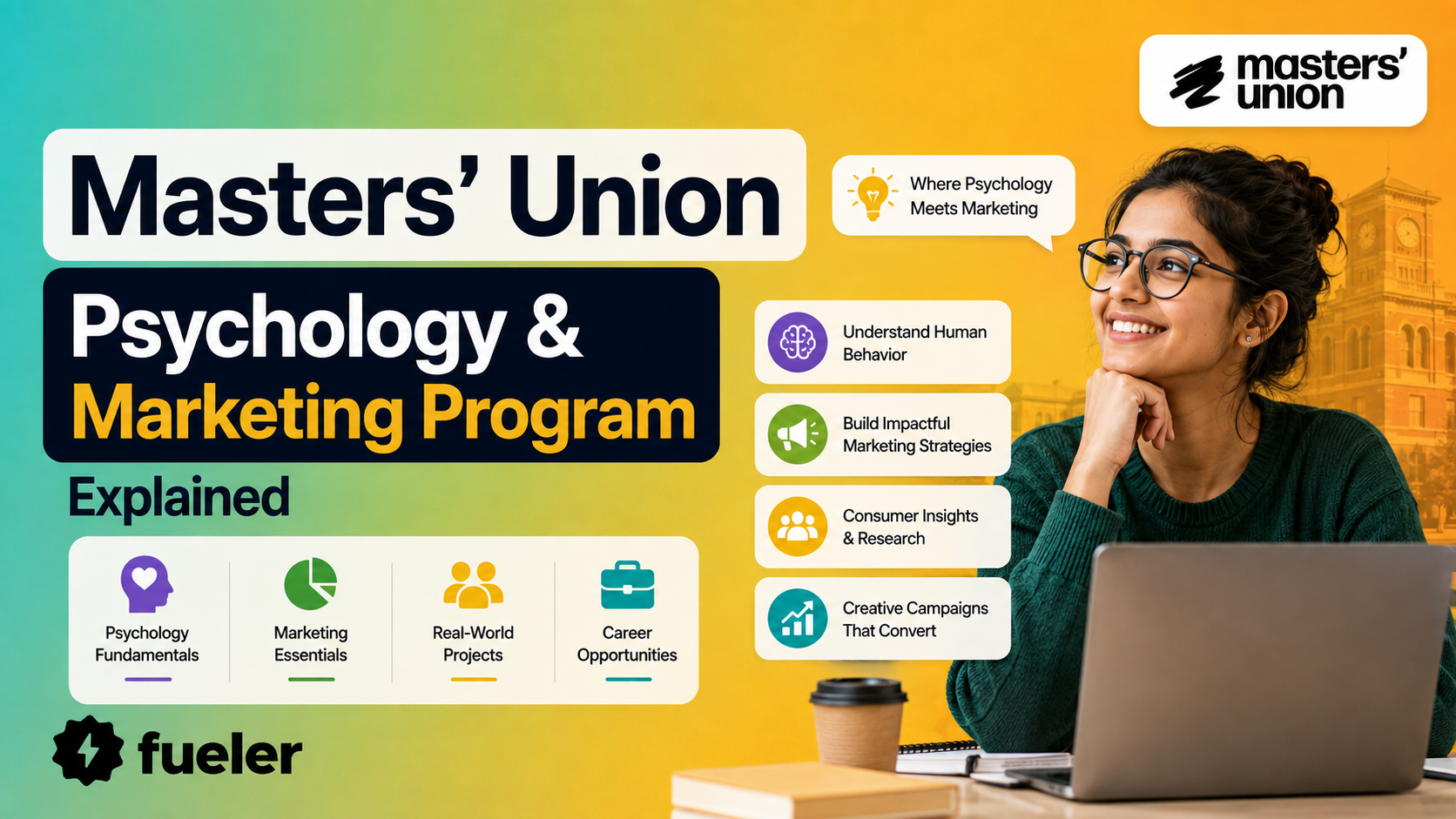
Masters' Union Psychology & Marketing Program Explained

Riten Debnath
17 Aug, 2026
Last updated: August 2026
Why do traditional business schools still teach marketing using 20-year-old textbook models when modern consumers buy based on cognitive biases, social proof, dynamic algorithm feeds, and emotional triggers?
I’m Riten, founder of Fueler, a skills-first portfolio platform building the career infrastructure for 100 million creative professionals. Fueler connects talented individuals with companies through assignments, portfolios, and projects, not just resumes or CVs. Think of it as Dribbble/Behance for work samples combined with AngelList for hiring infrastructure.
When the Masters' Union Psychology & Marketing program launched, it immediately caught my attention because it mirrors what we see happening across consumer internet companies, D2C brands, and tech startups. Traditional colleges teach marketing as static brand management essays. High-growth companies, venture funds, and digital agencies do not care about definitions; they hire growth strategists, UX researchers, and brand managers who can demonstrate actual proof of work, run behavioral experiments, analyze conversion funnels, and write high-converting copy.
This detailed guide breaks down the Masters' Union Psychology & Marketing Program covering its curriculum structure, hands-on challenges, fee breakdown, career paths, and real-world value.
Quick Answer Summary
- Who It Is For: High school graduates (Class 12) and gap-year students aiming for careers in growth marketing, consumer insights, brand strategy, UX research, or founder offices.
- Cost: Baseline tuition fees sit at ₹52.5 Lakhs. Total program expenses range from ₹54.3 Lakhs to ₹67.5 Lakhs when including housing and administrative deposits.
- Key Takeaway: Replaces traditional textbook exams with live ad campaigns, behavioral research sprints, creator challenges, and real-world brand drops.
- Best Suited For: Creative analytical thinkers who prefer building public portfolios, understanding human decision-making, and executing live growth strategies over memorizing theory.

What is the Masters' Union Psychology & Marketing Program?
The UG Program in Psychology & Marketing at Masters' Union is a 4-year practitioner-led course based in DLF Cyberpark, Gurugram. Rather than learning consumer behavior from academic professors who haven't run an ad campaign in a decade, students are taught by active industry operators including CMOs, growth leads, UX directors, brand strategists, and performance marketers.
TRADITIONAL MARKETING DEGREE
Theory Seminars ──► Essay Exams ──► Static Resumes ──► Unprepared Graduates
MASTERS' UNION PSYCHOLOGY & MARKETING MODEL
Behavioral Science ──► Live Ad Drops ──► Conversion Analytics ──► Verified Proof of Work
The core foundation rests on an obvious truth: marketing is applied psychology. You cannot persuade a customer, design a high-converting digital product, or build a cult brand without understanding cognitive bias, behavioral economics, and human motivation.
Instead of writing theoretical papers, students launch real e-commerce brands, run Meta and Google ad budgets, design user onboarding journeys, conduct field interviews, and analyze audience analytics in real-time.
Key Facts Table
Detailed Explanation
The curriculum of the Masters' Union Psychology & Marketing Program is designed to merge human behavior insights with modern growth tools over four structured years.
CURRICULUM ROADMAP OVERVIEW
Year 1: Cognitive Foundations + First Paycheck & Dropshipping Challenges
Year 2: Behavioral Economics, UX Research + Live Creator Sprint
Year 3: Performance Growth, Brand Building + D2C Incubation Capstone
Year 4: Global Immersion / Corporate Apprenticeship + Portfolio Career Placement
Year 1: Cognitive Psychology and Business Foundations
The opening year sets the stage by helping students decode why people think, decide, and buy.
- What: Courses focus on General Psychology, Social Psychology, Consumer Behavior, Principles of Management, Microeconomics, and Business Communication.
- Why: Effective marketing starts with an understanding of human motivation, memory retention, and group dynamics before touching digital ad tools.
- How: Concepts are applied through case teardowns and real-world experiments rather than written midterms.
- Out-of-Class Intervention: During Year 1, students participate in the First Paycheck Challenge and the Dropshipping Sprint. Armed with seed capital, they launch e-commerce stores, craft ad copy, handle customer service, and track return on ad spend (ROAS).
Year 2: Behavioral Economics, Digital Media, and UX Research
The second year bridges qualitative psychology with quantitative digital platforms.
- What: Modules cover Behavioral Economics, User Experience (UX) Research, Digital Media Architecture, Copywriting & Persuasion, Market Research Methods, and Data Analytics.
- Why: Modern growth managers must know how to map customer journeys, audit drop-off points, design intuitive wireframes, and test behavioral nudges.
- How: Students use tools like Figma, Hotjar, Google Analytics, and ad platforms to design digital experiences and audit real brand channels.
- Out-of-Class Intervention: In the Creator Challenge, students build an audience from scratch across platforms like YouTube, LinkedIn, or Instagram. They learn content hooks, viral loops, audience retention, and community monetization first-hand.
Year 3: Performance Marketing, Brand Architecture, and Incubation
Year 3 focuses on scaling brands, executing performance ads, and building scalable marketing operations.
- What: Core subjects include Performance Marketing (SEO/SEM/Meta Ads), Brand Positioning Strategy, Neuromarketing, PR & Communications, Omnichannel Strategy, and Product Marketing.
- Why: Companies look for strategists who can combine creative storytelling with quantitative ad efficiency and customer lifetime value (LTV) optimization.
- How: Students manage real campaign budgets, design viral product launches, write go-to-market strategies, and pitch to brand leaders.
- Out-of-Class Intervention: Through the D2C/Brand Capstone, students build an end-to-end consumer project developing product positioning, packaging, digital storefronts, and growth funnels. At Fueler, we notice that students who publish their ad creatives, campaign metrics, and strategy teardowns online gain a massive hiring advantage over peers relying on static resumes.
Year 4: Industry Apprenticeship and Global Track
The final year transfers classroom experience into real corporate execution.
- What: The year features an extended Corporate Apprenticeship or an optional semester abroad at partner universities in North America, Europe, or Asia.
- Why: Direct experience inside fast-moving corporate teams helps refine execution skills under real business constraints.
- How: Students work inside D2C startups, advertising agencies, tech platforms, or consumer brands, developing verified portfolios and transitioning into full-time placements.
How It Works
- Sprint-Based Learning: Terms run as intensive blocks where students focus on mastering one core domain like UX research or performance ads by producing a working business output.
- Practitioner Mentorship: Classes are taught by active CMOs, brand directors, performance leads, and agency founders who bring current playbooks into the classroom.
- Out-of-Class Drops: Students manage live ad spend, audit local corporate operations, run audience channels, and test behavioral interventions.
- Portfolio Construction: Every term produces a public artifacts consumer research deck, a Figma prototype, an ad performance report, or a go-to-market plan.
- Direct Recruitment: Hiring managers evaluate students continuously based on their live projects and verified execution capabilities throughout the four years.
Benefits
- Applied Behavioral Expertise: Combines deep psychological principles with actionable digital marketing skills.
- Verified Proof-of-Work: Students build a public profile featuring live campaigns, UX case studies, and brand teardowns.
- Location Advantage: Being based in DLF Cyberpark, Gurugram provides direct access to top D2C brands, tech giants, and marketing agencies.
- Modern Growth Toolkit: Students learn up-to-date toolsMeta Ads Manager, Google Analytics, Figma, SEO tools, and AI content engines.
- Direct Access to Operators: Over 200+ industry mentors provide realistic guidance on how modern consumer brands hire and scale.
Challenges / Limitations
- Significant Cost Investment: Total expenses between ₹54.3L and ₹67.5L require careful family financial planning.
- Fast Pace: The continuous cycle of live business drops and team sprints can feel intense for students expecting a slow-paced college life.
- Alternative Recognition: Being an operator-led institution, its recognition is strongest in startups, tech firms, and modern agencies rather than standard government tracks.
- Requires Proactive Initiative: Students who expect step-by-step hand-holding may struggle with open-ended creative and growth challenges.
Comparison Table
Fees and Cost Analysis
Here is a clear breakdown of the financial commitments over the 4-year duration:
- Tuition Fees: The core academic tuition fee is ₹52.50 Lakhs across the four years.
- One-Time Payments: Admission, registration, lab access, and security deposits total ₹1.80 Lakhs.
- Hostel and Accommodation: Campus housing and living options around Cyberpark in Gurugram come to around ₹13.20 Lakhs over four years.
- Scholarship Opportunities: Merit-based and need-based financial aid options are available through performance in the MU-SAT entrance evaluation.
Career Opportunities
Graduates of the program target roles at the intersection of consumer psychology, digital strategy, and product design:
- Growth & Performance Marketer: Managing digital ad budgets, optimizing conversion funnels, and scaling customer acquisition.
- UX & Consumer Insights Researcher: Conducting user interviews, auditing product drop-offs, and designing seamless user journeys.
- Brand Strategist: Building brand narratives, managing public launch campaigns, and directing creative assets.
- Product Marketing Manager (PMM): Positioning new products, creating launch strategies, and aligning product features with user needs.
- Founder's Office (Consumer Tech): Working directly alongside CEOs on consumer growth, market expansion, and campaign strategy.

Who Should Choose This?
- Students who want to combine creative storytelling with quantitative data analytics.
- High school pass-outs who prefer building real ad campaigns, running stores, and creating media channels over taking traditional exams.
- Aspiring growth marketers, brand leads, UX researchers, or consumer startup founders.
- Self-driven individuals who excel in fast-paced, project-driven team setups.
- Candidates seeking direct mentorship from active CMOs, growth heads, and agency founders.
Who Should Avoid This?
- Students looking for a low-pressure, traditional university setup focused purely on written exams.
- Candidates intending to pursue traditional clinical psychology degrees or government administrative careers.
- Families looking for low-cost undergraduate programs without major financial outlays.
- Individuals who find open-ended creative problem-solving and live campaign management stressful.
Final Thoughts
The Masters' Union Psychology & Marketing Program presents a modern take on marketing education. By anchoring marketing in real behavioral science and requiring students to launch live campaigns, it helps bridge the gap between classroom theory and real-world execution.
Given the overall cost of ₹54.3L to ₹67.5L, families should evaluate the financial commitment against their long-term career goals.
At Fueler, we see every day that modern consumer brands, fast-growing tech startups, and digital agencies do not care about exam marks. They hire talent based on real proof of work, a documented ad campaign, a verified UX audit, or a clear growth strategy. Whether you join an innovative degree like Masters' Union or take an independent learning path, publishing your real projects online remains the most reliable way to build your career.
Key Takeaways
- Masters' Union offers a 4-year undergraduate degree in Psychology & Marketing in DLF Cyberpark, Gurugram.
- The course combines behavioral science, consumer insights, digital marketing, and UX research.
- The faculty consists of active CMOs, growth directors, brand strategists, and startup founders.
- Total fees reach up to ₹67.50 Lakhs over four years, including tuition, deposits, and housing.
- Practical challenges include dropshipping drops, creator growth sprints, and live brand capstones.
- Target career outcomes include Growth Marketer, UX Researcher, Brand Manager, and Product Marketing Manager.
FAQs
What is the Masters' Union Psychology & Marketing program?
It is a 4-year practitioner-led undergraduate degree blending behavioral psychology, consumer research, performance marketing, and digital brand execution at DLF Cyberpark, Gurugram.
How much does the Psychology & Marketing program cost?
Tuition is ₹52.50 Lakhs. With registration fees and housing options, total expenses range between ₹54.3 Lakhs and ₹67.5 Lakhs.
What entrance exams are accepted for admission?
Admissions accept the internal MU-SAT entrance test, as well as valid scores from SAT, JEE Main, or CUET, followed by profile evaluation and personal interviews.
What roles do graduates from this specialization get?
Graduates pursue roles such as Growth Marketer, Consumer Insights Lead, UX Researcher, Brand Strategist, Product Marketing Manager, and Founder's Office Associate.
Are scholarships available for this course?
Yes, Masters' Union awards merit-based and need-based financial assistance through candidate performance in the MU-SAT entrance test, standardized test scores, and profile reviews.
Why 100,000+ professionals use Fueler
Fueler helps professionals showcase proof of work through projects, assignments, case studies, and achievements.
- Thousands of professionals use Fueler to create their digital portfolio
- Thousands of projects are published on Fueler. Check here
- Startups and Companies hire through proof of work on Fueler
- Used by freelancers, creators, marketers, video editors, writers, designers, and product managers
Our mission is to help the next 100 million professionals build a verified professional identity through proof of work
What should you do next?
You've read the article. Now turn your skills into proof of work and unlock more opportunities.
Build your proof of work portfolio
Create a clean portfolio with projects, assignments, resumes, and AI stack details that companies actually want to see.
Create your Fueler portfolio →Apply through assignments, not resumes
Stand out by solving real tasks from companies hiring on Fueler.
Explore assignments →Get discovered by companies
Make your work public and let recruiters discover your skills through actual projects instead of keywords.
Get discovered →