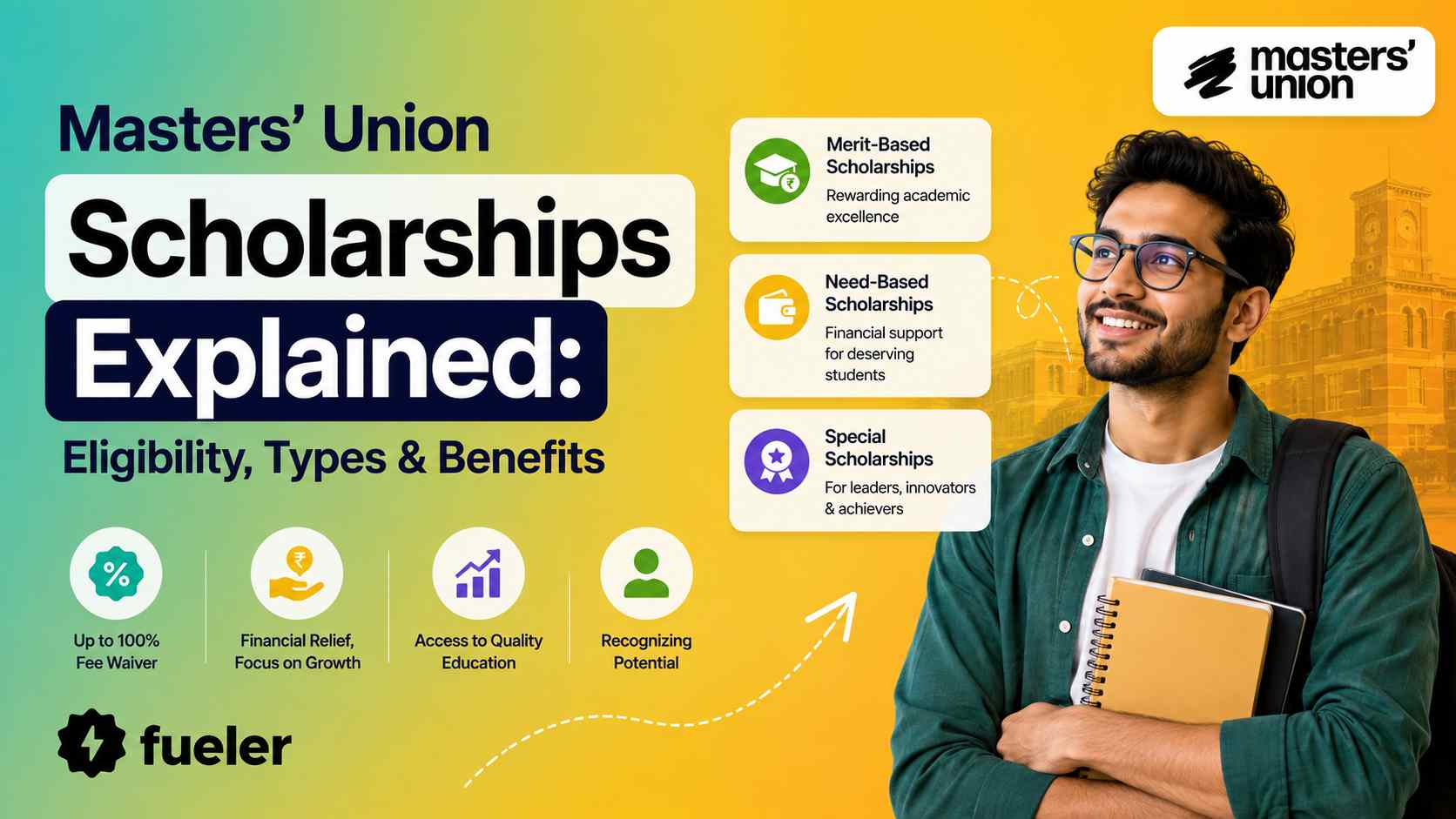
Masters' Union Scholarships Explained: Eligibility, Types & Benefits

Riten Debnath
16 Aug, 2026
Last updated: August 2026
When higher education costs push past ₹30 lakhs, tuition isn’t just an investment; it's a major risk calculation. High-growth business programs promise fast-track careers in technology, product management, and venture capital, but smart applicants want to know how to offset that upfront financial burden.
I’m Riten, founder of Fueler, a skills-first portfolio platform building the career infrastructure for 100 million creative professionals. Fueler connects talented individuals with companies through assignments, portfolios, and projects, not just resumes or CVs. Think of it as Dribbble/Behance for work samples combined with AngelList for hiring infrastructure.
Tracking modern business education shows a clear pattern: institutions are shifting away from traditional financial aid models toward targeted, merit-based, and need-aware grant structures. Instead of granting blanket fee waivers, they look for applicants who demonstrate tangible proof of work, academic excellence, or unique leadership backgrounds.
In this guide, we break down how financial support operates at Masters' Union, covering eligibility criteria, named scholarship categories, evaluation frameworks, and practical strategies to strengthen your application.
Quick Answer Summary
- Scholarship Range: Partial to significant tuition fee waivers based on merit, financial need, and candidate background.
- Primary Categories: Merit-Based, Need-Based, Diversity & Women in Tech, Entrepreneurship, and Named Corporate Grants.
- Core Eligibility: Admission offer for the Post Graduate Programme in Technology & Business Management (PGP TBM) or Undergraduate programs.
- Key Evaluation Metric: High entrance test percentiles (CAT, GMAT, GRE, or MU-BAAT/MUSAT), strong academic records, and verified portfolio impact.
- Application Strategy: Applying in early admission rounds improves your chances before allocated institutional scholarship funds run low.
- Best Suited For: Top academic performers, female tech leaders, gritty startup founders, first-generation learners, and applicants with verified proof of work.

What are Masters' Union Scholarships?
Masters' Union scholarships are institutional grants designed to reduce tuition costs for high-potential candidates entering its flagship programs, such as the PGP TBM.
Context
Unlike traditional universities that distribute aid purely through standardized test scores or strict income brackets, alternative B-schools look at a candidate's holistic potential. They treat financial support as an investment in building a high-performing, diverse cohort. Grants target candidates who bring exceptional skills, entrepreneurial grit, or technical expertise to the classroom.
Why It Matters
A program fee of nearly ₹30 lakhs can create significant financial friction for early-career professionals, self-funded founders, or applicants from modest economic backgrounds. Securing a partial or major tuition waiver significantly lowers your debt burden, accelerating your net return on investment once you transition into high-paying industry roles.
How It Differs From Alternatives
- Holistic Proof of Work Over Paper Scores: While high entrance test percentiles matter, the scholarship committee heavily evaluates practical projects, side ventures, and verified portfolio deliverables.
- No Separate Exam Wall for PG: Post-graduate applicants use their standard application materials, video responses, and interview performances rather than taking an isolated "aid-only" exam.
- Early-Round Funding Focus: The institutional grant pool is largest during earlier application rounds, giving proactive candidates a clear advantage over late applicants.
Key Facts Table
Detailed Explanation: Core Scholarship Categories
The financial support structure is organized across specific focus areas to ensure balanced cohort representation. Here is how each major category functions:
1. Merit-Based Grants
Designed for applicants who demonstrate exceptional academic records and outstanding performance on standardized aptitude assessments.
- What it is: Fee waivers granted to top percentiles in exams like CAT, GMAT, GRE, or the proprietary MU-BAAT / MUSAT test.
- Why it matters: It rewards proven analytical strength and academic consistency, easing the path for top-tier test takers.
- Eligibility baseline: Top-range entrance exam percentiles, strong undergraduate GPAs, and sharp performance during the AI assessment and personal interviews.
- Example: An engineering graduate scoring a high percentile on the GMAT or MU-BAAT who receives a 25% to 50% tuition waiver based on analytical excellence.
2. Need-Based Financial Aid
Aimed at ensuring financial constraints do not prevent high-potential, capable candidates from accessing top-tier business education.
- What it is: Financial grants tailored to an applicant's documented family income level and asset baseline.
- Why it matters: It opens doors for candidates from lower or middle-income households, first-generation learners, and underrepresented regions.
- Eligibility baseline: Verified family income documentation, IT returns, salary slips, and a clear statement explaining your financial background.
- Example: A candidate from a tier-3 city with strong academic credentials whose total annual family income falls below specified thresholds, qualifying for partial tuition assistance.
3. Diversity, Inclusion & Women in Tech Grants
Focused on increasing female representation and supporting professionals from unconventional, creative, or underrepresented career backgrounds.
- What it is: Specialized funding set aside for women leaders, creative artists, athletes, humanities graduates, and non-traditional applicants.
- Why it matters: Tech and business classrooms thrive when discussion groups include varied life experiences rather than a single background.
- Eligibility baseline: Strong leadership track record in technology, non-profit initiatives, creative arts, or non-traditional industries.
- Example: A female software engineer or product designer with a track record of building open-source projects or leading community tech initiatives.
4. Entrepreneurial & Exceptional Achievement Grants
Targeted at self-starters, startup founders, drop-shippers, and product builders who have already demonstrated real-world initiative.
- What it is: Institutional awards for candidates who have founded registered startups, built functional products, or generated real business revenue.
- Why it matters: Practitioners value grit. Applicants who have navigated product builds, customer acquisition, or fundraising bring direct practical insights to peer discussions.
- Eligibility baseline: Verified proof of work such as running a live business, presenting pitch decks, or showcasing a product portfolio. Applicants who aggregate their build logs, teardowns, and growth case studies on platforms like Fueler can present verified proof of execution to evaluators.
- Example: A candidate who ran a bootstrapped e-commerce brand or built a no-code SaaS tool generating active monthly recurring revenue.
5. Named & Foundation Scholarships
Grants sponsored by corporate partners, foundation funds, or distinguished advisory board members to support specific academic profiles.
- What it is: Endowed or named funding programs (such as the Karthik Ramanna Merit-Based Scholarship) earmarked for high-performing candidates.
- Why it matters: Connects scholars with external network recognition and industry mentorship alongside tuition relief.
- Eligibility baseline: Exceptional performance across all selection criteria, coupled with alignment to the specific charter of the sponsoring foundation.
Step-by-Step Scholarship Application Workflow
Getting considered for financial support does not require a complex separate admissions process, but it demands careful preparation. Here is how candidates navigate the process:
Step 1: Complete the Core Application
Start by filling out your personal, academic, and professional background details on the admissions portal.
Step 2: Select Your Scholarship Category
Within the application form, check the box indicating you want to be considered for institutional financial support. Select the category that best matches your profile (Merit, Need, Diversity, or Entrepreneurship).
Step 3: Upload Supporting Documents & Proof of Work
Submit the necessary documentation based on your chosen path:
- For Merit/Entrepreneurship: Upload verified project links, pitch decks, case study awards, or portfolio links. Presenting your case studies and product builds via a clean portfolio on Fueler helps reviewers verify your real-world contributions immediately.
- For Need-Based: Upload official income tax returns (ITR) for all earning family members, bank statements, and salary slips for the past financial year.
Step 4: Maximize Your Assessment Scores
Because scholarship decisions evaluate your complete application, aim for strong results across every component: the Video-Based Response (VBR), the MU-BAAT aptitude test (if applicable), and the CXO personal interview.
Step 5: Award Confirmation
If selected, your official offer letter will detail the exact percentage and monetary value of the tuition waiver granted, along with fee payment timelines to confirm your seat.
How Admissions Panels Evaluate Applicants
Understanding the committee's evaluation criteria helps you highlight the right strengths during your application:
Practical Benefits of Securing a Scholarship
- Lower Debt Burden: Reducing your upfront tuition costs lowers reliance on high-interest education loans.
- Faster ROI Alignment: Lower initial fees allow you to break even much faster when transitioning into post-graduation salaries.
- Profile Distinction: Earning a merit or named scholarship adds valuable recognition to your professional profile.
- Accessible Top-Tier Learning: Ensures talented individuals from diverse economic backgrounds can access modern, practitioner-led business education.
Limitations and Things to Keep in Mind
- Competitive Fund Pool: Institutional funding is limited and awarded on a competitive basis; securing admission does not guarantee a scholarship award.
- Living Costs Not Covered: Most grants apply specifically to program tuition fees. Students remain responsible for food, housing, and personal living expenses in NCR.
- Performance Requirements: Maintaining scholarship standing across multi-term programs may require maintaining minimum academic standards or conduct expectations.
- Early Deadline Sensitivity: Applicants in Round 3 face a smaller remaining grant pool compared to Round 1 and Round 2 applicants.
Financial Breakdown: Tuition, Living Costs & Aid Options

Who Should Apply for Scholarships?
- High-performing test takers with top scores in CAT, GMAT, GRE, or MU-BAAT.
- Applicants from lower or middle-income households who require financial support to pursue higher education.
- Female founders, developers, and product leaders aiming to build careers in tech and startup management.
- Self-starters, creators, and entrepreneurs who can present verified portfolios, product builds, or side ventures.
Who Should Avoid Relying Solely on Financial Aid?
- Applicants who delay submitting their forms until the final round while expecting major financial aid awards.
- Candidates unwilling to provide transparent, verified family income and tax documentation.
- Applicants with weak academic records, low test scores, and zero verifiable proof of work or side projects.
Final Thoughts
Scholarships at Masters' Union serve a clear purpose: attracting ambitious, high-performing builders regardless of their financial background. By evaluating candidates through a combination of test scores, real-world proof of work, and holistic potential, the program ensures its cohort remains competitive and diverse.
If you plan to apply for financial support, focus on building a strong, verifiable profile. Submit your application in early rounds, document your achievements transparently, present your build history on platforms like Fueler, and prepare thoroughly for every stage of evaluation. A well-prepared application is your best tool for securing both admission and financial assistance.
Key Takeaways
- Integrated Grants: Scholarship consideration is built directly into the core application process.
- Multiple Avenues: Aid spans Merit, Financial Need, Diversity/Women in Tech, and Entrepreneurship categories.
- Holistic Review: Evaluators balance entrance exam scores alongside real-world projects and interview performance.
- Early Advantage: Applying in Round 1 or Round 2 gives you access to a larger pool of unallocated institutional funds.
- Tuition-Focused: Grants reduce core tuition fees, while living and personal expenses remain separate.
- Proof of Work Weighs Heavy: Verifiable side projects, startups, and creative portfolios strengthen your overall evaluation.
FAQs
How do I apply for a scholarship at Masters' Union?
You apply by opting into the financial aid section within the standard online application form, selecting your preferred category, and uploading the required supporting documents or proof of work.
What is the maximum scholarship amount offered?
Scholarships vary based on profile strength, test scores, and documented need, ranging from partial fee waivers to significant tuition grants for top candidates.
Is there a separate exam for scholarship consideration?
Post-graduate applicants are evaluated using their standard application, interview performance, and entrance test scores (CAT, GMAT, GRE, or MU-BAAT) rather than a separate scholarship exam.
Are scholarships available for freshers without work experience?
Yes, freshers with strong academic records, top entrance scores, and exceptional side projects or extracurricular achievements are eligible for merit and diversity grants.
When will I know if I have been awarded a scholarship?
Scholarship award decisions are finalized by the admissions committee and communicated directly within your official admission offer letter.
Why 100,000+ professionals use Fueler
Fueler helps professionals showcase proof of work through projects, assignments, case studies, and achievements.
- Thousands of professionals use Fueler to create their digital portfolio
- Thousands of projects are published on Fueler. Check here
- Startups and Companies hire through proof of work on Fueler
- Used by freelancers, creators, marketers, video editors, writers, designers, and product managers
Our mission is to help the next 100 million professionals build a verified professional identity through proof of work

What should you do next?
You've read the article. Now turn your skills into proof of work and unlock more opportunities.
Build your proof of work portfolio
Create a clean portfolio with projects, assignments, resumes, and AI stack details that companies actually want to see.
Create your Fueler portfolio →Apply through assignments, not resumes
Stand out by solving real tasks from companies hiring on Fueler.
Explore assignments →Get discovered by companies
Make your work public and let recruiters discover your skills through actual projects instead of keywords.
Get discovered →