
My Device Configuration


Business Tools MCP Server — AI-Native Business Operations & MCP Integration


Designed and built an MCP server using n8n that exposes existing business operations as callable tools for AI assistants. Using Google Antigravity as the MCP client, I created an integration layer that allows users to interact with business systems through natural-language instructions instead of manually navigating applications or triggering individual automations.
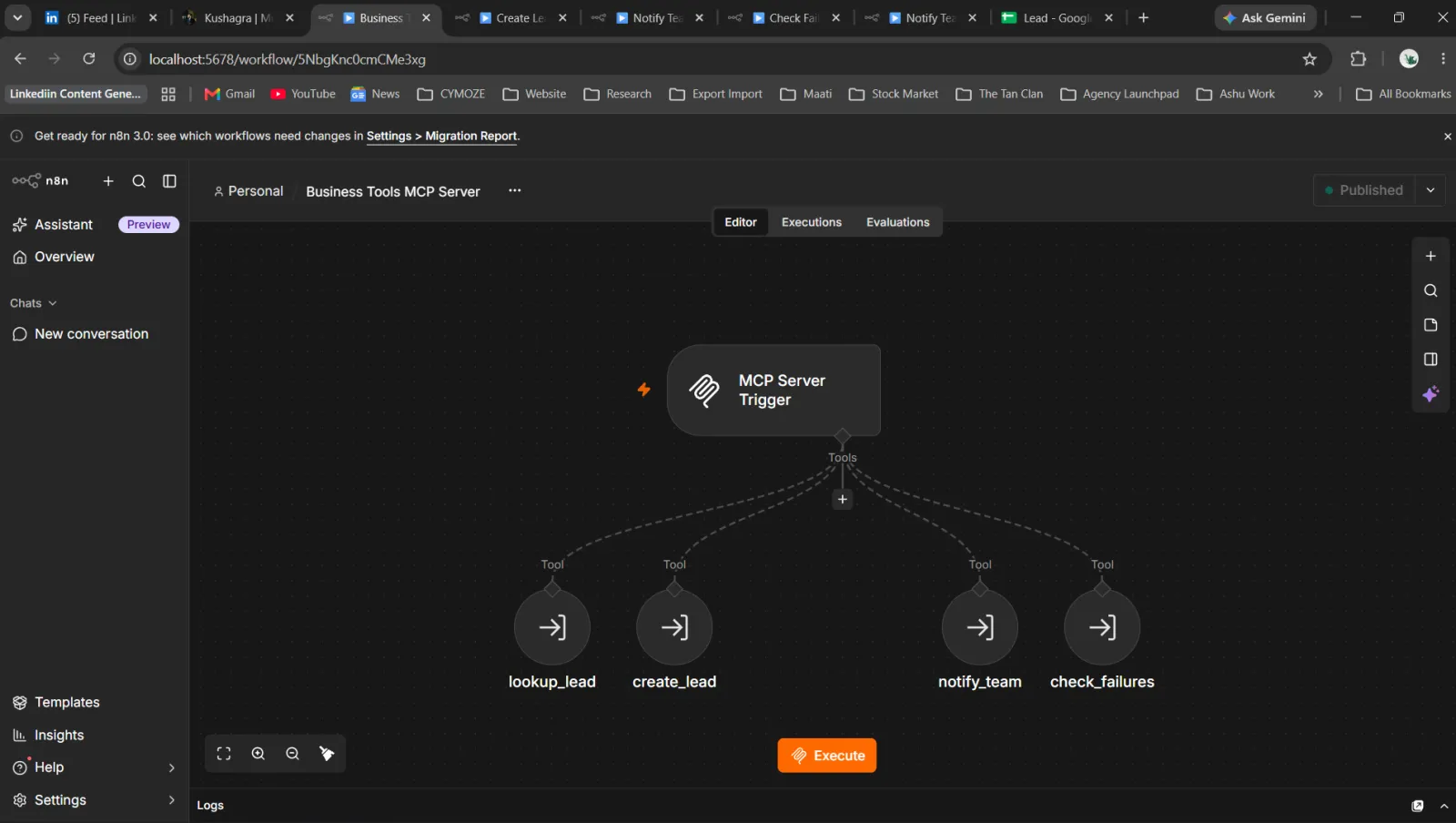
The system is built around an n8n MCP Server Trigger that exposes four independent business capabilities through a single authenticated MCP endpoint. Each tool delegates execution to a dedicated n8n sub-workflow, keeping the AI-facing interface separate from the underlying business logic and integrations.
MCP Server Architecture — The server uses n8n's MCP Server Trigger with Bearer Token authentication and a dedicated /mcp/business-tools endpoint. Google Antigravity connects to the MCP server as the client, allowing the AI assistant to discover available tools and invoke them using structured parameters.
Four Business Tools —
Lead Lookup (lookup_lead): Searches existing CRM records using a partial name, company name, or email address. The tool is read-only and returns matching lead records.
Lead Creation (create_lead): Creates a new lead record with a name, company, email, and additional notes. It is designed to execute only when the user has requested or confirmed creation.
Team Notifications (notify_team): Sends a plain-text message to the configured team Telegram chat. The tool requires user authorization before sending.
Failure Monitoring (check_failures): Retrieves the previous day's n8n execution failures, with optional filtering by workflow name. This gives the AI assistant access to operational failure information without requiring manual inspection of execution logs.
Workflow Execution Layer — Each MCP tool connects to a dedicated n8n workflow responsible for its underlying operation. Google Sheets serves as the CRM data layer and failure-log storage, while Telegram handles team notifications. This separation keeps the MCP interface lightweight while allowing individual business operations to be managed independently.
Security & Execution Control — The MCP endpoint is protected through Bearer Token authentication. Read-only operations are separated from write operations, and lead creation and team notifications require user-requested or confirmed actions.
The architecture is designed to be extensible, allowing additional business capabilities to be exposed as new MCP tools without redesigning the entire integration layer.
10 Nov 2026
Keywords


AI Usage
AI is used at the interaction and decision-making layer rather than inside every individual automation. Google Antigravity acts as the MCP client through which the AI assistant interprets natural-language requests, identifies the required business operation, selects the appropriate MCP tool, and supplies its parameters through structured tool calls. For example, a request such as "Find Rahul from Acme as a lead" can be translated into a lookup_lead call with dynamically extracted search parameters. Similarly, a request to add a new lead can invoke create_lead with the required fields, subject to its execution restrictions. The MCP server does not perform the underlying language reasoning. It provides the standardized interface through which the AI assistant accesses business functionality. I designed the integration architecture, tool definitions, dynamic parameter schemas, execution boundaries, authentication configuration, and separation between the MCP interface and the underlying n8n workflows.