

From 33 to 96: Fixing a Dental Practice's Mobile Speed, Winning AI Answer Engines (AEO), and Growing Organic Traffic ~59%

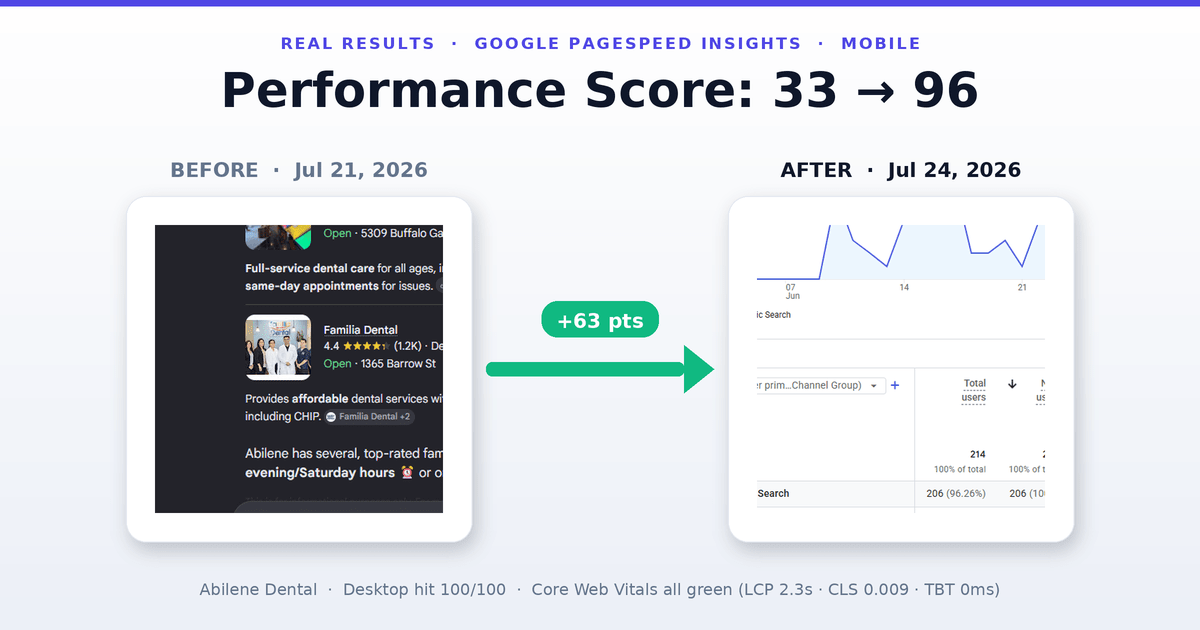
The 20-second version A local dental practice was losing patients to a slow phone experience. In about 3 days no redesign, no rebuild I got their mobile speed score from 33 → 96 (desktop to a perfect 100), and the results followed: organic new users up ~59% month over month, page-one local rankings, and a brand-new stream of visitors arriving from AI assistants that simply didn't exist before.
Client: Abilene Dental (a family + emergency dental practice in Abilene, Texas)
My role: SEO & web performance
Focus: Core Web Vitals optimization, Answer Engine Optimization (AEO), technical SEO, organic growth Timeline: Core fix shipped in ~3 days (Jul 21 → Jul 24, 2026); impact measured across June–July 2026 Headline result: Mobile Performance score went from 33 → 96, desktop hit a perfect 100, and organic new users climbed 206 → 327 month over month.
The challenge
Abilene Dental had a site that looked fine on a desktop — but the numbers told a different story on mobile, which is where the overwhelming majority of local "dentist near me" searches happen.
When I ran the homepage through Google PageSpeed Insights, mobile Performance came back at 33/100. In practice that meant a slow-loading page that visibly shifted around as it rendered on a phone. For a local business that lives or dies by patients finding and trusting it in the first few seconds, that's not a cosmetic problem it's lost bookings, and it's a signal Google factors into rankings.
The goal was straightforward: get Core Web Vitals into the green without a redesign or a rebuild, and turn that technical health into real search visibility.
How I diagnosed it
I audited the site with PageSpeed Insights and Lighthouse, testing both mobile and desktop so I could separate device-specific issues from sitewide ones.
The diagnosis was clear. The mobile score was being dragged down by two things: heavy, oversized images loading up front, and render-blocking scripts stopping the page from painting quickly. The desktop experience masked all of this — which is exactly why testing on mobile mattered.
The solution
I worked through the fixes in two passes, prioritizing the changes that would move Largest Contentful Paint and Cumulative Layout Shift the most:
Images. Compressed and converted the media to modern, lighter formats, sized them correctly for mobile, and lazy-loaded everything below the fold so the browser only fetched what a visitor actually needed to see first.
Code and delivery. Deferred non-critical JavaScript, removed render-blocking resources from the critical path, and enabled caching so repeat and returning visitors loaded even faster.
No redesign. No content changes. Just targeted technical work on how the existing page was built and delivered.
The results
Three days after the audit, I re-ran the reports. The turnaround was dramatic — and, importantly, it held across every category, not just the headline speed number.
| Metric (Mobile) | Before (Jul 21) | After (Jul 24) |
|---|---|---|
| Performance | 33 | 96 |
| Accessibility | 81 | 95 |
| Largest Contentful Paint | 11 | 2.3s |
| Cumulative Layout Shift | 6.5 | 0.009 |
| Total Blocking Time | 1200ms | 0 ms |
| SEO | 100 | 100 |
On desktop, the same page hit a perfect 100/100 Performance, with LCP at 0.6s, CLS at 0.001, and 0ms blocking time.
Every Core Web Vital landed comfortably in Google's "good" range — the layout shift score of 0.009 is roughly 10x better than Google's 0.1 pass threshold, and blocking time dropped to zero.
The business impact
A green score is only worth something if it shows up in the results that matter. It did — across organic search and the newer AI answer engines.
Organic traffic. Comparing acquisition month over month in Google Analytics, new organic users grew from 206 in June to 327 in July and July's figure was captured with two days still left in the month, so that roughly 59% jump came in less time. Total users rose from 214 to 367 over the same window.
Getting cited by AI the AEO win
A brand-new AI channel (AEO). This is the part I'm proudest of. In June, AI assistants sent the site zero traffic the channel didn't even register. After the work, AI assistants became a live source of new patients in July, sending first-time visitors from tools like ChatGPT. It's backed by placement, not luck: Abilene Dental now shows up first in Google's AI Overview for emergency dental searches in Abilene, pulled in as the featured answer. As more people search through AI instead of a search bar, being the answer the AI cites is a lead source most competitors haven't even thought about yet.
Better search visibility. On the traditional side, the site now ranks on page one for its core local searches, appearing in the Google local pack for family dentist queries in Abilene..
Ranking in search the SEO side
On the traditional side, the site now ranks on page one for its core local searches, appearing in the Google local pack for family dentist queries in Abilene.
Key takeaway
Speed isn't a vanity metric for a local business it's patients. A site scoring 33 on mobile is quietly turning people away before they ever see the "book now" button, and Google is watching that experience too.
The lesson I keep coming back to: you can unlock outsized results without a rebuild. The right technical fixes images, scripts, caching took this site from a failing mobile score to near-perfect in days, and the growth followed on two fronts. Organic search climbed, and the site went from invisible to AI assistants to being cited and sending real traffic from them. As more people search through AI, optimizing to be the answer not just a ranking is the lever most local businesses haven't touched yet. This one now has both working for it.
28 Jul 2026
Keywords